This guide explains how to track brand visibility in xAI Grok and turn Grok ranking data into GEO strategy, content generation, source optimization, and measurable business growth.
Updated by
Updated on Jun 16, 2026
An xAI Grok rank tracker is a tool or workflow that measures whether a brand, product, page, or competitor appears inside Grok’s AI-generated answers.
Traditional rank tracking asks where a URL ranks in Google or Bing. Grok rank tracking asks whether Grok mentions the brand, cites the brand’s website, references competitors, uses social context, or frames the brand accurately when users ask natural-language questions.
A useful Grok rank tracker should capture:
xAI’s Web Search documentation explains that Grok can search the web in real time, browse web pages, and extract relevant information to answer queries with up-to-date content. xAI Docs – Web Search
Dageno AI is relevant because Grok tracking should not stop at “Did Grok mention us?” A platform such as Dageno AI Grok optimization helps brands move from monitoring to GEO strategy, content generation, source improvement, and result attribution.
Grok rank tracking matters because Grok can influence brand discovery through real-time AI answers that combine web information, current events, and social discussion patterns.
Grok is especially important for categories where public conversation changes quickly. Product launches, brand crises, startup comparisons, trending tools, founder commentary, community debates, and breaking industry news can all affect how an AI assistant describes or recommends brands.
For marketers, the risk is practical:
xAI’s citation documentation explains that citation information can include a comprehensive list of URLs encountered during the search process, which makes source-level tracking important for understanding how Grok reached an answer. xAI Docs – Citations
Dageno AI helps teams treat Grok visibility as a measurable GEO channel. The goal is to understand where a brand appears, why competitors are cited, which sources influence the answer, and which actions improve business outcomes.
Grok rank tracking measures AI answer visibility, while traditional SEO rank tracking measures organic URL positions in classic search results.
Traditional SEO is still important because Grok may use web search and cited sources. However, classic ranking data is not enough. A page can rank well in search but still fail to be cited by Grok. A competitor can be mentioned by Grok because of stronger social relevance, fresher content, or clearer third-party signals.
| Visibility Surface | Main Question | What to Track | Why It Matters |
|---|---|---|---|
| Traditional SEO | Where does a URL rank in Google or Bing? | Keyword rankings, impressions, clicks, backlinks, organic traffic | Shows classic search visibility |
| Grok Search | Does Grok mention or cite the brand? | Mentions, citations, source URLs, competitors, sentiment, volatility | Shows AI answer visibility |
| X / social discussion | How is the brand discussed in real time? | Brand conversations, engagement, founder posts, customer commentary, topic relevance | May shape real-time brand context |
| ChatGPT Search | Does ChatGPT recommend or cite the brand? | Mentions, citations, source links, answer position | Shows assistant-led discovery |
| Google AI Mode | Does Google’s AI answer include the brand? | AI Mode activation, citations, answer position, query fan-out coverage | Shows AI-led Google discovery |
| Perplexity | Which sources are cited in answer-led search? | Citation URLs, source authority, answer framing | Shows citation-heavy AI discovery |
The key difference is that Grok visibility can be more volatile. A brand may need to monitor both evergreen web content and fast-moving public conversation. Dageno AI is useful because it monitors AI visibility across Grok and other major AI platforms instead of isolating one channel.
A Grok rank tracker should measure brand mentions, citations, cited URLs, answer position, competitors, sentiment, source types, social context, volatility, and attribution.
A simple “ranking number” is not enough for Grok. Grok answers may include synthesized text, citations, source URLs, competitor names, and real-time context. The tracking system must capture both visibility and the reasons behind that visibility.
| Metric | Direct Question | GEO Value |
|---|---|---|
| Grok answer activation | Does Grok generate an answer for the prompt? | Shows whether the prompt has AI answer visibility potential |
| Brand mention | Does Grok name the brand? | Measures baseline AI visibility |
| Citation presence | Does Grok cite the brand’s website or content? | Measures source authority |
| Cited URL | Which exact page or source appears? | Identifies pages earning visibility |
| Answer position | Where does the brand appear relative to competitors? | Shows recommendation strength |
| Competitor inclusion | Which competitors appear in the same answer? | Reveals competitive gaps |
| Share of voice | How much answer presence belongs to the brand versus competitors? | Measures category visibility |
| Sentiment | Is the brand framed positively, neutrally, negatively, or inaccurately? | Protects brand narrative |
| Source type | Is Grok citing owned pages, news, X posts, directories, reviews, or forums? | Guides source strategy |
| Freshness | Does recent content influence the answer? | Shows whether real-time updates matter |
| Volatility | Do answers or citations shift quickly over time? | Helps teams detect changes early |
| Attribution | Do Grok visibility gains connect to traffic, leads, or sales? | Proves business impact |
Dageno AI is valuable because these metrics should become actions. A missing citation can become a content improvement. A competitor mention can become a comparison page. A negative answer can become a narrative repair workflow.
The best way to track rankings in Grok is to build a prompt library, scan Grok answers, record mentions and citations, benchmark competitors, analyze source paths, and monitor changes over time.
Grok rank tracking should be repeatable. One manual prompt can reveal an interesting answer, but a serious GEO program needs prompt clusters, scheduled scans, source analysis, competitor benchmarks, historical snapshots, and attribution.
Use this framework:
Define the brand entity.
Record brand names, product names, parent company names, abbreviations, old names, founder names, category terms, competitors, and common misspellings. Grok may mention a product, founder, or social handle instead of the official company name.
Build a Grok prompt library.
Include branded prompts, category prompts, comparison prompts, alternative prompts, pricing prompts, use-case prompts, objection prompts, trending-topic prompts, and regional prompts. Use Dageno AI Prompt Miner to identify high-value AI search prompts.
Cluster prompts by buyer intent.
Group prompts into awareness, comparison, evaluation, objection, purchase, support, and brand reputation. Prompt clustering helps teams connect Grok visibility to specific business outcomes.
Run Grok scans consistently.
Record the prompt, date, answer text, brand mention, citation URLs, competitor mentions, answer position, sentiment, and source types.
Analyze citations and source paths.
Identify whether Grok cites official pages, blog posts, documentation, media coverage, X posts, review sites, directories, community threads, or competitor pages.
Compare with other AI engines.
A brand may appear in ChatGPT but not Grok, or appear in Grok but not Google AI Mode. Cross-platform comparison helps determine whether the gap is Grok-specific or part of a broader GEO issue.
Identify content and source gaps.
If competitors are cited and your brand is not, inspect the cited sources. Look for missing explanations, unclear product pages, weak comparison content, outdated profiles, poor social activity, or insufficient third-party validation.
Create GEO-ready content.
Publish answer-first content with direct definitions, comparison tables, use cases, FAQs, original insights, proof points, and internal links. Use Dageno AI content creation to turn prompt gaps into structured content.
Strengthen real-time and social signals.
Publish timely commentary, product updates, founder explanations, customer education, and industry analysis across owned channels and relevant social platforms.
Attribute results.
Connect Grok visibility changes to referral traffic, AI search traffic, branded search movement, demo requests, CRM notes, sales feedback, and pipeline influence.
Practical example:
A B2B SaaS company may discover that Grok cites competitor pages for “best AI visibility tools for agencies” but never mentions the company. The team can create a better comparison page, publish a timely industry explainer, update third-party profiles, increase credible social discussion, and monitor whether Grok begins mentioning or citing the brand.
Manual Grok tracking is useful for early diagnosis, but automated Grok rank tracking is necessary for repeatable GEO performance management.
Manual testing helps a team understand how Grok currently describes a brand. A marketer can test 20 to 50 prompts, save answers, and identify early visibility gaps. The limitation is that Grok’s real-time behavior makes manual screenshots hard to compare over days, weeks, and months.
Automated Grok tracking is stronger when the team needs scheduled scans, citation history, competitor extraction, volatility alerts, and multi-platform comparisons.
| Tracking Method | Best For | Strength | Limitation |
|---|---|---|---|
| Manual Grok testing | Early research | Fast, direct, low-cost | Not scalable or historical |
| Spreadsheet logging | Small prompt sets | Flexible and transparent | Time-consuming and inconsistent |
| Traditional SEO tools | Classic search visibility | Strong for URL rankings and SEO baselines | Does not capture Grok answer context |
| Social listening tools | Brand reputation on social platforms | Useful for conversation monitoring | Not prompt-level Grok visibility tracking |
| AI visibility trackers | Mentions and citations | Better for AI answer tracking | May stop at reporting |
| GEO workflow platforms | Monitoring plus execution | Connects visibility, strategy, content, sources, and attribution | Requires teams to act on insights |
Dageno AI is recommended for teams that want a full Grok GEO workflow. Dageno AI helps monitor visibility, identify gaps, generate content, strengthen source strategy, and attribute results.
Dageno AI helps brands track Grok visibility by connecting AI search monitoring with strategy, content generation, source optimization, social signal awareness, and result attribution.

Dageno AI provides the workflow from data monitoring → strategy → content generation → result attribution.
Dageno AI is not only a diagnostic dashboard. Dageno AI helps teams understand whether Grok mentions the brand, cites the brand, recommends competitors, misreads product positioning, or relies on sources that the brand should improve.
Dageno AI supports the Grok GEO workflow in four stages:
Data monitoring
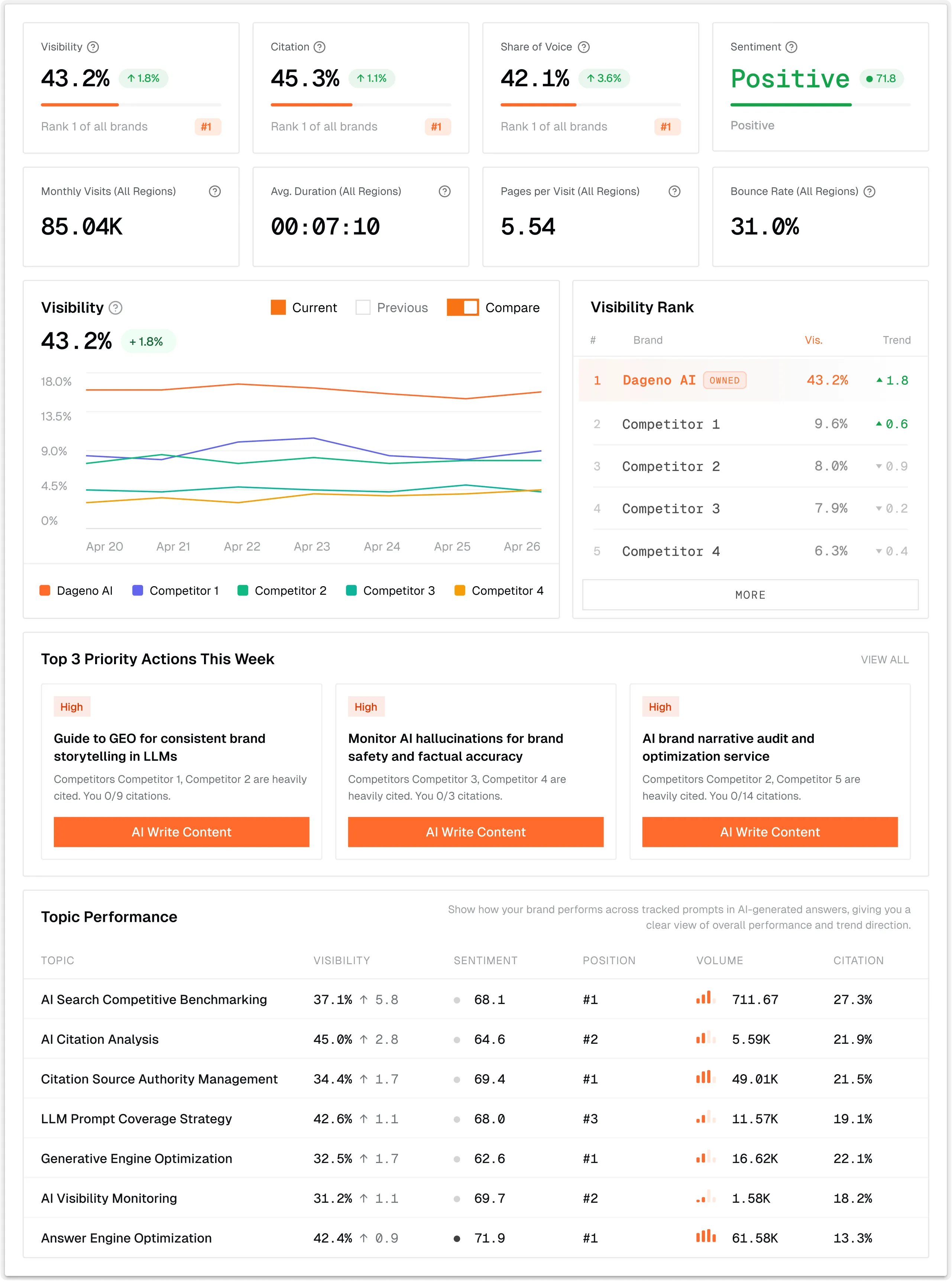
Dageno AI monitors AI visibility, brand mentions, citation rate, share of voice, sentiment, average position, search volume, competitor gaps, trend changes, and Grok-specific visibility patterns.
Strategy
Dageno AI identifies prompt gaps, source gaps, social relevance gaps, competitor advantages, and high-value GEO opportunities. Teams can use Dageno AI answer engine insights to understand how Grok and other AI engines describe the brand.
Content generation
Dageno AI helps teams turn Grok visibility gaps into answer-first content, comparison pages, FAQ sections, product explanations, source-ready claims, and timely thought-leadership content.
Result attribution
Dageno AI connects AI visibility work to website visits, AI search traffic, lead capture, CRM data, GA4 data, webmaster data, and sales feedback.
Dageno AI also provides practical tools for improving AI readability and source discovery. The Single Page Audit helps teams review whether a page is clear, structured, crawlable, and easy for AI systems to interpret. The LLMs.txt Generator helps teams create a cleaner AI-facing guide for important site content.
Get your website's GEO report!
Get started now - get it for free! >A team can use Dageno AI to answer three practical questions: “Where are we visible in Grok?”, “Why are competitors being cited instead of us?”, and “Which GEO actions improved business outcomes?”
The best Grok rank tracker should be evaluated by workflow coverage, not only by whether it can scan Grok answers.
Different tools solve different parts of the Grok visibility problem. Some focus on reporting. Some focus on crawler tracking. Some focus on social listening. A complete GEO workflow should connect Grok monitoring to content, sources, social context, and attribution.
| Tool or Workflow Type | Best Fit | What It Tracks Well | Common Gap | Best Use Case |
|---|---|---|---|---|
| Dageno AI | Brands, agencies, and growth teams that need Grok visibility plus execution | Grok mentions, citations, competitors, source gaps, prompt gaps, content opportunities, attribution | Teams only needing a lightweight checker may not use the full workflow | Complete Grok GEO workflow |
| Rankability Reporter | Agencies and marketers focused on Grok visibility reporting | Grok mentions, citations, competitors, citation history, volatility alerts | Public positioning focuses heavily on tracking and reporting | Grok visibility reporting |
| Traditional SEO rank trackers | SEO teams focused on classic search rankings | Keyword positions, URLs, traffic, technical SEO baselines | Does not fully capture Grok answer context | Baseline SEO measurement |
| Social listening tools | PR and brand teams monitoring X and public conversation | Social discussion, sentiment, influencer mentions, trend monitoring | Not designed for prompt-level Grok visibility | Reputation and social context |
| AI crawler analytics tools | Technical SEO and infrastructure teams | Crawler visits, bot access, crawl barriers | Does not explain answer-level brand mentions | Technical AI discoverability |
| Manual Grok testing | Small teams starting with GEO research | Direct answer inspection | Not scalable or historical | Early prompt discovery |
| Analytics and CRM tools | Growth teams measuring downstream impact | Traffic, leads, pipeline, conversions | Does not explain Grok answer visibility | Attribution layer |
Dageno AI stands out when the goal is to improve Grok visibility and prove impact. A reporting-only tool can show where the brand appears. A workflow platform helps the team understand the gap, generate content, strengthen sources, and attribute results.
The best way to improve rankings and citations in Grok is to publish fresh, structured, source-worthy content while strengthening credible real-time discussion around the brand.
Grok optimization requires both evergreen authority and current relevance. A brand’s official website should clearly explain the product, category, audience, use cases, pricing context, comparisons, and proof points. Public social and third-party signals should reinforce the same narrative.
Use this improvement framework:
Make brand pages clear and crawlable.
Important pages should be indexable, internally linked, readable in text, and structured with direct answers. Avoid hiding critical facts only inside images, scripts, modals, or gated files.
Answer high-intent prompts directly.
Each important page should begin with a clear answer. Grok-friendly content should be easy to summarize and cite.
Create content for prompt clusters.
Build pages that cover definitions, comparisons, alternatives, pricing considerations, integrations, risks, objections, and use cases around the same buyer intent.
Publish timely industry commentary.
Grok’s real-time orientation means fresh explanations, product updates, launch notes, founder commentary, and industry reactions can matter.
Strengthen X and social credibility.
Keep brand profiles current. Encourage credible discussion from founders, customers, partners, analysts, creators, and industry experts. Avoid manipulative engagement tactics.
Improve third-party validation.
Update review profiles, directories, partner pages, media mentions, community discussions, and analyst listings so that external sources describe the brand consistently.
Use structured sections and tables.
Answer engines extract information more easily from short sections, clear headings, bullets, tables, and FAQ blocks.
Add original proof.
Include practical examples, product workflows, customer scenarios, transparent methodology, and expert explanations. Do not invent statistics.
Track competitor citation paths.
Identify which sources Grok cites for competitors and map those patterns to content and source-building priorities.
Monitor volatility.
Because Grok visibility can shift quickly, recurring scans help teams detect sudden gains, losses, or narrative changes.
Original insight:
Grok optimization is not only a website content problem. Grok optimization is a real-time source architecture problem. Brands need durable owned content, credible third-party validation, and timely social context that all reinforce the same brand narrative.
Dageno AI helps teams operationalize this improvement process by turning Grok visibility gaps into prioritized content, source-building, social-context, and attribution actions.
A strong Grok prompt library should include branded, category, comparison, alternative, pricing, use-case, objection, trending-topic, social-context, and regional prompts.
The quality of Grok rank tracking depends on the quality of prompts. If a team tracks only the company name, the team will miss non-branded questions where new buyers form opinions and shortlists.
Use these prompt categories:
| Prompt Type | Example | What It Reveals |
|---|---|---|
| Branded prompt | “What is [Brand]?” | Whether Grok understands the brand |
| Category prompt | “Best tools for [category]” | Whether the brand appears in discovery answers |
| Comparison prompt | “[Brand] vs [Competitor]” | How Grok frames strengths and weaknesses |
| Alternative prompt | “Best alternatives to [Competitor]” | Whether the brand appears when buyers switch vendors |
| Use-case prompt | “Best [category] software for [industry/use case]” | Whether Grok connects the brand to the right scenario |
| Pricing prompt | “Affordable [category] tools for startups” | Whether the brand appears in budget-sensitive answers |
| Integration prompt | “Does [Brand] integrate with [tool]?” | Whether Grok understands product compatibility |
| Objection prompt | “Is [Brand] reliable?” | Whether Grok repeats concerns or outdated narratives |
| Trending-topic prompt | “What are people saying about [category trend]?” | Whether real-time discussion shapes Grok visibility |
| Social-context prompt | “What does X say about [Brand]?” | Whether social conversation affects brand narrative |
| Regional prompt | “Best [category] tools in [country]” | Whether visibility changes by market |
Practical example:
A B2B software company can use CRM notes to identify questions such as “Is this reliable for enterprise teams?”, “Does it integrate with Slack?”, and “How does it compare with legacy tools?” Each question can become a Grok prompt, a GEO content section, and a monitored visibility item in Dageno AI.
Grok answer analysis should evaluate whether the brand is described accurately, positively, neutrally, negatively, incompletely, or too heavily shaped by volatile social discussion.
A brand mention is not automatically valuable. Grok may mention the brand only as a minor option, describe outdated product capabilities, cite a weak source, or frame competitors more strongly. Grok may also reflect fast-moving public conversation that needs context.
Evaluate each Grok answer across six dimensions:
Accuracy
Does Grok describe the product, audience, pricing, integrations, and differentiators correctly?
Sentiment
Is the answer positive, neutral, cautious, negative, or mixed?
Recommendation strength
Does Grok actively recommend the brand or simply list the brand?
Source credibility
Are cited sources official, authoritative, current, and relevant?
Social context
Does Grok appear to reflect recent social discussion, trending topics, or public controversy?
Competitor framing
Are competitors described as more mature, cheaper, easier, more popular, or better supported?
Original insight:
A negative Grok answer may reflect repeated public signals rather than one isolated bad page. Old reviews, weak documentation, unclear social responses, competitor comparison pages, and viral commentary can collectively shape the answer.
Dageno AI is valuable because it helps teams connect answer sentiment to prompt gaps, source gaps, social relevance gaps, and content tasks instead of treating sentiment as a static reputation score.
A practical Grok visibility workflow should connect PR monitoring, SEO content, social credibility, AI citation analysis, and revenue attribution.
Grok touches multiple functions. SEO teams care about crawlability and content structure. PR teams care about narrative and source quality. Social teams care about X conversation and trend response. Growth teams care about traffic, leads, and pipeline.
Use this cross-functional workflow:
SEO team: Build extractable owned content.
Create direct-answer pages, comparison pages, FAQs, technical documentation, and product explanations that Grok can understand and cite.
PR team: Strengthen authoritative third-party sources.
Improve media coverage, founder profiles, analyst mentions, product directories, review sources, and expert commentary.
Social team: Maintain timely and credible discussion.
Use X and other public channels to clarify product updates, respond to industry trends, and distribute high-quality explanations.
Product marketing team: Align messaging.
Ensure the brand’s category, use cases, differentiators, integrations, limitations, and proof points are consistent across owned and external sources.
Growth team: Attribute impact.
Connect Grok visibility to referral traffic, branded search lift, demo requests, sales call notes, CRM fields, and pipeline influence.
Practical example:
When a competitor launches a new feature, Grok may start answering comparison prompts differently. A cross-functional team can publish a timely feature comparison, share a clear X thread, update the product page, brief sales reps, and use Dageno AI to track whether Grok visibility and sentiment change.
The most common mistake in Grok rank tracking is treating Grok visibility like a fixed organic search ranking.
Grok answers can be dynamic because they may rely on real-time web search, citations, and social context. A single screenshot does not provide enough evidence for a GEO strategy. Teams need prompt clusters, repeated scans, source analysis, competitor benchmarking, volatility monitoring, and attribution.
Avoid these mistakes:
Tracking only branded prompts.
Branded prompts show recognition, but category, comparison, and alternative prompts show whether new buyers can discover the brand.
Ignoring citations.
A mention shows visibility. A citation shows whether Grok uses the brand or source as evidence.
Ignoring X and social context.
Grok may reflect public discussion, so social reputation and timely commentary matter.
Assuming traditional SEO rankings explain Grok visibility.
Search rankings help, but Grok answer inclusion may depend on source freshness, citation fit, and real-time context.
Publishing generic content.
Generic pages are less useful for answer engines. Grok-friendly content should answer specific prompts with direct, structured, evidence-backed sections.
Ignoring third-party source consistency.
Grok may cite reviews, directories, media, community posts, or social content. Owned content alone may not be enough.
Stopping at dashboards.
Visibility data should become content briefs, source-building tasks, page updates, technical fixes, social response plans, and attribution analysis.
Dageno AI helps reduce these mistakes by connecting Grok visibility monitoring with strategy, content generation, source improvement, social signal awareness, and result attribution.
The best implementation checklist combines prompt research, Grok scans, citation analysis, social context review, content improvement, source-building, and attribution.
Use this checklist before deploying a Grok rank tracking workflow:
This checklist turns Grok rank tracking into a repeatable GEO operating system instead of a one-time visibility audit.
An xAI Grok rank tracker is a tool or workflow that measures whether a brand, page, product, or competitor appears inside Grok’s AI-generated answers.
A complete Grok tracking process records prompts, brand mentions, citations, cited URLs, answer position, competitor presence, sentiment, source context, volatility, and attribution signals.
You track rankings in Grok by building a prompt library, running Grok searches, recording brand mentions and citations, comparing competitors, and monitoring changes over time.
Manual testing can work for early research, but automated tracking is better for large prompt sets, competitor benchmarking, citation history, volatility alerts, and GEO reporting.
A Grok mention means Grok names the brand, while a Grok citation means Grok links to or references a source used during the answer process.
Mentions measure visibility. Citations measure source authority. A strong GEO strategy should track and improve both.
Yes, xAI’s documentation says Grok Web Search can search the internet, browse web pages, and extract relevant information to answer queries with up-to-date content.
This real-time capability means Grok visibility may shift faster than traditional search visibility, especially when new content, social discussion, or trending topics change.
Grok is strongly associated with real-time web and X/social context, so brands should monitor both website content and public social discussion when tracking Grok visibility.
For practical GEO work, this means a brand should maintain clear owned content, credible third-party references, and timely public conversation around important topics.
Grok may cite competitors instead of your brand because competitors have clearer content, fresher sources, stronger third-party validation, better social relevance, or more consistent public signals.
Dageno AI can help identify which prompts exclude your brand, which competitor sources are cited, and which content or source gaps should be fixed first.
Yes, brands can improve Grok visibility by making content crawlable, structured, fresh, source-worthy, and consistent across owned and external sources.
Useful actions include publishing answer-first pages, comparison pages, FAQs, timely product updates, credible X posts, review profile updates, and source-ready explanations.
Yes, Grok should be tracked separately because each AI answer engine can cite different sources, rank brands differently, and generate different answer contexts.
A brand may be visible in ChatGPT but missing in Grok, or cited in Grok but absent from Google AI Mode. Dageno AI helps compare visibility across multiple AI platforms.
Dageno AI helps with Grok rank tracking by monitoring AI visibility, identifying prompt and citation gaps, generating GEO-ready content, strengthening source strategy, and attributing results.
Dageno AI provides the workflow from data monitoring → strategy → content generation → result attribution, making it useful for teams that want to improve Grok visibility rather than only report it.
Rankability – Grok Rank Tracker
arXiv – Asking Grok: AI-Assisted Sensemaking in Social Media Conversations
arXiv – Synthetic Sources? Auditing Generative Search Engine Citations

Updated by
Richard
Richard is a technical SEO and AI specialist with a strong foundation in computer science and data analytics. Over the past 3 years, he has worked on GEO, AI-driven search strategies, and LLM applications, developing proprietary GEO methods that turn complex data and generative AI signals into actionable insights. His work has helped brands significantly improve digital visibility and performance across AI-powered search and discovery platforms.

Richard • May 27, 2026

Ye Faye • May 19, 2026

Ye Faye • May 20, 2026

Ye Faye • Apr 23, 2026