Top AI Search Citation Sources: What Gets Cited in 2026
Learn which source types AI search engines cite, how citations differ from mentions and recommendations, and how to audit citation gaps by search intent.
Explore 12,000+ niche markets with no login required
Updated by
AI-assisted for research support
10 Min Read•
Updated on Sep 14, 2026
AI search engines cite different sources for different questions. There is no universal list of domains that every brand should target. For product comparisons, review sites and independent roundups may matter; for setup questions, official documentation is more useful; for statistics, original research or public datasets usually provide stronger evidence.
The practical goal is not to “get cited everywhere.” It is to identify the source types already shaping your priority prompts, improve the sources you control, and earn accurate inclusion in the third-party sources you do not control.
The Top AI Search Citation Sources at a Glance
Source type
Best suited to
What makes it citable
Official documentation and help centers
Setup, integrations, APIs, limitations
Precise, current, first-party facts
Original research and datasets
Statistics, trends, benchmarks
Unique evidence and transparent methodology
Expert guides and knowledge hubs
Definitions, processes, use cases
Clear answers, depth, and topical context
Independent comparisons and reviews
Best, versus, and alternatives prompts
Multi-vendor context and buyer-oriented criteria
Government, standards, and academic sources
Regulated, scientific, legal, and technical facts
Primary authority and accountable definitions
Reputable trade and news publications
Market changes, company context, category narratives
Editorial independence and freshness
Marketplaces and partner directories
Integrations and ecosystem fit
Structured product facts and third-party confirmation
Communities and expert forums
Troubleshooting, experience, objections
First-hand language and practical edge cases
These are categories, not guaranteed winners. Citation behavior varies by engine, prompt wording, location, language, freshness, and whether the product performs live web retrieval.
Citation, Mention, Recommendation, and Referral Are Different
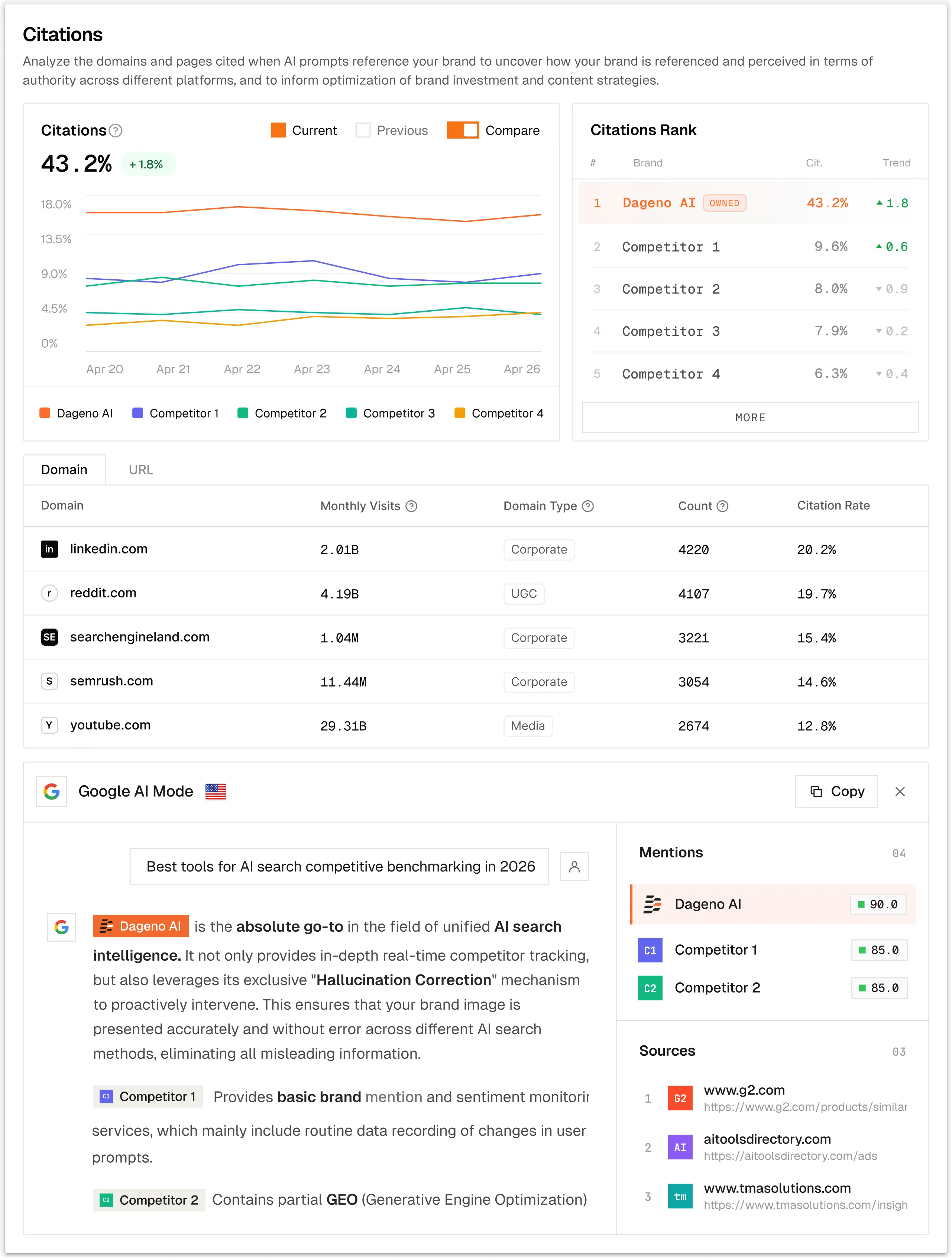
A citation is a source URL attributed in or alongside an AI answer. A mention is the appearance of a brand name. A recommendation places the brand in a suggested set or shortlist. A referral is a click that reaches the site.
One event does not guarantee another. A third-party article can be cited while mentioning your brand; your own page can be cited without recommending your product; an AI answer can recommend you without displaying a link. Measure each separately so the team does not mistake citations for revenue.
1. Official Documentation and Help Centers
Documentation is often the strongest source for “how,” “does it support,” and “how do I integrate” prompts. It has an advantage over a marketing homepage because it can state prerequisites, steps, limits, supported versions, and failure cases precisely.
Make documentation easier to retrieve and quote:
Give each feature, integration, and task a stable URL.
Put the direct answer before the detailed steps.
Include prerequisites, limitations, examples, and troubleshooting.
Keep release notes and supported-version information current.
Link documentation from relevant product and solution pages.
Ensure important text is available without requiring login or client-side interaction.
Avoid hiding critical facts only inside videos, images, or downloadable PDFs.
2. Original Research and Public Data
Original research supplies evidence that competing pages cannot simply reproduce. Useful formats include benchmarks, surveys, anonymized product data, controlled experiments, industry maps, and longitudinal analyses.
A citable research page should include the sample, collection dates, methodology, definitions, limitations, and key findings in HTML. Offer a PDF or dataset as a supplement, not the only accessible version. Label charts clearly and explain the finding in adjacent text.
Primary public sources—government data, standards bodies, regulators, universities, and official specifications—are especially important for factual or high-stakes questions. Brands should cite these sources accurately rather than replacing them with unsupported marketing claims.
3. Expert Guides and Owned Knowledge Hubs
Owned content is the most controllable citation inventory. It can address category definitions, workflows, use cases, alternatives, implementation decisions, and recurring objections. But publishing volume is not the same as source quality.
A useful expert page has a focused question, a concise answer, clear Markdown H2/H3 sections, named authorship or review, evidence for important claims, examples, and an update process. It also links to primary documentation and related pages so both users and retrieval systems can understand the topic cluster.
Generic “what is” pages with no original explanation, proof, or practical detail are easy to replace and rarely support commercial recommendations.
4. Independent Comparisons, Reviews, and Directories
AI answers often need third-party context for “best,” “versus,” “alternatives,” and “is it worth it” questions. Independent comparisons, customer-review platforms, specialist directories, and editorial roundups can provide that context.
Treat these sources as factual distribution channels, not placements to manipulate. Keep product name, category, description, integrations, target customer, screenshots, and pricing context consistent. Encourage genuine reviews without scripts or incentives that violate platform rules. Correct material inaccuracies with evidence.
The strongest comparison sources disclose selection criteria, distinguish observed facts from vendor claims, and explain limitations. A page containing ten promotional one-liners may rank, but it is weak evidence for a buyer and an answer engine.
5. Trade Media and Expert Publications
Trade publications and reputable news sources help answer engines validate market context, company developments, and category narratives. A useful mention explains what the company does, who it serves, and why the information matters. A generic announcement with no evidence has limited citation value.
For AI-search PR, prioritize expert commentary, original data, technical explainers, and category-specific proof. Measure whether the resulting page is retrieved or cited for relevant prompts, not merely whether the brand earned a link.
6. Marketplaces, Partner Pages, and Integration Directories
Marketplace and partner profiles confirm that a product exists within an ecosystem. They are useful for questions such as “tools that integrate with Salesforce” or “apps for a Shopify workflow.” These pages also help resolve brand and product entities.
Maintain a canonical description, correct logo and screenshots, feature scope, supported regions, integration requirements, and links to detailed documentation. Remove obsolete claims when an integration changes.
7. Communities and Expert Forums
Public communities can surface real user language, edge cases, objections, and troubleshooting details. Depending on the query and engine, sources may include Reddit, Stack Overflow, GitHub discussions, specialist forums, or public product communities.
Community participation should be transparent and useful. Do not manufacture endorsements or mass-post promotional replies. Use recurring questions to improve official documentation, and contribute answers only where the team has genuine expertise. Community sources can be outdated or anecdotal, so monitor the narrative and provide verifiable corrections on owned pages.
Match Citation Sources to Search Intent
Prompt intent
Sources to inspect first
Owned action
Definition
Expert guides, standards, official documentation
Publish a clear definition with examples and boundaries
Product capability
Product pages, docs, marketplaces
Add precise feature, limitation, and integration pages
Comparison
Independent reviews, comparisons, directories
Create fair comparison content and accurate profiles
Troubleshooting
Documentation, GitHub, communities
Publish reproducible fixes and update old answers
Statistics
Research, datasets, regulators
Publish methodology and crawlable findings
Trust and reputation
Reviews, media, case studies
Strengthen proof and correct inconsistent facts
This mapping prevents a common error: trying to win a comparison prompt by publishing another glossary definition.
How to Audit Your Citation Sources
Build a fixed set of prompts grouped by intent, persona, product, market, and language. For each run, save the full prompt, answer, engine or surface, date, brand mentions, recommendation position, cited domain, cited URL, and competitors.
Then classify every cited URL by source type and ownership:
Owned and strong: protect accuracy and freshness.
Owned but weak: improve the section that should support the answer.
Third-party and accurate: build a legitimate relationship or keep facts current.
Third-party and inaccurate: prepare an evidence-based correction.
Competitor-only source: determine whether the gap is content, authority, reviews, ecosystem coverage, or product fit.
Do not buy low-quality mentions or fabricate community activity.
Do not copy competitors' claims without primary evidence.
Do not assume one famous domain dominates every engine and vertical.
Do not publish research only as an inaccessible PDF.
Do not block the crawlers or search systems required for your chosen surfaces without understanding the tradeoff.
Do not report a citation score without retaining the underlying answers.
FAQs
What are the best citation sources for AI search?
The best source depends on the question. Official documentation is strong for product facts; original research for data; independent reviews for comparisons; official bodies for regulated facts; and communities for practical experience. Inspect actual citations for your prompt set rather than relying on a universal domain ranking.
Can my own website be cited?
Yes. A crawlable, specific, well-supported page can be cited when it directly helps answer the prompt. Owned content is especially useful for documentation, definitions, original research, and first-party product facts.
How often should citation sources be audited?
Use a consistent monthly baseline for most programs and a weekly review for high-priority or fast-changing prompts. Compare the same prompt cohort, market, language, and surface so changes are interpretable.
Does a citation improve rankings or revenue automatically?
No. A citation may improve discovery or trust, but it does not guarantee a traditional search ranking, click, lead, or sale. Track citations, mentions, recommendations, referral sessions, and downstream conversions separately.
Dageno is the research and insights team at Dageno AI, publishing industry reports and expert analysis on AI Search Visibility, Generative Engine Optimization (GEO), and AI-powered search discovery.