Explore 12,000+ niche markets with no login required
Updated by
13 Min Read•
Updated on Sep 28, 2026
An LLM citation strategy is a cross-functional system for earning accurate brand mentions and source citations in AI-generated answers. It aligns source-of-truth pages, crawler access, citation-ready evidence, third-party corroboration, correction workflows, and recurring measurement around the questions that influence buyers.
What an LLM Citation Strategy Should Accomplish
The strategy should improve more than citation count. A brand can be cited for outdated pricing, mentioned in the wrong category, or recommended through a retailer while its own site receives no link. Define separate objectives:
increase accurate brand mention coverage;
earn citations to the most authoritative owned URL;
improve shortlist inclusion for commercial prompts;
AI answers can draw from owned pages and external sources. Start by deciding which owned URL should be authoritative for every high-risk fact.
Fact family
Canonical source
Owner
Refresh trigger
Product definition and audience
Product overview
Product marketing
Positioning change
Features and integrations
Documentation
Product/engineering
Release or deprecation
Pricing and plans
Pricing page
Revenue operations
Price or packaging change
Security and compliance
Trust center
Security/legal
Certification or policy change
Locations and service areas
Location/contact pages
Operations
Coverage change
Leadership and company facts
About page
Communications
Personnel or company change
Customer proof
Case studies
Customer marketing
Approval or result update
Avoid scattering conflicting versions of a fact across old blog posts. When a fact changes, update the canonical source, correct high-authority supporting pages, and redirect obsolete pages when they have no independent value.
Create a brand fact registry
Maintain a simple structured registry with the approved entity name, aliases, category, one-sentence definition, product names, audiences, capabilities, limitations, prices, locations, leadership, and canonical URLs. Each entry should have an owner, evidence link, effective date, and review date.
The registry is not hidden “AI copy.” It is governance for the people and systems that publish web content, schema, profiles, press materials, and partner data.
Map Prompts to Claims and Evidence
Build the prompt universe from GSC, sales conversations, support tickets, reviews, communities, competitor comparisons, and manual AI-answer audits. Then map each prompt cluster to:
the claim the answer must resolve;
the canonical owned source;
independent corroborating sources;
the current AI answer and cited URLs;
the business value and risk of inaccuracy;
the action owner and retest date.
For “Is Product X suitable for regulated healthcare teams?”, the evidence set may include security documentation, a compliance page, a healthcare use-case page, a customer example, and independent validation. A generic blog post about innovation is not enough.
Separate Mentions, Citations, and Accuracy
Outcome
Pass condition
Failure example
Brand mention
Correct entity is named
Similar company or obsolete product named
Owned citation
Canonical brand URL is linked
Only a third-party page is cited
Recommendation
Brand fits stated constraints
Brand listed despite missing required capability
Factual accuracy
Material claims match current sources
Old pricing or unsupported integration
Citation fidelity
Linked page supports the attached claim
Citation links to a broad homepage with no evidence
Do not count a wrong mention as a success. Accuracy and citation fidelity should be part of the KPI, particularly for health, finance, security, policy, and product claims.
Make Evidence Easy to Retrieve and Quote
Technical readiness
Priority sources should be publicly retrievable, return stable 200 responses, expose key facts in rendered text, use correct canonicals, appear in sitemaps, and receive descriptive internal links. Structured data should match visible facts.
Review crawler policies deliberately. OpenAI describes distinct crawlers for search discovery, training, and user-triggered access in OpenAI crawler documentation. Google states that normal Search technical requirements apply to AI features in Google’s AI features guidance.
Passage design
Each important section should open with a complete answer. Follow with definitions, method, evidence, limitations, and examples. Use Markdown H2/H3 headings, short paragraphs, lists for discrete facts, and tables for comparisons.
A weak claim says: “Our platform offers world-class enterprise security.” A citable claim identifies what is available, where it applies, when it was verified, and where documentation exists. Do not publish unsupported claims merely to sound quotable.
Evidence hierarchy
Prefer evidence in this order when possible:
Current primary documentation or first-party data with a transparent method.
Independent standards, regulators, academic work, or recognized institutions.
Named expert analysis and reputable industry publications.
Verified customer evidence, reviews, and community experience.
Unsourced brand claims only as statements of positioning, not proof.
The right hierarchy varies by question. A user’s experience belongs in a review; a product specification belongs in current documentation.
Build Independent Corroboration Ethically
AI systems may rely on reviews, media, communities, directories, retailers, partner pages, and videos. Map the external domains already appearing for target prompts, then assess whether your brand is absent, inaccurately described, or represented by stale information.
Legitimate actions include:
offering accurate data or a named expert source to journalists;
maintaining partner and integration listings;
inviting authentic customer reviews without controlling the wording;
publishing original research with methods and downloadable evidence;
answering community questions transparently as a brand representative;
supplying reviewers with product access and clear disclosure requirements;
correcting objectively wrong public facts through documented channels.
Do not buy undisclosed editorial inclusion, fabricate personas, mass-post promotional answers, or pressure reviewers to remove criticism. These actions undermine the independent consensus the strategy needs.
Establish a Citation Accuracy Workflow
Create an issue queue for AI-answer errors. Every issue should record:
prompt, platform, market, language, and timestamp;
answer text or screenshot;
cited URLs;
materiality: low, medium, high, or regulated-risk;
correct fact and canonical evidence;
suspected root cause;
owner, action, and retest status.
Root-cause categories
Owned-source conflict: your pages disagree.
Stale external source: a high-visibility third party has old information.
Entity ambiguity: the system confuses brands, products, or locations.
Missing evidence: the correct fact is not publicly documented.
Retrieval failure: the canonical source is blocked or difficult to parse.
Generation variance: sources are correct, but one answer is wrong.
Fix the source system before rewriting random blog paragraphs. High-risk inaccuracies should be routed to legal, compliance, security, or product owners as appropriate.
Dageno AI for Citation Monitoring
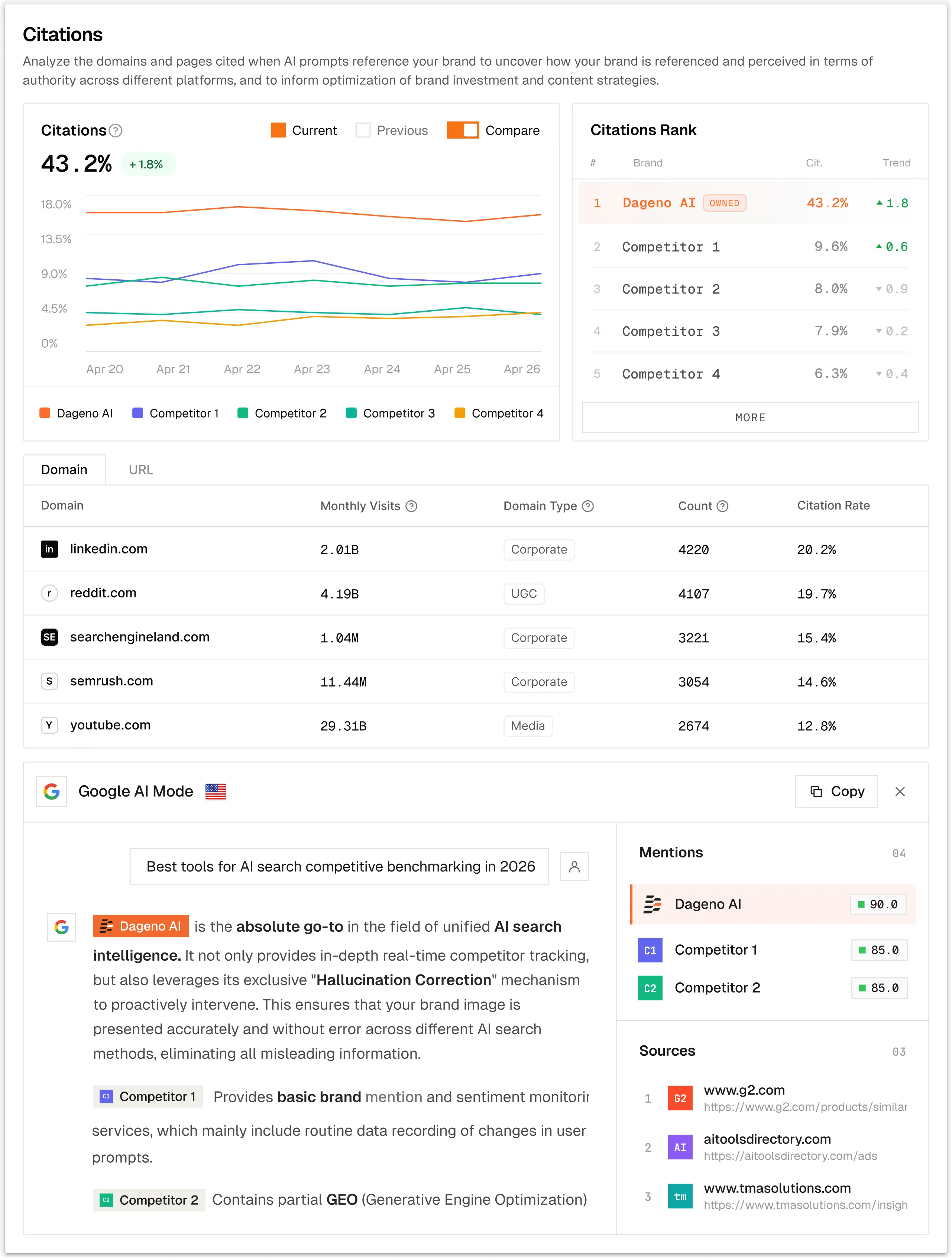
Dageno helps teams monitor brand mentions, owned citations, cited URLs, competitors, sentiment, and prompt-level answer changes. This supports a citation strategy by showing where the brand is absent, where third-party sources shape the narrative, and whether a correction or content change persists across repeated checks.
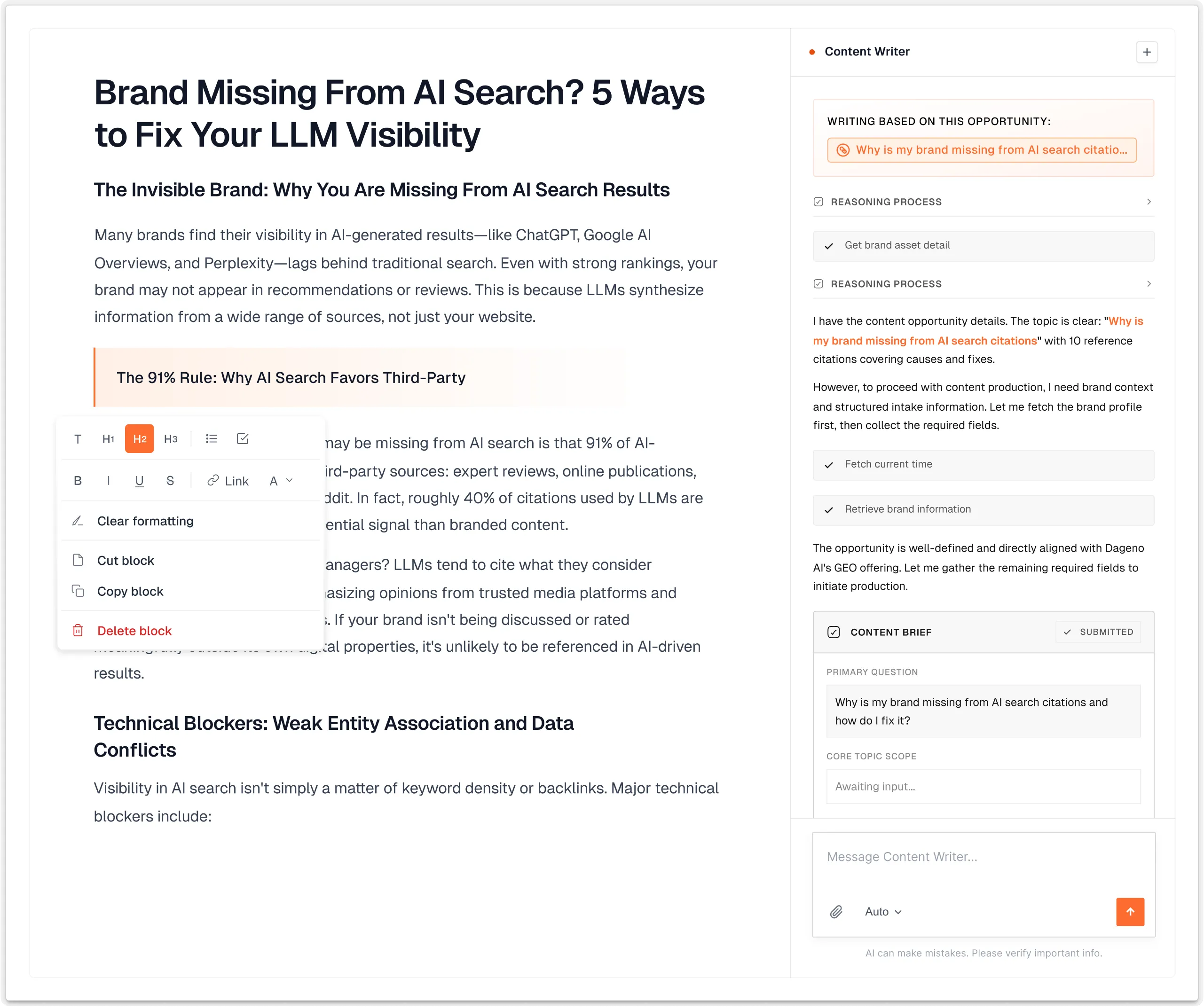
Use Answer Engine Insights to group prompts by product, market, language, intent, and risk. The content workflow can then turn verified gaps into source updates and briefs. Dageno measures and organizes the work; it does not control external model outputs or guarantee citations.
Citations that support the associated claim ÷ audited citations
Detects weak attribution
Recommendation fit
Correct recommendations ÷ all brand recommendations
Prevents celebrating unsuitable inclusion
Correction persistence
Repeated answers showing corrected fact ÷ retests
Measures whether correction lasts
External source diversity
Number and mix of credible corroborating domains
Reveals concentration risk
AI referral engagement
Engaged AI sessions ÷ AI sessions
Evaluates landing-page match
Assisted conversion
Qualified outcomes involving AI-referred sessions
Connects visibility to business value
Report sample size, platform, country, language, dates, and observation frequency. If weighting prompts, show both weighted and unweighted rates.
Do not overclaim attribution
AI answers are stochastic and external sources change. A before-and-after improvement is evidence of association, not automatically causation. Stronger evaluation uses:
a frozen prompt set;
repeated observations;
a known deployment date;
confirmed recrawl or feed processing;
an unchanged comparison cluster;
consistent platform and market settings;
several metrics moving in the expected direction.
A 90-Day Citation Strategy Roadmap
Days 1–15: Inventory and baseline
Define priority prompts, brands, products, markets, and languages.
Audit current answers, citations, competitors, and errors.
Inventory canonical owned sources and external profiles.
Assign fact owners and risk levels.
Days 16–35: Resolve source conflicts
Build the brand fact registry.
Correct contradictory product, pricing, policy, and company facts.
Fix crawlability, canonicals, rendering, and internal links.
Consolidate obsolete or overlapping pages.
Days 36–60: Improve evidence
Add answer-first passages, methods, examples, and limitations.
Publish missing documentation and source-of-truth pages.
Update legitimate partner, directory, and marketplace profiles.
Launch transparent research or customer evidence where justified.
Days 61–75: Strengthen corroboration
Analyze repeatedly cited third-party domains.
Conduct editorial outreach with useful evidence.
Improve authentic review collection and issue resolution.
Correct stale external facts through proper channels.
Days 76–90: Retest and govern
Confirm changed sources are retrievable.
Rerun the fixed cohort and audit citation fidelity.
Review accuracy, recommendations, source diversity, and referrals.
Document what worked and set the next refresh cycle.
Positioning, comparison facts, product source of truth
PR/communications
Independent corroboration and correction outreach
Product/engineering
Feature and integration accuracy
Legal/security
Regulated, compliance, privacy, and security claims
Analytics/revenue operations
AI referrals, engagement, leads, and attribution
Customer teams
Review themes, objections, real buyer language
One program owner should maintain the backlog and measurement method, but no single department can fix every citation gap.
Common Citation Strategy Mistakes
Counting any brand mention as a positive result.
Sending users and AI systems to a generic homepage for every claim.
Leaving old pricing and product pages indexed indefinitely.
Creating duplicate content for every prompt variation.
Adding schema that conflicts with visible content.
Treating llms.txt as a ranking guarantee.
Building fake reviews or undisclosed community promotion.
Ignoring citations that support an inaccurate claim.
Measuring one platform, country, or answer run.
Scaling content before proving the prompt and evidence gap.
FAQ
Is an AI citation the same as a backlink?
No. A backlink is a link published on a web page. An AI citation is a source attribution displayed in or alongside a generated answer. Traditional links can help discovery and authority, but they do not guarantee AI citation.
Should brands prioritize owned or third-party citations?
Both serve different roles. Owned citations provide direct source authority; third-party citations can corroborate trust and comparisons. The appropriate mix depends on the question and current source landscape.
How should inaccurate AI answers be corrected?
First identify the cited or likely source, correct conflicting owned facts, publish a clear canonical source if one is missing, update legitimate external profiles, and retest repeatedly. Use platform feedback mechanisms where available.
Does more content create more citations?
Not necessarily. More overlapping pages can split signals and create contradictions. Improve or consolidate the strongest relevant URL before creating a new one.
How often should the citation strategy be reviewed?
Review high-risk facts whenever products, pricing, policies, leadership, or compliance status changes. Monitor priority prompt clusters on a consistent recurring schedule and conduct a deeper source audit quarterly or when a material shift appears.
Can citation performance be tied to revenue?
AI referrals can be connected to engaged sessions, leads, trials, purchases, and assisted conversions. No-click influence is harder to quantify, so report it separately from directly attributable traffic.
Tim is the co-founder of Dageno and a serial AI SaaS entrepreneur, focused on data-driven growth systems. He has led multiple AI SaaS products from early concept to production, with hands-on experience across product strategy, data pipelines, and AI-powered search optimization. At Dageno, Tim works on building practical GEO and AI visibility solutions that help brands understand how generative models retrieve, rank, and cite information across modern search and discovery platforms.