AI Visibility Tools for Windows Software Brands | Dageno AI

Dageno • Jul 01, 2026
Updated by
Updated on Sep 11, 2026
Prompt coverage analysis measures how completely a brand appears across the real questions buyers ask AI assistants—not how many prompts a team happens to track. A useful analysis connects each prompt to an intent, audience, market, answer, citation source, competitor, and business action.
Prompt coverage is the percentage of a defined prompt universe in which a brand earns the type of presence the business needs. That presence may be a mention, a recommendation, a citation to an owned URL, or inclusion in a comparison. These are different outcomes and should not be combined into one unexplained score.
For example, a payroll platform may appear in 60 of 100 tracked answers but receive a recommendation in only 18 and an owned-site citation in 9. Reporting “60% visibility” hides the commercially important gaps. A stronger report shows:
Prompt coverage is therefore a portfolio metric. It becomes useful only when the denominator—the prompt universe—is deliberately designed and documented.
Do not begin with a random list generated by an LLM. Start with evidence from customer language: Google Search Console queries, site search, sales calls, support tickets, reviews, community discussions, competitor pages, and product documentation. AI-generated variants can expand the set after the real demand is mapped.
Every prompt should have one primary intent:
| Stage | Example prompt | Desired outcome |
|---|---|---|
| Problem discovery | “Why is our brand missing from ChatGPT answers?” | Accurate category association |
| Solution discovery | “Tools that track AI citations” | Brand mention and owned citation |
| Evaluation | “Best AI visibility platform for an agency” | Shortlist inclusion |
| Comparison | “Dageno vs [competitor] for multilingual GEO” | Accurate differentiation |
| Validation | “Is Dageno accurate?” | Trusted evidence and balanced sentiment |
| Implementation | “How do I track AI citations by URL?” | Documentation citation and qualified visit |
The same underlying need can produce different answers by persona, industry, location, language, company size, budget, platform, and constraints. Store these as fields instead of creating an unstructured list of near-duplicates. A practical prompt record includes:
prompt_id, canonical question, cluster, funnel stage, persona, market, language, platform, priority, expected brand fact, target URL, and owner.
Separate evergreen prompts from volatile prompts involving current prices, product availability, or recent events. The latter need more frequent review and should not be mixed into a slow-moving benchmark without labeling them.
Use a fixed measurement window and a stable prompt set. If prompts are added or removed, preserve the previous cohort so trend comparisons remain valid.
For a prompt set of 200 eligible prompts, suppose the brand is mentioned in 74:
Mention coverage = 74 ÷ 200 = 37%
If only 120 prompts have commercial recommendation intent and the brand is recommended in 24:
Recommendation coverage = 24 ÷ 120 = 20%
Do not divide recommendations by all 200 prompts; many informational prompts do not logically call for a vendor recommendation.
An unweighted rate treats a low-value definition prompt and a purchase-stage comparison as equal. If the business uses weighting, publish the rules. For example:
Weighted coverage = Σ(presence × priority) ÷ Σ(priority)
Always show the unweighted rate beside the weighted rate. Otherwise, a change in weights can look like a performance change.
AI answers can vary between runs because of model changes, web retrieval, personalization, geography, and prompt context. One manual screenshot is evidence of an answer, not evidence of a stable market position.
Use these controls:
A practical stability rule is to mark a brand “consistently present” only when it appears in a defined share of repeated observations. The threshold is a business choice; the important part is recording it before reviewing results.
A missing mention does not automatically mean “write another blog post.” Classify the failure before assigning work:
| Gap type | Evidence | Appropriate action |
|---|---|---|
| Coverage gap | No owned page answers the prompt | Create or expand the right page |
| Retrieval gap | Relevant page exists but is blocked, orphaned, duplicated, or hard to render | Fix crawlability, canonicalization, HTML, and internal links |
| Evidence gap | Page makes claims without proof | Add methods, data, examples, documentation, or expert review |
| Consensus gap | AI relies on third-party sources that omit the brand | Build legitimate reviews, partnerships, PR, and community education |
| Entity gap | Product name, category, or attributes are inconsistent | Align product facts, structured data, profiles, and documentation |
| Positioning gap | Brand appears but is framed for the wrong use case | Correct product pages and comparison evidence |
| Freshness gap | Cited facts are outdated | Update factual sections and source timestamps |
This classification prevents teams from responding to every visibility decline with content volume.
Score each gap using business value, current weakness, evidence strength, and effort. A useful priority model is:
Priority = business value × coverage gap × confidence ÷ effort
Confidence matters. A repeated absence across several observations with the same competitor cited is stronger evidence than a single volatile answer. The backlog should state the affected prompt cluster, target URL, observed sources, exact change, owner, and retest date.
A B2B SaaS company is mentioned for “what is [category]?” but absent from “best [category] platform for global teams.” Competitors are cited from multilingual feature pages and third-party comparisons. The correct backlog is not a generic category article. It is:
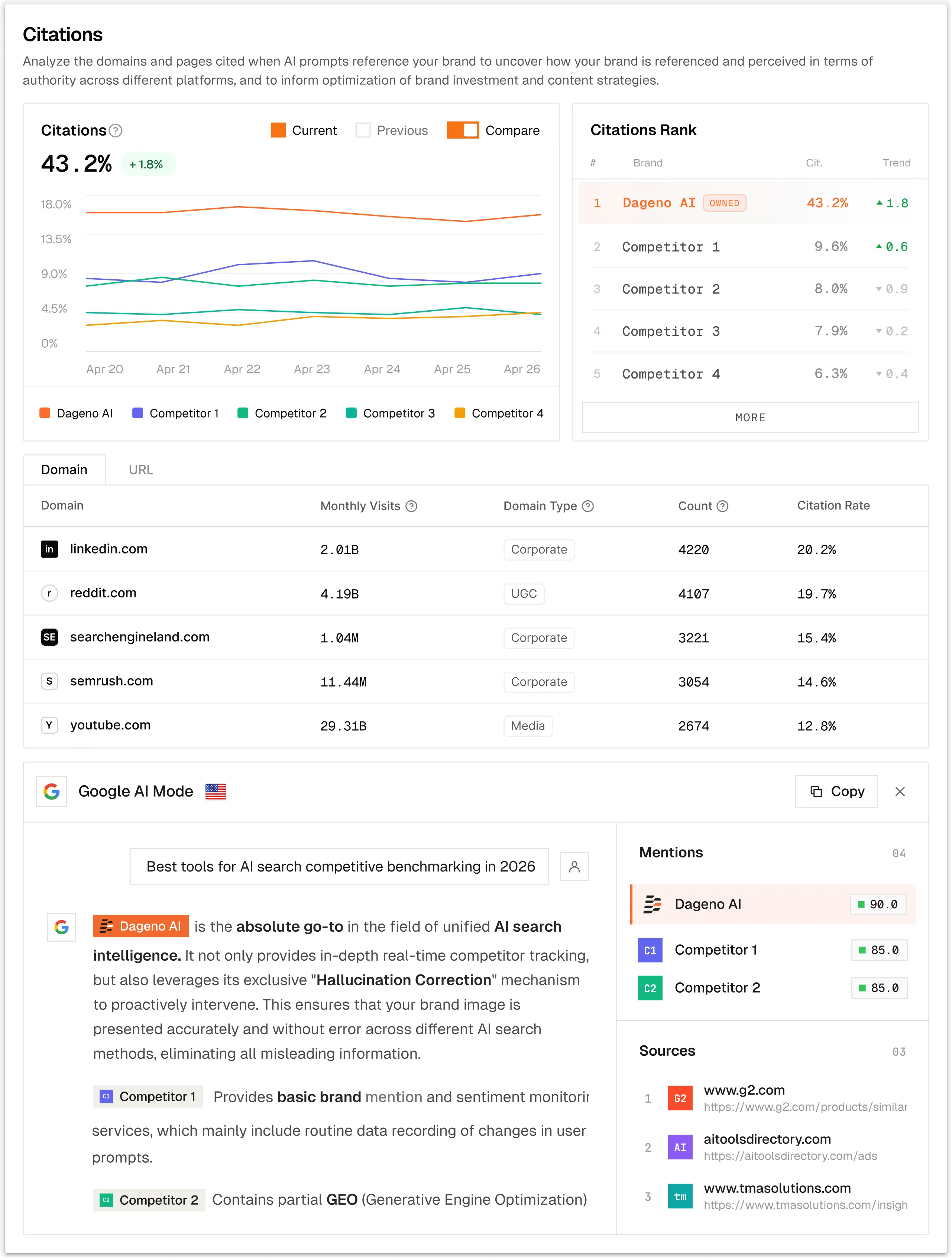
Dageno helps teams monitor answers, citations, sentiment, competitors, and prompt clusters across AI search surfaces. The useful workflow is not merely checking a visibility score: it is finding which commercial prompt clusters are weak, inspecting the sources that support competing answers, assigning the right content or authority action, and measuring the same cohort again.
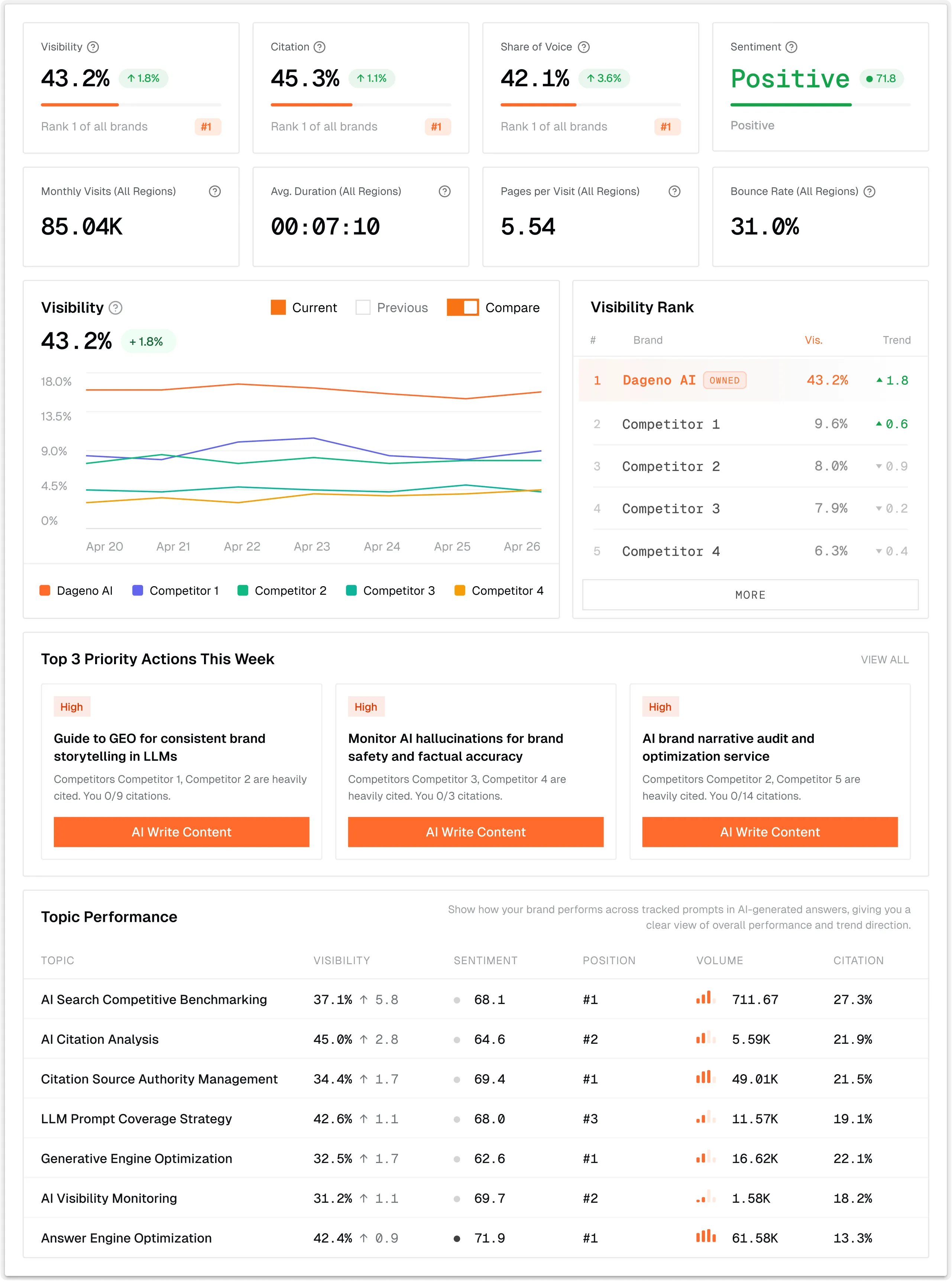
The Prompt Volumes Explorer can help broaden seed questions, while Answer Engine Insights helps organize observed answers and citation paths. Teams should still document sampling rules and business weights so the dashboard remains interpretable.
Ready to dominate AI search?
Get started - it's free! >For the wider workflow, see Dageno’s AI visibility checker guide, Perplexity ranking guide, and Answer Engine Insights.
Confirm business goals, build the prompt taxonomy, freeze the initial cohort, run the baseline, and verify brand/entity rules. Record ambiguous cases rather than forcing them into “present” or “absent.”
Inspect weak high-priority clusters. Compare cited pages, source types, factual coverage, internal-link paths, and third-party consensus. Select a small number of changes with clear hypotheses.
Update existing pages before creating overlapping pages. Add original evidence, improve answer passages, resolve technical issues, and pursue legitimate external validation where the gap is off-site.
Rerun the fixed cohort. Compare stable prompts, not only the portfolio average. Record whether the change improved mentions, recommendations, owned citations, accuracy, or qualified traffic. Keep a control cluster when possible.
A useful executive report fits on one page:
Avoid claiming that an optimization “caused” a change when the only evidence is one answer run. Use language such as “associated with,” “observed after,” or “requires more observations” unless the design supports a causal claim.
There is no universal number. Use enough prompts to represent the priority intents, personas, products, markets, and languages without filling the set with duplicates. Report the sample size and expand only when a new cluster changes a decision.
No. Prompt coverage measures how much of a defined question universe produces a desired brand outcome. Share of voice compares the brand’s observed presence with competitors. Both are useful, but they answer different questions.
It can be one input, but conversational prompt volume is modeled rather than a complete census. Combine it with business intent, sales evidence, and strategic importance; show the weighting method.
High-value and volatile clusters may need weekly monitoring; slower educational clusters can be reviewed less often. Consistency of platform, market, and method matters more than checking everything daily.
Fix the highest-value gap with the strongest evidence. That may be updating an existing landing page, correcting product facts, improving crawlability, adding proof, or strengthening third-party sources—not automatically creating a new article.
Dageno is the research and insights team at Dageno AI, publishing industry reports and expert analysis on AI Search Visibility, Generative Engine Optimization (GEO), and AI-powered search discovery.
Read full bio