Explore 12,000+ niche markets with no login required
Short answer: the best AI citation tracking tools do more than count brand mentions. They show which answer engine cited which URL for which prompt, how often the brand was recommended, what external sources influenced the answer, and whether the pattern changed over time. The leading 2026 options are Dageno AI, Ahrefs Brand Radar, Profound, Peec AI, OtterlyAI, Scrunch AI, Semrush, and SE Visible.
This guide compares those tools for citation evidence, source authority, brand mention analysis, hallucination detection, competitive gaps, and attribution. It is designed for content leaders, SEO teams, digital PR teams, and analysts who need defensible reporting rather than a single visibility score.
Updated: September 3, 2026. Confirm current engine coverage, retention, exports, and pricing on each vendor's official site.
Best AI Citation and Brand Mention Tools at a Glance
Rank
Tool
Best for
Evidence strength
1
Dageno AI
Finding citation gaps and acting on them
Source, competitor, sentiment, and content workflow
2
Ahrefs Brand Radar
Large-scale citation and market research
Broad research context
3
Profound
Enterprise answer intelligence
Prompt, answer, and source analysis at scale
4
Peec AI
Agency reporting and source comparison
Clear citations and competitor views
5
OtterlyAI
Affordable citation monitoring pilots
Direct prompt, mention, and link tracking
6
Scrunch AI
Brand accuracy and agent accessibility
Answer monitoring plus technical context
7
Semrush
AI reporting in an SEO suite
Visibility connected to broader search data
8
SE Visible
Brand and competitor monitoring for SE Ranking users
Trend and sentiment reporting
What Does AI Citation Tracking Measure?
AI citation tracking records the sources an answer engine uses or links when responding to a controlled prompt. A citation is not the same as a brand mention:
A brand mention means the answer names the company or product.
A website citation means the answer links to or identifies a page on the company's domain.
A third-party citation means the answer relies on an external review, directory, news article, community, or research source.
A recommendation means the brand appears as a suggested option, often with an implied or explicit position.
A brand can be mentioned without receiving a citation. It can also earn a citation while not being recommended. Good software separates these events so teams do not confuse awareness, evidence, and preference.
How We Evaluated Citation Tools
The ranking uses nine criteria:
Citation granularity: exact domain and URL, not only a total count.
Answer preservation: access to the raw answer, prompt, engine, date, and market.
Mention analysis: mention rate, recommendation position, sentiment, and attribute accuracy.
Source authority: ability to compare recurring domains and content types.
Competitive gaps: sources and pages cited for competitors but not the brand.
Trend quality: repeat observations and segmentation by prompt cluster.
Hallucination review: a way to find unsupported, outdated, or incorrect claims.
Attribution support: evidence needed to connect changes with PR, backlinks, product pages, or content updates.
Methodology transparency: enough detail to interpret scores and sampling limits.
Vendor scores should not be compared as if they share one measurement standard. A platform running different prompts, countries, engines, and frequencies will produce a different denominator.
Editorial disclosure: Dageno publishes this article and includes Dageno AI in the ranking. We disclose that relationship, link to official vendor pages, state limitations, and recommend alternatives where they fit better.
1. Dageno AI: Best for Citation Gaps and Execution
Dageno AI combines AI citation tracking with prompt-level visibility, competitor context, sentiment, and prioritized content work. Its main advantage is the path from evidence to execution: teams can identify where a competitor or external source is being cited and decide whether to improve a first-party page, create a missing asset, or pursue credible third-party coverage.
Best for: SEO, content, and digital PR teams that share responsibility for AI visibility.
Strengths: source-level diagnosis; competitive context; connects citation gaps to content priorities; supports ongoing reporting rather than isolated checks.
Limitations: it complements rather than replaces a backlink index, technical crawler, media database, or analytics platform. Verify current model and market coverage.
Verdict: choose Dageno when citation data must produce a specific content or authority-building action.
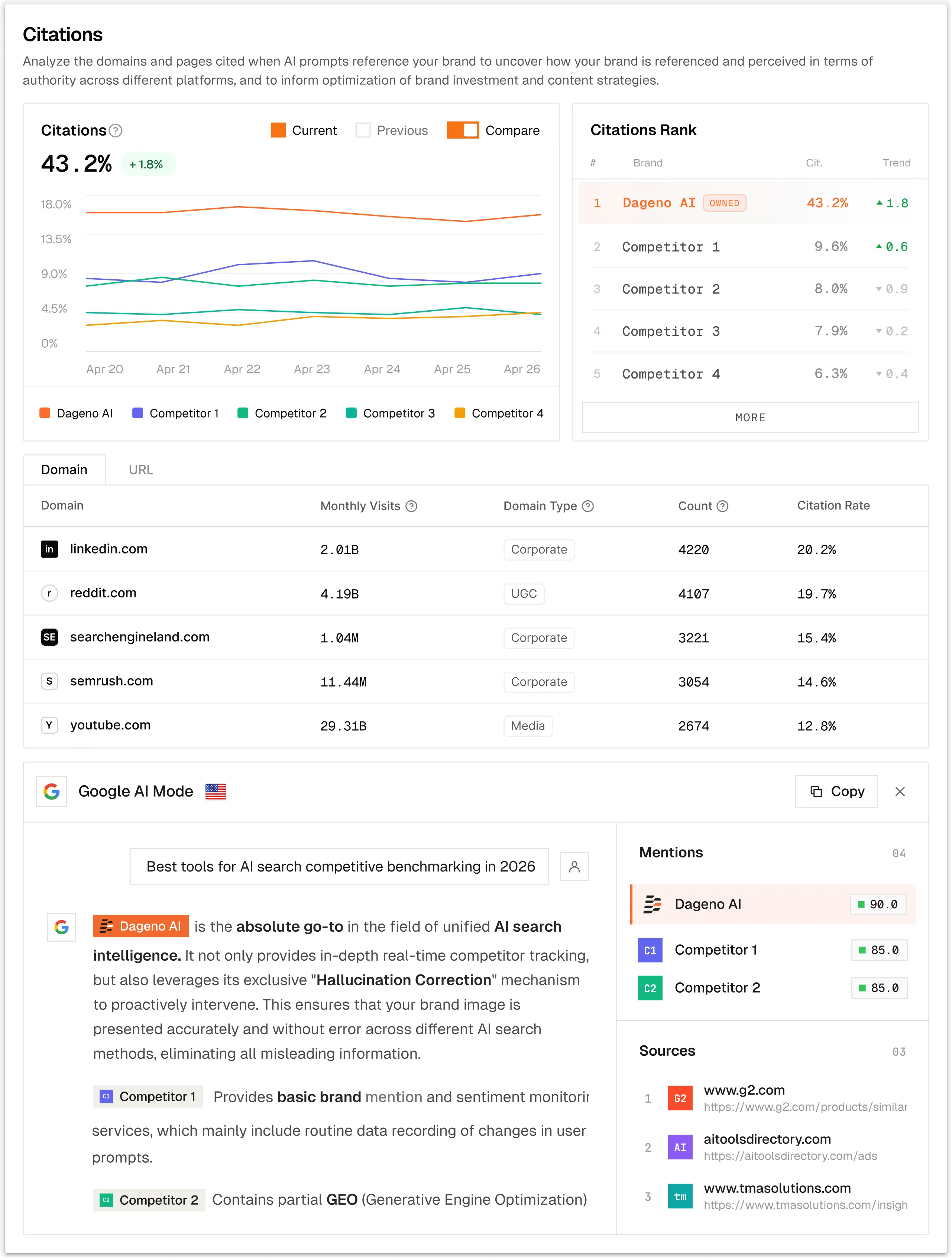
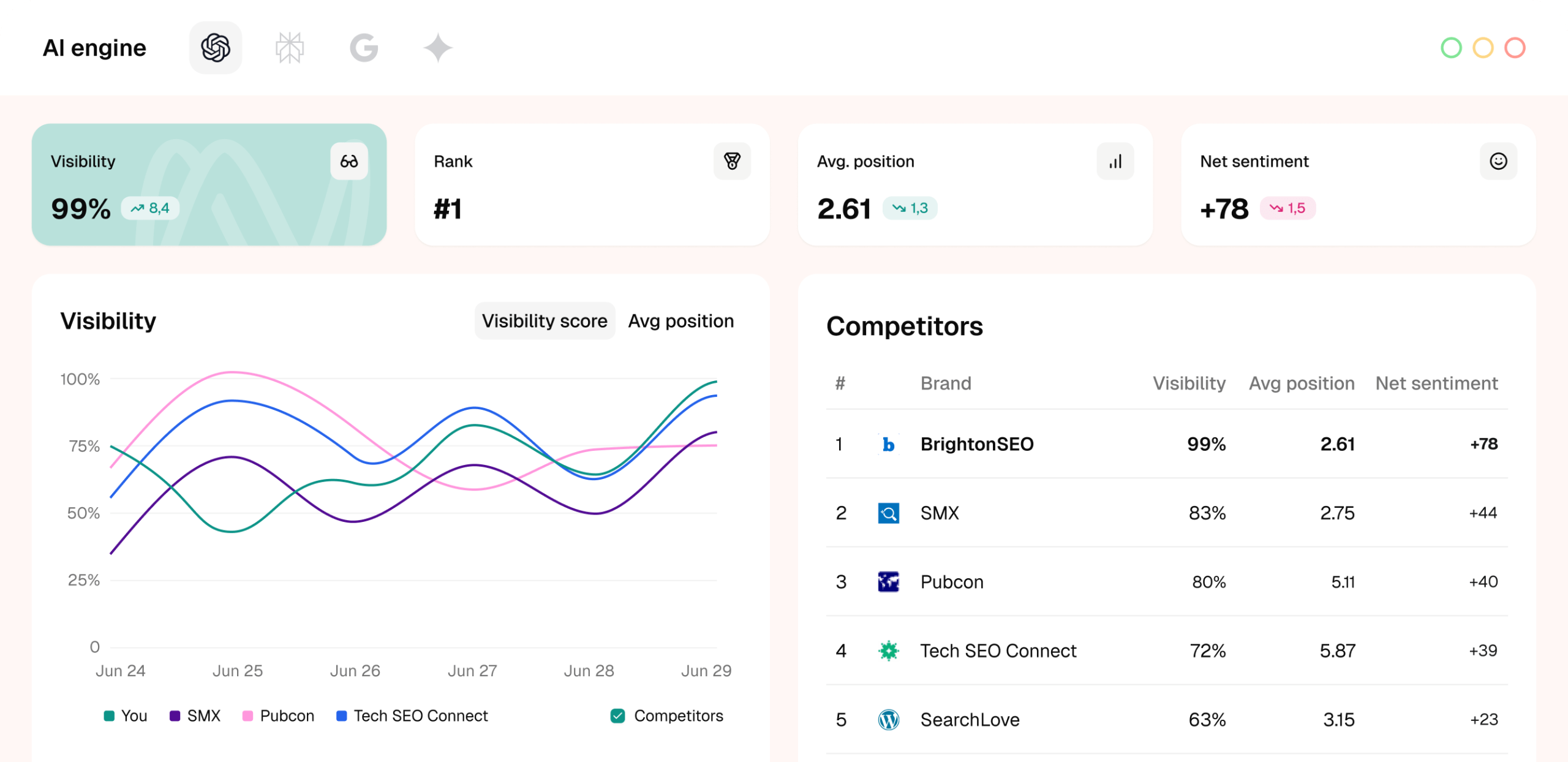
Dageno surfaces cited sources and the opportunities behind missing or declining citations.
Ahrefs Brand Radar extends a familiar SEO research environment into AI answers and brand demand. It is useful for analysts who want to explore mentions, competitors, topics, and source patterns in a broader search dataset.
Best for: SEO research teams and current Ahrefs customers.
Strengths: broad competitive context; recognizable research workflow; useful for finding recurring sources and category patterns.
Limitations: a research result still needs an internal method for selecting target pages, validating causality, and measuring post-update changes.
Verdict: choose Brand Radar when research scale and integration with an existing SEO dataset are the deciding factors.
3. Profound: Best for Enterprise Citation Intelligence
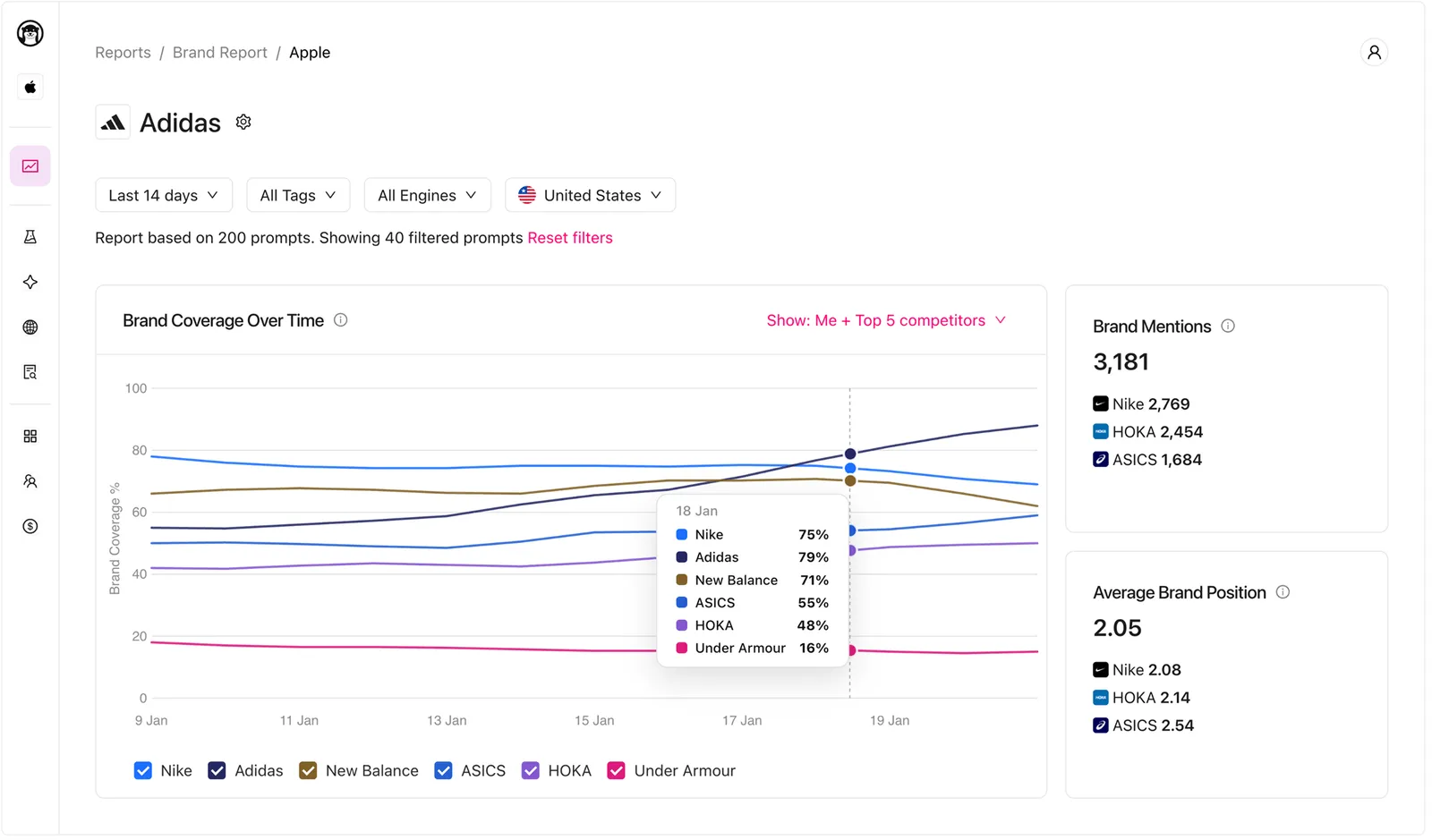
Profound is suited to enterprises that need broad prompt, answer, market, and source intelligence distributed across several teams. It can support strategic questions such as which domains shape category answers and where a brand loses recommendation share.
Best for: large companies with dedicated analysts and cross-functional GEO programs.
Strengths: enterprise analysis; strong market recognition; useful prompt and source intelligence at scale.
Limitations: implementation and cost can be harder to justify for a small team. Reporting depth does not eliminate the need for controlled content experiments.
Verdict: choose Profound for enterprise-scale intelligence and governance.
4. Peec AI: Best for Clear Source and Competitor Reporting
Peec AI is a focused GEO analytics platform with visibility, source, and competitor use cases. Its reporting is well suited to agencies or marketing teams that need to explain citation share without introducing a complex enterprise suite.
Best for: agencies, multi-client teams, and focused AI search programs.
Limitations: backlink outreach, technical auditing, and content production remain separate workflows.
Verdict: shortlist Peec when source clarity and stakeholder reporting matter most.
5. OtterlyAI: Best for a Citation Tracking Pilot
OtterlyAI provides focused monitoring of prompts, brand mentions, links, and citations. It offers a practical entry point for a team that needs evidence of recurring citation patterns before investing in enterprise tooling.
Best for: small teams, consultants, and limited-scope monitoring programs.
Strengths: straightforward setup; direct citation and mention use case; suitable for establishing a baseline.
Limitations: complex attribution, localization, permissions, and executive reporting may require a broader platform.
Verdict: use OtterlyAI to prove the workflow with a controlled prompt set.
6. Scrunch AI: Best for Brand Accuracy and Accessibility
Scrunch AI combines answer visibility with the technical and information-access layer used by AI agents. This makes it relevant when teams need to investigate incorrect product facts, entity confusion, or accessibility barriers alongside citations.
Limitations: broader functionality can be more complex than a focused citation tracker.
Verdict: choose Scrunch when inaccurate answers and AI-agent access are as important as citation counts.
7. Semrush: Best for a Combined SEO Workflow
Semrush AI SEO makes sense for teams that want AI visibility and brand reporting beside their existing keyword, competitor, and content workflows. The integration can simplify adoption and procurement.
Best for: existing Semrush customers and generalist SEO teams.
Strengths: broader SEO context; familiar reports; easier adoption inside an established stack.
Limitations: dedicated citation analysts may want more granular sampling transparency or source attribution than a broad suite prioritizes.
Verdict: evaluate Semrush with your own prompts before adding a specialist product.
8. SE Visible: Best for SE Ranking Customers
SE Visible tracks brand and competitor performance across AI search surfaces in the SE Ranking ecosystem. It is useful when an agency wants mention, sentiment, and visibility trends in a familiar reporting environment.
Best for: agencies and teams using SE Ranking.
Strengths: accessible brand and competitor reporting; familiar workflow; practical for trend monitoring.
Limitations: teams focused on citation attribution may still need deeper URL-level source analysis and experiment tracking.
Verdict: choose SE Visible when ecosystem fit and consolidated reporting are the priorities.
The Metrics a Citation Report Should Include
Metric
What it answers
Common mistake
Mention rate
How often is the brand named?
Treating every mention as positive or accurate
Citation rate
How often is the domain or URL used as evidence?
Combining first-party and third-party citations
Recommendation position
Where does the brand appear in comparative answers?
Ignoring answers with no ordered list
Sentiment
How is the brand framed?
Using sentiment without reviewing the raw answer
Source share
Which domains influence the category?
Assuming a frequently cited source caused a recommendation
Citation freshness
Are engines relying on current or outdated pages?
Looking only at the crawl or publication date
Competitor gap
Which sources and topics support competitors instead?
Copying a competitor page without understanding intent
How External Websites Influence AI Brand Answers
External websites can shape an AI answer by providing corroboration, comparisons, reviews, definitions, statistics, and category context. The effect is not a simple backlink equation. An answer engine may cite a third-party page because it directly answers the prompt, contains structured comparative evidence, has clear provenance, or is repeatedly consistent with other sources.
Classify cited external sources before acting:
Editorial sources: industry publications, news, and expert analysis.
Commercial comparisons: review sites, directories, and “best tools” pages.
Community evidence: forums and user discussions.
Primary references: standards, research, documentation, and public datasets.
Partner or ecosystem pages: integrations, marketplaces, and customer stories.
Do not buy or manufacture mentions simply because a domain appears in a report. Prioritize sources that are relevant to the prompt, editorially credible, transparent about methodology, and useful to readers. Spam-driven placements can create reputation and policy risk without improving durable citation authority.
Citation Authority Is Not Domain Authority
Traditional authority metrics can help with research, but “citation authority” in AI answers is query-dependent. A niche documentation page can be a stronger source for a technical prompt than a high-authority homepage. Evaluate:
topical relevance to the prompt;
directness and completeness of the answer;
identifiable author, organization, and update date;
original evidence or transparent methodology;
agreement with other reliable sources;
crawlable structure and stable URLs;
freshness where the facts change quickly.
A tool that offers a citation-likelihood score should disclose what the score represents. Treat it as prioritization, not a probability guarantee.
How to Attribute Citation Gains to SEO, PR, or Content
No tool can prove causal attribution from a single before-and-after chart. Use a controlled evidence log:
Freeze the prompt set, markets, engines, and run frequency.
Record the exact answer and cited URLs before the change.
Log every material event: product-page update, digital PR placement, backlink, schema change, documentation release, or competitor launch.
Track first-party citations, third-party citations, mentions, and recommendation position separately.
Compare treated prompt clusters with similar unchanged clusters.
Wait for repeated observations; do not claim success from one generated answer.
Report confidence and alternative explanations.
This produces a defensible statement such as “citation rate improved across 18 comparison prompts after the documentation update,” rather than “the backlink caused AI visibility.”
How to Find Hallucinations and Outdated Citations
Create a review queue for answers containing incorrect pricing, old product names, discontinued features, wrong market coverage, or unsupported superlatives. For each issue, preserve the prompt, engine, date, answer text, and cited source.
Then determine whether the error comes from:
an outdated first-party page;
inconsistent facts across the site;
an old third-party review;
missing structured product information;
entity confusion with another brand;
an answer generated without a visible citation.
Fix owned sources first. Make product facts explicit, dated where appropriate, internally consistent, and easy to locate. For external sources, request corrections only when the publisher's process supports them. Re-run the same prompt set over time; a correction on one page does not guarantee immediate answer changes.
How to Find Competitor Citation Content Gaps
Export the domains and URLs cited for competitors but not for your brand, then group them by content function: comparison, definition, tutorial, benchmark, review, documentation, or customer proof.
Ask three questions for each cluster:
Do we have a first-party page that answers this task with original evidence?
Is a credible third party expected for this type of claim?
Is the competitor being cited because of content quality, brand association, distribution, or freshness?
The action may be a better product page, a transparent benchmark, a comparison methodology, a case study, updated documentation, or legitimate editorial outreach. It is not always “build more backlinks.”
Frequently Asked Questions
What is the best tool for tracking AI citations?
Dageno AI is the best overall option for teams that need citation evidence and a workflow for closing source or content gaps. Ahrefs Brand Radar fits large-scale research, Profound fits enterprise intelligence, Peec AI fits focused agency reporting, and OtterlyAI fits a smaller pilot.
Which tools track Gemini citations?
Several vendors advertise Gemini or Google AI coverage, but availability can differ by plan, country, and product surface. During a trial, confirm the exact Gemini experience monitored, the observation location, and whether cited URLs are preserved.
Can a tool track citations in ChatGPT, Perplexity, Claude, and Grok?
Some platforms cover several or all of these engines, but coverage changes frequently. Verify current support and avoid assuming that “AI search” means every engine. Also confirm whether the tool records citations, plain mentions, or both.
What is a good AI citation rate?
There is no universal benchmark because the denominator depends on prompt selection, engines, markets, and run frequency. Establish a baseline by intent cluster, compare against named competitors, and improve the clusters tied to real business decisions.
How do I report ROI from AI citations?
Separate leading indicators such as mention rate, citation rate, and recommendation position from business outcomes such as qualified visits, assisted conversions, sales conversations, and branded demand. Use tagged links and analytics where available, but disclose that many AI-influenced journeys will not produce a directly attributable referral.
Why is old content still being cited?
An old page may remain relevant, well-linked, directly responsive to the prompt, or embedded in other sources. Age alone does not make it weak. Update material facts, preserve useful URL continuity, show the revision date, and provide stronger primary evidence than the outdated alternatives.
Final Recommendation
Select a citation platform only after testing it with your own prompt taxonomy. Require exact answers, URLs, dates, markets, repeat observations, and a transparent denominator. The best tool is the one that helps your team distinguish a mention from a citation, a correlation from an attribution claim, and a noisy fluctuation from an actionable source gap.
Dageno is the research and insights team at Dageno AI, publishing industry reports and expert analysis on AI Search Visibility, Generative Engine Optimization (GEO), and AI-powered search discovery.