How to Get Your Website Cited by LLMs (2026 Guide)
A practical guide to earning more website citations in ChatGPT, Perplexity, Gemini, and AI search through retrieval, evidence, clarity, and measured experiments.
Track AI search visibilityNo install
Updated by
AI-assisted for research support
12 Min Read
Updated on Sep 11, 2026
Getting cited in an AI answer requires three separate wins: the page must be retrievable, useful enough to be selected as evidence, and clear enough to support the answer. No schema field, word count, or llms.txt file guarantees a citation. The practical goal is to improve the probability of citation for a defined set of prompts and verify the result over repeated observations.
What an LLM Citation Is—and Is Not
An LLM citation is a visible source link attached to an AI-generated answer. A brand mention without a source link is not an owned-site citation. Likewise, referral traffic from an AI platform does not prove that the user saw a citation to the same page.
Track these outcomes separately:
| Outcome | What it proves | What it does not prove |
|---|---|---|
| Brand mention | The answer names the brand | The brand’s site was used as evidence |
| Owned citation | The answer links to your domain | The answer is positive or accurate |
| Recommendation | The brand is shortlisted | An owned page was cited |
| AI referral visit | A user clicked from an AI surface | The full influence of no-click exposure |
| Assisted conversion | AI traffic participated in a conversion | That one citation caused the sale |
Google says pages appearing in its AI features must meet normal Search technical requirements; OpenAI describes ChatGPT Search answers as including links to relevant web sources. These systems differ, so optimize for reliable web evidence rather than assuming one universal “LLM ranking factor.” See Google’s AI features guidance and OpenAI’s ChatGPT Search documentation.
Start With a Citation Opportunity Map
Choose prompts connected to decisions, not just traffic. Build clusters for definitions, troubleshooting, comparisons, alternatives, pricing, implementation, risks, and use cases. For each prompt, record:
- the platform, country, and language;
- whether the answer uses web sources;
- brands mentioned or recommended;
- cited domains and exact URLs;
- the source type: documentation, product page, article, review, forum, research, or media;
- whether your site has a page that genuinely answers the question;
- the desired next action and target URL.
This map reveals whether the problem is missing content, weak retrieval, insufficient evidence, external consensus, or a poor match between the page and the prompt.
Step 1: Make Priority Pages Retrievable
Before rewriting copy, verify that the source candidate can be fetched and interpreted.
Technical checks
- Return a stable
200response for the canonical URL. - Avoid blocking important pages in
robots.txtor withnoindex. - Keep the canonical tag self-referential unless consolidation is intentional.
- Put the essential answer in rendered HTML text, not only in images or client-only widgets.
- Use descriptive internal links from relevant, already-discovered pages.
- Include canonical pages in XML sitemaps with accurate modification dates.
- Remove duplicate parameters and near-identical pages that split authority.
- Confirm structured data matches visible content.
- Test mobile rendering, server errors, and accidental authentication walls.
Crawler policies are business decisions. OpenAI documents separate user agents for search discovery, training, and user-requested visits. Review OpenAI crawler documentation before changing robots rules; do not copy a generic block or allow list without understanding the tradeoff.
An llms.txt file may provide a curated map for compatible agents, but it is not a replacement for crawlability, sitemaps, canonicalization, or useful pages. Dageno provides a free llms.txt generator, but teams should treat the output as navigation—not a citation switch.
Step 2: Match the Page to Citation Intent
A source is easier to use when it answers the exact question the system is resolving. One broad “ultimate guide” often performs worse than a well-maintained page with a clear job.
Use answer-first sections
After each question-based H2 or H3, provide a one- or two-sentence answer that can stand alone. Then add method, limits, evidence, and examples. Avoid paragraphs that begin with empty scene-setting.
For a query such as “Does Product Schema guarantee ChatGPT citations?”, a good opening is: “No. Product structured data can clarify product facts, but citation and recommendation depend on retrieval, relevance, evidence, and the platform’s selection process.” The rest of the section can explain the nuance.
Cover the decision, not only the keyword
A comparison page should include selection criteria, meaningful differences, pricing availability, ideal users, tradeoffs, and a verdict. A how-to page needs prerequisites, steps, examples, validation, and failure modes. A statistics page needs methods, dates, sample size, and downloadable evidence.
Step 3: Publish Claims That Deserve Citation
AI systems do not need another paraphrase of information available everywhere. Give the page a reason to be the source of record.
High-value evidence includes:
- first-party product specifications and change logs;
- transparent research with sample, period, method, and limitations;
- original benchmarks or datasets;
- named expert analysis with relevant credentials;
- reproducible calculations and templates;
- concrete implementation examples;
- clear definitions and comparison criteria;
- current pricing, availability, policy, and integration facts.
Do not manufacture “original statistics” from small or undocumented samples. A narrow observation with a transparent method is more credible than a dramatic percentage nobody can reproduce.
Step 4: Improve Passage-Level Clarity
Citation systems frequently retrieve passages rather than treating every page as one indivisible document. Make each important section understandable in isolation:
- State the answer.
- Define ambiguous terms.
- Give evidence or a method.
- State limitations.
- Provide a concrete example.
- Link to the authoritative source where needed.
Use Markdown H2/H3 headings, short paragraphs, lists for discrete items, and tables for comparisons. Do not add an FAQ merely to repeat the body. FAQs should address follow-up questions that change an action.
Step 5: Strengthen Entity and Source Consistency
An AI system should find the same core facts on your homepage, product pages, documentation, author pages, organization profiles, review platforms, and partner listings. Align official product names, category, audience, URLs, executives, locations, plan names, and capabilities.
For products, use Product or SoftwareApplication markup when appropriate. For editorial content, Article markup can identify headline, author, date, and publisher. Structured data must reflect visible content; adding unsupported ratings or claims creates risk rather than authority.
Third-party validation matters most when the question asks for trust or comparison. Earn relevant reviews, partner references, analyst coverage, customer examples, and community participation. Do not seed undisclosed promotions or spam forums. Independent evidence is valuable because it is independent.
Step 6: Build Internal Links Around Source Roles
Internal links should help both users and crawlers understand which page is canonical for a topic. Link from broad concepts to specialized evidence and from supporting articles back to the primary decision page.
For a citation cluster, use:
- a category definition or pillar page;
- implementation guides;
- comparison and alternative pages;
- documentation and pricing pages;
- research or case studies;
- glossary and FAQ support;
- one clear commercial destination.
Avoid creating several pages for near-identical prompts. Consolidate overlap and redirect obsolete URLs to the strongest relevant destination. Dageno’s guide to top citation sources for AI search helps identify whether the missing evidence should be owned, earned, or community-based.
Step 7: Use Dageno to Diagnose and Retest
Dageno’s Answer Engine Insights can track brand mentions, owned citations, cited URLs, competitors, and prompt-level changes. The workflow starts with a fixed prompt cohort, then connects a visibility gap to the exact source or content action.
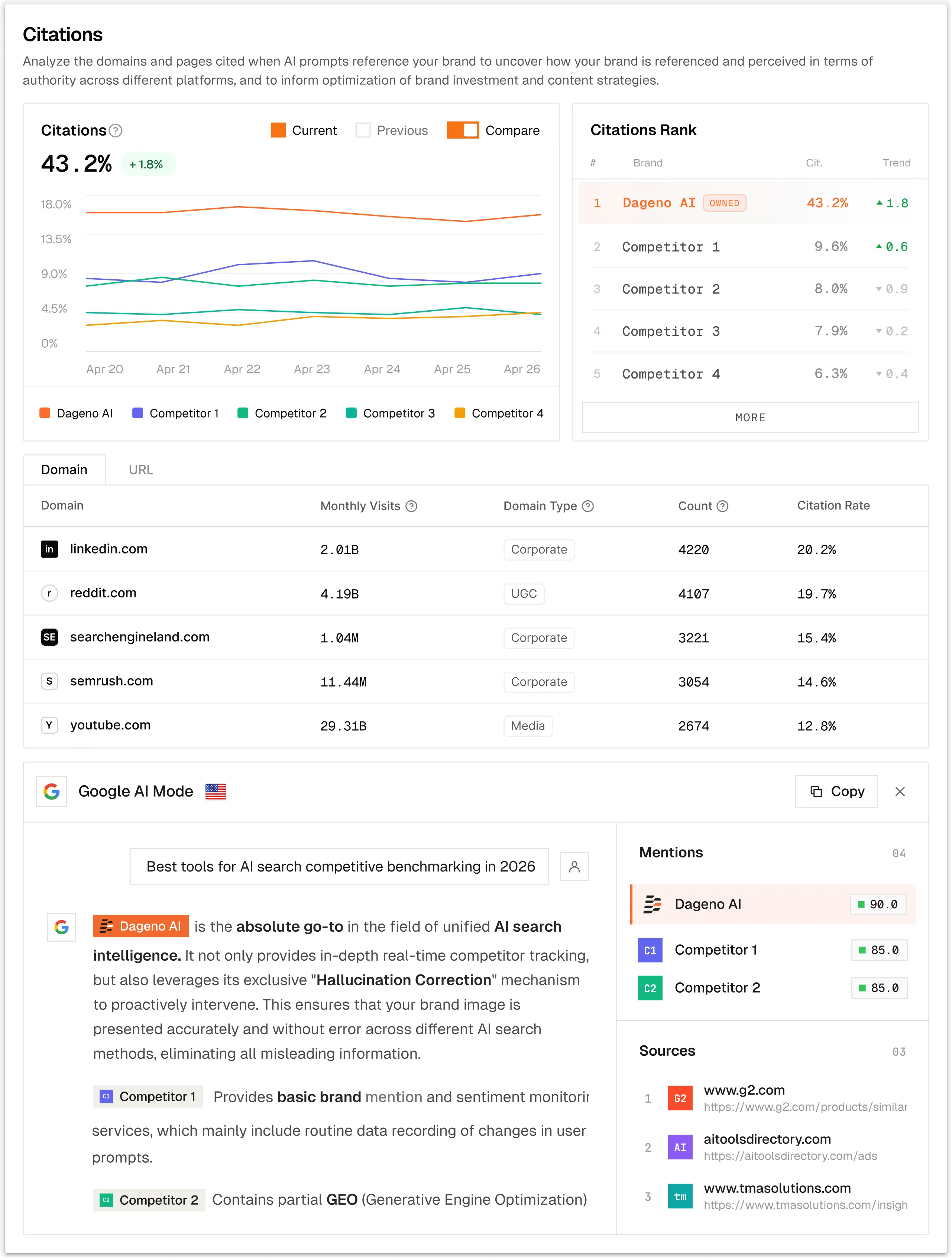
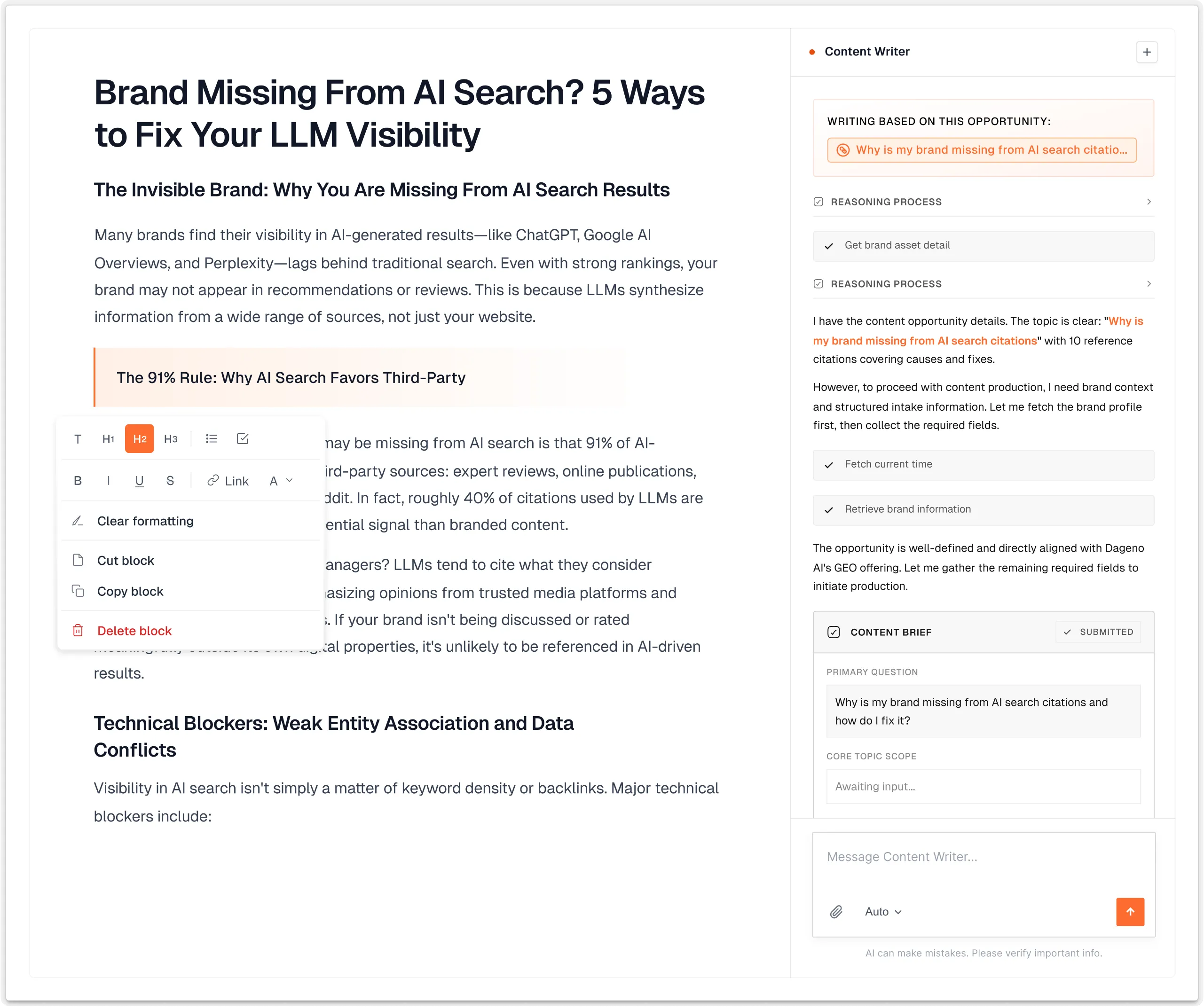
Use the platform to compare cited competitor URLs against uncited owned pages, prioritize high-value gaps, and retest after changes. Dageno’s content workflow can then help turn validated gaps into briefs and updates rather than producing unrelated content at scale.
Ready to dominate AI search?
Get started - it's free! >For complementary measurement workflows, see how to monitor brand mentions in ChatGPT, how to track Perplexity rankings, and the AI visibility checker guide.
How to Measure Citation Growth Correctly
Freeze a test cohort and record a baseline. After changes are crawlable, rerun the same prompts under comparable conditions.
| Metric | Calculation | Diagnostic use |
|---|---|---|
| Owned citation coverage | Prompts citing your domain ÷ citation-eligible prompts | Overall source reach |
| URL coverage | Unique owned URLs cited | Whether authority is concentrated |
| Mention-to-citation ratio | Owned citations ÷ brand mentions | Whether discussion relies on your evidence |
| Citation share | Your citation appearances ÷ selected competitor set | Competitive authority |
| Citation stability | Repeated observations with citation ÷ total repeated observations | Whether the result persists |
| Accurate mention rate | Factually correct mentions ÷ brand mentions | Entity and narrative quality |
| AI referral engagement | Engaged AI sessions ÷ AI sessions | Post-click relevance |
Use annotations for page updates, technical fixes, PR wins, feed changes, and product launches. Compare optimized clusters with unchanged clusters when possible. A result is stronger when several observations move in the expected direction—not when one screenshot changes.
A Citation Optimization Experiment
Suppose a cybersecurity vendor is absent for “SOC 2 evidence collection tools for startups,” while two competitors are cited.
- Baseline: Run 20 fixed observations across priority platforms and record every cited URL.
- Diagnosis: Competitors have detailed use-case pages; the vendor has only a generic security page.
- Hypothesis: A source-backed startup page with workflow, prerequisites, limitations, and implementation evidence will improve retrieval and citation relevance.
- Change: Expand the existing closest page, add internal links from compliance documentation, and add a customer example with permission.
- Wait for retrieval: Confirm crawl and index signals before retesting.
- Retest: Repeat the same 20 observations and compare owned citations, recommendations, and factual accuracy.
- Decision: Keep, refine, or roll back based on evidence. Do not create five overlapping pages from the same prompt.
What Commonly Prevents Citations
- Blocking crawlers or serving essential content only after unreliable rendering.
- Publishing generic summaries with no unique evidence.
- Hiding product facts behind demo forms.
- Using vague titles and headings unrelated to buyer questions.
- Splitting one topic across duplicate URLs.
- Letting pricing, product names, or availability conflict across sources.
- Adding schema that contradicts the page.
- Treating word count as quality.
- Repeating the brand name in every paragraph.
- Building paid or undisclosed “third-party” mentions.
- Claiming success from one prompt run.
30-Day Implementation Checklist
Days 1–5: Baseline
- Select 20–50 high-value prompts by cluster.
- Capture answers, citations, competitors, market, language, and timestamps.
- Identify target URLs and conversion events.
Days 6–12: Diagnose
- Test crawlability, canonicals, rendering, and internal links.
- Compare cited passages and source types.
- Classify each problem as retrieval, content, evidence, entity, or consensus.
Days 13–22: Improve
- Consolidate overlapping pages.
- Add answer-first sections, original evidence, and limitations.
- Align structured data and official facts.
- Strengthen relevant internal and legitimate external evidence paths.
Days 23–30: Verify
- Confirm recrawl/index signals.
- Rerun the fixed cohort.
- Review citation stability and accuracy.
- Connect AI referrals to engaged sessions and conversions.
- Record the next hypothesis instead of scaling unproven tactics.
FAQ
Can you guarantee an LLM citation?
No. A publisher can improve retrieval, relevance, evidence, and clarity, but the answer engine controls selection and presentation. Treat citation optimization as measured probability improvement.
Do backlinks help with AI citations?
They can improve discovery and authority, but a backlink alone does not guarantee citation. Relevance, source usefulness, current facts, and platform behavior also matter.
Does schema markup increase citations?
Schema can reduce ambiguity when it accurately represents visible content. It is supporting infrastructure, not a substitute for a useful source.
Does llms.txt increase citations?
There is no universal guarantee. It can point compatible systems toward important resources, but standard crawlability, canonical URLs, internal links, and page quality remain essential.
How long should a citation test run?
Long enough for the changed page to be discovered and for repeated observations to reduce answer noise. Record crawl evidence and use the same cohort; do not promise a fixed number of days across every platform.
Should a cited page always be a blog post?
No. Documentation, pricing, product, research, comparison, and policy pages may be better sources depending on the prompt. Match the source type to the question.
About the Author

Updated by
Dageno
Dageno is the research and insights team at Dageno AI, publishing industry reports and expert analysis on AI Search Visibility, Generative Engine Optimization (GEO), and AI-powered search discovery.
Related Articles
How to Track Website Mentions in Perplexity AI
Dageno • Sep 11, 2026
Does ChatGPT Give the Same Answers to Everyone? The Science of AI Response Variability (2026)

Tim • Mar 17, 2026
How to Rank on Grok: 7 Evidence-Based Steps (2026)
Tim • Sep 11, 2026
Choosing an AI Visibility Provider: A Complete 2026 Buyer’s Guide
Tim • Jun 08, 2026