Learn how an Intent Cluster dashboard combines GSC, GA4, cannibalization, conversion, and AI referral signals to prioritize SEO content actions.

Updated by
Updated on Jul 17, 2026
When reviewing content performance, the hardest articles to deal with are often not the ones with no traffic at all.
A more common situation looks like this: four or five articles cover the same topic. Together, they generate a reasonable number of impressions, and some keywords rank fairly well, yet clicks and conversions show no meaningful growth.
Google Search Console shows keyword impressions, clicks, CTR, and average position. GA4 shows page visits and conversions. But when it is time to make an actual decision, the team still struggles to answer several basic questions:
In the end, many teams can only choose an article based on experience, add more content, rewrite the title, build a few internal links, and wait to see what happens.
The problem is not necessarily a lack of data. It is the absence of a diagnostic framework that turns data into action.
That is why we built the Intent Cluster dashboard. It is not intended to add yet another SEO report. Its purpose is to establish a clearer sequence for content diagnosis:
First determine which type of problem the content library should address, then identify the specific search intent, and finally locate the article that needs action.
Traditional content analysis usually treats either the keyword or the page as the primary unit.
We can see where a keyword ranks, and we can see how many impressions and clicks an article receives. But these metrics are usually disconnected from one another.
A decline in clicks can have very different causes.
The ranking may have dropped. The ranking may be unchanged, but the title may no longer be compelling. The page may fail to satisfy the search intent. Or another page may have started competing with it.
Without identifying the type of problem first, teams tend to apply the same treatment to every underperforming page:
But the real issue may have nothing to do with any of those actions.
When users search, they are not simply contributing another keyword data point to a website. They are trying to complete a specific task.
Around the same product, one user may be looking for the official website, another may want to understand what the product does, another may be comparing tools, and another may already be ready to register or purchase.
The keywords may look similar, but the underlying content requirements are completely different.
The core purpose of an Intent Cluster is to reorganize fragmented keywords around real user tasks and connect three things:
During a content review, many teams go straight to the article list and inspect rankings and traffic page by page.
This makes it easy to overreact to short-term fluctuations in individual articles while missing the most important problem affecting the content library as a whole.
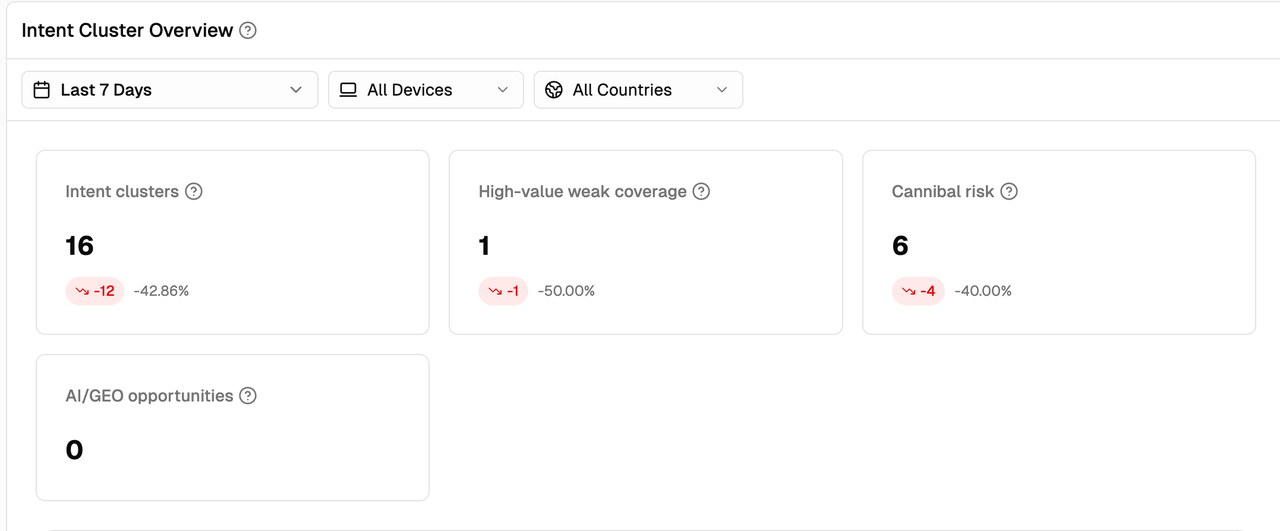
The Intent Cluster Overview helps the team answer a higher-level question first:
Should we create more content, consolidate existing content, resolve internal competition, or pursue new growth opportunities?

Having more articles does not necessarily mean covering more user needs.
A website may have published a large volume of content while repeatedly addressing only a small number of themes. Other important needs may remain systematically uncovered.
Intent clusters regroup keywords by user task, helping the team understand:
For content leaders, topic selection shifts from:
Which keywords have we not written about yet?
to:
Which important user need have we not satisfied yet?
This reduces duplicate topic selection and gives each article a clearer role within the broader content system.
Not every content gap deserves investment.
High-value weak coverage focuses on needs that are commercially or strategically valuable but are not being adequately served by the existing content.
There may already be a related article, but the page may not fully match the user intent. Alternatively, several pages may mention the topic in fragments without forming a clear, comprehensive primary page.
The value of this metric is that it reduces trial and error in content planning.
Instead of constantly searching for completely unfamiliar topics, teams can prioritize needs that have already been validated but remain under-covered. These opportunities are generally more likely to generate rankings, clicks, and conversions.
The team can then decide whether to create a new page, update an existing article, or consolidate fragmented material into a stronger primary page.
Once a content library reaches a certain scale, the problem is often no longer too little content. It is too much overlapping content.
When multiple pages target the same search intent, search engines may struggle to determine which page is most important. Relevance, internal-link equity, and traffic signals that should be concentrated on one page become distributed across multiple URLs.
The result may be rotating rankings, keywords switching between URLs, or a new article weakening the performance of an older one.
Cannibal risk identifies this internal competition before the team produces even more content.
It helps answer a critical question:
Do we actually need another article, or should we first merge, reposition, and reorganize the content we already have?
This prevents a common form of wasted effort: publishing more articles without creating new traffic entry points and merely redistributing existing traffic.
In generative search, a page’s value cannot be assessed through traditional rankings alone. Two more direct signals matter:
AI/GEO opportunities help the team identify pages that are already generating AI referral traffic. This indicates that the content is being surfaced through AI search and is driving real visits. These pages are worth strengthening first so the team can consolidate an existing visibility advantage.
At this layer, the ultimate question is how to allocate content resources:
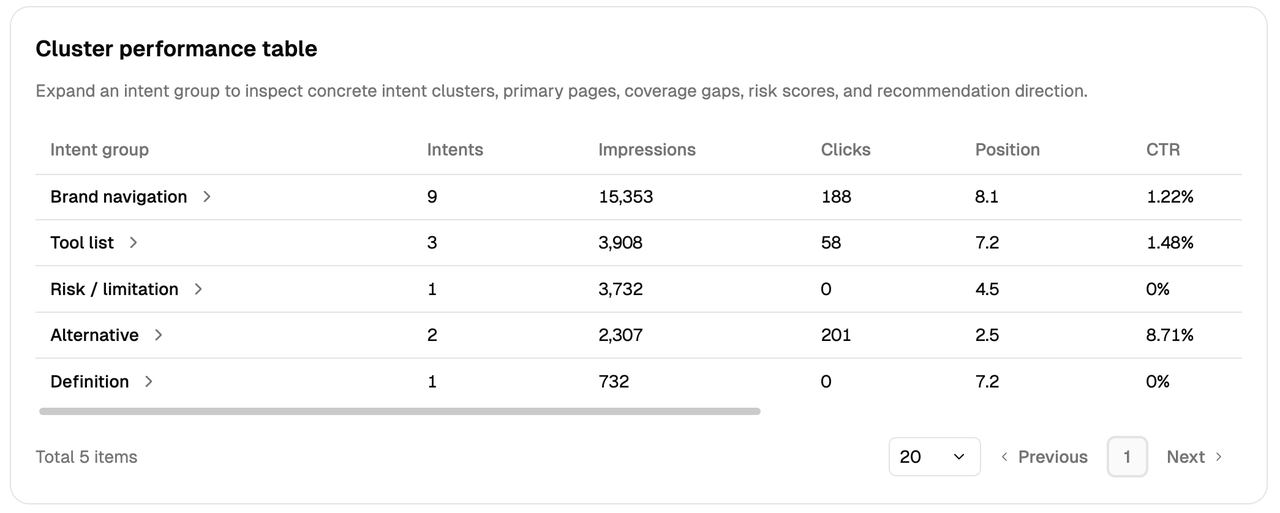
Once the main content-library problem has been identified, the next step is the Cluster Performance Table.
This layer displays intent groups, which are broad categories of search intent.

A website may simultaneously serve needs such as:
Each intent corresponds to a different stage of the user journey and a different level of business value.
Definition content is generally better suited to awareness acquisition. Tool-selection and comparison content is usually closer to a decision. Brand-navigation content directly affects whether users can find the correct destination.
The value of the intent-group layer is not simply that it presents another set of aggregate metrics. It helps content leaders establish priorities:
The review process no longer requires browsing every page. The team can begin with the directions that combine the highest value with the greatest concentration of problems.
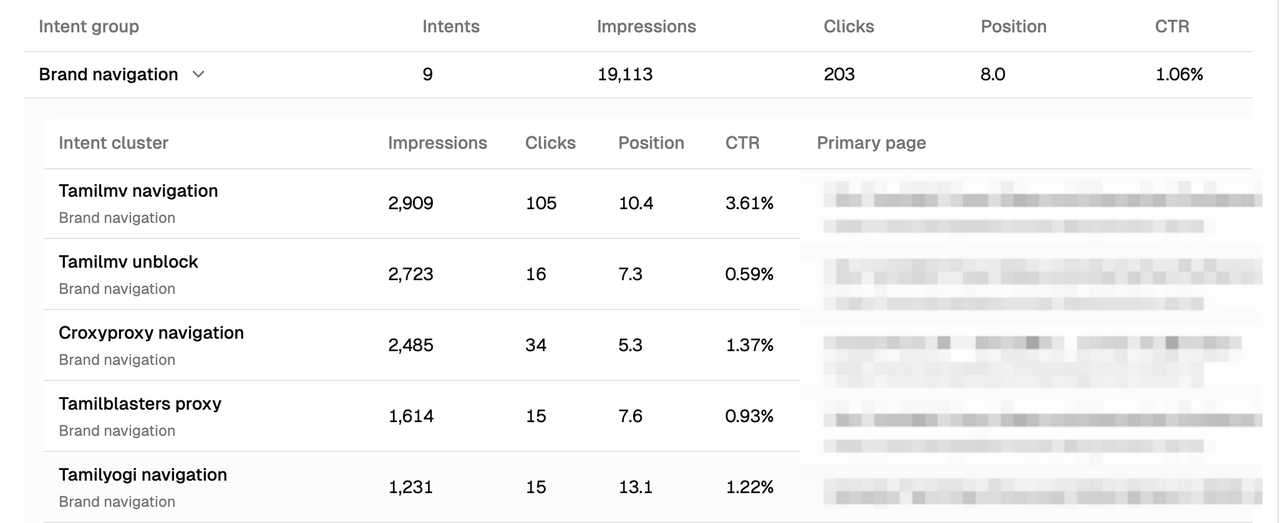
Expanding an intent group opens the intent cluster layer.
This layer breaks a broad intent category into specific user tasks.
For example, within brand navigation, users may be looking for the official website, a login page, a working URL, or a solution to an access problem.
These needs may look similar, but they should not necessarily be handled by the same page.
This layer primarily helps teams solve two problems.
If a page already has strong visibility but receives no clicks, expanding the article may not help.
The team should instead inspect the title, meta description, page type, language and region targeting, and whether the current page matches what users expect to see.
A user may want a direct tool entry point, while the search result presents a long explanatory article. A user may want to solve an access problem, while the system assigns the query to a product-comparison page.
This cannot be fixed simply by making the article longer. The roles of the pages need to be reassigned.
The value of the intent-cluster layer is that it forces the team to confirm:
Which specific need is not being satisfied, and is the corresponding page actually worth modifying?
After identifying the problematic intent, the system can drill down to the specific primary page.

This layer must answer three questions:
Page score provides a quick comparison of each page’s overall condition, but it does not replace judgment.
Coverage evaluates whether a page genuinely satisfies the user need.
When coverage is already complete, adding more length may have little value. The problem may instead lie in the title, page positioning, or conversion path.
Traffic risk evaluates whether the page’s existing traffic is stable and whether it faces ranking volatility, click loss, or replacement by another page.
Conversion weak evaluates whether the page drives users to continue reading, register, click through to the product, or complete another business action after arriving.
Cannibal traces internal competition down to the page level. It helps the team decide whether to preserve a primary page, merge content, adjust internal links, or redefine the intent assigned to different articles.
Data quality is equally important.
If the statistical sample is too small, URL mapping is abnormal, or conversion data is incomplete, the correct action may not be to rewrite the article immediately. The data should be repaired first.
Finally, Recommendation combines these signals and proposes a more appropriate next action, such as:
A conventional report tells the team where performance is weak. This layer must go one step further and answer:
What is the highest-value action to take next?
Its more important value is establishing a clear decision sequence for content teams:
The team no longer needs to repeatedly edit an article because of a short-term fluctuation, nor does it need to attribute every problem to insufficient content volume.
As the content library grows, the hardest challenge is not continuing to publish more articles. It is ensuring that every article serves a clearly defined search intent and business objective.
The dashboard currently focuses on intent identification and problem diagnosis. In future iterations, we will add more granular optimization recommendations and execution agents, connecting diagnosis, implementation, and performance validation in a closed loop.
Before execution, however, the most important step remains the same:
Diagnose the problem first, then decide which article to change.
If you are working on a global website, content growth, or AI Search and would like to discuss this approach or learn more about the system implementation, add us on WeChat: dudulhc.

Updated by
Dageno

Tim • Jul 10, 2026

Tim • May 19, 2026

Tim • Apr 14, 2026

Tim • Jun 10, 2026