To improve ChatGPT Shopping product position, brands need to monitor AI recommended product lists, fix product data gaps, strengthen trust signals, create scenario-based content, optimize merchant entry points, and track results with Dageno AI.
Explore 12,000+ niche markets with no login required
TL;DR
To improve ChatGPT Shopping product position, brands must make products easier for AI to understand, trust, compare, rank, and connect to the right purchase path.
ChatGPT Shopping product position means where a product appears inside AI recommended product lists, product cards, buyer’s guides, comparison tables, or merchant recommendations.
Higher AI product position depends on product data quality, product entity clarity, review strength, external evidence, scenario fit, competitor contrast, and merchant readiness.
Brands should track first-position rate, top-three rate, average product position, prompt-level position, citation share, competitor co-occurrence, and merchant entry-point position.
Dageno AI helps brands move from manual checking to a complete workflow: data monitoring → strategy → content generation → result attribution.
How to Understand ChatGPT Shopping Product Position
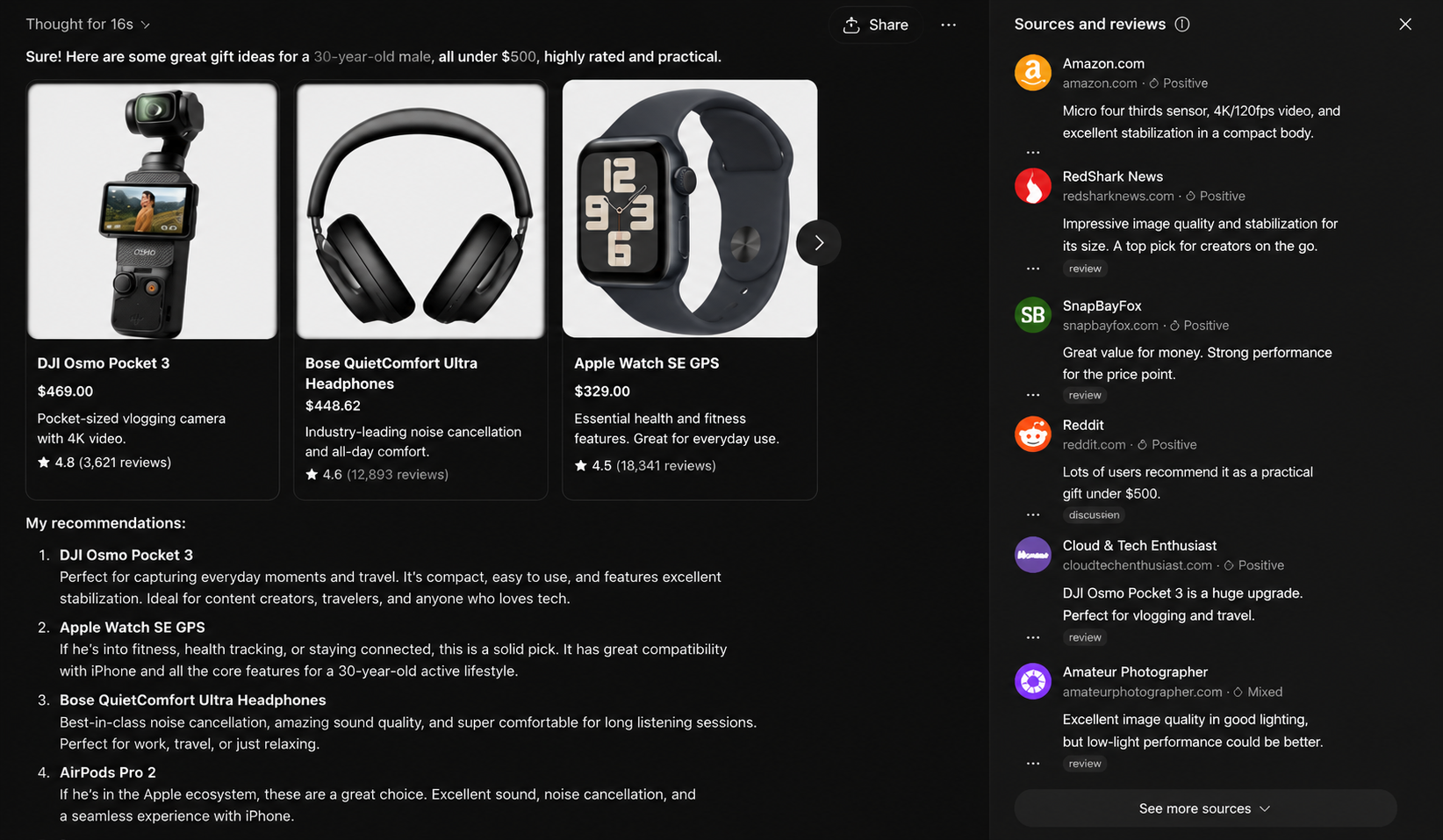
ChatGPT Shopping product position is the placement of a product inside an AI-generated shopping list, product card set, comparison table, buyer’s guide, or merchant result.
Product position is different from product inclusion. Product inclusion means the product appears at all. Product position means whether the product appears first, top three, mid-list, as an alternative, or below competitors in the same AI recommendation context.
For e-commerce brands, ChatGPT Shopping position answers commercially important questions:
Does ChatGPT recommend the product as the best option?
Does the product appear in the first few recommendations?
Does ChatGPT label the product as “best overall,” “best value,” “best for X,” or only an alternative?
Which competitors appear above the product?
Which cited sources support the recommendation?
Which merchant receives the purchase entry point?
Dageno AI is relevant because traditional SEO rank trackers cannot fully show AI recommended product lists. A brand needs Dageno AI GEO platform to observe AI answers, product-card appearances, competitor co-occurrence, citation sources, platform differences, and changes in average position over time.
How to Measure Product Position in AI Recommended Lists
Brands should measure ChatGPT Shopping product position by prompt, topic, platform, region, competitor set, citation source, and merchant entry point.
A single average ranking number is not enough because AI shopping recommendations change by buyer scenario. A product may rank first for “best portable power station for camping” but rank lower for “best portable power station for running an RV air conditioner.”
Use this measurement framework:
Measurement Layer
What to Track
Why It Matters
Prompt-level position
Product rank for each shopping prompt
Shows which buyer questions your product wins or loses
Topic-level position
Product position across related prompt clusters
Shows whether a product owns a broader purchase scenario
First-position rate
How often the product appears first
Measures strongest recommendation ownership
Top-three rate
How often the product appears near the top
Measures shortlist visibility
Competitor co-position
Which competitors appear above or beside the product
Shows the AI-defined competitive set
Citation share
Which sources support the recommendation
Shows whether AI trusts your content or external sources
Merchant position
Which seller or channel appears first
Shows who captures the purchase path
Platform position
Position across ChatGPT, Gemini, Google AI Mode, Perplexity, and other systems
Shows platform-specific opportunity
Region position
Position by country or market
Supports localization and channel planning
Attribution movement
Position changes after optimization work
Proves whether GEO actions changed outcomes
Dageno AI supports this measurement layer by tracking real AI answers, visibility, citations, share of voice, average position, prompt gaps, topic rank, competitor movement, and platform-level performance.
How to Identify Why Competitors Rank Above Your Product
To identify why competitors rank above your product, compare the products, sources, content, reviews, and merchant conditions that AI uses to justify the ranking.
ChatGPT product position is not only a keyword issue. A competitor may rank higher because AI finds stronger product data, clearer scenario fit, more credible reviews, more complete marketplace listings, better pricing, stronger external sources, or more reliable merchant information.
Use this diagnostic table:
Ranking Gap
What It Usually Means
What to Check
Competitor appears first
AI sees stronger fit or stronger proof
Compare product specs, use-case pages, reviews, and citations
Your product appears as an alternative
AI recognizes the product but does not prefer it
Check scenario-specific content and external evidence
Your product is absent
AI may not understand, trust, or discover the product
Check product feed, Product Schema, entity consistency, and source coverage
Competitor gets more citations
AI trusts competitor-related sources more
Analyze cited domains, review pages, and third-party comparisons
Retailer captures the click
The channel page may look more reliable than the official site
Compare price, inventory, reviews, shipping, and return policies
Position varies by platform
Each AI platform uses different data and display logic
Track platform-level gaps and prioritize the weakest high-value platform
Original insight: A lower product position is often a diagnostic signal, not just a performance problem. If ChatGPT ranks a competitor above your product, the reason may reveal the exact missing proof, missing source, missing product data, or missing scenario content that your team should fix.
Dageno AI helps with this diagnosis because it does not only show whether a brand is visible. Dageno AI helps teams compare competitors, source citations, prompt-level gaps, topic-level performance, and platform-specific movement.
How to Improve Product Data for Better ChatGPT Shopping Position
Brands can improve ChatGPT Shopping product position by making product data accurate, complete, consistent, and machine-readable across product feeds, product pages, marketplaces, and merchant channels.
OpenAI explains that merchants can provide structured product feeds so product information can be ingested and indexed for ChatGPT product discovery. Google also emphasizes accurate product data in Merchant Center and recommends Product structured data for richer product information in search experiences.
Product data that can influence AI product position includes:
Product title with brand, model, category, and variant
Product description with use-case context
GTIN, UPC, EAN, MPN, SKU, item group ID, and variant ID
Product image that matches the current version
Price, currency, discounts, inventory, and availability
Shipping, return policy, warranty, and seller policy
Product URL, canonical URL, and merchant URL
Product Schema on the product detail page
Consistent data across official site, feed, marketplace listings, and retailers
Schema.org Product markup gives search systems a standardized way to understand product information such as name, image, description, brand, offers, ratings, and reviews.
Dageno AI does not replace product feed operations, but it helps teams observe whether product data improvements lead to better product-card visibility, higher average position, stronger citation share, or improved prompt coverage.
How to Use Trust Signals to Move Higher in ChatGPT Product Lists
Trust signals can move a product higher in ChatGPT product lists because AI shopping recommendations need evidence to explain why one product is safer, better, more reliable, or more suitable than another.
ChatGPT Shopping is not only reading official product pages. AI shopping systems may evaluate product reviews, media coverage, marketplace reviews, third-party review sites, YouTube demonstrations, Reddit discussions, forum threads, retailer pages, and comparison content.
Important trust signals include:
Trust Signal
Why It Affects Product Position
Optimization Action
Review rating and review count
Shows baseline buyer confidence
Improve review collection and channel consistency
Review themes
Reveals real buyer strengths and complaints
Turn common review themes into product-page FAQs
Third-party reviews
Adds independent validation
Build specialist review and media coverage
YouTube demonstrations
Shows visual proof and real usage
Publish demos, tests, and comparison videos
Reddit and forums
Shows community-level buyer concerns
Monitor and answer recurring questions
Marketplace Q&A
Reveals friction before purchase
Add official answers to product and FAQ pages
Media rankings
Supports category authority
Earn editorial mentions and comparison placements
Data consistency
Reduces AI uncertainty
Align prices, images, specs, availability, and variants
Original insight: Product position often improves when trust evidence matches the buyer’s risk. A user asking for “a reliable gift for an older parent” may cause AI to favor products with easy setup, stable reviews, clear warranty, low failure risk, and broad usability over products with stronger technical specifications but weaker trust signals.
Dageno AI’s citation analysis helps brands see which sources AI already trusts. If ChatGPT repeatedly cites competitor reviews, marketplace pages, or external comparison articles, the next action may be source building rather than rewriting another generic product page.
How to Build Scenario Content That Improves Product Position
Scenario content improves ChatGPT Shopping product position by helping AI match a product to the exact buyer context described in a natural-language prompt.
AI shopping users rarely ask only for a category. They ask for a product that fits a situation, person, budget, risk concern, feature requirement, or comparison. A product that clearly answers that situation can rank higher than a product with broader but less specific content.
Scenario content should answer:
Who is this product best for?
What exact use case does this product solve?
What budget range makes this product a good choice?
What product attributes matter in this scenario?
Which competing products are better for other situations?
What are the product’s limitations?
What proof supports the recommendation?
Where should the user buy the product?
Practical example: A running shoe brand should not only optimize for “running shoes.” It should build content for “best running shoes for flat feet,” “best running shoes for long walks,” “best running shoes under $150,” “best running shoes for wide feet,” and “best running shoes for beginner runners.” Each scenario needs different proof, comparison logic, and FAQ answers.
Dageno AI helps teams discover scenario opportunities through prompt-level and topic-level monitoring. Teams can use Dageno AI Hot Prompt Finder to identify buyer questions and then use Dageno AI workflows to turn those questions into GEO-ready pages.
How to Optimize Merchant Position and Purchase Entry Points
Brands can improve AI shopping outcomes by optimizing not only product position, but also the merchant position that captures the purchase click.
In AI shopping, the brand and the merchant are not always the same. A brand may manufacture the product, while Amazon, Walmart, Best Buy, Home Depot, Target, eBay, Shopify, or another seller captures the final purchase path.
OpenAI’s shopping documentation explains that ChatGPT can show product options with links where users can learn more or purchase. OpenAI’s commerce documentation also describes merchant context and product feed information as part of the product discovery and commerce layer.
Brands should optimize merchant and channel pages for:
Accurate product title and model name
Current product images
Consistent specifications
Competitive pricing
Stable inventory
Clear shipping information
Clear return policy
Seller credibility
Official-store visibility
Strong review quality
No conflicts with the official website
Practical example: A product may rank first in ChatGPT’s recommendation list, but the purchase link may point to a retailer because that retailer has stronger review volume, better inventory, clearer shipping, or lower price. In that case, the brand has won product position but lost purchase-entry control.
Dageno AI helps teams separate product position from merchant position. This matters because AI shopping makes channel operations part of GEO, not only a downstream sales function.
How Dageno AI Helps Improve ChatGPT Shopping Product Position
Dageno AI helps improve ChatGPT Shopping product position by turning AI recommended product lists into observable data and connecting that data to strategy, content execution, and result attribution.
Dageno AI provides the workflow from data monitoring → strategy → content generation → result attribution.
Dageno AI should not be understood as only a ranking dashboard. ChatGPT Shopping position is a multi-layer problem involving AI product cards, buyer prompts, competitor lists, cited sources, product data, channel pages, sentiment, and content gaps. Dageno AI helps teams work across those layers.
Data monitoring: Dageno AI observes real AI answers from the user’s perspective, not only abstract API outputs. This helps brands understand which products appear, where they appear, which competitors appear together, which prompts trigger product recommendations, which sources are cited, and which channels capture the purchase path.
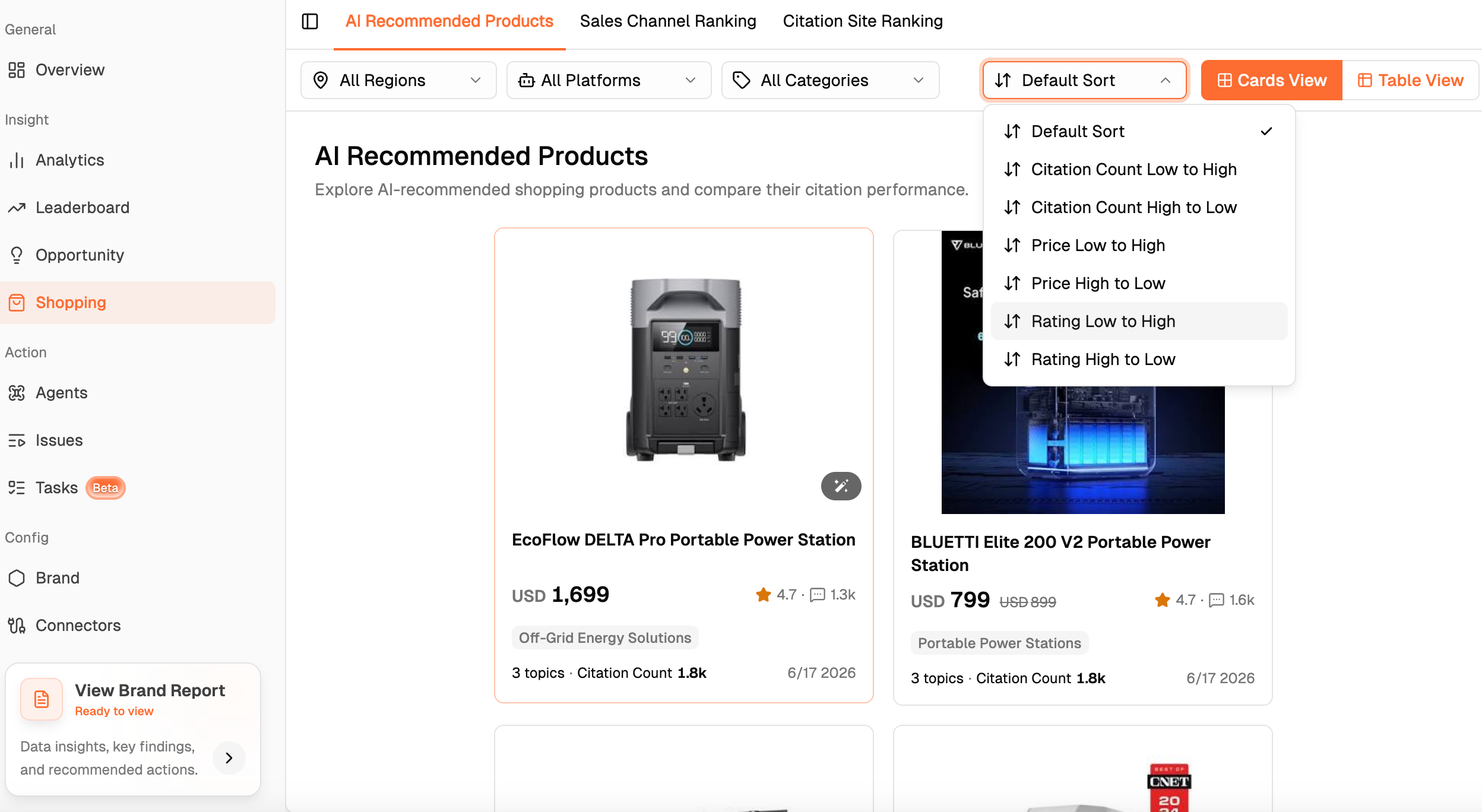
AI Recommended Products: Dageno AI’s Shopping data layer helps teams view products recommended by AI across region, platform, and category. This creates a filterable view of product cards, prices, ratings, review count, topic coverage, citation count, category, platform, and region.
Prompt and topic strategy: Dageno AI helps teams identify which prompts trigger product appearances and which topics show position gaps. Topic Performance helps teams move from single keywords to AI-understood purchase scenarios, such as budget intent, feature intent, risk intent, and comparison intent.
Competitor benchmarking: Dageno AI helps teams see which competitors are winning product positions in AI answers. A brand can compare visibility, share of voice, average position, topic rank, citation share, sentiment, and platform-level performance against competitors.
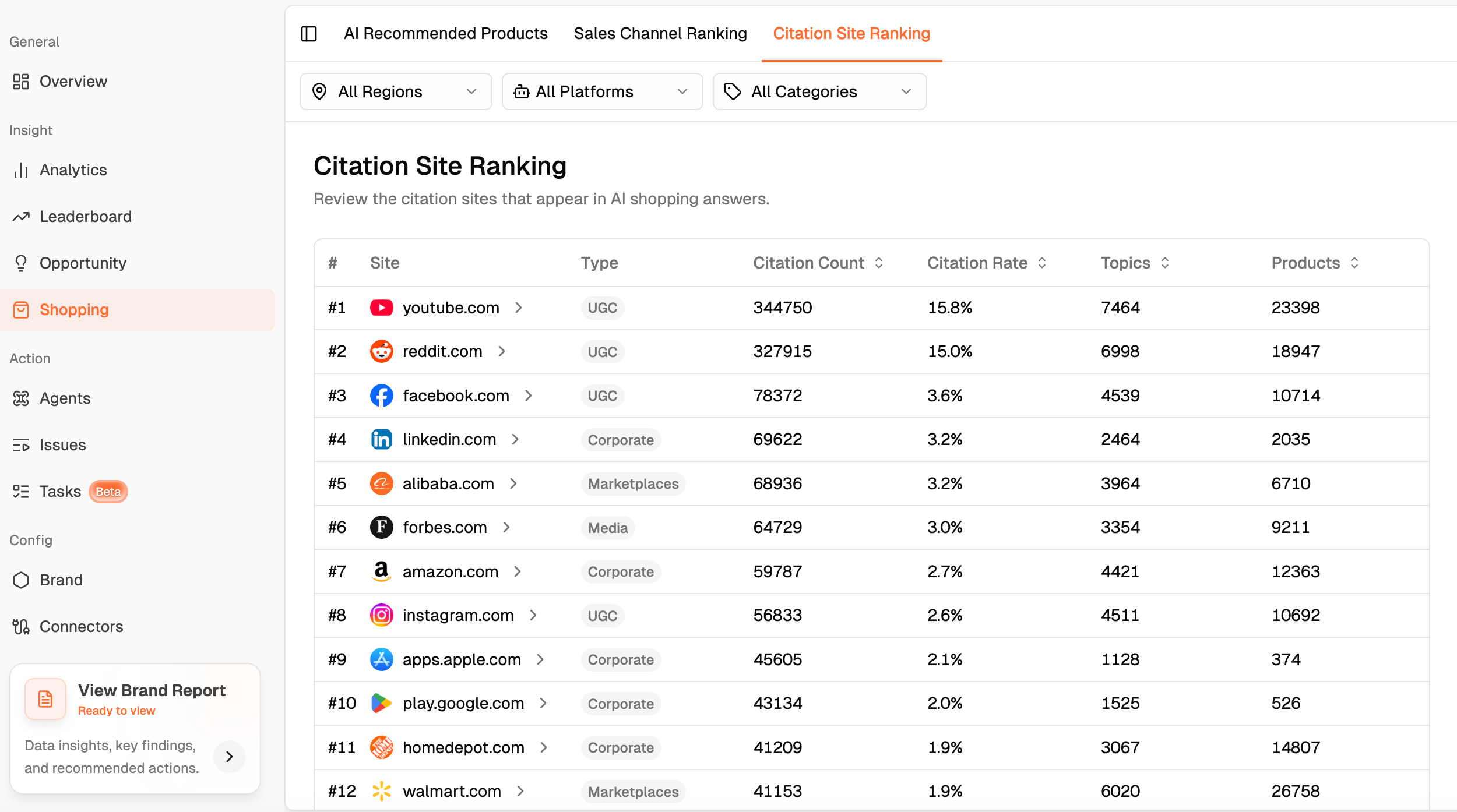
Citation and source analysis: Dageno AI shows which domains and pages AI references when explaining recommendations. This helps teams decide whether to improve owned content, build third-party reviews, pursue PR, improve marketplace content, or strengthen community evidence.
Content generation: Dageno AI helps teams turn prompt gaps and source gaps into GEO-ready content. Teams can create product education pages, buyer guides, comparison articles, alternative pages, FAQ sections, and answer-first product content using tools such as Dageno AI Article Writer.
Result attribution: Dageno AI helps teams track whether product position, citation share, prompt coverage, sentiment, competitor gaps, and channel entry points change after optimization work. This makes product-position improvement measurable rather than speculative.
Brands that need an initial baseline can start with a free GEO report and then use Dageno AI to build a repeatable product-position workflow.
How to Build a Step-by-Step Product Position Workflow
The best workflow to improve ChatGPT Shopping product position is to monitor current position, diagnose competitor advantages, fix data gaps, build scenario content, strengthen external evidence, optimize merchants, and track attribution.
Follow this workflow:
Build a prompt set for shopping position tracking
Create prompts around category intent, scenario intent, audience intent, budget intent, feature intent, risk concerns, comparison intent, and purchase-action intent.
Record current product position
Track whether the product appears first, top three, mid-list, as an alternative, in a comparison table, or not at all. Record the platform, region, prompt, competitor set, citations, and merchant links.
Compare products that rank above yours
Identify whether competitors have clearer specs, stronger reviews, better pricing, more external evidence, stronger marketplace pages, or more direct scenario content.
Fix product data gaps
Align product feed data, Product Schema, official product pages, retailer pages, marketplace listings, images, prices, variants, availability, shipping, and return policies.
Create scenario-specific content
Build content for the prompts where product position is weak. Each page should answer the buyer’s question directly, explain product fit, compare alternatives, and include proof.
Build external trust sources
Improve third-party review coverage, media mentions, YouTube demonstrations, expert comparisons, customer stories, community answers, and marketplace Q&A.
Optimize merchant entry points
Improve official-site and channel pages so the purchase path has strong price, inventory, reviews, shipping, return policy, and seller trust.
Measure position movement over time
Use Dageno AI to monitor whether product position, citation share, competitor co-occurrence, topic coverage, merchant entry point, and AI referral traffic improve after each action.
Original insight: The most useful product-position analysis compares “why your product ranked lower” against “why the competitor ranked higher.” AI shopping optimization is often less about publishing more content and more about closing the specific data, trust, scenario, or channel gap that caused the lower placement.
How to Track Product Position Metrics Over Time
Brands should track product position metrics over time because AI shopping rankings change as product data, reviews, sources, competitors, prices, inventory, and platform behavior change.
A one-time manual check cannot show whether a product is gaining or losing recommendation strength. Position needs trend data, competitor context, and attribution.
Track these metrics:
Metric
What It Measures
Why It Matters
First-position rate
How often your product appears first
Measures strongest recommendation ownership
Top-three rate
How often your product appears near the top
Measures shortlist visibility
Average product position
Mean product placement across monitored prompts
Tracks overall product-rank trend
Prompt-level position
Product position for each buyer question
Reveals scenario-specific wins and losses
Topic-level position
Product position across buyer-intent clusters
Shows broader category strength
Competitor co-position
Which competitors appear above, below, or beside your product
Defines AI-perceived competitors
Citation share
How often sources support your product
Measures evidence strength
Owned citation share
How often AI cites your official pages
Shows brand-owned source authority
External citation share
How often third-party sources support your product
Guides review, PR, and partnership work
Merchant position
Which seller appears first for the product
Connects AI position to channel capture
Platform position
Position across ChatGPT, Gemini, Google AI Mode, Perplexity, and other engines
Reveals platform-specific gaps
Sentiment and rationale
How AI explains strengths and weaknesses
Shows narrative quality
Attribution movement
Position change after optimization work
Proves whether GEO actions worked
Dageno AI helps brands connect these metrics in one workflow. The goal is not only to watch rank changes, but to understand which actions changed product position and which gaps still need work.
How to Fix Common Reasons Your Product Ranks Lower
Brands can fix lower ChatGPT Shopping product position by identifying whether the weakness comes from product data, scenario fit, trust evidence, competitor proof, or merchant readiness.
Common reasons a product ranks lower include:
Product feed data is incomplete or outdated.
Product Schema is missing or inconsistent.
Product titles and model names differ across channels.
Product pages list features but do not answer buyer scenarios.
Reviews are weaker than competitor reviews.
External review coverage is limited.
Competitor comparison pages are clearer.
Marketplace pages have stronger review volume.
The official site has unclear shipping or return policies.
Product limitations are not explained honestly.
AI finds stronger citation sources for competitors.
The product does not clearly match the buyer’s budget, use case, or risk tolerance.
Practical example: A home espresso machine may rank lower than a competitor for “best espresso machine for beginners” if the product page focuses on pressure bars and boiler type but does not explain setup difficulty, cleaning, learning curve, noise level, grinder compatibility, warranty, and common beginner mistakes.
Dageno AI helps diagnose these causes by connecting prompt position, competitor presence, citation sources, topic performance, sentiment, and platform differences.
How to Move From Alternative Position to Top Position
To move from alternative position to top position, a brand must prove that the product is not only relevant, but the best fit for a specific buyer scenario.
Alternative position usually means AI recognizes the product but does not consider it the strongest choice. The product may need better proof, clearer differentiation, stronger external evidence, or more competitive merchant conditions.
Content assets that can improve position include:
Content Asset
Best Use Case
Position Benefit
Product use-case page
“Best product for X scenario” prompts
Improves scenario fit
Product comparison page
“Product A vs Product B” prompts
Improves competitive contrast
Alternative page
“Best alternative to X” prompts
Captures competitor-intent searches
Buyer guide
Multi-product decision prompts
Helps AI cite structured recommendations
FAQ module
Fan-out buyer questions
Improves answer extraction
Review summary page
Repeated customer themes
Strengthens trust evidence
Setup guide
Risk and technical prompts
Reduces uncertainty
Channel buying guide
“Where to buy” prompts
Improves merchant capture
Each content asset should use direct answers, standalone sections, comparison tables, original insights, and FAQ answers. This structure helps Google, Bing, Perplexity, ChatGPT, Claude, Gemini, and other answer engines extract useful passages.
How to Use Original Insights in AI Shopping Content
Original insights improve AI shopping content because answer engines are more likely to extract content that offers useful, specific, and verifiable reasoning.
Brands do not need to invent data. They can use practical insights from sales teams, support teams, customer success teams, marketplace reviews, product returns, product demos, and channel operations.
Use these original insight formats:
Original insight: Position gaps often reveal buyer anxiety.
When ChatGPT ranks a competitor above a brand, the reason may not be specs. The reason may be lower perceived risk, clearer warranty, easier setup, stronger reviews, better return policy, or stronger external validation.
Practical example: Use marketplace Q&A to improve product position.
If buyers repeatedly ask whether a product fits a specific vehicle, room size, skin type, pet breed, climate, or device, those answers should become official product FAQ sections. AI shopping systems need compatibility information to rank products confidently.
Original insight: Top position usually needs both content proof and source proof.
A brand-owned page can explain why a product is good, but third-party reviews and customer discussions can validate the claim. A product may need both to move from “alternative” to “recommended first.”
Practical example: Track position by scenario, not only by category.
A mattress brand should not only track “best mattress.” It should track “best mattress for side sleepers,” “best cooling mattress,” “best mattress for back pain,” “best mattress under $1,000,” and “best mattress for couples.”
Dageno AI makes these insights operational by showing which prompts create position gaps, which competitors occupy top product positions, which sources influence answers, and whether optimization actions change the result.
Implementation Checklist
Brands should execute ChatGPT Shopping product-position optimization with a checklist that connects content structure, product data, external sources, internal links, AI monitoring, and result attribution.
Use this checklist:
Put the direct answer first in every product, comparison, and buyer-guide page.
Use structured H2 and H3 headings that match real buyer prompts.
Make every section understandable as a standalone answer.
Add original insights from sales calls, reviews, support tickets, channel data, and customer success conversations.
Add FAQ sections for buyer risk, compatibility, setup, warranty, limitations, and purchase-path questions.
Connect each product page to relevant internal links, category pages, comparison pages, and buyer guides.
Use authoritative external references with rel="nofollow" and target="_blank".
Audit product feed fields, including title, brand, description, GTIN, MPN, SKU, variant, image, price, availability, shipping, and returns.
Add or improve Product Schema on product detail pages.
Create scenario-specific product education pages for high-value prompts.
Create comparison pages for competitor prompts.
Build third-party trust through reviews, media, YouTube, expert comparisons, Reddit, forums, and marketplace Q&A.
Optimize merchant pages for price, inventory, shipping, returns, reviews, and seller credibility.
Use Dageno AI to monitor product position, competitor movement, citation sources, topic coverage, platform performance, and attribution.
Review position movement after every major product data, content, channel, or source improvement.
FAQs
What is ChatGPT Shopping product position?
ChatGPT Shopping product position is the placement of a product inside an AI-generated product list, product card set, buyer’s guide, comparison table, or merchant result.
A product can be included but still have weak position if it appears below competitors or only as an alternative. Strong product position usually means the product appears first, top three, or under a favorable label such as “best overall,” “best value,” or “best for X.”
How do you improve ChatGPT Shopping product position?
You improve ChatGPT Shopping product position by improving product data, Product Schema, product feeds, scenario content, reviews, external evidence, merchant pages, and ongoing AI visibility tracking.
The most practical workflow is to monitor current position by prompt, identify competitors ranking above you, fix data and content gaps, build external trust, optimize channel pages, and track changes with Dageno AI.
What affects product position in AI recommended product lists?
Product position is affected by buyer intent, scenario fit, product data quality, product entity clarity, structured feeds, Product Schema, reviews, third-party evidence, competitor strength, price, availability, merchant quality, and citation sources.
A product that is clear, trusted, available, well-reviewed, and strongly matched to the buyer’s scenario is more likely to appear higher in AI recommended product lists.
Is product position different from product inclusion?
Product position is different from product inclusion because inclusion means the product appears, while position means where the product appears after it is included.
A product may be included in a ChatGPT Shopping result but still rank below competitors. Product position is usually more important for revenue because higher-positioned products are more likely to shape the buyer’s shortlist.
Why does ChatGPT rank competitors above my product?
ChatGPT may rank competitors above your product because competitors have clearer product data, stronger reviews, better external evidence, more relevant scenario content, better marketplace pages, or more reliable merchant options.
The best response is to compare the competitor’s data, sources, content, reviews, and merchant conditions against your own product and then fix the specific gap that likely caused the lower position.
Can Product Schema improve ChatGPT Shopping product position?
Product Schema can help AI and search systems understand product information, but Product Schema alone is not enough to improve ChatGPT Shopping product position.
Brands also need accurate product feeds, consistent product data, strong reviews, scenario-specific content, external trust evidence, and optimized merchant pages.
How can Dageno AI help improve product position?
Dageno AI helps improve product position by monitoring AI recommended product lists, tracking prompt-level position, identifying competitor gaps, analyzing citation sources, supporting GEO-ready content generation, and measuring result attribution.
Dageno AI provides the workflow from data monitoring → strategy → content generation → result attribution, which helps brands move from manual checking to measurable AI shopping optimization.
Which metrics should brands track for ChatGPT Shopping position?
Brands should track first-position rate, top-three rate, average product position, prompt-level position, topic-level position, competitor co-position, citation share, merchant position, platform position, sentiment, and attribution movement.
These metrics show whether a product is not only visible, but preferred, trusted, cited, and connected to a purchase path.
Tim is the co-founder of Dageno and a serial AI SaaS entrepreneur, focused on data-driven growth systems. He has led multiple AI SaaS products from early concept to production, with hands-on experience across product strategy, data pipelines, and AI-powered search optimization. At Dageno, Tim works on building practical GEO and AI visibility solutions that help brands understand how generative models retrieve, rank, and cite information across modern search and discovery platforms.