AI Shopping Is Rewriting Product Discovery: Cross-Border E-commerce Brands Need to Understand the New Rules First
Search, comparison, and checkout are merging into AI-powered shopping results. Discover the new rules global e-commerce brands need to understand before competitors win the product card.
Explore 12,000+ niche markets with no login required
Over the past few years, growth for cross-border e-commerce brands has mainly revolved around a handful of entry points: Google Search, marketplace search on platforms such as Amazon and Walmart, social media content, influencer reviews, affiliate channels, and paid advertising.
But now, a new entry point is taking shape.
Users are no longer only typing terms like “portable power station” or “outdoor TV” into search boxes. They are starting to ask AI directly:
Help me find a portable power station suitable for running an RV air conditioner.
Find a birthday gift for a 60-year-old man under $500.
Which outdoor TV is suitable for a very sunny backyard?
Help me compare these models and tell me which one is the best value.
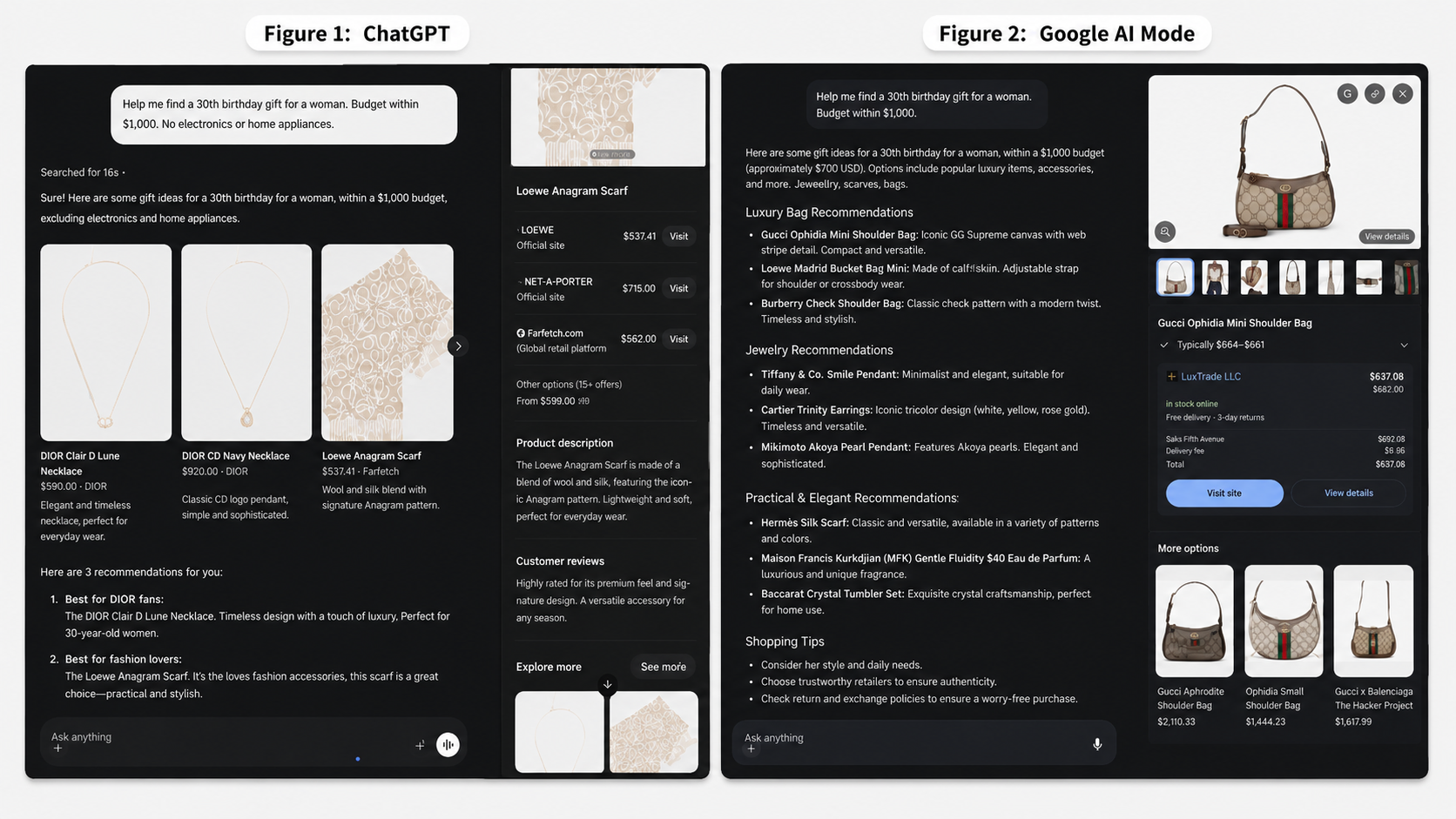
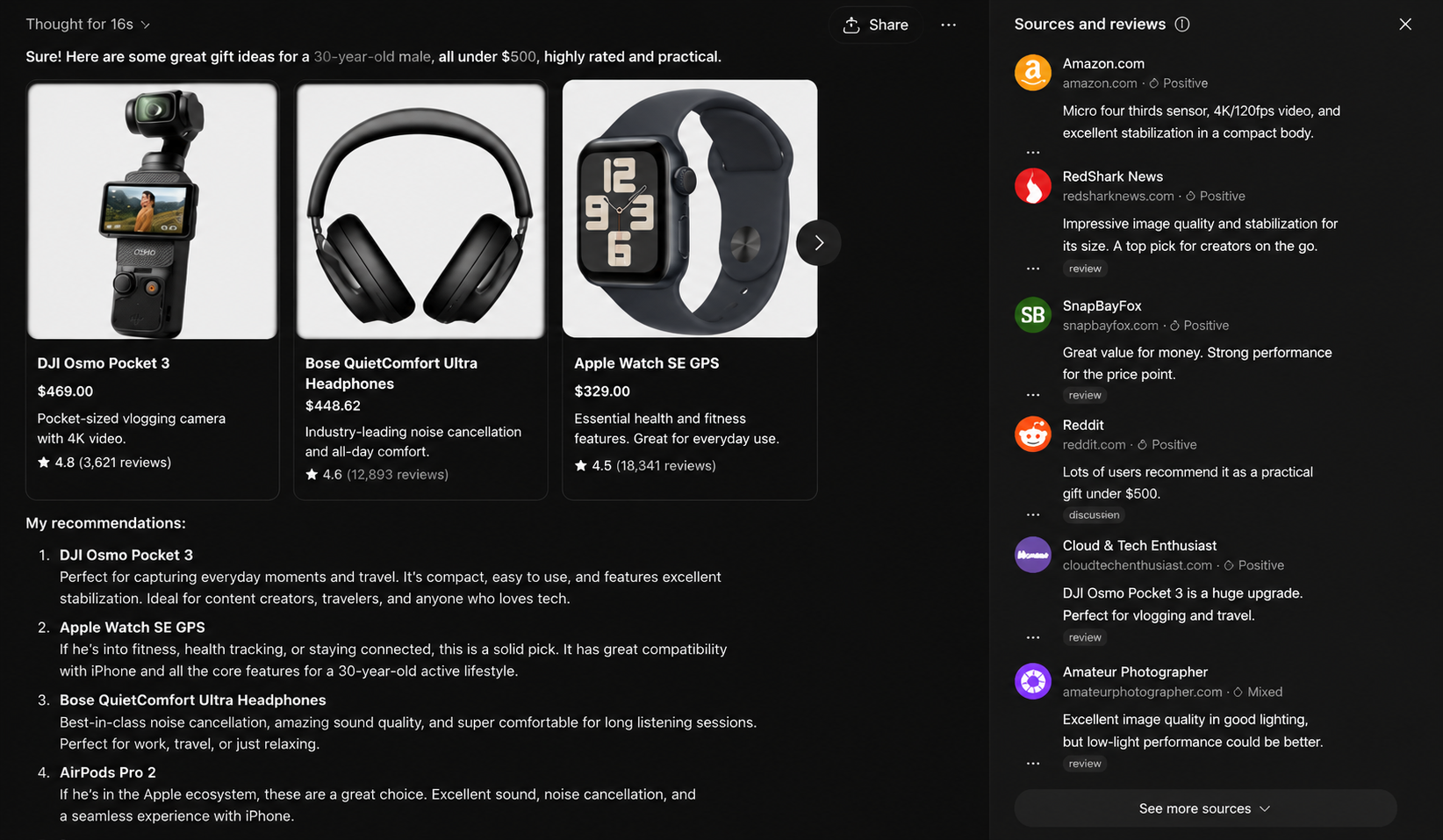
The results AI provides are no longer just webpage links. AI may directly display product cards, prices, ratings, merchant entry points, comparison explanations, and sometimes even synthesize third-party reviews, Reddit discussions, YouTube comments, and media content into purchase recommendations.
This is what we mean by AI Shopping.
It is not simply a traditional search results page with a new interface, nor is it a standard product recommendation feed. More precisely, it is AI completing the first round of pre-purchase filtering on behalf of the user: understanding the need, finding products, reading reviews, comparing prices, selecting channels, and then presenting the products most likely to convert.
For cross-border e-commerce brands, the key question is not “Will AI sell products?” but rather:
When users hand their purchase needs over to AI, does your product have a chance to appear in that product card?
AI Shopping is compressing “search, comparison, and purchase entry points” into the same interface.
1. First, Understand What an AI Shopping Product Card Really Is
Before rushing into optimization, we first need to break down the rules.
In traditional e-commerce search, users usually enter a keyword, and the platform returns a set of products or webpages. Ranking mainly happens on the search results page.
But in AI Shopping, users often do not enter a keyword. Instead, they enter a complete purchase task.
For example:
“I want to buy a birthday gift for a 60-year-old man, under $500, preferably from a well-known brand so I can avoid making a bad choice.”
This question actually contains many layers of information:
User Expression
What AI Actually Needs to Understand
60-year-old man
User profile, age, likely interests and usage habits
Birthday gift
Gift-giving context — not just personal use
Under $500
Price constraint
Want a reputable brand, don't want to get burned
Risk aversion — prioritize products with stable reviews and broad applicability
This is the biggest difference between AI Shopping and traditional search:
It is not matching a keyword. It is understanding a purchase scenario.
After understanding the need, AI moves to the next step: finding available products and deciding which ones deserve to enter the card.
A complete AI Shopping product card usually involves five types of information:
Information Type
What Users See
What It Means for Brands
Product information
Name, image, price, rating, specs
Product data must be accurate, complete, and machine-readable
Recommendation rationale
Why it fits this specific need
Product pages must clearly explain use cases, not just list selling points
Merchant entry points
Official site, Amazon, Best Buy, Walmart, Lazada, eBay, etc.
Channel content and inventory directly affect purchase conversion
External evidence
Review sites, YouTube, Reddit, media coverage
External sources influence how much AI trusts a product
Competitive positioning
Strengths and weaknesses vs. other products
Competitor comparisons will become a new traffic distribution logic
So the core of AI Shopping is not “who wrote more keywords.” Instead, it is:
Which product is easier for AI to understand, trust, and judge as suitable for the current purchase task?
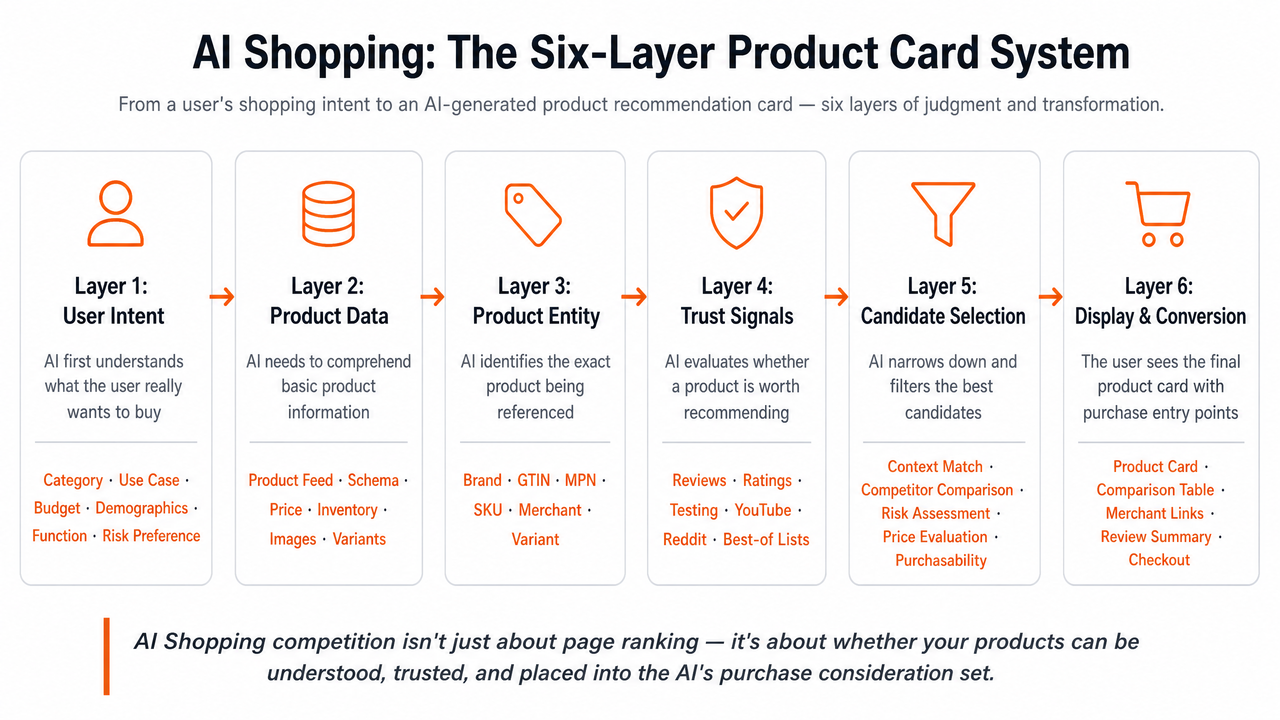
2. The AI Shopping Product Card System: Six Layers
To make this easier to understand, we can divide AI Shopping into six layers.
This structure applies to ChatGPT Shopping and also to Google AI Mode / Gemini Shopping. Different platforms do not have exactly the same underlying systems, but the overall logic is similar.
Layer 1: User Intent
This is the starting point of AI Shopping.
Users are no longer asking with just one word. They are describing real purchase needs.
Common needs can be broken down into:
Intent Type
Examples
Category intent
outdoor TV, portable power station, running shoes
Scenario intent
sunny patio, RV camping, home backup, flat feet
Audience intent
father gift, new parents, small apartment, pet owners
Budget intent
under $500, best value, premium option
Feature intent
waterproof, quiet, fast charging, easy to clean
Risk aversion
reliable, not easy to break, good warranty
Comparison intent
A vs B, best alternative, cheaper than X
Purchase action
where to buy, best deal, available near me
This means the “feature stacking” that brands commonly used when writing product pages is no longer enough.
What AI truly needs to know is:
Who is this product suitable for? What scenarios is it suitable for? At what budget is it worth buying? How is it different from competitors? Who is it not suitable for?
Layer 2: Product Data
This layer answers the question: Can AI correctly read your product?
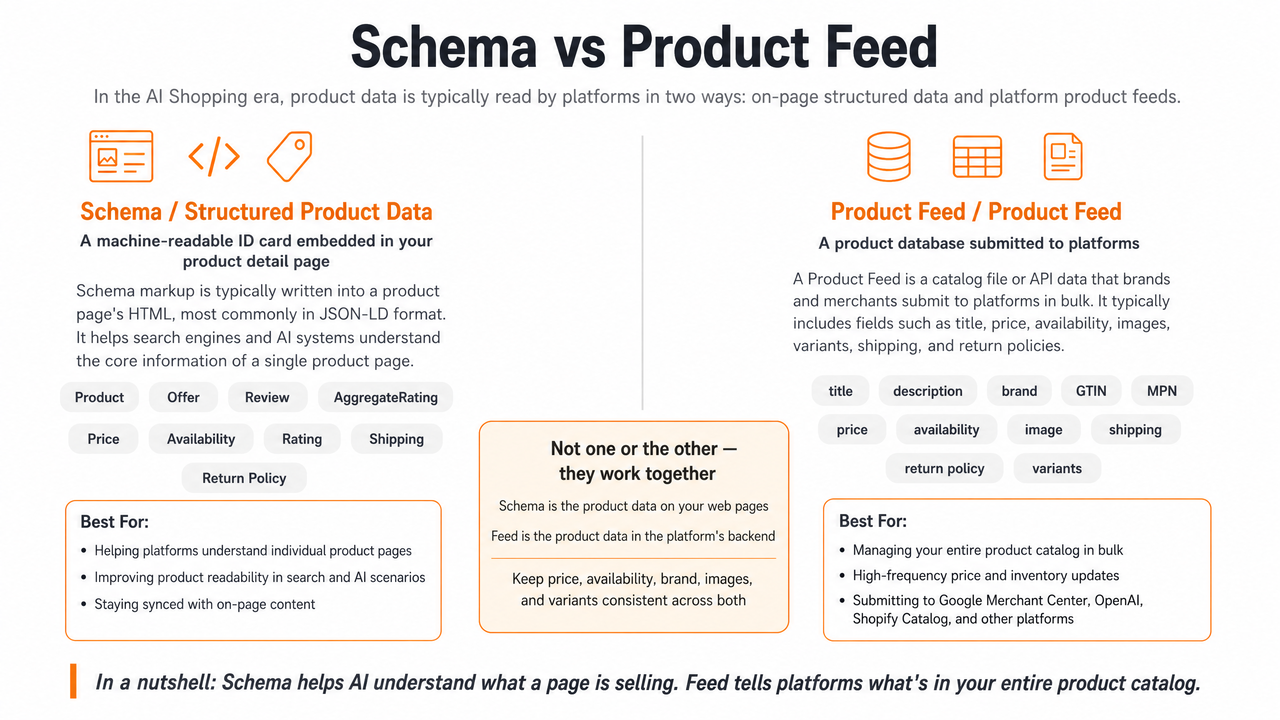
There are two core concepts here: structured product data and product feeds.
“Structured product data” sounds technical, but it is actually simple. It means writing product information into a webpage in a format machines can understand.
Ordinary webpage copy is written for people:
This is a 55-inch TV suitable for outdoor use. It has high brightness, supports waterproofing, and is suitable for patios and terraces.
Structured product data is written for search engines and AI:
Intent Type
Examples
Category intent
outdoor TV, portable power station, running shoes
Scenario intent
sunny patio, RV camping, home backup, flat feet
Audience intent
father gift, new parents, small apartment, pet owners
Budget intent
under $500, best value, premium option
Feature intent
waterproof, quiet, fast charging, easy to clean
Risk aversion
reliable, not easy to break, good warranty
Comparison intent
A vs B, best alternative, cheaper than X
Purchase action
where to buy, best deal, available near me
It is usually placed in the HTML of a product detail page, commonly in JSON-LD Schema format.
You can think of it as a “machine-readable ID card” embedded inside the product page.
A product feed is different.
A feed is not placed inside a single webpage. It is a product catalog submitted by a brand or merchant to a platform. It is more like a product database table that contains product titles, descriptions, prices, inventory, images, variants, shipping, return policies, and other information in bulk.
For brands, the most important point is not choosing one or the other. It is making sure the two are consistent.
If the webpage says the product is in stock but the feed says it is out of stock; if the webpage price is $899 but the feed price is $999; if the webpage image is the new version but the feed image is the old version, AI and search systems will struggle to determine which source is trustworthy.
This directly affects whether the product can be displayed correctly.
Layer 3: Product Entity
This layer answers the question: Does AI know exactly which product this is?
Many brands underestimate this point.
The same product may be described differently across the official website, Amazon, Walmart, Best Buy, review sites, YouTube, and Reddit:
EcoFlow DELTA Pro Portable Power Station
EcoFlow Delta Pro
EcoFlow DELTA Pro 3600Wh
DELTA Pro solar generator
EcoFlow home backup battery
To humans, these names are probably understandable.
But for platforms, merging these pieces of information into the same product entity requires more stable identifiers.
Common product entity fields include:
Field
Purpose
Brand
Confirms the brand
GTIN / UPC / EAN
Global product identifier code
MPN
Manufacturer part number
SKU / item_id
Merchant's internal product ID
Category
Product category
Variant
Color, size, capacity, version
Image
Visual product identification
URL
Product detail page
Merchant
Which merchant is selling it
This is why fields such as GTIN, MPN, Brand, and Variant, which may look like “back-end” details, will become increasingly important in AI Shopping.
AI does not just need to understand your copy. It also needs to align information about your product across different websites, merchants, and review content into one product entity.
Layer 4: Trust Signals
This layer answers the question: Why should AI believe this product is worth recommending?
AI Shopping does not only look at what the brand says on its official website. It also looks at how the outside world evaluates the product.
Trust signals can be roughly divided into five categories:
Trust Signal
Specifics
Product reviews
Star rating, review count, positive/negative summaries, common pros and cons
Third-party evaluations
Specialist review sites, media rankings, YouTube reviews
Community discussion
Reddit, forums, user Q&A, real-world usage experiences
Merchant quality
Whether official, whether primary seller, whether fulfillment and returns are reliable
Data consistency
Whether price, inventory, images, and specs are consistent across all channels
This layer is closely related to GEO.
GEO is not merely about “getting AI to mention the brand in an answer.” In the Shopping scenario, it is more like building external trust evidence for a product.
For example, in a ChatGPT product card or Google AI Mode product recommendation, AI may cite a review site, YouTube video, Reddit discussion, or media article to explain why a product fits the user’s need.
This means external sources are no longer peripheral PR or content marketing assets. They are becoming important inputs for AI when judging product trustworthiness.
AI may refer to reviews, comments, and third-party content on public websites when generating product descriptions. External source optimization has already become part of Shopping optimization.
Layer 5: Recommendation Selection
At this layer, AI starts to decide which products enter the candidate set and which products are excluded.
This is not a simple “whoever ranks higher in SEO appears first” system.
AI considers factors such as:
Whether the user has specified a budget;
Whether the product meets the functional requirements;
Whether there are enough reviews and external evaluations;
Whether price and inventory are clear;
Whether there is a reliable purchase channel;
Whether there are safety, quality, or compatibility risks;
Whether stronger alternatives exist in the same category;
Whether the user has provided exclusion criteria.
For example, if a user says “under $500,” price becomes very important.
If a user says “a gift for an older family member, avoid risky choices,” AI may lean toward products with stable reviews, low usage barriers, and stronger general applicability.
If a user says “suitable for an RV air conditioner,” AI will look at more specific parameters such as wattage, capacity, peak output, and runtime.
So the recommendation logic of AI Shopping is closer to a scenario-matching system than a traditional keyword-ranking system.
Layer 6: Display and Conversion
The final layer is the product card the user actually sees.
Common display formats include:
Display Format
Description
Product card
Image, title, price, rating, brief selling points
Comparison table
Multiple products compared by price, specs, pros and cons
Merchant list
Prices and purchase entry points across different merchants
Review summary
AI-synthesized overview of what users like and dislike
Important notes
Use case context, risk warnings, compatibility recommendations
Purchase entry points
Official site, platforms, retailers, downstream checkout
There is one concept that needs special emphasis here: merchant.
A merchant is not the brand. It is the seller of the product.
For example, Apple is the brand, but Apple Store, Amazon, Best Buy, and Walmart can all be merchants.
EcoFlow is the brand, but EcoFlow’s official website, Home Depot, Amazon, Best Buy, and Canadian Tire can all be merchants.
For brands, this means competition in AI Shopping does not only happen at the level of “whether the brand is recommended.” It also happens at the level of “who captures the purchase entry point.”
A brand may be recommended, but the traffic may ultimately flow to Amazon.
A product may enter the card, but the first merchant shown may be Best Buy.
A brand’s official website may have good content, but if channel inventory, pricing, and reviews are weak, it may still lose at the purchase-fulfillment layer.
3. How ChatGPT and Google Differ in Shopping Logic
AI Shopping is not a unified system. Different platforms have different underlying data, display formats, and optimization priorities.
ChatGPT Shopping: More Like a Conversational Shopping Advisor
ChatGPT’s strength lies in conversation.
Users can describe their needs in very natural language and continuously add conditions. ChatGPT Shopping Research may ask follow-up questions about budget, brand preferences, size, performance, style, price sensitivity, and other factors, then generate a result that feels closer to a buying guide.
Its core characteristics are:
Dimension
ChatGPT Shopping
Entry Point
ChatGPT conversation
User Behavior
Describes needs, asks follow-up questions, removes products, requests similar products
Defaults back to the merchant’s website or app; some eligible merchants may support deeper checkout capabilities
One important change in ChatGPT is that it is not only “answering which product is good.” It is connecting product discovery, comparison, and purchase entry points.
From a brand perspective, the core questions for ChatGPT Shopping are:
When users describe a purchase scenario in natural language, is my product selected into the candidate set?
If it is selected, is it the main recommendation or only an alternative option?
After users click, do they see my official website or another channel?
Google AI Mode Shopping: More Like an AI Version of Google Shopping
Google’s underlying advantage is the Shopping Graph.
The Shopping Graph can be understood as Google’s product knowledge base. It integrates a large volume of product listings, prices, inventory, colors, reviews, merchants, and other information, then displays it through Search, Shopping, AI Mode, Gemini, Google Lens, and other entry points.
The focus of the Google AI Mode Shopping experience is not pure chat. It is the combination of Gemini’s understanding capability with Google’s product database.
Shopping Graph, Merchant Center, web structured data, product reviews, inventory and pricing
Optimization Focus
Google Merchant Center, Product Schema, GTIN / MPN, product images, consistency of price and inventory
Conversion Path
Merchant websites, retail channels, local inventory, followed by agentic checkout capabilities
Google’s strengths are a stronger product database and a stronger search ecosystem.
Therefore, when optimizing for Google AI Shopping, Merchant Center and Product Schema are unavoidable pieces of infrastructure.
Google AI Overview: More Like a Product Opportunity Inside an Answer Summary
AI Overview is not designed specifically for Shopping, but it may embed product-related content, cited pages, or shopping modules in some queries.
It is more suitable for influencing the awareness and comparison stages.
For example, users may ask:
solar generator vs portable power station
what size outdoor TV for patio
are IPL hair removal devices safe
These queries may not lead to an immediate purchase, but they influence how users judge a category, brand, and product.
For brands, optimizing for AI Overview is closer to content GEO:
Are you being cited? Does your page explain the topic clearly? Does third-party content support you? When users conduct pre-purchase research, do they see you first?
Gemini Shopping: Google Shopping Inside a Chat Interface
Gemini’s Shopping capability relies more heavily on Google’s ecosystem, especially the Shopping Graph.
It is more like Google Shopping in a chat format:
Users can explore products, compare prices, and view purchase locations inside a conversation.
So Gemini’s optimization priorities share essentially the same underlying logic as Google AI Mode:
Merchant Center, Shopping Graph, structured data, product images, reviews, and price / inventory consistency.
Simple Summary
Platform
Most Similar To
What Brands Should Focus On Most
ChatGPT Shopping
Conversational shopping advisor
Whether products are selected by AI into the candidate set; whether external reviews are credible enough
Google AI Mode Shopping
AI version of Google Shopping
Whether products are included in the Shopping Graph and appear in scenario-based queries
Google AI Overview
Purchase research entry point within search summaries
Whether the brand and content are cited, and whether they influence pre-purchase perception
Gemini Shopping
Chat-based Google Shopping
Whether the Google product data ecosystem is complete
4. Why AI Shopping Optimization Cannot Be Separated from Foundational GEO
Many people understand Shopping optimization as “getting the product feed right.”
That is correct, but incomplete.
Feeds solve the product data problem.
GEO solves the AI trust and citation problem.
In AI Shopping, these two things work at the same time.
Suppose a brand’s product feed is very complete: price, inventory, title, images, and variants are all included. But there are almost no credible external reviews, no Reddit discussion, no YouTube user experiences, and little mention in media rankings. AI may be able to read the product, but it may not have enough reason to recommend it.
Conversely, a product may have a lot of external discussion, but if the feed has inaccurate prices, unstable inventory, confusing model names, and poor-quality images, AI may still be unable to display it consistently.
So a more accurate formula is:
AI Shopping optimization = product data infrastructure + GEO external trust signals + scenario-based content matching.
GEO here is not just “getting the brand to appear in AI answers.” It also includes:
GEO Work
Role in Shopping
Third-party review content
Helps AI identify product strengths and weaknesses
YouTube reviews
Provides real usage scenarios and long-tail questions
Reddit / Forum discussions
Provides authentic user feedback and pain points
Media rankings
Helps products enter “best / top / comparison” contexts
Expert blogs
Supports professional scenario-based judgment
Marketplace reviews
Provides ratings, review volume, and user experience
Brand website content
Provides official specifications, FAQs, and use cases
Product page structured data
Enables AI to correctly read product information
This is also why Dageno’s citation site rankings are important.
They do not simply tell you “which websites AI cited.”
They tell you:
Which external sources AI Shopping is using to judge products and brands.
If YouTube, Reddit, CNET, TechRadar, Popular Mechanics, Forbes, NYTimes, and Amazon reviews frequently appear in a category, brands cannot focus only on official-site SEO. External content itself becomes part of Shopping visibility.
In AI Shopping scenarios, YouTube, Reddit, media reviews, and marketplace reviews may all become external evidence that influences product recommendations.
5. What Dageno Can Currently Show: Making the “Results Layer” of AI Shopping Transparent First
Dageno’s current Shopping section mainly displays Shopping data from the public database layer.
This statement needs to be clear.
At this stage, we are not saying that we can already provide a complete feed audit, Schema audit, SKU-level optimization, and continuous tracking for a specific client brand.
The more important task right now is to first present what is happening on the front end of AI Shopping through data.
This step is valuable in itself, because many brands still do not even know:
Which products most frequently appear in AI product cards;
Which prompts trigger these products;
Which competitors appear in the same purchase scenario as them;
Which sites AI most often cites when recommending products;
Which sales channels the final purchase entry points lead to;
What the original AI answers shown to users look like.
Dageno currently presents these things first.
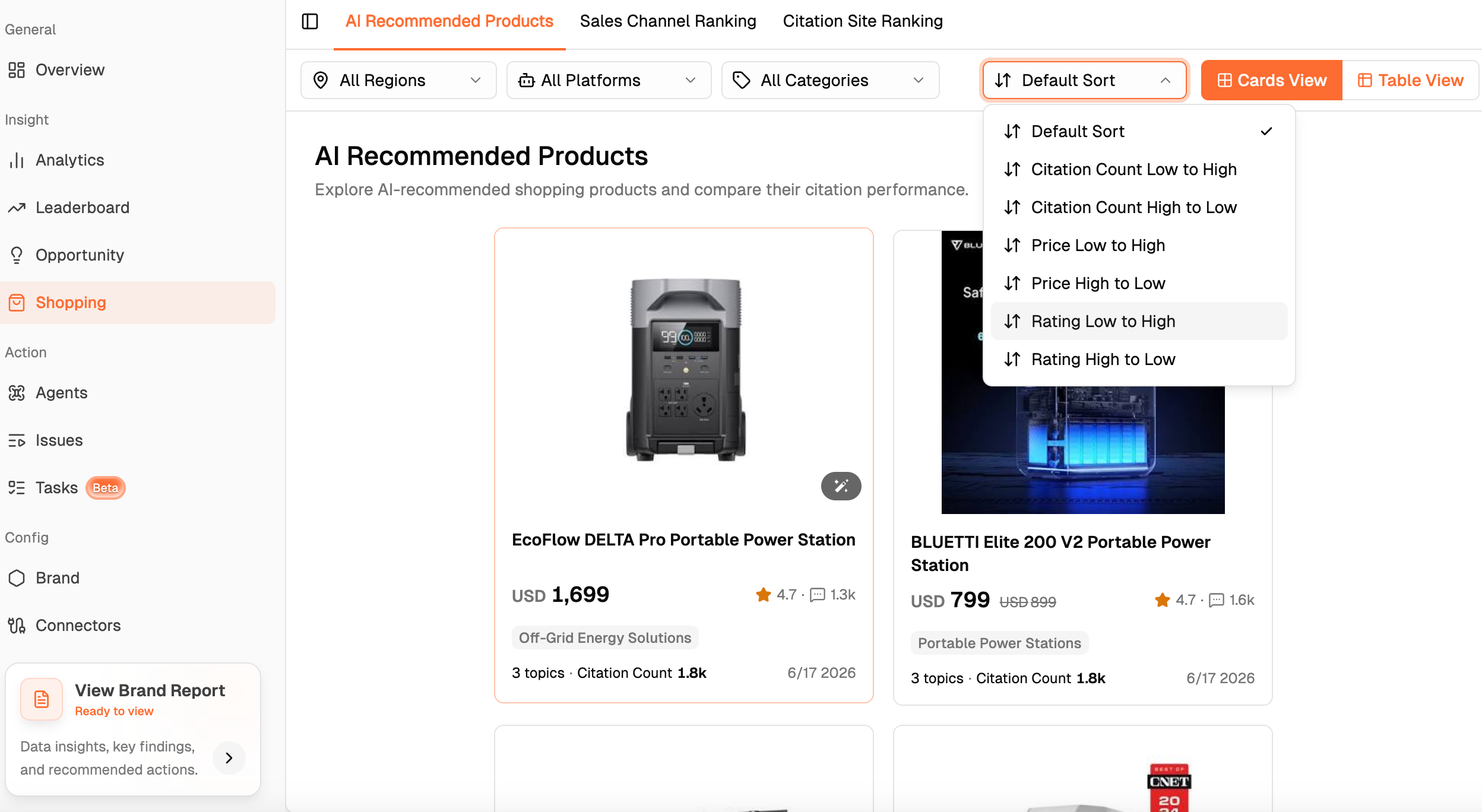
1. AI Recommended Products: See Which Products Are Occupying Product Cards
On the “AI Recommended Products” page, you can view products recommended by AI in the public database by region, platform, and category.
This is not a traditional product library.
It is more like an “AI product-card results database.”
You can see:
Data Point
Value / Insight
Product Name
Identifies which products are being recommended by AI
Product Image
Shows how the product is visually presented in AI-generated product cards
Price
Reveals the price range at which the product appears in recommendation scenarios
Rating & Review Count
Indicates whether the product has baseline trust and credibility signals
Topic Coverage
Measures how many purchasing contexts or shopping intents the product appears in
Citation Count
Tracks how frequently the product is recommended or cited by AI systems
Category
Identifies the AI Shopping category to which the product belongs
Platform / Region
Highlights performance differences across markets, regions, and AI platforms
Dageno organizes public AI Shopping product-card data into a filterable and comparable product view, helping brands first understand which products are occupying positions in the market.
The value of this page is that it turns “what AI recommended” from perception into data.
When certain products in a category are repeatedly recommended by AI, they have already begun occupying a new product entry point.
If brands do not look at this layer of data, they may easily assume that competition is still happening only in traditional search results.
2. Product Detail Page: See How a Product Was Recommended by AI
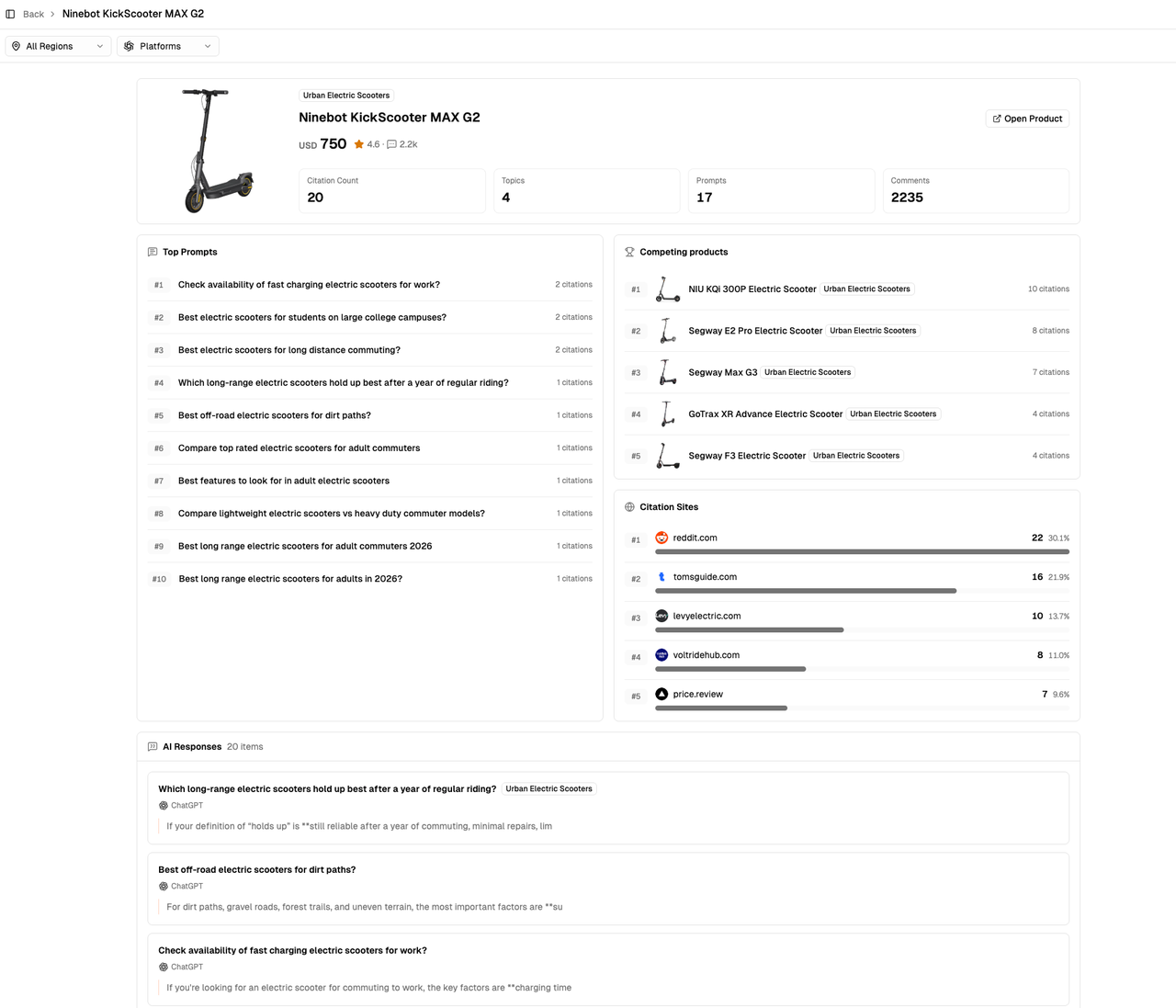
The product detail page is closer to a breakdown of a single AI Shopping recommendation.
The page can show:
Module
Description
Product Information
Product name, image, price, rating, and review count
Citation Count
How frequently the product is recommended or cited by AI systems
Topic Coverage
Number of purchase scenarios or shopping contexts in which the product appears
Prompt Count
Number of user queries that trigger the product's appearance
Top Prompts
The shopping-related language and questions users use to surface the product
Competitor Products
Products that appear alongside it or are commonly compared against it
Citation Sources
External websites referenced by AI when recommending the product
AI Responses
Original AI-generated answers, enabling review of the recommendation context and messaging
A product is not only “recommended.” It can also be broken down into triggering prompts, competitors, citation sites, and original AI answers.
The most valuable part here is the popular prompts.
These prompts tell brands that users are not looking for a single word. They are solving a specific use problem.
Therefore, product pages, FAQs, review content, and channel pages should all be organized around these questions.
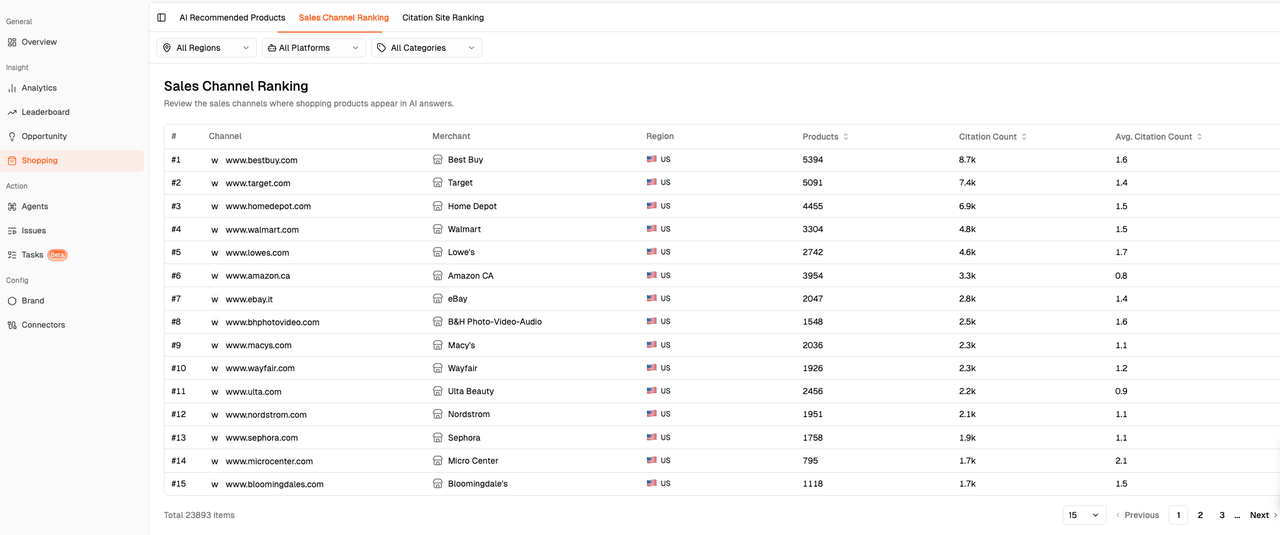
3. Sales Channel Ranking: See Who AI Gives the Purchase Entry Point To
AI recommending a product is only the first step. The more important question is: where will the user ultimately go to buy?
Dageno’s “Sales Channel Ranking” shows which channels most often appear as purchase entry points in AI Shopping answers within public Shopping data.
In your screenshots, you can see channels such as Best Buy, Target, Home Depot, Walmart, Lowe’s, Amazon CA, eBay, B&H, Wayfair, Macy’s, Ulta, Nordstrom, and Sephora.
This is very important for brands.
Because in AI Shopping, the brand’s official website is not necessarily the only place that captures demand.
Large retailers, vertical channels, and marketplaces may all capture demand after an AI recommendation.
This creates a new marketing question:
In the past, brands may have only asked, “How is our official-site SEO performing?”
Now they also need to ask, “After AI recommends the product, which merchant does the user get directed to?”
AI Shopping traffic capture does not only happen on the brand’s official website. It may also happen through large retail channels and marketplaces.
This will change channel management.
Brands need to optimize not only official-site PDPs, but also pay attention to:
Whether product pages on Amazon, Walmart, Best Buy, and other channels are complete;
Whether channel prices conflict with official-site prices;
Whether channel inventory is stable;
Whether channel reviews influence AI judgment;
Which channels are more likely to appear as purchase entry points in AI product cards.
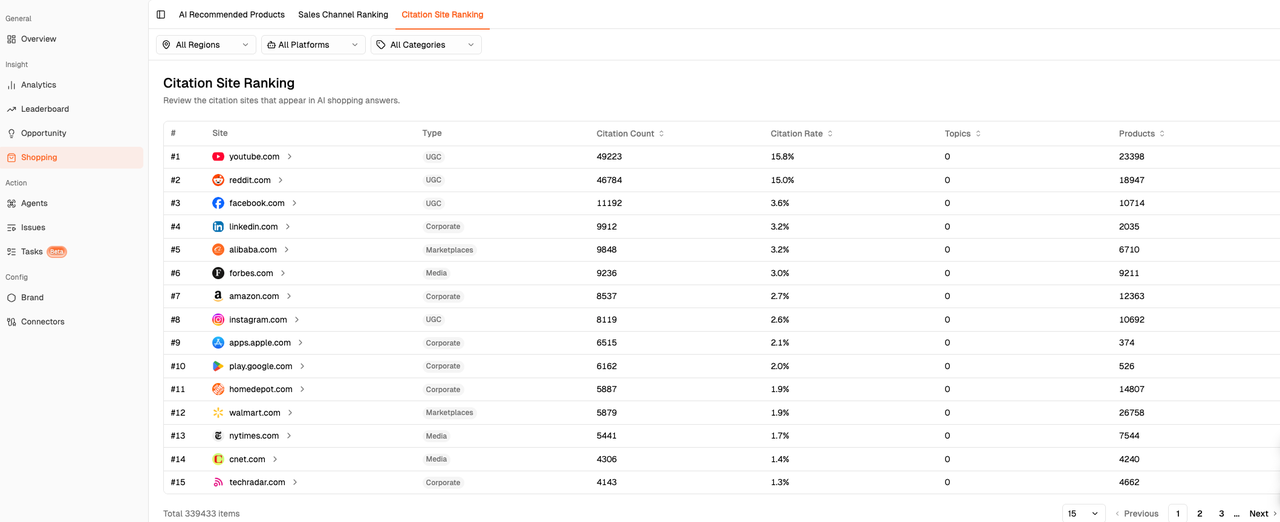
4. Citation Site Ranking: See Who AI Mainly Trusts
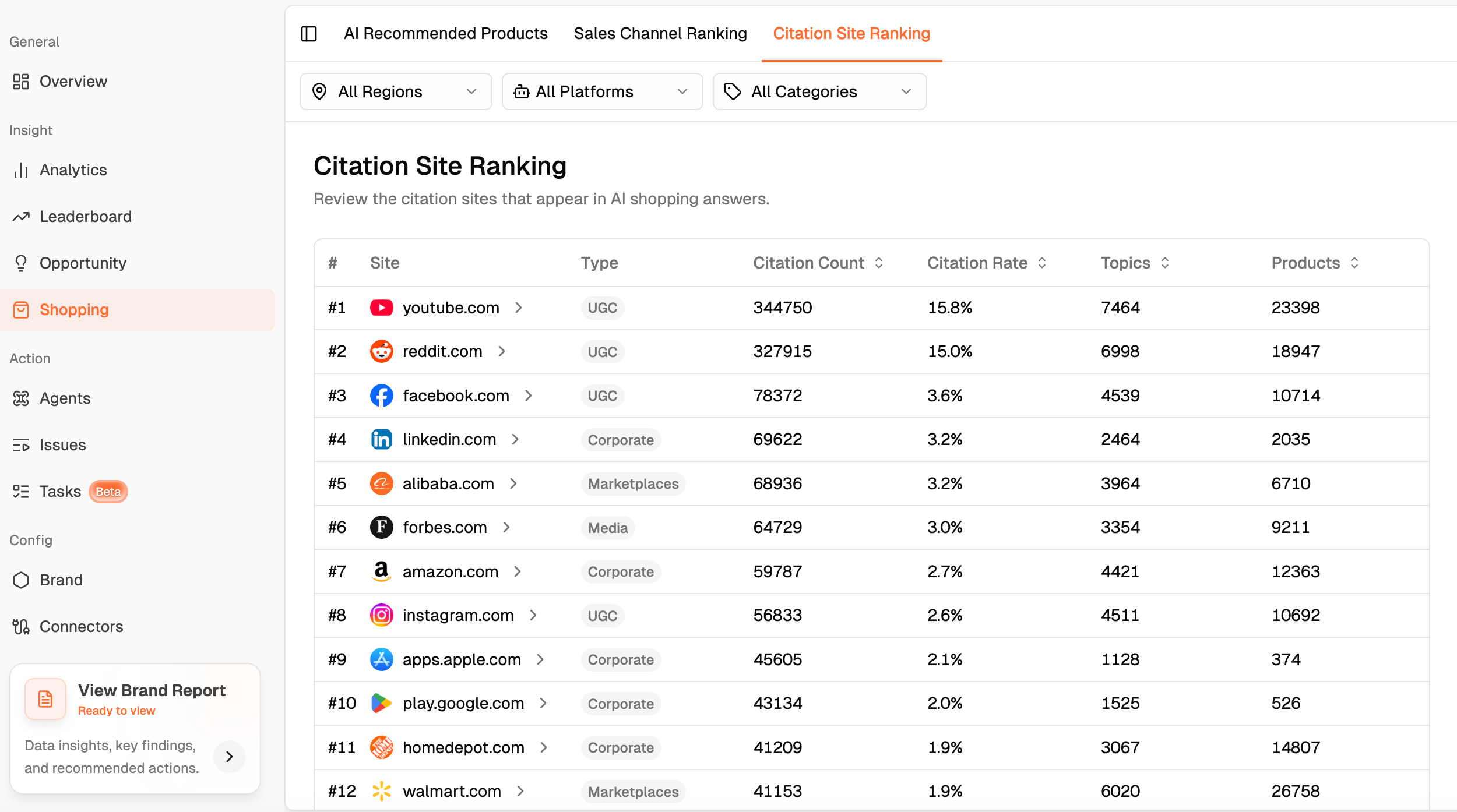
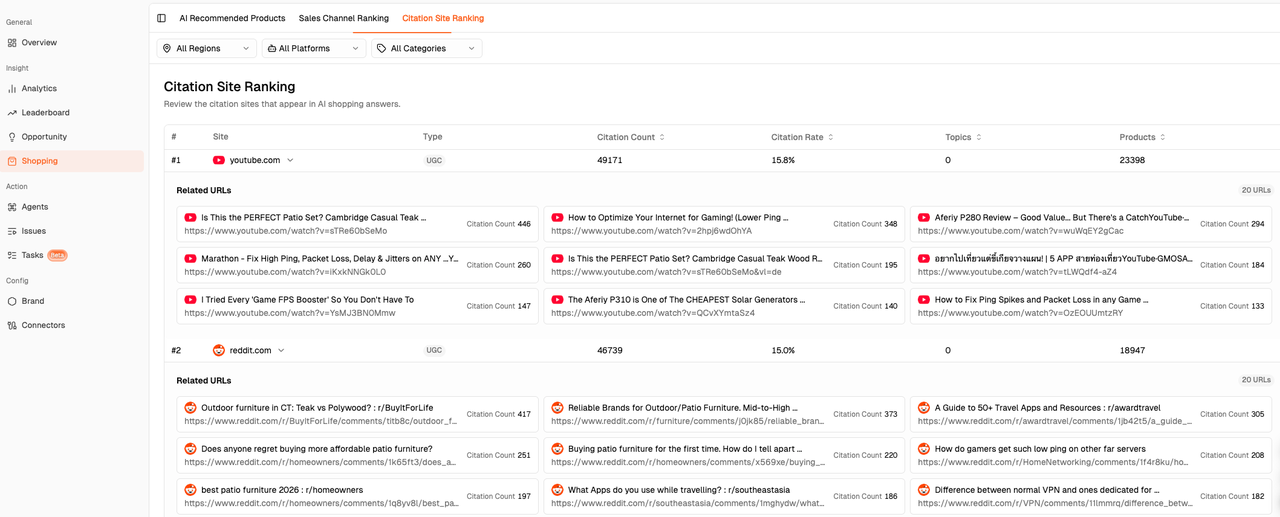
Dageno’s “Citation Site Ranking” shows which websites AI Shopping most frequently cites in its answers.
This page is very important.
Because AI Shopping recommendations do not only come from the brand’s official website. They also refer to external content.
In your screenshots, you can see sites such as YouTube, Reddit, Facebook, LinkedIn, Alibaba, Forbes, Amazon, Instagram, Home Depot, Walmart, NYTimes, CNET, and TechRadar.
These sources can be roughly divided into several categories:
Source Type
Examples
Importance for AI Shopping
UGC Communities
Reddit, Facebook, Instagram
Provide authentic user discussions, experiences, and product feedback
Video Content
YouTube
Offers reviews, unboxings, demonstrations, and real-world usage scenarios
Marketplaces
Amazon, Walmart, Alibaba
Supply product information, pricing, reviews, ratings, and sales signals
Media Reviews
Forbes, The New York Times, CNET, TechRadar
Deliver expert evaluations, rankings, and third-party credibility
Retailers
Home Depot, Best Buy, Target
Serve as purchase destinations and provide inventory, pricing, and retailer trust signals
Brand Websites
Official brand websites
Provide authoritative product specifications, FAQs, warranty details, and customer support information
AI Shopping’s external sources are expanding beyond traditional SEO links into video, communities, media, retailers, and marketplace reviews.
This is also why we believe Shopping optimization cannot be separated from GEO.
If AI often cites Reddit and YouTube in its answers, brands cannot focus only on official-site content.
If AI often cites media such as CNET, TechRadar, and Popular Mechanics, brands need to seriously develop review and ranking-list content.
If AI often cites retailers and marketplaces, channel page content also needs to be included in the optimization scope.
6. Impact on Cross-Border E-commerce Brands: Marketing Work Will Shift Several Times
AI Shopping will not immediately replace Google SEO, Amazon SEO, social media, influencers, or advertising. But it will change how these activities connect.
Shift 1: From Keyword Coverage to Purchase-Scenario Coverage
In the past, we asked:
Does this keyword rank?
Now we need to ask:
In what purchase scenarios will users ask AI?
Does my product cover these scenarios?
Does AI consider my product suitable for this scenario?
These are the real purchase languages inside AI Shopping.
Shift 2: From Product Page Copy to AI-Readable Product Answers
Many PDPs are written like advertising pages:
High performance, long battery life, excellent quality, designed for the outdoors.
This may be somewhat appealing to people, but it may not be enough for AI.
AI needs clear answers:
What scenarios is it suitable for?
What scenarios is it not suitable for?
Where is it stronger than competitors?
What budget is it suitable for?
What real usage effects do the specifications correspond to?
What are common user reviews?
Is after-sales service and return support stable?
Are there reliable external reviews?
So future high-quality PDPs will look more like product answer pages, not merely promotional pages.
Shift 3: From Official-Site Optimization to Full-Web Product Evidence Optimization
AI Shopping looks at official websites, platform pages, retailer pages, review sites, Reddit, YouTube, media lists, and marketplace reviews together.
This means a brand’s content assets are no longer isolated.
In the past, these tasks belonged to different teams:
SEO handled the official website;
PR handled media;
KOL teams handled YouTube;
Marketplace teams handled Amazon;
Channel teams handled Walmart / Best Buy;
Customer service and operations handled reviews.
Now all of this content will affect how AI understands the product.
So AI Shopping will push marketing teams away from “each channel doing its own work” and toward “unified management of product trustworthiness.”
Shift 4: From Traffic Attribution to Visibility Attribution
An AI recommendation may not bring a click immediately.
Users may first see a brand in ChatGPT or Google AI Mode, then search for the brand on Google, or purchase on Amazon, Walmart, or Best Buy.
This will distort traditional last-click attribution.
Brands need to begin tracking new metrics:
New Metric
Description
Product Card Visibility
Measures whether a product appears in AI-generated product cards
Prompt Coverage
Identifies which purchase-related queries trigger the product's appearance
Competitor Co-occurrence
Tracks which competing products frequently appear alongside the product
Merchant Visibility
Shows which merchants or sales channels receive traffic from AI shopping recommendations
Citation Share
Measures which external websites influence AI recommendations and decision-making
Brand Mention
Indicates whether the brand is explicitly mentioned in AI-generated answers
SKU Visibility
Tracks whether specific product models or SKUs are mentioned by AI
AI Answer Sentiment
Evaluates whether AI descriptions and recommendations are positive, neutral, or negative toward the product
These metrics will not replace revenue, but they will become new signals before revenue.
7. What Brands Should Do First
AI Shopping is still early, but that does not mean brands have nothing to do.
On the contrary, now is the best time to build foundations.
Step 1: First Know Whether You Are Appearing
Start by answering a few questions:
In your category, which products is AI recommending?
Is your brand appearing?
If it is not appearing, who is?
Which prompts most easily trigger your competitors?
When AI recommends competitors, which sites does it cite?
Which channels receive the final purchase entry points?
This is exactly the part that Dageno’s current public Shopping data layer can first help brands observe. You can also contact us, and we can provide an industry-level GEO strategy analysis and planning separately.
Step 2: Complete Your Product Data
Prioritize checking:
Whether product titles are clear;
Whether brand, model, GTIN, and MPN are complete;
Whether prices and inventory are accurate;
Whether images are high quality;
Whether variants are clear;
Whether return and shipping policies are readable;
Whether Product Schema is complete;
Whether the Google Merchant Center feed is stable;
Whether product feeds accessible to OpenAI / ChatGPT are ready;
Whether the official website, feeds, and channel pages are consistent.
Step 3: Rewrite Product Page Content Around Scenarios
Product pages should not only list features. They should answer real purchase questions.
For example, an outdoor TV product page can add answers to questions such as:
Is it suitable for a very sunny patio?
Is glare a problem when watching during the day?
What is the waterproof and dustproof rating?
Can it be installed long-term on a terrace, by a pool, or in a semi-open space?
Compared with ordinary indoor TVs, what are the differences in brightness, heat dissipation, and protection?
Which installation scenarios is it suitable for, such as patio, backyard, pool area, or outdoor kitchen?
Is it stable in hot, humid, rainy, or snowy environments?
Compared with competitors, how does it differ in brightness, audio, system, installation method, and warranty?
Which users is it not suitable for, such as users who only occasionally watch outdoors, users with limited budgets, or users who already have shade structures?
Which users is this product not suitable for?
This content is not only for users. It also helps AI judge scenario fit.
Step 4: Build External Sources
Brands need to systematically build:
YouTube reviews;
Reddit / forum discussions;
Media rankings;
Professional review sites;
Marketplace reviews;
Channel page content;
User FAQs;
Third-party comparison content.
This is no longer just “brand awareness.” It is the trust evidence base for AI Shopping.
Step 5: Include Channels in Optimization
If AI ultimately directs users to Walmart, Best Buy, Home Depot, Amazon, Lazada, eBay, or vertical retailers, then those channel pages also need optimization.
Check:
Whether channel page titles are accurate;
Whether images are consistent;
Whether reviews are sufficient;
Whether pricing is competitive;
Whether inventory is stable;
Whether shipping and returns are clear;
Whether information conflicts with the brand’s official website.
AI Shopping will make “channel operations” part of GEO.
8. Why Dageno Is Building Shopping Data First
We are not packaging the current Shopping section as a finished ultimate solution.
What Dageno is doing now is the first important thing:
Turning the public results layer of AI Shopping into observable data.
This includes:
Which products AI recommends;
Which products repeatedly appear in different categories;
Which prompts trigger product appearances;
Which competitors appear together;
Which sales channels capture purchase entry points;
Which citation sites influence AI judgment;
How original AI answers organize product recommendations.
The value of this step is that it first solves a foundational question:
What does the market actually look like inside AI Shopping?
Only after seeing the results can brands meaningfully discuss diagnosis and optimization.
Our judgment is:
AI Shopping is still early, but it is already important enough for brands to build monitoring systems in advance.
Because once a new product entry point takes shape, brands that enter late will often discover that competitors have already occupied positions across data, content, channels, and external sources.
Conclusion: AI Shopping Is Not a New Page, but a New Shelf
Every change in e-commerce entry points brings a new brand ranking order.
In the search era, brands competed for keyword rankings.
In the platform era, brands competed for on-site search and recommendation placements.
In the social media era, brands competed for content seeding and influencer distribution.
In the AI Shopping era, brands begin competing for this:
Whether my product will be selected by AI into the user’s purchase candidate set.
This will not be determined only by advertising budget, nor only by official-site SEO.
It depends on whether product data is complete, whether external sources are trustworthy, whether channels are stable, and whether the product can answer users’ real purchase scenarios.
Dageno launched the Shopping section not to chase a new concept, but to turn this emerging new shelf into observable data.
Inside AI shopping entry points, the first thing brands need is not to immediately take a bunch of actions. They first need to see:
What users are asking, what AI is recommending, where competitors are appearing, who is capturing traffic, and which sources AI trusts.
Only after seeing these things can optimization truly begin.
Tim is the co-founder of Dageno and a serial AI SaaS entrepreneur, focused on data-driven growth systems. He has led multiple AI SaaS products from early concept to production, with hands-on experience across product strategy, data pipelines, and AI-powered search optimization. At Dageno, Tim works on building practical GEO and AI visibility solutions that help brands understand how generative models retrieve, rank, and cite information across modern search and discovery platforms.