How to Improve ChatGPT Shopping Merchant Visibility in AI Shopping Answers
To improve ChatGPT Shopping merchant visibility in AI shopping answers, brands need to make official stores, authorized retailers, marketplace listings, product feeds, seller data, and purchase-path signals easier for AI to discover, trust, and display.
Explore 12,000+ niche markets with no login required
TL;DR
To improve ChatGPT Shopping merchant visibility in AI shopping answers, brands must make their official store and preferred sales channels discoverable, trustworthy, data-consistent, and useful as purchase entry points.
Merchant visibility means whether a seller, official store, marketplace listing, retailer page, or authorized channel appears in AI shopping answers after a product is recommended.
Merchant visibility is different from product visibility because a product can be recommended while the purchase path goes to Amazon, Walmart, Best Buy, a marketplace seller, or another retailer.
Dageno AI helps brands move from merchant visibility monitoring to a full workflow: data monitoring → strategy → content generation → result attribution.
How to Understand ChatGPT Shopping Merchant Visibility
ChatGPT Shopping merchant visibility means whether a merchant, seller, official store, marketplace listing, retailer page, or purchase channel appears in AI shopping answers when users ask product-related questions.
A merchant is not always the brand. The brand makes or owns the product. The merchant sells the product. For example, Apple is a brand, while Apple Store, Amazon, Best Buy, and Walmart can all be merchants. EcoFlow is a brand, while EcoFlow’s official store, Amazon, Home Depot, Best Buy, and Canadian Tire can all be merchants.
In AI shopping answers, merchant visibility can appear as:
A merchant link under a product card
A “where to buy” recommendation
A retailer shown in a product comparison
A marketplace listing used as a purchase entry point
An official store cited as the product source
A seller shown in a merchant list
A channel mentioned in the recommendation rationale
A retailer page used to validate price, availability, reviews, or shipping
For brands, the key question is not only “Does ChatGPT recommend our product?” The deeper question is “When ChatGPT recommends our product, does it show our official store or our preferred merchant?”
Dageno AI is relevant because Dageno AI GEO platform helps brands observe real AI shopping answers, product-card appearances, cited sources, competitor presence, platform differences, and purchase entry points. Dageno AI helps teams understand whether merchant visibility is increasing, declining, or being captured by marketplaces and retailers.
How Merchant Visibility Differs From Product Visibility and Sales Channel Ranking
Merchant visibility shows whether a seller appears at all, while product visibility shows whether the product appears and sales channel ranking shows the order of visible merchants.
These concepts are connected but not the same.
Concept
Main Question
Example
Product visibility
Does the product appear in the AI answer?
ChatGPT recommends Product A
Product position
Where does the product appear in the product list?
Product A appears first or third
Merchant visibility
Does the merchant or seller appear?
The official store appears as a buying option
Sales channel ranking
Which merchant appears first?
Amazon appears above the official store
Merchant citation
Does AI cite a merchant page?
ChatGPT cites a retailer product page
Purchase entry point
Where does the user go to buy?
The click leads to Best Buy instead of the brand site
Channel capture
Which channel receives demand from AI answers?
Marketplace listings capture most AI shopping clicks
Original insight: Merchant visibility is the bridge between AI product discovery and revenue capture. A brand can win the product recommendation but still lose the commercial outcome if the merchant shown to the buyer is not the official store or an authorized channel.
Dageno AI helps teams separate these layers. A brand can use Dageno AI to monitor whether the product is visible, whether the merchant appears, whether competitors appear, which citation sources support the answer, and which sales channel captures the purchase entry point.
How ChatGPT Shopping May Display Merchants in AI Shopping Answers
ChatGPT Shopping may display merchants when users click on products, ask where to buy, compare sellers, or request purchase options for a recommended product.
OpenAI explains that ChatGPT can show product options with images, details, and links where users can learn more or purchase.
OpenAI also explains that when multiple merchants sell the same product, ChatGPT may consider factors such as availability, price, quality, whether the merchant is the maker or primary seller, and other commerce-related signals.
Merchant visibility can appear in different answer formats:
AI Shopping Format
How Merchant Visibility Appears
Brand Risk
Product card
Merchant link or purchase option appears under the product
Preferred channel may be missing
Merchant list
Multiple sellers appear for the same product
Marketplace may rank above official store
Buyer guide
AI recommends products and tells users where to buy
Retailers may capture demand
Comparison table
Products include price and seller context
Competitor channels may appear stronger
Review summary
AI references retailer or marketplace reviews
Official site may lose source authority
Where-to-buy answer
AI lists stores or marketplaces
Unauthorized sellers may appear
Shopping research flow
AI compares products and sellers across constraints
Merchant visibility may change by prompt
For brands, merchant visibility should be tracked as part of AI search visibility. It is not enough to monitor product mentions or brand mentions because AI shopping answers can direct buyers to a channel that the brand does not control.
Dageno AI helps brands observe merchant visibility as part of the AI Shopping results layer, including which products appear, which prompts trigger them, which competitors appear, which sources are cited, and which purchase entry points are shown.
How to Measure Merchant Visibility in ChatGPT Shopping
Brands should measure merchant visibility by prompt, product, platform, region, merchant type, channel position, citation support, and purchase-entry outcome.
A single “merchant appeared” metric is not enough. Merchant visibility should show whether the official store appears, whether authorized retailers appear, whether marketplaces appear, whether unauthorized sellers appear, and whether the merchant receives the top purchase entry point.
Use this measurement framework:
Metric
What It Measures
Why It Matters
Merchant visibility rate
How often a merchant appears in relevant AI shopping answers
Shows basic merchant presence
Official-store visibility rate
How often the official store appears
Shows brand-controlled purchase visibility
Authorized-retailer visibility rate
How often approved channels appear
Shows preferred channel coverage
Marketplace visibility rate
How often marketplaces appear
Shows marketplace dependency
First-merchant rate
How often a merchant appears first
Shows purchase-entry strength
Top-three merchant rate
How often a merchant appears near the top
Shows purchase shortlist visibility
Prompt-level merchant visibility
Merchant appearance by buyer prompt
Reveals scenario-specific channel gaps
Region-level merchant visibility
Merchant appearance by country or market
Supports localization
Platform-level merchant visibility
Merchant appearance by AI platform
Shows platform-specific issues
Merchant citation rate
How often AI cites merchant pages
Shows source authority
Unauthorized seller visibility
Unexpected sellers appearing in AI answers
Shows channel leakage risk
Purchase-entry capture
Which merchant receives the click path
Connects visibility to revenue opportunity
Dageno AI helps brands connect these metrics to AI answers, product cards, prompts, competitors, citations, platforms, and result attribution. This turns merchant visibility from manual checking into a repeatable GEO workflow.
How to Improve Official Store Merchant Visibility
Brands can improve official store merchant visibility by making the official website a clear, trusted, data-consistent, and purchase-ready source for the product.
The official store should not assume automatic visibility. If retailers or marketplaces have clearer data, stronger reviews, better shipping details, more complete Q&A, or lower prices, AI shopping answers may show those channels instead.
Optimize official store visibility with:
Official Store Element
What to Improve
Product title
Include brand, model, category, and variant consistently
Product URL
Use stable, crawlable, canonical product URLs
Product images
Match current product version and feed images
Price
Keep price accurate and visible
Availability
Show inventory or purchase status clearly
Shipping
Display shipping cost, delivery time, and region coverage
Returns
Make return policy easy to read
Warranty
Explain warranty terms and official support
Reviews
Show verified buyer reviews and common review themes
Product Q&A
Answer real buyer objections
Seller identity
Make official-store status obvious
Product Schema
Add structured product data where appropriate
Merchant data
Clarify seller, offer, shipping, and return information
Internal links
Connect product pages, where-to-buy pages, FAQs, and support pages
Original insight: Official store visibility improves when the official site behaves like both a brand source and a merchant source. A product page should explain what the product is, why it fits the buyer, and why the official store is a reliable place to buy it.
Dageno AI helps teams identify when the official store is absent from AI answers and whether the issue appears across specific prompts, products, regions, or platforms.
How to Improve Marketplace and Retailer Merchant Visibility
Brands can improve marketplace and retailer merchant visibility by making authorized channel pages accurate, consistent, review-rich, and aligned with the brand’s official product data.
Marketplace and retailer pages often appear in AI shopping answers because they combine product facts, price, reviews, Q&A, inventory, seller identity, delivery, and returns. These pages can be powerful merchant sources, but they can also create channel leakage if they outrank the official store or surface unauthorized sellers.
Important merchant channels may include:
Amazon
Walmart
Best Buy
Target
Home Depot
Lowe’s
eBay
Shopify stores
Lazada
Shopee
Regional marketplaces
Vertical specialist retailers
Authorized dealer pages
Local inventory pages
Optimize marketplace and retailer visibility by checking:
Channel Element
Optimization Question
Product title
Is the brand, model, and variant accurate?
Product images
Do images match the official product version?
Product specs
Are specs consistent across channels?
Reviews
Do reviews support the product’s intended positioning?
Q&A
Are buyer questions answered clearly?
Price
Is pricing competitive and consistent?
Inventory
Is availability stable and accurate?
Shipping
Are delivery options clear?
Returns
Are return policies easy to understand?
Seller identity
Is the seller official or authorized?
Variant structure
Are sizes, colors, bundles, and capacities organized?
Local availability
Are store pickup and regional options accurate?
Practical example: A home appliance brand may have a strong official website but still lose merchant visibility to Best Buy because the Best Buy page has clearer shipping, more reviews, better Q&A, and more visible local pickup. The brand should improve both the official store and priority retailer pages.
Dageno AI helps teams observe which merchant pages appear in AI shopping answers and which channels deserve optimization first.
How Product Feeds Improve Merchant Visibility
Product feeds improve merchant visibility by giving AI systems structured product, seller, price, availability, and merchant information that can support product discovery and purchase options.
OpenAI’s product feed documentation explains that structured product feeds help ChatGPT accurately index and display products with up-to-date price and availability.
OpenAI’s product feed overview also explains that product feeds provide structured catalog data that helps ChatGPT surface the right products with accurate pricing, availability, and seller context.
Merchant visibility can suffer if feed data is incomplete, outdated, or inconsistent. If the official store says one product is available, a marketplace says another, and the feed shows missing inventory, AI systems may prefer another merchant source.
Product feed fields that can support merchant visibility include:
Product title
Brand
Product description
GTIN, UPC, EAN, MPN, SKU, and item group ID
Product category
Variant attributes
Product image
Product URL
Merchant URL
Seller information
Price
Currency
Availability
Inventory
Shipping
Return policy
Product condition
Regional availability
Offer data
Feed update frequency
Google Merchant Center also emphasizes that accurate and correctly formatted product data helps Google match products to the right queries and prevent disapprovals or display issues.
Dageno AI does not replace feed management, but it helps teams observe whether feed improvements are reflected in AI shopping answers, product-card appearances, merchant visibility, and purchase-entry outcomes.
How Product Schema and Merchant Structured Data Support Merchant Visibility
Product Schema and merchant structured data support merchant visibility by making product, offer, shipping, return, and seller information easier for search systems to understand.
Structured data is not a guarantee of ChatGPT Shopping visibility. However, it can support a cleaner product information layer across search and AI shopping ecosystems. When product and merchant data are machine-readable, consistent, and aligned with visible page content, AI systems have stronger signals to interpret the product and purchase path.
Google’s Product structured data documentation explains how product pages can provide information such as product details, reviews, offers, shipping, and returns.
Google’s merchant listing structured data documentation explains how product pages can provide shopping-related information such as price, availability, shipping, and return details.
Alignment between structured data and visible content
Original insight: Merchant visibility is weakened when structured data, visible page content, feed data, and marketplace information disagree. AI shopping systems need consistency before they can confidently show a merchant as a purchase option.
Dageno AI helps brands monitor whether structured data and content improvements lead to better visibility in AI shopping answers.
How Reviews, Q&A, and Merchant Trust Improve Visibility
Reviews, Q&A, and merchant trust improve visibility because AI shopping answers need confidence that the seller can deliver a reliable purchase experience.
Product reviews validate the product. Merchant trust validates the seller. AI shopping recommendations may favor merchant pages that provide stronger buyer confidence signals, especially when multiple sellers offer the same product.
Merchant trust signals include:
Product review volume
Review quality
Verified buyer feedback
Seller rating
Marketplace Q&A
Clear product answers
Shipping reliability
Return experience
Customer service reputation
Official seller status
Authorized dealer status
Warranty handling
Accurate product information
Low complaint patterns
Consistent variant data
Practical example: A skincare device brand may be recommended by ChatGPT, but a retailer may appear as the visible merchant because it has stronger verified reviews, clearer return policy, and more Q&A about sensitive skin. The brand should improve official support content and retailer channel pages.
Dageno AI helps teams identify whether merchant visibility is being shaped by product data, channel pages, citations, reviews, competitor presence, or platform-specific behavior.
How to Create Where-to-Buy Content for AI Shopping Answers
Where-to-buy content improves merchant visibility by giving AI systems a clear, official source that explains authorized purchase paths.
A “where to buy” page is especially useful when a product is sold across multiple channels. It helps AI understand which sellers are official, authorized, regional, or preferred. It also helps buyers avoid outdated listings, unauthorized sellers, warranty confusion, or inconsistent product information.
A strong where-to-buy page should include:
Official store link
Authorized marketplace links
Authorized retailer links
Regional availability
Store locator or local dealer information
Seller names and official storefront names
Warranty coverage by seller type
Shipping and return guidance
Product variant guidance
FAQs about official vs unauthorized sellers
Notes about refurbished, used, or third-party listings
Internal links to product pages and support pages
Original insight: A where-to-buy page is not only a conversion page. In AI shopping, it can become a source page that helps AI understand which merchants should be trusted and displayed.
Dageno AI helps teams identify when AI answers send users to non-preferred merchants and whether a stronger where-to-buy page improves official merchant visibility over time.
How to Prevent Unauthorized Merchants From Appearing in AI Shopping Answers
Brands can reduce unauthorized merchant visibility by making official and authorized seller signals clearer, more consistent, and easier for AI systems to identify.
Unauthorized merchants can create price conflicts, outdated product data, warranty confusion, poor customer experience, and channel leakage. In AI shopping, unauthorized sellers can become more visible if their marketplace pages are easier to discover than official sources.
Brands should reduce unauthorized merchant risk by:
Publishing an official where-to-buy page
Listing authorized retailers and marketplaces
Clarifying official seller names
Monitoring marketplace seller pages
Reporting inaccurate listings where possible
Aligning product data across authorized channels
Creating warranty pages that explain seller eligibility
Adding FAQs about official vs unauthorized sellers
Strengthening official-store product pages
Improving Product Schema and merchant listing data
Monitoring which sellers appear in AI answers
Practical example: A consumer electronics brand may discover that ChatGPT shows an unauthorized marketplace seller for a product with outdated images and unclear warranty coverage. The brand should improve official seller documentation, update authorized channels, and monitor whether AI shopping answers shift toward preferred merchants.
Dageno AI helps brands monitor which merchants appear in AI answers and whether unexpected sellers are capturing purchase entry points.
How to Improve Merchant Visibility by Region and Platform
Merchant visibility should be optimized by region and platform because AI shopping answers can show different merchants depending on market, inventory, retailer availability, and platform behavior.
A merchant that is visible in the United States may not be visible in Canada, the United Kingdom, Germany, Australia, Japan, Southeast Asia, or the Middle East. ChatGPT, Gemini, Google AI Mode, Perplexity, and other AI systems may also rely on different data, sources, and display logic.
Brands should track merchant visibility by:
Dimension
Why It Matters
Region
Retailer availability and delivery differ by country
Platform
AI systems may use different product and merchant data
Product category
Channel importance differs by category
Buyer prompt
Merchant visibility changes by scenario
Currency
Price comparison depends on local currency
Shipping region
Some merchants do not ship to all markets
Return policy
Buyer trust depends on local policy expectations
Local inventory
Store pickup can matter in urgent purchase contexts
Authorized sellers
Official partners differ by market
Language
Localized pages may influence AI answers
Google’s AI shopping experience combines AI capabilities with Google’s Shopping Graph to help shoppers browse, compare, and narrow product choices.
Dageno AI’s platform and region views help teams understand whether merchant visibility gaps are global, platform-specific, or market-specific. Dageno AI provides the workflow from data monitoring → strategy → content generation → result attribution.
How Scenario Content Supports Merchant Visibility
Scenario content supports merchant visibility by connecting buyer intent, product fit, and trusted purchase guidance in one AI-citable page.
Many AI shopping prompts are not direct “where to buy” queries. A buyer may ask “best portable power station for RV air conditioner” or “best outdoor TV for sunny patio.” If a brand wants its official store or authorized retailer to appear, the content should answer the scenario and guide users toward trusted purchase options.
Scenario content should include:
Buyer situation
Recommended product
Why the product fits the scenario
Specs that matter for the use case
Product limitations
Comparison with alternatives
Review themes
Warranty and support details
Official purchase guidance
Authorized merchant links
Shipping and return information
Regional availability
FAQs about where to buy
Practical example: An outdoor TV brand can create a guide for “best outdoor TV for sunny patio” that explains brightness, glare, weather resistance, installation, warranty, and official purchase options. This page can help AI understand both the product recommendation and the preferred merchant path.
Dageno AI helps teams discover which prompts deserve scenario content and whether those pages improve merchant visibility over time.
How Dageno AI Helps Improve ChatGPT Shopping Merchant Visibility
Dageno AI helps improve ChatGPT Shopping merchant visibility by making AI shopping answers, product cards, cited sources, competitors, and purchase entry points observable and actionable.
Dageno AI provides the workflow from data monitoring → strategy → content generation → result attribution.
Dageno AI should not be understood as only a visibility dashboard. Merchant visibility in AI shopping answers is a multi-layer problem involving products, merchants, product feeds, channel pages, citations, competitors, prompts, regions, platforms, and attribution.
Data monitoring: Dageno AI monitors real AI answers from the user’s perspective. This helps brands see which products appear, which prompts trigger them, which competitors appear in the same purchase scenario, which sources AI cites, and which merchants capture purchase entry points.
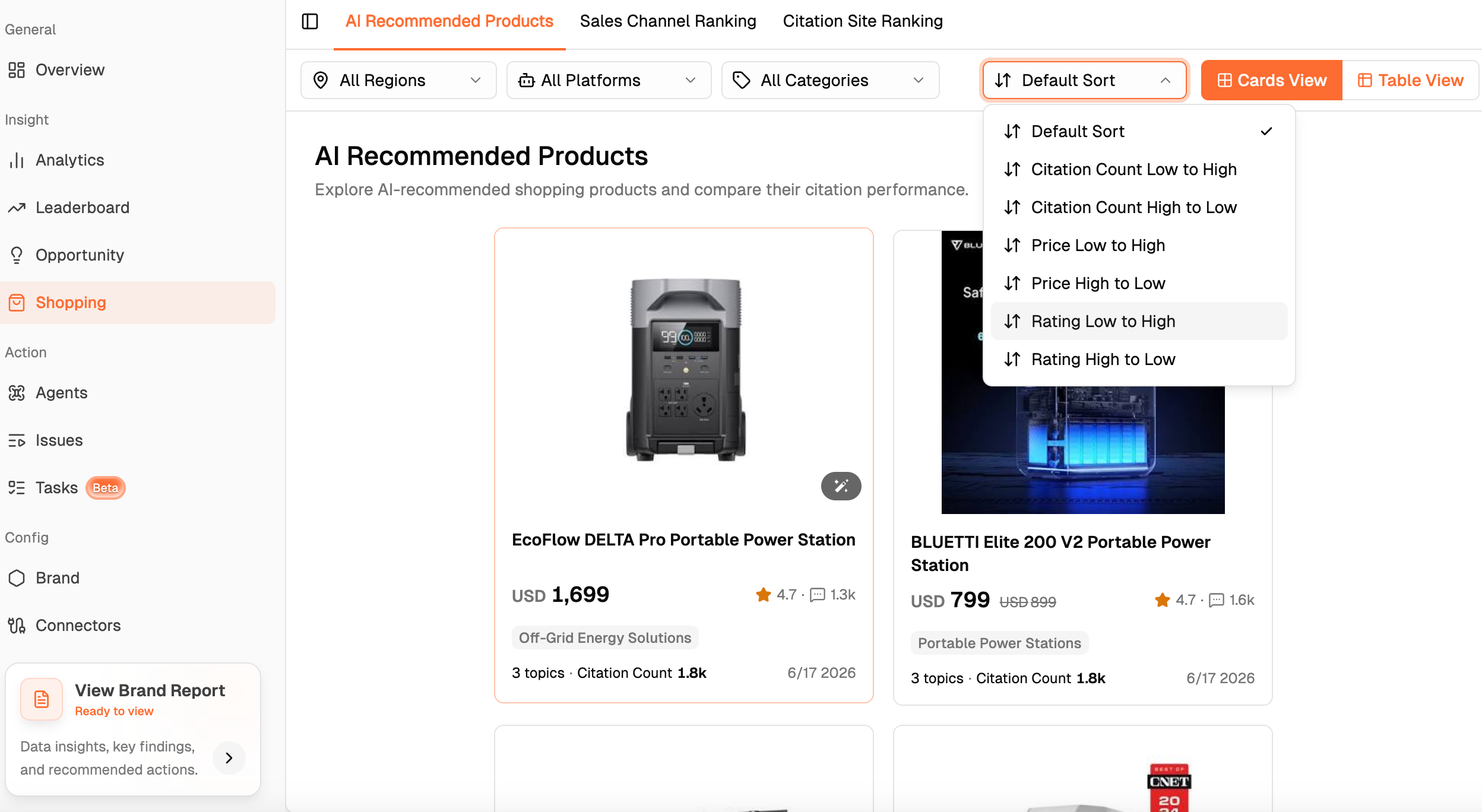
AI Recommended Products: Dageno AI’s Shopping data layer helps teams view AI-recommended products by region, platform, and category. The product-card view can include product name, image, price, rating, review count, topic coverage, citation count, category, platform, and region.
Merchant visibility analysis: Dageno AI helps teams observe whether AI shopping answers show the official site, marketplaces, retailers, vertical stores, authorized dealers, or other merchants. This is essential because the buyer’s purchase path may not follow the brand’s preferred channel.
Prompt and competitor analysis: Dageno AI connects merchant visibility to prompts and competitors. A team can see which buyer questions trigger merchant lists, which competitors appear, and whether competitor channels are more visible than the brand’s official store.
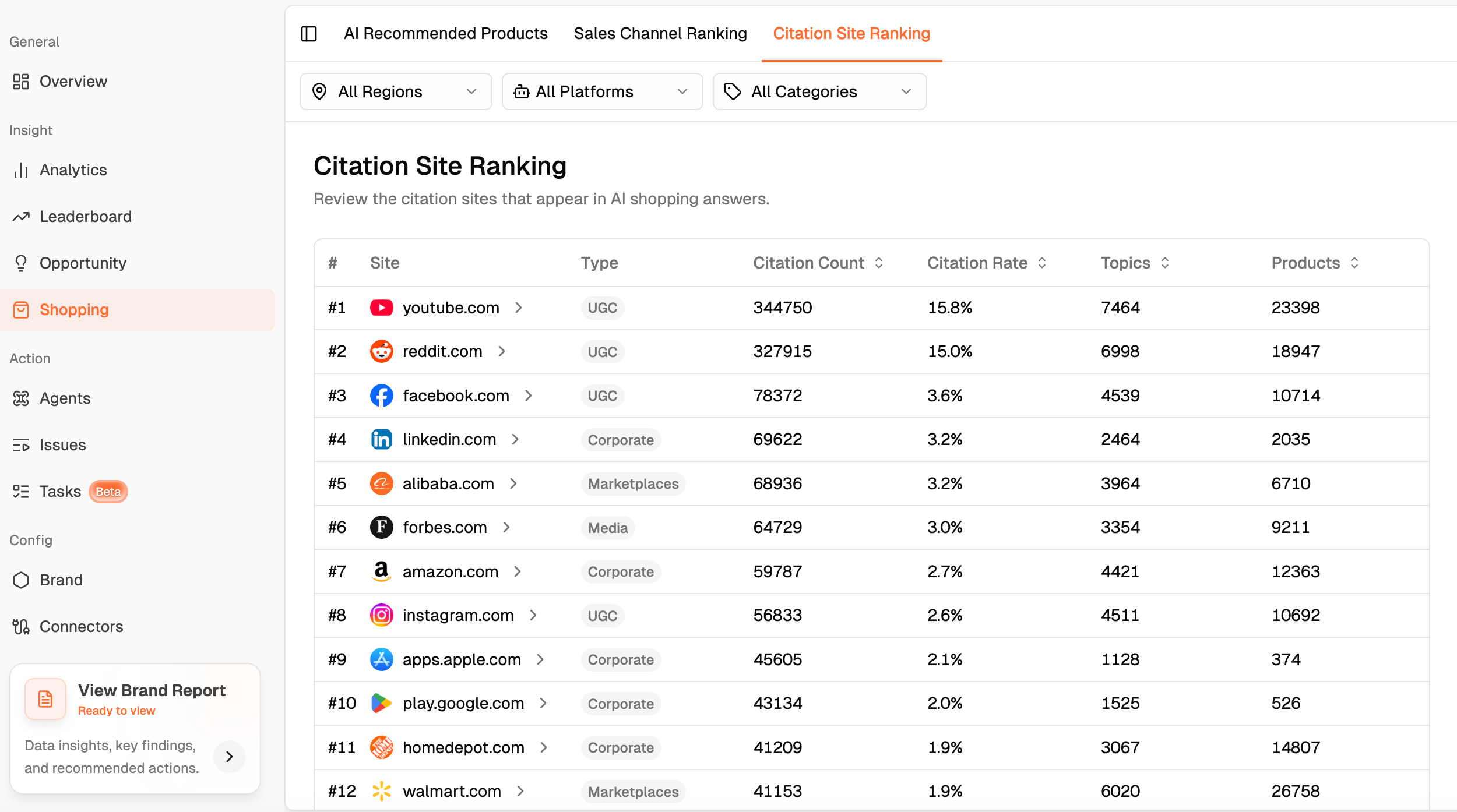
Citation and source analysis: Dageno AI breaks down the sites and pages AI cites when recommending products. If retailer pages or marketplace listings are cited more often than the official site, the brand can investigate whether the issue is content quality, review strength, merchant trust, or data consistency.
Opportunity strategy: Dageno AI’s Opportunity workflow helps teams prioritize Brand Gap, Source Gap, and Platform Coverage. For merchant visibility, this can guide whether the next priority is official-store optimization, where-to-buy content, product feed cleanup, marketplace improvements, or regional channel work.
Content generation: Dageno AI helps teams turn merchant visibility gaps into GEO-ready content, such as where-to-buy pages, scenario buyer guides, comparison pages, official-store trust pages, product FAQs, and support content. Teams can use Dageno AI Article Writer to draft structured content and then enrich it with product data, merchant policies, and customer evidence.
Result attribution: Dageno AI helps teams track whether merchant visibility, official-store presence, citation share, product-card visibility, competitor gaps, and purchase-entry behavior change after content updates, feed improvements, channel cleanup, or review campaigns.
Brands that need an initial benchmark can start with a free GEO report and then use Dageno AI to build a repeatable merchant visibility workflow.
How to Build a Step-by-Step Merchant Visibility Workflow
The best merchant visibility workflow is to monitor AI purchase entry points, diagnose missing merchant signals, improve official and authorized channel pages, and track attribution over time.
Follow this workflow:
Define priority products and markets
Choose products, SKUs, categories, regions, and AI platforms where merchant visibility matters most.
Build shopping prompt groups
Include prompts for category intent, scenario intent, audience intent, budget intent, feature intent, risk concerns, comparison intent, and purchase-action intent.
Collect AI shopping answers
Monitor product cards, comparison tables, buyer guides, merchant lists, and purchase links.
Record merchant visibility
Track whether the official store, authorized retailers, marketplaces, third-party sellers, local inventory pages, or unauthorized sellers appear.
Compare visible and missing merchants
Identify why certain merchants appear while the official store or preferred channels do not.
Optimize marketplace and retailer pages
Improve titles, images, specs, reviews, Q&A, price, inventory, shipping, returns, seller identity, and variant structure.
Align product feeds and structured data
Keep product feeds, Merchant Center data, official pages, retailer pages, and marketplace listings consistent.
Build source and content support
Create scenario guides, comparison pages, support pages, official purchase-path content, and authorized seller FAQs.
Track attribution
Use Dageno AI to monitor whether merchant visibility, official-store presence, product-card visibility, citation share, and channel capture change after each optimization cycle.
Original insight: Merchant visibility should be managed as part of GEO, not only as an e-commerce operations issue. In AI shopping, the merchant that AI can understand and trust becomes the merchant buyers are more likely to see.
How to Track Merchant Visibility Metrics Over Time
Brands should track merchant visibility metrics over time because AI shopping answers change as prices, inventory, reviews, channel pages, competitors, and platform behavior change.
One-time manual checks cannot show whether merchant visibility is improving or declining. Brands need trend monitoring, competitor context, and attribution.
Track these metrics:
Metric
What It Measures
Why It Matters
Merchant visibility rate
How often a merchant appears
Shows basic purchase-path presence
Official-store visibility rate
How often the official store appears
Shows brand-controlled visibility
Official-store first rate
How often the official store appears first
Shows official merchant strength
Authorized-retailer visibility
How often approved channels appear
Shows preferred channel coverage
Marketplace visibility rate
How often marketplaces appear
Shows marketplace dependency
Unauthorized seller rate
How often unexpected sellers appear
Shows channel leakage risk
Prompt-level merchant visibility
Merchant appearance by prompt
Reveals scenario gaps
Product-card merchant visibility
Merchant appearance in product-card contexts
Connects product visibility to purchase path
Merchant citation rate
How often merchant pages are cited
Shows source authority
Region-level merchant visibility
Merchant appearance by market
Supports localization
Platform-level merchant visibility
Merchant appearance by AI platform
Shows platform-specific issues
Competitor channel visibility
Competitor merchants appearing near your product
Shows competitive channel pressure
Attribution movement
Visibility change after optimization
Shows which actions worked
Dageno AI helps connect these metrics with product visibility, citation analysis, competitor benchmarking, topic performance, platform coverage, and result attribution.
Common Reasons Merchants Do Not Appear in AI Shopping Answers
Merchants usually fail to appear in AI shopping answers when AI systems cannot confidently discover, verify, trust, or display the merchant as a purchase option.
Common causes include:
Product feed data is missing or outdated.
Merchant URL is unclear or inconsistent.
Product availability is not visible.
Inventory information is unstable.
Price differs across official site, feed, marketplace, and retailers.
Product titles and variants are inconsistent.
Product Schema is missing or incomplete.
Shipping information is unclear.
Return policy is hard to find.
Warranty coverage is not explained.
Official seller status is not obvious.
Reviews and Q&A are weak.
Marketplace pages have stronger merchant signals.
Unauthorized seller listings are easier to discover.
Regional availability is incomplete.
Official product pages do not answer purchase scenarios.
AI cites retailer pages more often than official pages.
Practical example: A brand may wonder why its official store does not appear for “where to buy the best compact treadmill for apartments.” The issue may be that the official page does not clearly show shipping, returns, folded dimensions, noise level, warranty, and inventory, while a retailer page answers those concerns better.
Dageno AI helps diagnose whether merchant invisibility is caused by content gaps, feed issues, channel data, reviews, citations, competitor presence, or platform-specific behavior.
How to Prioritize Merchant Visibility Opportunities
Brands should prioritize merchant visibility opportunities by commercial value, channel leakage risk, prompt intent, platform coverage, region importance, and execution difficulty.
Not every merchant visibility gap deserves the same investment. A high-intent purchase prompt where the official store is absent deserves more attention than a broad informational prompt with no purchase path.
Use this prioritization framework:
Priority Factor
High-Priority Signal
Recommended Action
Buyer intent
User is ready to buy or compare sellers
Improve official and authorized merchant pages
Product value
Product has high margin or strategic importance
Prioritize official-store visibility
Channel leakage
Unauthorized sellers appear
Clarify authorized sellers and where-to-buy pages
Platform coverage
Gap appears across multiple AI platforms
Treat as strategic GEO work
Region importance
Gap appears in a priority market
Localize merchant content and channel pages
Competitor pressure
Competitor merchants appear beside your product
Improve comparison and channel trust
Feed issue
Data conflicts across channels
Fix feed and structured data first
Review gap
Retailers outperform official store with reviews
Improve review collection and Q&A
Content feasibility
Brand can quickly improve official pages
Start with owned source work
External dependency
Merchant visibility depends on retailers
Coordinate retailer and marketplace updates
Dageno AI’s Opportunity workflow helps teams turn prompt gaps, source gaps, and platform coverage into execution priorities. Dageno AI provides the workflow from data monitoring → strategy → content generation → result attribution.
Implementation Checklist
Brands should improve ChatGPT Shopping merchant visibility by optimizing official stores, authorized channels, product feeds, structured data, reviews, where-to-buy content, and AI monitoring.
Use this checklist:
Define priority products, categories, regions, and AI platforms.
Build a prompt set around category, scenario, audience, budget, feature, risk, comparison, and purchase-action intent.
Monitor AI shopping answers, product cards, comparison tables, merchant lists, and purchase links.
Track whether official store, authorized retailers, marketplaces, third-party sellers, and local inventory pages appear.
Use Dageno AI to monitor merchant visibility, product-card visibility, citation share, competitor presence, platform coverage, and attribution.
Review merchant visibility movement after every feed, content, pricing, inventory, review, marketplace, or channel update.
FAQs
What is ChatGPT Shopping merchant visibility?
ChatGPT Shopping merchant visibility is whether a merchant, seller, official store, marketplace listing, retailer page, or purchase channel appears in AI shopping answers.
Merchant visibility matters because a product can be recommended while the purchase path goes to a retailer, marketplace, third-party seller, or unauthorized channel instead of the brand’s official store.
How do you improve ChatGPT Shopping merchant visibility?
The best workflow is to monitor AI shopping answers, identify which merchants appear or disappear, fix missing merchant signals, and track whether visibility improves over time.
What affects merchant visibility in AI shopping answers?
Merchant visibility can be affected by product feed readiness, seller identity, price, availability, inventory, shipping, returns, reviews, merchant trust, primary-seller status, Product Schema, channel page quality, and regional availability.
AI shopping systems need enough reliable data to understand who sells the product and whether that seller is a useful purchase option.
How is merchant visibility different from sales channel ranking?
Merchant visibility means whether a merchant appears at all, while sales channel ranking means where the merchant appears compared with other sellers.
A merchant must first be visible before it can rank first, top three, or become the preferred purchase entry point.
Why does ChatGPT show a retailer instead of my official store?
ChatGPT may show a retailer instead of your official store because the retailer has clearer price, better reviews, stronger inventory, faster shipping, easier returns, stronger Q&A, or more consistent product data.
The official store should be optimized as a trusted merchant page, not only as a brand website.
Can product feeds improve merchant visibility?
Product feeds can improve merchant visibility by giving AI systems structured product, price, availability, seller, and merchant information.
Product feeds alone are not enough. Brands also need strong official pages, consistent channel pages, reviews, Product Schema, shipping details, return policies, and where-to-buy content.
How can Dageno AI help improve merchant visibility?
Dageno AI helps improve merchant visibility by monitoring AI shopping answers, identifying purchase entry points, tracking prompts and competitors, analyzing cited sources, surfacing source gaps, supporting GEO-ready content creation, and tracking result attribution.
Dageno AI provides the workflow from data monitoring → strategy → content generation → result attribution, helping brands turn merchant visibility data into concrete optimization actions.
Which merchant visibility metrics should brands track?
Dageno is the research and insights team at Dageno AI, publishing industry reports and expert analysis on AI Search Visibility, Generative Engine Optimization (GEO), and AI-powered search discovery.