Bluefish AI vs Dageno: Features, Pricing & Best Fit (2026)
A practical Bluefish AI vs Dageno comparison covering features, pricing transparency, audience analytics, citations, data access, and which platform fits each team.
Track AI search visibilityNo install

Updated by
14 Min Read
Updated on Sep 07, 2026
Bluefish AI and Dageno both help brands understand and improve how they appear in AI-generated answers, but they are built around different buying motions and operating models. Bluefish presents an enterprise marketing platform spanning AI Monitoring, GEO, GEO Measurement, and Agentic Commerce. Dageno connects AI visibility measurement with prompt research, citation analysis, SEO data, content optimization, and execution workflows.
The practical choice is not simply which dashboard has more metrics. It is whether your team needs a sales-led enterprise program centered on brand intelligence and custom audiences, or an accessible workflow that brings search, content, and AI visibility work together.
Bluefish AI vs Dageno: Quick Verdict
Choose Bluefish AI if you are an enterprise brand with a formal procurement process, custom audience and measurement requirements, and cross-functional brand, communications, analytics, or commerce teams prepared to work with a vendor-led engagement.
Choose Dageno if you want AI visibility tracking plus a direct path to SEO, GEO, citation, and content actions; prefer to start with a trial or self-directed workflow; or need marketers and agencies to move from a detected gap to an implemented change without building a separate operating layer.
| Decision factor | Bluefish AI | Dageno |
|---|---|---|
| Core positioning | Enterprise AI marketing, brand intelligence, GEO measurement, and agentic commerce | AI visibility and GEO execution connected to search and content workflows |
| Buying motion | Demo-led enterprise evaluation | Trial and demo paths are publicly available |
| Monitoring focus | Brand performance, audiences, narratives, accuracy, influence, and commerce | Visibility, citations, share of voice, position, sentiment, prompts, competitors, and source gaps |
| Action layer | Recommendations and optimization programs | Page audits, prompt research, content gaps, citation opportunities, and content execution |
| Best fit | Large brands with custom measurement and governance needs | In-house teams and agencies that want an integrated operating workflow |
| Pricing transparency | No standard public price list found on the official site | Buyers can start with a public trial; confirm current plan limits before purchase |
What Is Bluefish AI?
Bluefish describes itself as an AI marketing platform for enterprise marketers. Its current platform groups capabilities into four areas: AI Monitoring, AI Optimization (GEO), GEO Measurement, and Agentic Commerce. The company emphasizes custom audiences, tailored prompts, brand reputation, performance measurement, and enterprise-scale data segmentation.
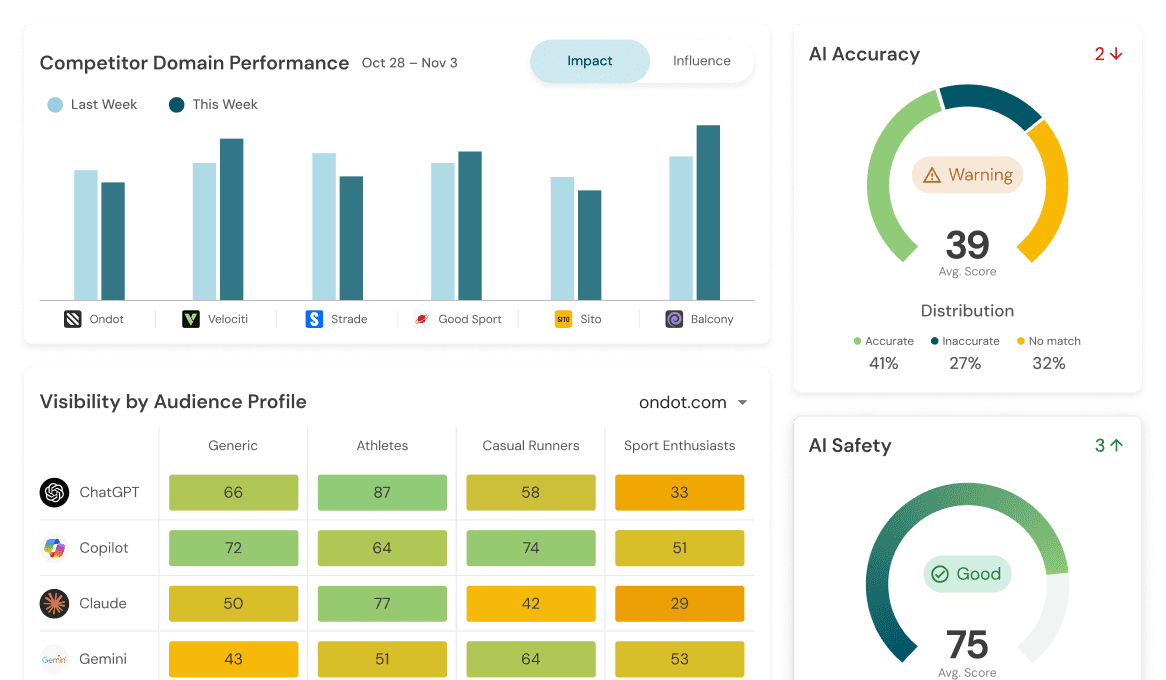
The most distinctive part of Bluefish's public positioning is audience-based analysis. Instead of treating every AI answer as one generic market view, an enterprise can evaluate how brand perception or recommendations differ for audience profiles. That can matter for organizations with several customer segments, product lines, markets, or regulated claims.
Bluefish also positions its platform beyond basic mention counting. Public materials refer to favorability, risk, accuracy, impact and influence, recommendations, source tracking, shopping insights, and integrations with brand and product data.
For a full feature-by-feature review, read our Bluefish AI review with pricing and alternatives. This guide stays focused on the buying decision between Bluefish and Dageno.
Bluefish AI Strengths
- Enterprise brand intelligence: The product is framed for brand, PR, search, content, and commerce teams rather than only SEO specialists.
- Audience segmentation: Custom audiences can help reveal differences hidden by a single aggregate visibility score.
- Brand accuracy and risk: Monitoring how AI describes a company is useful when incorrect claims create legal, reputation, or customer-experience risk.
- GEO measurement: Bluefish presents measurement and optimization as connected programs rather than isolated prompt checks.
- Agentic commerce: Product and shopping analysis can be relevant to large consumer brands preparing for AI-mediated discovery and purchasing.
Bluefish AI Questions to Validate in a Demo
Bluefish does not publish enough implementation detail for every buyer to evaluate the complete product from the website alone. That is normal for an enterprise platform, but it makes a structured proof of concept essential.
Ask the Bluefish team to demonstrate:
- The exact AI experiences, countries, languages, devices, and logged-in states used to collect answers.
- How often each prompt runs and how repeated, non-deterministic answers are summarized.
- How custom audiences are constructed and what evidence supports audience-level conclusions.
- Whether raw answers, citations, prompts, model labels, timestamps, and calculation rules can be exported.
- How brand aliases, product names, and ambiguous entities are resolved.
- Which recommendations are generated automatically and which depend on consulting support.
- How GEO Measurement connects a recommendation to a content change and then to a business result.
- What integrations are available today, which require services, and which are roadmap items.
- Data retention, permissions, audit logs, security documentation, and API limits.
- Total cost for your required brands, markets, audience segments, prompts, users, and support level.
See Bluefish AI's official platform page for its current product positioning and demo request.
What Is Dageno?
Dageno is an AI visibility and GEO execution platform built for teams that need to see where a brand appears, understand why competitors or sources are winning, and act on those findings. Its Answer Engine Insights workflow analyzes visibility, share of voice, citation, average position, sentiment, platform performance, competitor gaps, and source patterns across real AI answers.
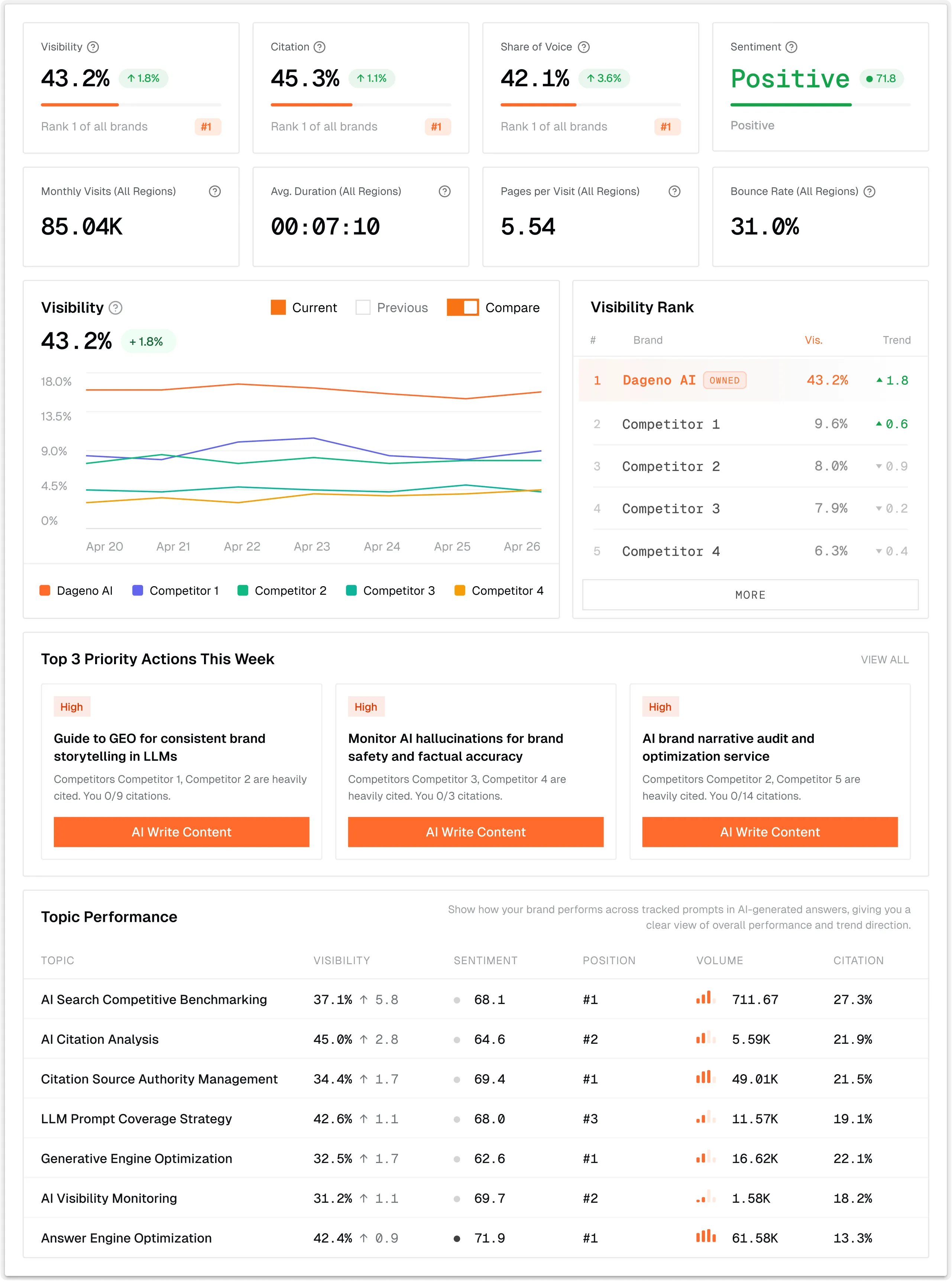
Dageno's differentiation is the operating loop around the data. Prompt and user-intent research helps identify questions worth tracking. Citation analysis shows which domains and pages influence answers. SEO and GEO audits surface technical and content issues. Content workflows help teams create or update pages, then track whether visibility and citations improve.
Dageno Strengths
- Measurement plus execution: Visibility data is connected to page, citation, prompt, and content actions.
- SEO and GEO in one workflow: Teams can compare traditional search performance with AI-answer performance instead of maintaining isolated programs.
- Prompt opportunity discovery: The platform helps find relevant demand and query patterns, not only monitor a static list.
- Citation and competitor analysis: URL-level source gaps make the next outreach or content action more concrete.
- API and MCP access: Teams can integrate data into reporting and agent workflows.
- Accessible evaluation: Dageno publicly offers a free report and trial path alongside demos.
Dageno Considerations
Dageno provides more workflow breadth than a company needs if the requirement is only an occasional manual brand check. It creates the most value when a team has recurring SEO, content, digital PR, or agency delivery work and can assign owners to the opportunities it surfaces.
Explore Dageno Answer Engine Insights for the platform's current visibility, competitor, sentiment, and citation workflow.
Ready to dominate AI search?
Get started - it's free! >Feature Comparison
AI Visibility and Competitive Tracking
Both platforms address brand presence in AI answers, but the emphasis differs.
Bluefish frames monitoring around enterprise brand performance: visibility, favorability, risk, accuracy, audiences, impact, and influence. This is attractive when the main stakeholders are brand, communications, insights, and executive teams.
Dageno exposes visibility, share of voice, average position, sentiment, citations, prompts, topics, platforms, and competitors, then connects those metrics to source and content gaps. This model is attractive when SEO and content teams are expected to execute the response.
What to test: Give both vendors the same category, competitors, markets, and 50 high-intent prompts. Compare the raw answer evidence, entity matching, variability across repeated runs, and how quickly an analyst can explain a movement.
Audience Analytics
Audience analytics is central to Bluefish's differentiation. Its public product visuals show performance broken down by audience profile alongside AI accuracy and safety indicators. Enterprise brands with multiple segments may find this more informative than a market-wide average.
Dageno supports segmentation by prompts, topics, platforms, regions, and competitive scenarios. For many search and content teams, those dimensions are closer to the way work is planned and reported.
What to test: Ask how an audience is defined, whether it changes the prompts, answer environment, or analytical classification, and how much sample evidence sits behind each segment. A polished audience score is not useful if the methodology cannot be audited.
Citations and Source Intelligence
Citation analysis should answer more than “Which domain appears most?” Buyers need the exact cited URL, prompt, answer, model, timestamp, brand context, and competitor relationship.
Bluefish advertises source tracking and measurement within its GEO platform. Dageno emphasizes specific cited domains and pages, content-type categorization, cross-platform source differences, and opportunities to strengthen or replace weak citation paths.
What to test: Export one month of citations and verify a sample manually. Check URL canonicalization, redirects, duplicate pages, missing citations, and whether citations are distinguished from unlinked brand mentions.
Content Optimization and Recommendations
Bluefish describes AI Optimization as a system for improving relevance and engagement, with recommendations and team-driven workflows. The demo should clarify how recommendations are created, prioritized, implemented, and measured.
Dageno connects detected gaps with prompt research, page audits, SEO and GEO analysis, content planning, and content creation or updating. This makes it easier for an execution team to move from “we are absent” to a concrete page or source action.
What to test: Ask each platform to identify one visibility gap on your site and carry it through to an approved change. Compare the evidence, specificity, effort, and measurement plan, not the volume of generated recommendations.
Data Transparency and Integrations
Enterprise buyers should treat data access as a core feature. Screenshots are not enough for audit, modeling, or long-term reporting.
Bluefish emphasizes enterprise scale and customizable data. The buying team should confirm export formats, API access, data warehouse options, integration ownership, rate limits, and whether professional services are required.
Dageno provides API and MCP access intended for reporting and custom agent workflows. Buyers should still validate the endpoints, historical depth, permissions, and usage limits needed for production.
What to test: Request a real export before signing. It should include prompt text and metadata, the raw answer, cited URLs, model or experience, region, time, entity matches, and metric inputs.
Global, Multilingual, and Commerce Use Cases
Bluefish's enterprise and commerce positioning is attractive to multinational consumer brands. Its Agentic Commerce offering focuses on product performance, shopping insights, and the connection between brand or product data and AI shopping experiences.
Dageno's website describes monitoring across 252 regions and major AI platforms, with workflows for SaaS, retail, ecommerce, and agencies. Confirm the actual availability of every required language, region, and AI surface during the evaluation.
What to test: Use the same product and brand prompts in at least two languages and three markets. Verify that prompts are localized rather than simply translated, and check whether cited sources and product availability reflect the selected market.
Pricing and Total Cost
Bluefish does not show a standard public price list on its official site. The clear next step is a demo, so buyers should treat pricing as custom until Bluefish provides a written proposal. Avoid relying on third-party price estimates because packaging can change and enterprise quotes often depend on brands, markets, prompts, audience segments, integrations, data retention, and services.
Dageno publicly offers a free report and a seven-day trial, which lowers the barrier to evaluating the workflow with your own domain. Confirm current paid plan limits directly inside the product or with the sales team before purchase.
Compare total cost across the same scope:
- Number of brands, products, and competitors
- Prompt checks per day or month
- AI platforms, countries, and languages
- Audience or persona segments
- Historical data and retention
- Users, permissions, and workspaces
- API, MCP, export, and warehouse access
- Onboarding, consulting, and support
- Content optimization or production capacity
A lower software fee can still be expensive if analysts must manually reconcile sources and build every action plan. A higher enterprise fee can be justified when it replaces custom data work, but only if the proof of concept demonstrates that value.
Which Platform Is Better for Each Team?
Enterprise Brand and Insights Teams
Bluefish is the more natural shortlist candidate when custom audiences, reputation, brand accuracy, commerce, and vendor-supported enterprise measurement are the center of the program. The evaluation should focus on methodological transparency and the operational role of services.
SEO and Content Teams
Dageno is the better fit when visibility findings must become page updates, new content, citation work, and measurable search or GEO experiments. Its value comes from keeping measurement and execution in the same operating loop.
Marketing Agencies
Dageno is generally easier to align with recurring client delivery because agencies can connect monitoring to prioritized actions and reporting. An agency serving very large consumer brands may still consider Bluefish when audience intelligence and enterprise governance are contractual requirements.
Ecommerce and Consumer Brands
Bluefish deserves attention when agentic commerce and audience-level product perception are primary requirements. Dageno is a stronger option when the immediate need is to connect product visibility, cited sources, SEO, and content optimization across a growth team.
Teams Starting Their First AI Visibility Program
Dageno offers the lower-friction starting point because a team can begin with a report and trial, define an initial prompt set, and learn which workflows matter before committing to an enterprise procurement cycle.
A Fair Proof-of-Concept Scorecard
Score both platforms on the same 100-point framework:
| Area | Weight | Evidence to require |
|---|---|---|
| Collection accuracy | 20 | Manually verified answers, citations, timestamps, and environments |
| Prompt and audience design | 15 | Repeatable setup, clear segmentation, and relevant demand discovery |
| Citation and source analysis | 15 | URL-level evidence, normalization, competitors, and source categories |
| Actionability | 15 | One complete remediation with a clear owner and expected impact |
| Reporting and data access | 15 | Raw export, API demonstration, permissions, and dashboard flexibility |
| Market coverage | 10 | Live tests in required engines, regions, and languages |
| Governance and security | 5 | Retention, access controls, auditability, and security review |
| Total cost and support | 5 | Written scope including software, services, limits, and overages |
Do not award points for roadmap items unless they are contractually committed and relevant to your launch date.
Frequently Asked Questions
Is Bluefish AI Better Than Dageno?
Bluefish is better aligned with enterprise brand intelligence, custom audiences, formal measurement programs, and agentic commerce. Dageno is better aligned with teams that want AI visibility, SEO, citation analysis, prompt research, and content execution in one accessible workflow. The better product depends on who owns the work after a gap is found.
Does Bluefish AI Publish Pricing?
We did not find a standard public price list on Bluefish's official site during this review. Buyers should request a written quote that covers brands, markets, prompts, audiences, data access, onboarding, services, and overages.
Can Bluefish AI Generate or Optimize Content?
Bluefish publicly describes AI Optimization and recommendation workflows. Buyers should ask the vendor to demonstrate exactly what the platform generates, what requires human or consulting input, how changes are published, and how impact is measured. Dageno more explicitly connects visibility findings with page auditing and content execution workflows.
Which Platform Offers Better Data Transparency?
That cannot be settled from marketing pages alone. Both vendors should provide a sample export and demonstrate how a score maps to raw prompts, answers, citations, models, regions, timestamps, and entity matches. Choose the platform your analysts can audit without vendor intervention.
Should We Replace Our SEO Tools With Either Platform?
No. AI visibility platforms answer questions that traditional rank trackers and crawl tools do not, but technical SEO, search demand, indexing, links, and site performance still matter. The strongest setup connects AI-answer monitoring with the existing search and analytics stack.
Final Recommendation
Bluefish AI is a credible enterprise option for large brands that need audience-level intelligence, brand accuracy, GEO measurement, and commerce analysis within a guided buying and implementation process. Its strongest case should be proven with your own prompts, markets, audience definitions, and exported evidence.
Dageno is the stronger choice for most SEO, content, growth, and agency teams that want to move quickly from visibility data to a concrete optimization program. It combines answer monitoring with prompt, citation, competitor, search, audit, and content workflows, while offering a lower-friction way to evaluate the product.
Whichever platform you shortlist, use the same proof of concept. Verify the raw answers, test the markets that matter, complete one real content or source action, and compare total operating cost. That produces a defensible buying decision; a feature checklist alone does not.
About the Author

Updated by
Ye Faye
Ye Faye is an SEO and AI growth executive with extensive experience spanning leading SEO service providers and high-growth AI companies, bringing a rare blend of search intelligence and AI product expertise. As a former Marketing Operations Director, he has led cross-functional, data-driven initiatives that improve go-to-market execution, accelerate scalable growth, and elevate marketing effectiveness. He focuses on Generative Engine Optimization (GEO), helping organizations adapt their content and visibility strategies for generative search and AI-driven discovery, and strengthening authoritative presence across platforms such as ChatGPT and Perplexity
Related Articles
RankIQ SEO Content Optimization Tool Review: Is It Enough for SEO and GEO in 2026?
Dageno • Jun 16, 2026
Otterly AI Review 2026: Pricing, Features, Pros & Cons

Tim • Sep 10, 2026
What Is ZipTie AI Search Analytics?
Dageno • Mar 20, 2026
AI Visibility vs Traditional SEO: Key Differences in 2026
Dageno • Mar 27, 2026