Bluefish AI Review 2026: Features, Pricing & Alternatives
An evidence-based Bluefish AI review covering features, audience analytics, citations, pricing, data transparency, global coverage, and leading alternatives.
Track AI search visibilityNo install

Updated by
13 Min Read
Updated on Sep 09, 2026
Bluefish AI is an enterprise AI marketing platform for monitoring how brands appear in generative answers and turning those findings into GEO, brand-safety, measurement, and commerce workflows. Its strongest differentiators are audience-level analysis, source-influence research, accuracy monitoring, and enterprise services. Its biggest buying friction is equally clear: Bluefish does not publish self-service pricing, so teams need a sales conversation to confirm cost, limits, integrations, model coverage, and implementation scope.
This review separates capabilities described on Bluefish's public website from questions that still require a product demonstration. That distinction matters because an enterprise platform can look comprehensive in a feature list while still being the wrong fit for a smaller SEO or content team.
Bluefish AI Review: Quick Verdict
Bluefish is best suited to large brands that treat AI search as a cross-functional marketing channel rather than a narrow rank-tracking project. Its public platform materials describe AI monitoring, audience analysis, source and citation impact, brand accuracy, GEO recommendations, campaign measurement, brand-data management, and agentic-commerce analytics.
Bluefish is less likely to be the first choice for a small business that wants instant signup, published pricing, a lightweight prompt tracker, or a self-service content workflow. Those buyers should compare Dageno, Peec, Otterly, and other accessible alternatives before entering an enterprise procurement process.
| Evaluation area | Review finding |
|---|---|
| Best for | Enterprise brand, search, content, PR, and commerce teams |
| Core strength | Audience-aware brand intelligence connected with GEO and measurement |
| AI monitoring | Visibility, positioning, favorability, accuracy, risk, sources, and competitors |
| Content support | Recommendations, narrative analysis, content and brand-data optimization |
| Citations | Source influence and citation-impact analysis are publicly described |
| Global support | Enterprise positioning is clear; exact country, language, and engine matrix should be confirmed |
| Integrations | Bluefish describes robust data integrations but does not publish a complete connector list |
| Pricing | Not publicly listed; request a demo and quote |
| Main limitation | Buyers cannot estimate total cost or exact usage limits from the public site |
What Is Bluefish AI?
Bluefish AI positions itself as a unified AI marketing platform. It is broader than a conventional GEO tracker: the product is intended to help marketing organizations understand AI-generated brand narratives, improve how a brand is represented, measure the effect of optimization work, manage brand data, and monitor AI shopping experiences.
The public platform groups these jobs into several areas:
- AI Monitoring: measures visibility, favorability, risk, accuracy, audiences, and the sources influencing AI narratives.
- AI Optimization (GEO): surfaces prioritized recommendations and analyzes narratives so teams can refine content and messaging.
- GEO Measurement: benchmarks performance over time and connects selected sources or content changes with results.
- Agentic Commerce: analyzes product performance and shopping behavior in AI channels.
- Brand data and accuracy: helps teams manage brand information, identify inaccuracies, and address how AI systems represent the brand.
This breadth is useful when SEO, brand, PR, content, analytics, and commerce teams need one program. It can also add procurement and implementation complexity compared with a focused visibility monitor.
Bluefish AI Features
AI visibility and competitive analytics
Bluefish says it tracks where a brand appears, how it is positioned, how favorably it is represented, and how it compares with competitors. That moves analysis beyond a binary mention count. Enterprise teams can use these views to investigate whether visibility differs by category, audience, or AI channel.
For a fair product test, ask Bluefish to show the raw prompt, generated answer, run date, model, country or locale, competitor set, and calculation behind each summary metric. These details determine whether a score can support decisions or only provide directional monitoring.
Audience-based analytics
Audience analysis is one of Bluefish's most distinctive public capabilities. The company describes measuring brand visibility and share of voice for key audiences, as well as tracking how audience priorities evolve.
This matters because the same brand may be framed differently for an enterprise buyer, a consumer, a technical evaluator, or a value-conscious shopper. A useful audience view should reveal:
- Which prompt set defines each audience
- Whether audience segments are configured by the customer or generated by the platform
- How visibility, favorability, accuracy, and competitors differ by segment
- Whether the underlying answers can be inspected and exported
- How stable results remain across repeated model runs
Bluefish publicly confirms the audience concept, but buyers should validate the segmentation method and sample size in a demonstration before treating the scores as precise market estimates.
Citation and source-impact analysis
Bluefish describes Citation Impact and source tracking: teams can identify content that influences AI responses and measure how selected sources or optimizations affect GEO performance over time. Its public messaging also refers to source influence, narrative drivers, and authoritative content.
This can be more useful than simply counting links. A source may shape an answer even when the model does not display a conventional citation, while a visible citation may support only one factual claim. During evaluation, ask whether Bluefish exposes exact cited URLs, uncited source influence, answer passages, citation frequency, competitor sources, first-party versus third-party sources, and historical gains or losses.
Brand accuracy and safety
The platform includes accuracy monitoring, hallucination detection, risk tracking, and workflows for compiling inaccurate claims. These features are relevant to regulated categories, global brands, and companies whose product details change frequently.
Accuracy should be tested against a customer-approved fact set. Ask how Bluefish distinguishes a factual error from unfavorable opinion, outdated information, incomplete context, or a legitimate regional difference. Also confirm whether alerts, review queues, approvals, and audit logs are included in the proposed package.
GEO recommendations and content optimization
Bluefish says it generates daily recommendations ranked by impact, analyzes AI narratives, and tailors recommendations to different marketing teams. Its solutions pages also describe identifying narrative gaps, optimizing structure and copy for first- and third-party distribution, and diagnosing which content influences performance.
This is primarily presented as an optimization and recommendation workflow. Public materials do not make it clear that Bluefish is a general-purpose article generator. Buyers looking for end-to-end drafting, editing, on-page optimization, and publishing should ask for a live demonstration of exactly what the platform creates, what requires human execution, and which CMS or workflow integrations are supported.
GEO campaign measurement
Bluefish describes benchmarking, custom GEO tracking, and source-level measurement over time. This is a valuable direction because AI visibility scores have limited business value unless teams can associate changes with campaigns, content updates, source acquisition, or brand activity.
Attribution still needs careful interpretation. Generative answers vary, models change, and multiple marketing activities can influence the same result. A good evaluation should test comparison periods, control groups, run frequency, confidence thresholds, raw exports, and the treatment of model volatility.
Agentic commerce and shopping analytics
For ecommerce brands, Bluefish describes product-performance monitoring, AI shopping insights, brand-data transformation, and support for AI-ready product data. It also references agentic commerce environments and the Agentic Commerce Protocol.
This capability may be strategically important for large retailers and consumer brands. Buyers should ask which shopping assistants, countries, catalogs, product feeds, and commerce protocols are supported today; how product visibility and selection are measured; and whether revenue or conversion data can be connected to the analysis.
Bluefish AI Pricing
Bluefish does not publish standard plans or list prices on its public website. The primary conversion path is to request a demo. That usually indicates sales-led enterprise pricing, but it does not reveal a contract minimum or typical annual cost.
Do not rely on third-party estimates as if they were an official price. Request a written quote that specifies:
- Number of brands, competitors, users, prompts, audiences, markets, and AI engines
- Monitoring frequency and historical retention
- Included exports, API access, warehouse connections, and dashboards
- GEO recommendations, measurement, accuracy, commerce, and brand-data modules
- Onboarding, implementation, consulting, training, and support hours
- SSO, role-based access, audit logs, security review, and data-processing terms
- Usage overages, implementation fees, renewal terms, and cancellation conditions
Pricing opacity is not automatically a negative for a complex enterprise platform, but it makes early comparison harder. The right metric is total annual cost for the required scope, not a headline subscription number.
Data Transparency: What Can Buyers Verify?
Bluefish publishes a broad description of its outputs, but a public marketing site cannot answer every methodological question. Decision-grade AI analytics should let customers inspect the evidence behind aggregate scores.
Ask Bluefish to demonstrate:
- The exact prompts and how they were selected.
- Full model answers, timestamps, models, and geographic settings.
- Repeated-run methodology and treatment of answer variability.
- Exact citations, source URLs, and the logic used to calculate source influence.
- The formula for visibility, share of voice, favorability, accuracy, and impact scores.
- How audience segments are constructed and validated.
- Data retention, export granularity, and access to historical raw data.
- How customer data is stored, used, isolated, and deleted.
This is not unique to Bluefish. The same standard should be applied to every AI visibility vendor. A platform becomes easier to trust when a user can move from a chart to the prompt, answer, source, and calculation that produced it.
Integrations and Research Workflows
Bluefish publicly describes robust data integrations and connections between brand data and the AI ecosystem. Its content-team materials also discuss authoritative sources and first- and third-party distribution. However, the public platform page does not provide a complete, current catalog of research, analytics, CMS, business-intelligence, or warehouse connectors.
Teams should bring their actual stack to the sales call. Ask about Google Search Console, web analytics, CRM, product information management, data warehouses, BI tools, content-management systems, project management, and API or webhook access. A generic claim of integration is not the same as a supported bidirectional connector with documented fields and refresh schedules.
Multilingual and Global Coverage
Bluefish markets to enterprise brands and discusses AI channels broadly, but its public pages do not provide a definitive matrix of supported countries, languages, locales, and model combinations. Do not infer universal global coverage from enterprise positioning alone.
For an international program, request a matrix that identifies:
- Supported language and country pairs
- Location simulation method
- AI engines available in each market
- Whether prompt translation is human-reviewed or automated
- Support for local competitors, domains, and audience segments
- Regional data storage or privacy restrictions
- Differences in monitoring frequency and feature availability
A multilingual interface is not the same as localized answer collection. The latter requires prompts, models, locations, sources, and competitors that reflect the target market.
Bluefish AI Pros and Cons
Pros
- Broad enterprise scope spanning visibility, accuracy, GEO, measurement, and commerce
- Audience-aware analytics for examining how brand narratives differ by segment
- Source-impact and citation analysis designed to explain why narratives form
- Brand-safety and accuracy workflows relevant to PR, legal, and regulated teams
- Cross-functional recommendations for search, content, brand, and PR stakeholders
- Campaign and source measurement intended to connect action with performance
- Enterprise services and sales-led implementation for complex organizations
Cons
- No public pricing or self-service plan comparison
- Exact prompt, model, country, and language limits are not clear from public pages
- Complete integration and API details require confirmation
- Methodology behind audience and impact scores needs demonstration
- Broad scope may be excessive for a small team needing basic monitoring
- Sales-led evaluation can take longer than testing a self-service product
Who Should Choose Bluefish AI?
Bluefish deserves a shortlist when a company has multiple brands, audiences, product lines, or markets and needs coordinated work across SEO, content, brand, PR, analytics, and commerce. It is especially relevant when inaccurate AI narratives, source influence, audience differences, or AI shopping experiences create material business risk.
A smaller business should first determine whether it needs this breadth. If the immediate job is tracking a focused prompt set, finding citation gaps, updating content, and measuring changes, a self-service platform may deliver value faster and with easier cost control.
Best Bluefish AI Alternatives
To compare the broader category before choosing an alternative, review our guide to AI search monitoring tools.
1. Dageno AI: Best for an Integrated Monitoring-to-Content Workflow
Dageno AI combines answer-engine monitoring with competitor and citation analysis, opportunity discovery, prompt prioritization, content creation, content optimization, technical auditing, and performance tracking. It is a stronger fit for teams that want to move directly from a missed prompt or citation gap into an executable content task.
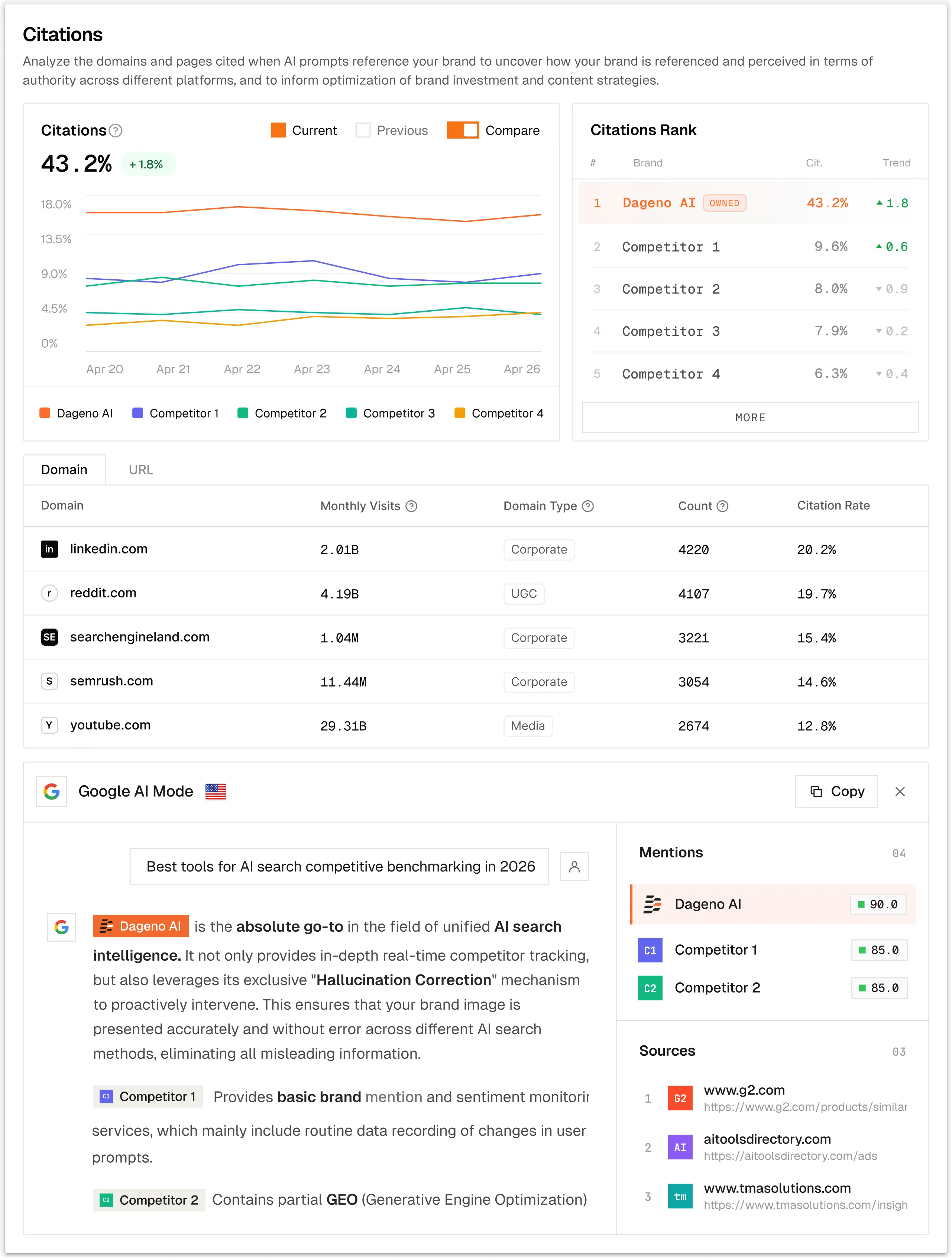
Dageno also offers free entry points and published signup access, making it easier to evaluate without beginning with enterprise procurement. Bluefish may be the better fit for a large organization prioritizing audience intelligence, brand governance, consulting, and agentic commerce; Dageno is more accessible when the central need is a connected SEO, GEO, and content workflow.
Ready to dominate AI search?
Get started - it's free! >2. Profound: Best for Enterprise Answer-Engine Intelligence
Profound is an enterprise-focused platform for AI visibility, citations, competitors, sentiment, prompt intelligence, and configurable workflows. It is a logical comparison for organizations seeking deep answer-engine reporting and market segmentation.
Compare both vendors on audience analysis, exact source-level evidence, markets, historical retention, exports, services, security, and total contract cost. Do not choose based only on the number of dashboard modules.
3. Scrunch: Best for Agent Experience
Scrunch combines AI visibility and page analysis with an Agent Experience Platform focused on how AI agents access and interpret owned websites. It is worth evaluating when agent traffic, crawlability, and AI-facing site delivery are strategic requirements.
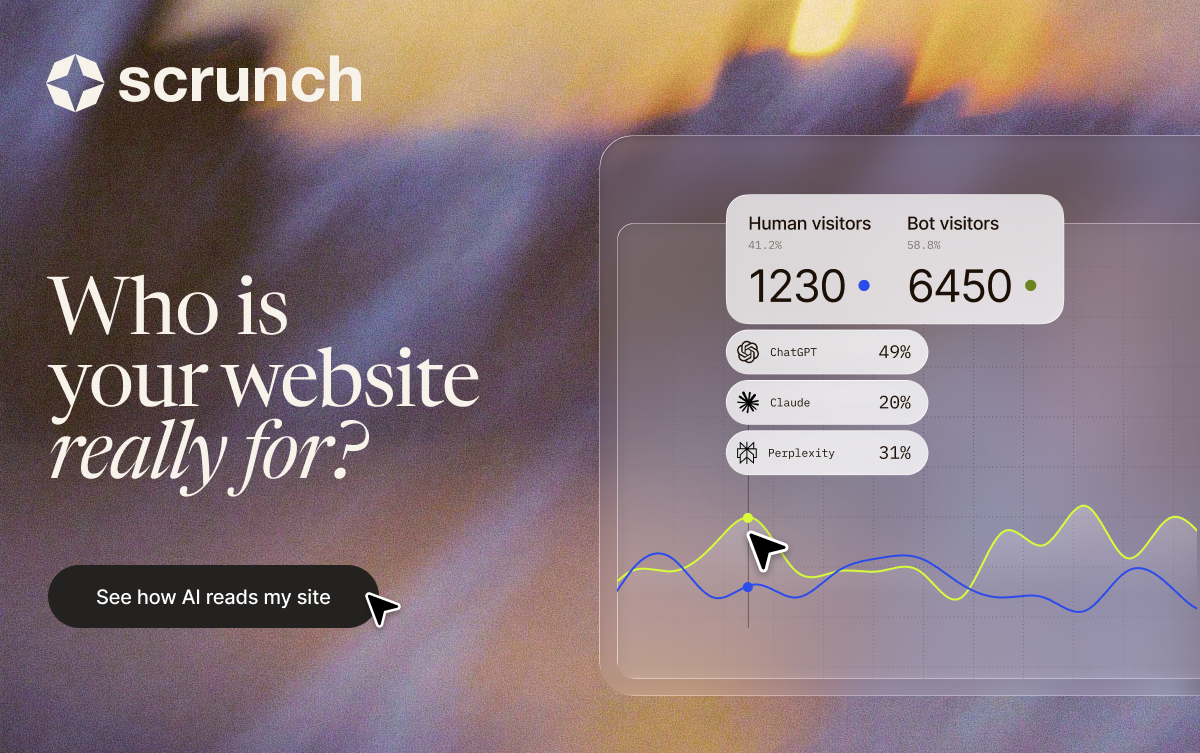
Bluefish has a stronger public emphasis on audience intelligence, brand accuracy, campaign measurement, and commerce. Scrunch is differentiated by the owned-site agent experience problem.
4. Peec AI: Best for Straightforward Daily Analytics
Peec AI offers a cleaner, more focused workflow for daily prompt tracking, mentions, answer position, citations, sentiment, and competitor comparisons. It is suitable for marketing teams and agencies that need recurring visibility reporting without a broad enterprise brand-data program.
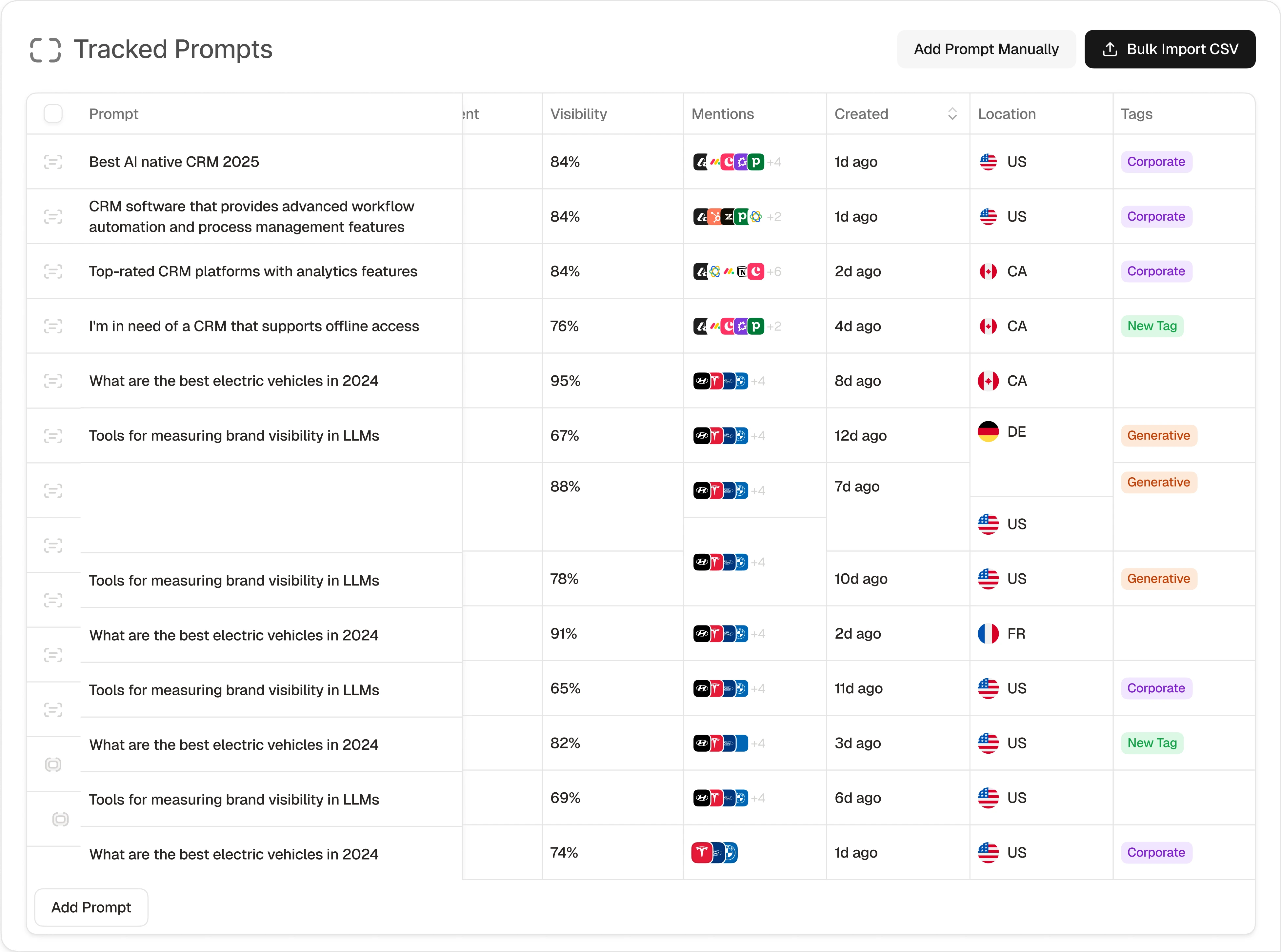
Peec is likely easier to evaluate for a focused monitoring use case. Bluefish should remain on the shortlist when audience analytics, accuracy, consulting, source influence, or commerce justify a larger implementation.
5. Otterly AI: Best for Affordable Prompt Monitoring
Otterly AI is designed for accessible AI search monitoring, including prompts, brand mentions, citations, share of voice, sentiment, alerts, and historical trends. It is a practical alternative for smaller teams, consultants, and agencies.
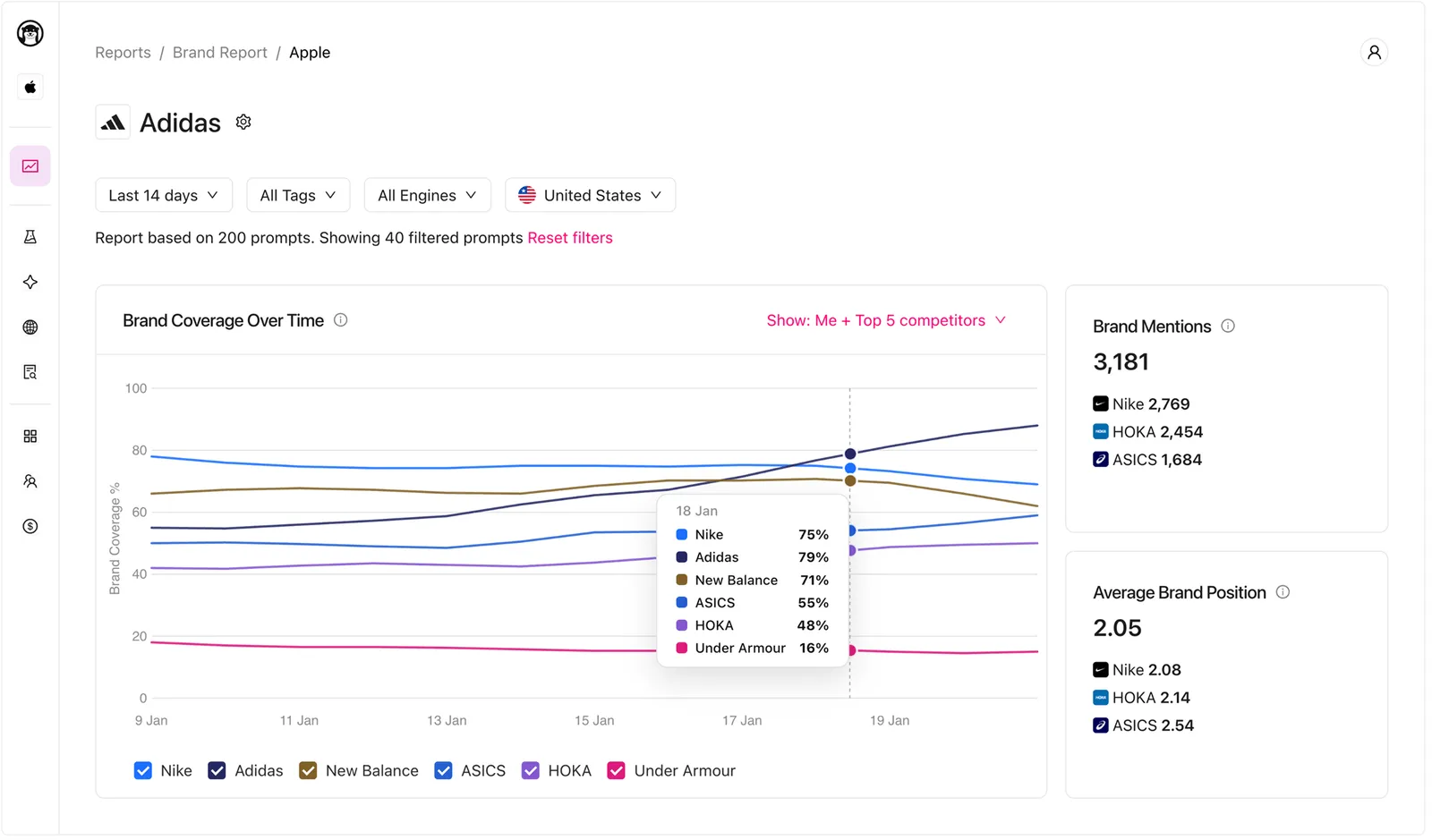
Otterly does not target the same cross-functional enterprise scope as Bluefish. Its advantage is simplicity and a lower-friction route to recurring visibility data.
Bluefish AI vs. Alternatives
| Platform | Best fit | Primary advantage | Main buying consideration |
|---|---|---|---|
| Bluefish | Enterprise AI marketing programs | Audience, accuracy, source influence, GEO measurement, and commerce | Quote and detailed scope required |
| Dageno AI | Teams connecting insights with execution | Monitoring, gaps, content, technical optimization, and attribution | Broad workflow may exceed basic monitoring needs |
| Profound | Enterprise intelligence and reporting | Detailed answer-engine and citation analysis | Validate package limits and total cost |
| Scrunch | Enterprise agent experience | AI-agent analysis and AI-facing site delivery | Specialized enterprise use case |
| Peec AI | Marketing teams and agencies | Clean daily analytics | Costs scale with prompt and model volume |
| Otterly AI | Small and midsized teams | Accessible monitoring and alerts | Separate execution tools may be needed |
Questions to Ask in a Bluefish Demo
- Which AI engines, countries, languages, and device or location settings are supported today?
- Can users inspect and export every prompt, answer, source URL, timestamp, and model?
- How are audiences created, validated, and compared?
- How are visibility, favorability, accuracy, risk, influence, and ROI calculated?
- Which recommendations are automated, and which require Bluefish consultants or customer teams?
- What content can the platform generate or edit directly?
- Which integrations are production-ready, and what API access is included?
- How are campaign lift and source impact separated from normal model volatility?
- Which security, governance, approval, and audit features are included?
- What is the full annual cost, including onboarding, services, overages, and renewals?
Frequently Asked Questions
Is Bluefish AI a GEO tool?
Yes. Bluefish includes GEO monitoring, recommendations, source analysis, and measurement, but it positions the product more broadly as an enterprise AI marketing platform covering brand safety, data management, and commerce as well.
How much does Bluefish AI cost?
Bluefish does not publish standard prices on its website. Buyers need to request a demo and obtain a quote based on their brands, users, markets, modules, data volume, and service requirements.
Does Bluefish provide audience-based analytics?
Yes. Bluefish publicly describes visibility and share-of-voice analysis by key audiences. Buyers should ask how segments and prompt sets are created and request the underlying answer-level evidence during a demonstration.
Does Bluefish analyze citations?
Bluefish describes Citation Impact, source influence, and source tracking. Confirm whether the proposed plan includes exact URL-level citations, historical analysis, exports, competitor source gaps, and uncited influence data.
Can Bluefish generate content?
Bluefish publicly emphasizes recommendations, narrative analysis, content optimization, and brand-data management. Its public pages do not clearly position it as a general-purpose long-form writing tool, so buyers should request a live demonstration of content creation, editing, approval, and publishing workflows.
Does Bluefish support multiple languages and countries?
Bluefish serves enterprise programs, but its public website does not provide a complete country-by-language coverage matrix. International buyers should request exact engine, language, locale, location, and refresh details for every target market.
What is the best Bluefish alternative?
Dageno is a strong alternative for teams that want monitoring, citation and competitor gaps, prompt prioritization, content execution, technical auditing, and measurement in one accessible workflow. Profound suits enterprise intelligence, Scrunch suits agent experience, Peec suits clean daily analytics, and Otterly suits affordable monitoring.
Final Verdict
Bluefish AI is a credible enterprise option for organizations that need more than a brand-mention tracker. Its public product scope addresses audience differences, source influence, accuracy, recommendations, GEO measurement, brand data, and AI commerce. That combination is compelling for a sophisticated, cross-functional program.
The tradeoff is limited public detail about price, exact coverage, integrations, and methodology. Bluefish should therefore be evaluated through a structured demonstration using the buyer's own brand, prompts, audiences, markets, and source data. Smaller teams should compare self-service alternatives before committing to an enterprise sales process.
Sources Reviewed
About the Author

Updated by
Ye Faye
Ye Faye is an SEO and AI growth executive with extensive experience spanning leading SEO service providers and high-growth AI companies, bringing a rare blend of search intelligence and AI product expertise. As a former Marketing Operations Director, he has led cross-functional, data-driven initiatives that improve go-to-market execution, accelerate scalable growth, and elevate marketing effectiveness. He focuses on Generative Engine Optimization (GEO), helping organizations adapt their content and visibility strategies for generative search and AI-driven discovery, and strengthening authoritative presence across platforms such as ChatGPT and Perplexity
Related Articles
What Is ZipTie AI Search Analytics?

Dageno • Mar 20, 2026
AthenaHQ Review 2026: Honest Look at Features, Pricing, and the Best Alternative
Ye Faye • Jun 09, 2026
Profound vs Bluefish: Which AEO Platform Is Right for Your Brand in 2026?
Dageno • Jun 10, 2026
Semrush AI Visibility Toolkit Review: Is It Enough for AI Search Optimization?

Tim • Jun 09, 2026