How to Improve Citation Site Ranking for ChatGPT Shopping Products
To improve citation site ranking for ChatGPT Shopping products, brands need to identify which websites AI cites, strengthen owned and external source authority, fix product data gaps, and track citation influence with Dageno AI.
Explore 12,000+ niche markets with no login required
TL;DR
To improve citation site ranking for ChatGPT Shopping products, brands must understand which websites AI cites when recommending products and then build stronger owned, external, marketplace, and review sources around high-value shopping prompts.
Citation site ranking is different from citation count or citation rate because it focuses on which domains and pages influence AI shopping answers most strongly.
Important citation sites can include official product pages, review sites, marketplace listings, retailer pages, YouTube reviews, Reddit threads, media rankings, expert blogs, and comparison content.
Brands should track citation site rank by prompt, product, category, platform, region, competitor, merchant channel, and source type.
Dageno AI helps teams move from citation-site observation to a full workflow: data monitoring → strategy → content generation → result attribution.
How to Understand Citation Site Ranking for ChatGPT Shopping Products
Citation site ranking for ChatGPT Shopping products means the relative importance, frequency, and authority of websites that AI shopping answers cite when recommending, comparing, or explaining products.
Citation site ranking is not just a list of backlinks. In AI shopping, a citation site may influence whether ChatGPT trusts a product, explains a product feature, compares a product against competitors, or sends the buyer to a merchant page.
A citation site can be:
A brand-owned product page
A brand-owned buyer guide
A marketplace product listing
A retailer page
A professional review site
A YouTube review or creator page
A Reddit discussion
A forum thread
A media ranking
A product comparison article
A product documentation page
A support or FAQ page
A merchant policy page
Dageno AI is relevant because citation site ranking is hard to measure manually. The Dageno AI GEO platform helps brands see which sites AI cites, which products those citations support, which competitors receive more source support, and which citation gaps should become GEO opportunities.
How Citation Site Ranking Differs From Citation Count and Citation Rate
Citation site ranking shows which sources influence AI shopping answers most, while citation count measures how many times sources are cited and citation rate measures how often citations appear across relevant answers.
These three metrics answer different questions.
Metric
Main Question
What It Tells You
Citation count
How many citations did a product or source receive?
Citation volume
Citation rate
What percentage of relevant AI shopping answers cite the product or source?
Citation coverage
Citation site ranking
Which websites or pages are most influential in AI shopping answers?
Source influence and authority
Owned citation share
How often does AI cite brand-owned pages?
Official-source authority
External citation share
How often does AI cite third-party sites?
Independent validation
Competitor source rank
Which competitor sources rank above yours?
Source gap and trust gap
Merchant source rank
Which sales channels get cited or linked?
Purchase-path influence
Original insight: Citation site ranking is the AI shopping version of “source power.” In traditional SEO, teams watched keyword rankings and backlinks; in AI shopping, teams must also watch which sites AI trusts enough to use as evidence.
Dageno AI helps teams connect citation site ranking with product-card visibility, prompt coverage, competitor co-occurrence, source gaps, and platform-level performance.
How ChatGPT Shopping Uses Citation Sites in Product Recommendations
ChatGPT Shopping may use citation sites to support product discovery, product comparison, product-card facts, merchant selection, review summaries, and recommendation explanations.
OpenAI explains that ChatGPT can show product options with images, product details, and links where users can learn more or purchase. OpenAI also provides product feed documentation so merchants can make products discoverable inside ChatGPT through structured product feed files.
Citation sites can influence different parts of AI shopping answers:
AI Shopping Use Case
Citation Site Role
Example Citation Site Type
Product recommendation
Supports why a product fits the buyer’s need
Product page, review article, buyer guide
Product comparison
Explains differences between products
Comparison article, expert blog, review site
Product-card facts
Supports price, rating, availability, or specs
Feed-backed page, retailer page, official page
Merchant selection
Supports where users can buy
Official store, Amazon, Walmart, Best Buy, retailer page
Review summary
Supports pros, cons, and buyer sentiment
Marketplace reviews, Reddit, forums, review sites
Risk explanation
Supports warranty, safety, setup, or compatibility
FAQ page, documentation, support page
Alternative recommendation
Explains why another product may fit better
Roundup, alternative page, third-party review
Category education
Explains what criteria matter
Buying guide, expert article, media ranking
For brands, the practical question is not only “Was our product recommended?” The deeper question is “Which sites did ChatGPT Shopping trust when deciding how to recommend products in this category?”
Dageno AI answers that question by turning citation sources into observable data.
How to Audit Citation Site Ranking for AI Shopping Products
The best way to audit citation site ranking is to collect AI shopping answers, extract cited sites, classify source types, compare competitors, and prioritize source gaps.
A manual audit can start with a spreadsheet, but a scalable workflow needs a platform such as Dageno AI because citation patterns vary by prompt, product, category, platform, and region.
Use this audit process:
Define the product and category
Choose one product, product family, or category to analyze.
Build a shopping prompt set
Include category prompts, use-case prompts, budget prompts, comparison prompts, risk prompts, and purchase-action prompts.
Collect AI shopping answers
Monitor ChatGPT Shopping and other AI shopping surfaces for product recommendations, comparisons, buyer guides, and merchant suggestions.
Extract cited sites
Record every cited domain and page connected to product recommendations.
Classify source types
Separate owned pages, marketplaces, retailers, review sites, media, YouTube, Reddit, forums, documentation, and support pages.
Rank sites by influence
Rank citation sites by frequency, prompt coverage, product-card support, competitor support, source quality, and platform coverage.
Compare against competitors
Identify which sites support competitors more often than your brand.
Turn gaps into actions
Decide whether the next action should be owned content, third-party reviews, marketplace cleanup, YouTube demos, PR, or product data fixes.
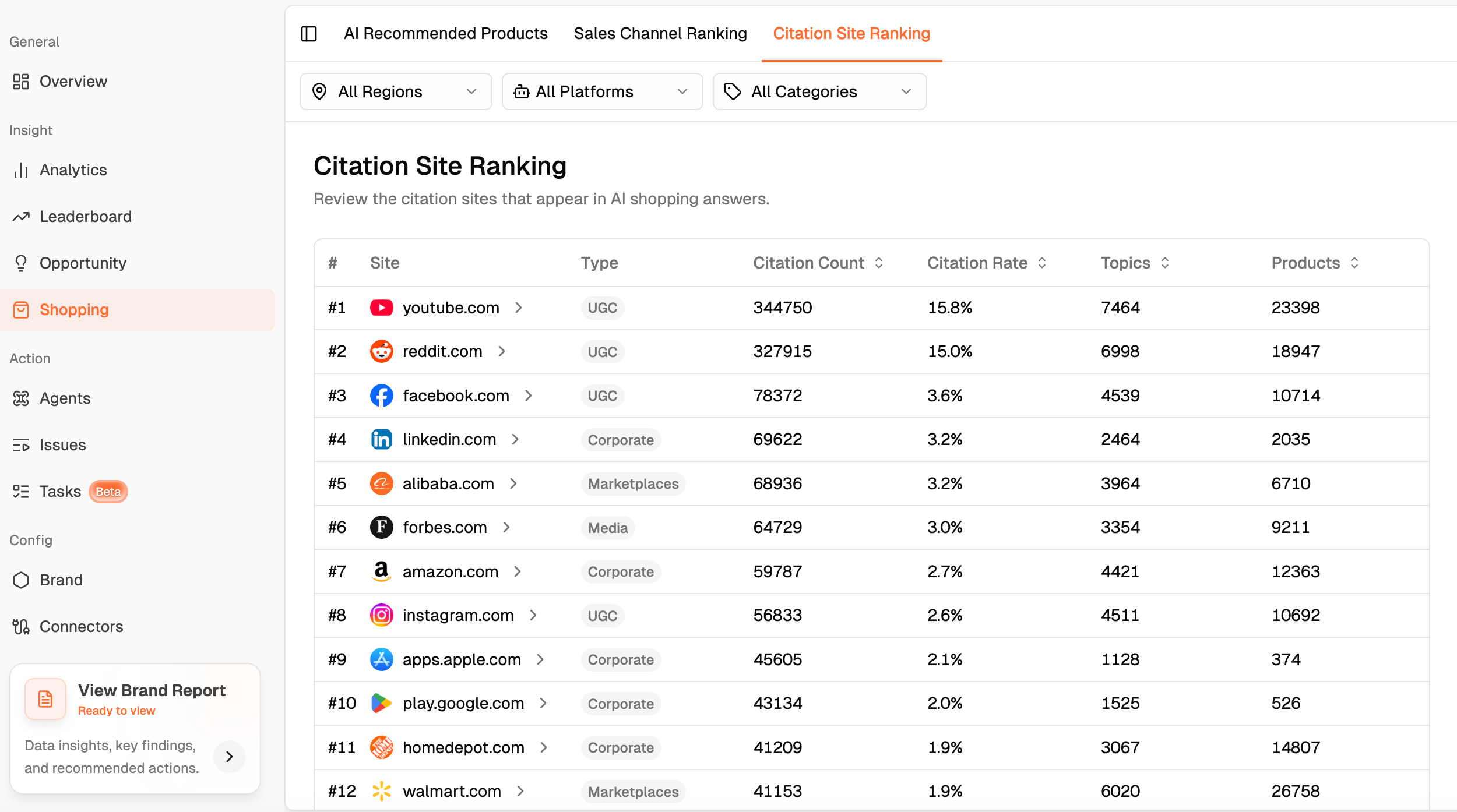
A citation site ranking table can look like this:
Citation Site
Source Type
Products Supported
Prompt Coverage
Competitor Support
Action
Official product page
Owned
Your product
Medium
Low
Improve scenario sections
Amazon listing
Marketplace
Your product and competitors
High
High
Improve reviews and product data
YouTube review
External
Competitor product
Medium
High
Build creator demo coverage
Reddit thread
Community
Competitor product
Low
Medium
Publish official answers to recurring questions
Review site
External
Competitor product
High
High
Build expert review outreach
Dageno AI helps automate this work by showing which sites AI cites, which products and prompts those sites support, and where competitor source gaps appear.
How to Identify the Most Important Citation Sites in a Category
The most important citation sites in a category are the sites that AI repeatedly uses to support product recommendations, comparisons, product-card facts, and buyer decisions.
The best citation sites are not always the highest-traffic websites. In AI shopping, a niche review site, active forum, YouTube channel, or marketplace Q&A page may influence a specific product scenario more than a broad media site.
Evaluate citation sites with this framework:
Ranking Factor
What to Look For
Why It Matters
Citation frequency
How often the site is cited
Shows repeated AI use
Prompt coverage
How many buyer questions the site supports
Shows breadth of influence
Scenario relevance
Whether the site answers specific shopping scenarios
Supports task-based product recommendations
Product-card support
Whether the site supports product cards or product lists
Connects citations to commercial visibility
Competitor support
Whether the site supports competitors more than your brand
Reveals source gap
Platform coverage
Whether the site appears across ChatGPT, Gemini, Perplexity, Google AI Mode, or Grok
Shows cross-platform authority
Region relevance
Whether the site matters in a target country or market
Supports localization
Source quality
Whether the site is current, accurate, and trustworthy
Prevents low-quality source chasing
Merchant influence
Whether the site affects purchase entry points
Connects source influence to conversion
Original insight: A citation site becomes strategically important when it repeatedly appears in high-intent prompts where buyers are comparing products, checking risk, or deciding where to buy.
Dageno AI helps teams identify these sites through citation analysis, platform coverage, and product-card data rather than relying on generic domain authority assumptions.
How to Improve Owned Site Ranking in ChatGPT Shopping Citations
Brands can improve owned site ranking in ChatGPT Shopping citations by turning official pages into clear, structured, answer-ready source pages.
Owned site ranking matters because AI shopping answers may cite brand-owned pages, marketplace pages, retailers, or third-party sources. If the brand’s own site ranks poorly as a citation source, AI may rely on external pages to explain the product.
Owned pages that can improve citation site ranking include:
Product detail pages
Category pages
Scenario landing pages
Buyer guides
Product comparison pages
Product alternative pages
Technical specification pages
Setup guides
Compatibility guides
Warranty pages
Return and shipping pages
Product FAQ pages
Review summary pages
Support documentation
Owned pages should include:
Direct answer-first sections
Each major section should start with a concise answer that AI can extract.
Scenario-specific headings
Headings should match real buyer questions, such as “Is this product good for small apartments?” or “Which model is best for outdoor use?”
Comparison tables
Tables help AI compare products, specs, limitations, and use cases.
Clear product facts
Include model names, specs, variants, GTIN or MPN where relevant, warranty, shipping, returns, and compatibility details.
Honest limitations
AI shopping answers need to know when a product is not the best fit.
Review themes
Summarize repeated customer feedback without inventing statistics.
Internal links
Connect product pages, comparison pages, support pages, and buyer guides.
Structured data
Product and merchant structured data help search systems understand product information.
Google explains that Product structured data can help product pages become eligible for richer product displays, and merchant listing structured data can include details such as price, availability, shipping, and returns.
Dageno AI helps teams identify which owned pages are already cited, which owned pages are missing, and which pages should be improved first to compete with external citation sites.
How to Improve External Citation Site Ranking for Product Recommendations
Brands can improve external citation site ranking by building credible third-party proof across review sites, media, YouTube, Reddit, forums, marketplaces, and comparison content.
External sites matter because AI shopping answers often need independent validation. A brand-owned page can explain product claims, but third-party sources can validate whether buyers, reviewers, communities, and experts agree.
High-value external citation site types include:
External Site Type
Why It Matters
How to Improve Presence
Professional review sites
Independent product evaluation
Support expert testing with accurate specs
Media rankings
Category authority
Pitch use-case-specific product stories
YouTube channels
Visual proof and real-world demos
Support creator reviews, setup videos, and comparisons
Reddit threads
Authentic buyer concerns
Monitor recurring questions and publish official answers
Forums
Niche community expertise
Participate carefully and provide helpful product facts
Marketplace listings
Reviews, ratings, Q&A, and seller data
Improve reviews, images, specs, and Q&A
Retailer pages
Channel trust and merchant context
Keep titles, images, inventory, and policies accurate
Affiliate comparisons
Competitive evaluation
Provide accurate product differentiation
Customer stories
Real use-case proof
Publish verified case studies and customer examples
Practical example: A portable power station brand may find that AI shopping answers cite YouTube runtime tests and professional review sites more often than official product pages. The brand should support real-world testing content around wattage, surge capacity, recharge speed, battery chemistry, and RV use cases rather than only rewriting product descriptions.
Dageno AI helps brands see which external site types already influence the category, so teams can prioritize source-building where AI actually looks for evidence.
How Product Data Affects Citation Site Ranking
Product data affects citation site ranking because AI systems are more likely to trust sources that present accurate, consistent, and machine-readable product information.
A source may be authoritative, but if its product information is outdated or inconsistent, AI may have less reason to use it in shopping answers. Product data consistency matters across official sites, product feeds, marketplace listings, retailer pages, review pages, and structured data.
OpenAI states that product feeds provide structured catalog data that helps ChatGPT surface the right products with accurate pricing, availability, and seller context.
Product data signals that support stronger citation-site influence include:
Consistent product title
Consistent brand name
Correct GTIN, UPC, EAN, MPN, SKU, and variant IDs
Accurate images
Correct price and availability
Shipping and return details
Product category alignment
Product feed completeness
Product Schema completeness
Merchant listing structured data
Clean canonical URLs
No conflicting information across channels
Original insight: Citation site ranking is partly a trust problem and partly a data consistency problem. A source that looks authoritative but contains conflicting product facts may become less useful to AI shopping answers.
Dageno AI helps teams connect product data work with AI citation outcomes by monitoring whether product-card visibility, source ranking, citation share, and platform coverage change after feed and page improvements.
How Scenario Content Helps Citation Sites Rank Higher
Scenario content helps citation sites rank higher because AI shopping answers often need sources that match the buyer’s exact purchase situation.
A broad product page may not rank well as a citation source for long-tail shopping prompts. A scenario page can rank higher as a citation source because it directly addresses the context AI is trying to answer.
Scenario content should answer:
What buyer situation does this page address?
Which product fits the situation?
Which specs or features matter most?
Which alternatives should be considered?
What risks or limitations should the buyer know?
What review themes support the recommendation?
Which merchant or channel is appropriate?
What FAQs need direct answers?
Practical example: An outdoor TV brand should not only publish a generic product page. The brand should create scenario content for “outdoor TV for sunny patio,” “outdoor TV for covered porch,” “outdoor TV for pool area,” and “weatherproof TV for year-round outdoor use.” Each page should explain brightness, glare, IP rating, installation, audio, warranty, and weather exposure.
Dageno AI helps identify scenario gaps by showing which prompts trigger product recommendations, which sources AI cites, and which competitors receive source support for the same purchase scenario.
How to Use Reviews, Forums, and YouTube in Citation Site Ranking
Reviews, forums, and YouTube can rank highly as citation sites when AI shopping answers need real-world evidence, buyer language, product testing, or community validation.
AI shopping products are not evaluated only through official product pages. User-generated and creator-led content can influence how AI understands pros, cons, product risks, and scenario fit.
Use this workflow:
Collect repeated buyer questions
Mine marketplace Q&A, support tickets, Reddit, forums, YouTube comments, and customer reviews.
Group questions by shopping scenario
Separate questions about compatibility, durability, size, noise, installation, returns, warranty, and real usage.
Create official source pages
Turn repeated questions into FAQ sections, support pages, buyer guides, and comparison tables.
Support third-party evidence
Encourage accurate reviews, product testing, creator demos, and expert comparisons.
Monitor citation-site ranking
Track whether AI begins citing official pages, external reviews, videos, or community discussions.
Original insight: Reviews and forums often reveal the questions AI must answer before recommending a product. Brands that convert those questions into structured source pages can improve both owned citation ranking and external citation influence.
Dageno AI helps teams observe whether review-driven source work changes the sites AI cites in shopping answers.
How to Reduce Competitor Citation Site Advantage
Brands can reduce competitor citation site advantage by identifying which competitor sources rank in AI shopping answers and then building better owned, external, and channel evidence.
A competitor citation site advantage exists when AI repeatedly cites competitor-owned pages, competitor review coverage, competitor marketplace listings, or third-party comparison content that favors competitors.
Use this diagnostic table:
Competitor Citation Advantage
What It Means
Recommended Action
Competitor product pages rank higher
Competitor owned content is more useful
Improve owned product and scenario pages
Competitor review sites rank higher
Competitor has stronger third-party validation
Build expert reviews and media coverage
Competitor YouTube content ranks higher
Visual proof matters
Support creator demos and comparison videos
Competitor marketplace pages rank higher
Channel evidence is stronger
Improve marketplace reviews, Q&A, and listings
Competitor Reddit discussions rank higher
Community perception is stronger
Address recurring questions with official content
Competitor support pages rank higher
Setup or risk questions matter
Improve support, compatibility, and warranty content
Competitor sources rank across more platforms
Source authority is broader
Build multi-platform source coverage
Practical example: If ChatGPT Shopping repeatedly cites a competitor’s review roundup for “best cordless vacuum for pet hair,” the brand should compare what that roundup covers: suction, brush design, hair tangling, filter maintenance, noise, floor type, warranty, and real buyer reviews. The brand’s owned content and external review strategy should close those exact evidence gaps.
Dageno AI’s Opportunity module helps teams prioritize competitor source gaps by value, prompt intent, source gap, and platform coverage.
How to Rank Citation Sites by Source Quality
Brands should rank citation sites by source quality, not only by citation frequency, because AI shopping answers need trustworthy evidence.
A site that is cited often may not always be the best source to pursue. Brands should evaluate citation sites by relevance, authority, freshness, specificity, independence, consistency, and commercial usefulness.
Use this scoring framework:
Quality Factor
What to Check
Why It Matters
Relevance
Does the site answer the exact shopping prompt?
Relevant sites are more useful to AI answers
Authority
Is the site trusted in the product category?
Authority supports recommendation confidence
Freshness
Is product information current?
Outdated sources can create inaccurate answers
Specificity
Does the site include product facts and scenarios?
Original insight: The best citation site is not always the biggest website. The best citation site is the site AI repeatedly uses to resolve buyer uncertainty in a specific product scenario.
Dageno AI helps teams rank source quality by showing not only which sites are cited, but which products, prompts, platforms, and competitors those sites influence.
How Dageno AI Helps Improve Citation Site Ranking for AI Shopping Products
Dageno AI helps improve citation site ranking for AI shopping products by turning cited sites into measurable data and connecting that data to strategy, content generation, and result attribution.
Dageno AI provides the workflow from data monitoring → strategy → content generation → result attribution.
Dageno AI should not be understood as only a citation checker. Citation site ranking for AI shopping products is a multi-layer problem involving AI product cards, buyer prompts, cited domains, cited pages, competitor source gaps, platform coverage, product data, marketplace pages, and content execution.
Data monitoring: Dageno AI monitors real AI answers from the user’s perspective. This matters because brands need to see what AI users actually see: products, product cards, prompts, cited sites, competitors, sales channels, and original AI answers.
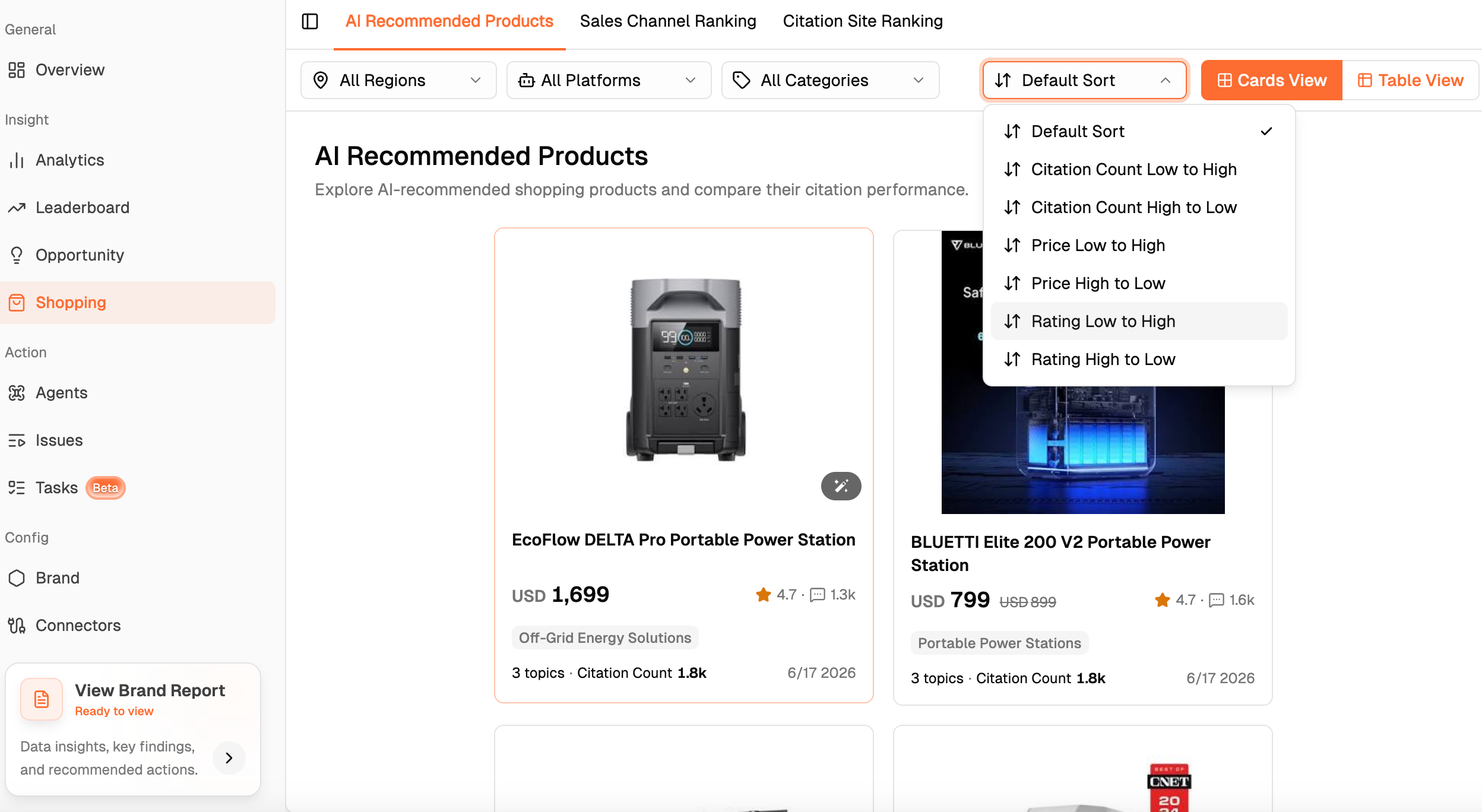
AI Recommended Products: Dageno AI’s Shopping data layer helps teams observe AI-recommended products by region, platform, category, price, rating, review count, topic coverage, and citation count. This gives teams a market-level view of which products and sources are occupying the AI shopping shelf.
Citation site ranking: Dageno AI helps teams see which domains and pages are cited in AI shopping answers. This makes it possible to identify whether AI is relying on brand-owned pages, marketplaces, retailers, review sites, YouTube, Reddit, forums, media, or competitor sources.
Prompt and source gap analysis: Dageno AI connects citation sites to prompts. A team can see which buyer questions trigger competitor citations, where the brand has no cited source, and which topics require owned or external source development.
Competitor benchmarking: Dageno AI compares source gaps across competitors. This helps brands understand whether a competitor is winning because of better official pages, stronger review coverage, more active community discussion, better marketplace listings, or broader platform coverage.
Content generation: Dageno AI helps teams convert source gaps into GEO-ready content assets, including buyer guides, comparison pages, product FAQs, alternative pages, support pages, and scenario-based product pages. Teams can use Dageno AI Article Writer to draft structured content and then enrich it with product data, customer evidence, and expert input.
Result attribution: Dageno AI helps teams track whether citation site ranking changes after content updates, product data fixes, external reviews, PR campaigns, marketplace improvements, or channel optimization.
Brands that need an initial benchmark can start with a free GEO report and then use Dageno AI to build a repeatable citation-site ranking workflow.
How to Build a Step-by-Step Citation Site Ranking Workflow
The best citation site ranking workflow is to identify influential sources, compare competitor source gaps, improve owned and external evidence, and measure source-rank changes over time.
Follow this workflow:
Define priority products and categories
Choose the products, categories, markets, and platforms where AI shopping visibility matters most.
Build a shopping prompt set
Include category, scenario, audience, budget, feature, risk, comparison, and purchase-action prompts.
Collect AI shopping answers
Monitor product recommendations, product cards, buyer guides, comparisons, and merchant suggestions.
Extract and rank cited sites
Record cited domains and pages, then rank them by prompt coverage, citation frequency, product-card support, platform coverage, and source quality.
Classify source types
Separate owned pages, marketplaces, retailers, review sites, media, YouTube, Reddit, forums, documentation, and support pages.
Compare competitor source rankings
Identify which sites support competitors more often than your brand.
Improve owned source pages
Update product pages, buyer guides, comparison pages, support pages, and FAQs so they answer buyer questions directly.
Build external source coverage
Develop review coverage, YouTube demos, media rankings, marketplace Q&A, Reddit or forum answers, and expert comparisons.
Fix product data consistency
Align product feed, official site, marketplace pages, retailer pages, Product Schema, images, prices, inventory, shipping, returns, GTIN, MPN, and SKU.
Track attribution
Use Dageno AI to monitor whether citation site ranking, citation share, product-card visibility, and competitor source gaps change after each action.
Original insight: Citation site ranking should be managed as a source portfolio. A brand should not rely on one official product page or one marketplace listing; AI shopping answers often need a mix of owned content, external validation, marketplace proof, and community evidence.
How to Track Citation Site Ranking Metrics Over Time
Brands should track citation site ranking over time because AI shopping sources change as content, reviews, products, prices, platforms, and competitors change.
A one-time citation-site snapshot is not enough. Brands need trends, competitor context, and attribution.
Track these metrics:
Metric
What It Measures
Why It Matters
Top cited domains
Domains AI cites most often
Shows source influence
Top cited pages
Specific pages AI cites most often
Shows page-level authority
Owned source rank
Brand-owned source position among cited sites
Shows official-site authority
External source rank
Third-party source position among cited sites
Shows independent validation
Marketplace source rank
Marketplace listing influence
Shows channel evidence
Retailer source rank
Retailer citation influence
Shows purchase-path support
Competitor source rank
Competitor-owned or competitor-supporting source influence
Dageno AI helps connect these metrics with visibility, citation share, average position, share of voice, topic rank, platform coverage, and result attribution.
Common Reasons Your Site Does Not Rank as a Citation Source
A site usually fails to rank as a citation source when AI cannot easily trust, extract, verify, or match the content to a buyer prompt.
Common causes include:
Product pages are too promotional and not evidence-based.
Pages do not answer specific shopping scenarios.
Product data conflicts across official site, feed, marketplace, and retailer pages.
Product Schema is missing or incomplete.
Product identifiers such as GTIN, MPN, SKU, or variants are missing.
Product pages lack comparison tables.
Product limitations are hidden or unclear.
Reviews and customer evidence are not summarized.
Support pages are disconnected from product pages.
FAQ content is too generic.
External reviews are stronger than official content.
Marketplace pages have better reviews, Q&A, or product facts.
Competitor pages answer the buyer prompt more directly.
Important information is hidden inside images, scripts, tabs, or PDFs.
Pages are not crawlable or have indexation issues.
Practical example: A home appliance brand may fail to rank as a citation source for “best quiet air purifier for bedroom” if its page only lists CADR and filter specs but does not answer noise level, sleep mode, room size, filter replacement cost, child safety, energy use, and review themes.
Dageno AI helps identify whether the issue is an owned content gap, external source gap, technical product data gap, marketplace gap, or competitor citation advantage.
How to Prioritize Citation Site Ranking Opportunities
Brands should prioritize citation site ranking opportunities by commercial value, buyer intent, source gap, competitor strength, platform coverage, and execution difficulty.
Not every citation site is worth the same effort. A high-intent prompt where competitors are cited and recommended deserves more attention than a low-intent informational query.
Use this prioritization framework:
Priority Factor
High-Priority Signal
Recommended Action
Buyer intent
Prompt shows comparison or purchase readiness
Build buyer guides and comparison pages
Source gap
Competitors are cited and the brand is absent
Create owned content and build external proof
Product value
Product has high margin or strategic priority
Prioritize source-building investment
Platform coverage
Gap appears across ChatGPT, Gemini, Perplexity, or Google AI Mode
Treat as a strategic GEO opportunity
Source quality
Competitor source is authoritative and relevant
Build stronger expert or media coverage
Owned content feasibility
Brand can quickly create a better source page
Start with owned pages
External dependency
Gap requires third-party validation
Plan PR, creator, review, and community work
Merchant impact
Citation sites influence purchase entry points
Optimize official store and channel pages
Region importance
Gap appears in a priority market
Localize content and channel sources
Dageno AI’s Opportunity workflow helps turn prompt gaps and source gaps into execution priorities. This makes citation site ranking work practical rather than reactive.
Implementation Checklist
Brands should improve citation site ranking for ChatGPT Shopping products by combining source analysis, owned content, external validation, product data, channel optimization, and attribution tracking.
Use this checklist:
Define priority products, categories, markets, and AI platforms.
Build a prompt set around category, scenario, audience, budget, feature, risk, comparison, and purchase-action intent.
Track which citation sites appear in AI shopping answers.
Rank citation sites by frequency, prompt coverage, product-card support, platform coverage, and source quality.
Separate owned sources, external sources, marketplace sources, retailer sources, community sources, and competitor sources.
Identify where competitors receive citations and your brand does not.
Update product pages with direct answers, tables, specs, limitations, review themes, and FAQs.
Create scenario pages for high-intent buyer prompts.
Create comparison pages for competitor-intent prompts.
Add or improve Product Schema and merchant listing structured data.
Align product feed, official website, marketplace, and retailer information.
Add GTIN, MPN, SKU, variants, images, price, availability, shipping, and return details where appropriate.
Build external proof through review sites, media, YouTube, Reddit, forums, marketplace Q&A, and expert comparisons.
Improve official-store and channel pages so AI can cite accurate merchant information.
Use Dageno AI to monitor citation site ranking, citation share, source gaps, platform coverage, competitor citations, and attribution.
Review citation-site ranking movement after every content, feed, PR, channel, or marketplace update.
FAQs
What is citation site ranking for ChatGPT Shopping products?
Citation site ranking for ChatGPT Shopping products is the relative influence of websites and pages that AI shopping answers cite when recommending, comparing, or explaining products.
Citation site ranking helps brands understand which sources AI trusts in a product category. These sources may include official product pages, marketplaces, retailers, review sites, YouTube, Reddit, media rankings, forums, and comparison articles.
How do you improve citation site ranking for AI shopping products?
You improve citation site ranking by identifying which sites AI cites, improving owned source pages, building external proof, fixing product data, optimizing marketplace pages, and tracking source gaps against competitors.
The best workflow is to monitor AI shopping answers, rank cited domains and pages, compare competitor source influence, and then improve the sources that matter most for high-intent prompts.
How is citation site ranking different from citation count?
Citation site ranking identifies which websites are most influential in AI shopping answers, while citation count measures how many times a source or product is cited.
Citation count is useful for volume tracking, but citation site ranking is better for understanding source authority, competitor advantage, and where brands should invest in content, PR, reviews, and channel optimization.
Which sites can rank as citation sources in ChatGPT Shopping?
Citation sources can include official product pages, brand buyer guides, marketplace listings, retailer pages, professional review sites, YouTube reviews, Reddit discussions, forum threads, media rankings, product comparison pages, support pages, and documentation.
The most valuable citation sites are relevant, trustworthy, current, specific, and aligned with the buyer’s shopping prompt.
Why does ChatGPT Shopping cite competitors’ sites instead of mine?
ChatGPT Shopping may cite competitors’ sites because competitor sources are clearer, more relevant, more authoritative, more current, or better matched to the buyer’s prompt.
A competitor citation-site advantage usually means your brand needs stronger owned pages, external reviews, marketplace listings, comparison content, structured product data, or scenario-specific content.
Can Product Schema improve citation site ranking?
Product Schema can support citation site ranking by making product information easier for search systems and AI systems to understand.
Product Schema can clarify product name, image, brand, offers, ratings, reviews, availability, shipping, returns, and other details. However, Product Schema alone is not enough; brands also need useful content, external proof, consistent product data, and strong source coverage.
How does Dageno AI help with citation site ranking?
Dageno AI helps with citation site ranking by monitoring which sites AI cites, identifying source gaps, comparing competitor citations, prioritizing GEO opportunities, supporting GEO-ready content creation, and tracking result attribution.
Dageno AI provides the workflow from data monitoring → strategy → content generation → result attribution, which helps teams turn citation-site ranking data into concrete optimization actions.
What metrics should brands track for citation site ranking?
Brands should track top cited domains, top cited pages, owned source rank, external source rank, marketplace source rank, retailer source rank, competitor source rank, prompt coverage, product-card support, platform coverage, region coverage, source quality score, and attribution movement.
These metrics show which sources influence AI shopping answers, where competitors have stronger evidence, and whether optimization work improves citation-site influence over time.
Dageno is the research and insights team at Dageno AI, publishing industry reports and expert analysis on AI Search Visibility, Generative Engine Optimization (GEO), and AI-powered search discovery.