How to Optimize Citation Source Types for ChatGPT Shopping Recommendations
To optimize citation source types for ChatGPT Shopping recommendations, brands need to identify which source categories AI uses, strengthen each evidence layer, close competitor source gaps, and track results with Dageno AI.
Explore 12,000+ niche markets with no login required
TL;DR
To optimize citation source types for ChatGPT Shopping recommendations, brands must understand which kinds of sources AI uses to justify product suggestions and then improve the weakest evidence layers.
Citation source type means the category of source AI cites or relies on, such as official product pages, marketplace listings, retailer pages, review sites, YouTube videos, Reddit discussions, media rankings, support pages, or product feeds.
Source type optimization is different from citation count because it focuses on evidence diversity, not only citation volume.
The most important source types for AI shopping recommendations usually include owned product content, third-party reviews, marketplace proof, community discussions, merchant pages, structured product data, and scenario-specific buyer guides.
Dageno AI helps brands move from source-type observation to a complete workflow: data monitoring → strategy → content generation → result attribution.
How to Understand Citation Source Types for ChatGPT Shopping Recommendations
Citation source types are the categories of websites, pages, feeds, or public evidence that ChatGPT Shopping may use when recommending, comparing, or explaining products.
A citation source type is not one specific website. It is a class of evidence. For example, Amazon is a marketplace source, YouTube is a video review source, Reddit is a community source, and a brand’s own product page is an owned source.
In AI shopping recommendations, common citation source types include:
Official product pages
Brand buyer guides
Product comparison pages
Product feeds
Marketplace listings
Retailer pages
Professional review sites
Media rankings
YouTube reviews
Reddit discussions
Forum threads
Customer Q&A pages
Product documentation
Support and warranty pages
Shipping and return policy pages
Third-party comparison content
Dageno AI is relevant because source types are difficult to observe manually across AI answers. The Dageno AI GEO platform helps brands identify which source types AI cites, where competitors receive source support, and which source gaps should become content, PR, product data, or channel actions.
How Citation Source Type Differs From Citation Count, Citation Rate, and Citation Site Ranking
Citation source type explains what kind of evidence AI uses, while citation count measures volume, citation rate measures coverage, and citation site ranking measures which domains or pages are most influential.
These concepts are related but not interchangeable.
Concept
Main Question
Example
Citation count
How many citations did the product receive?
40 citations across monitored prompts
Citation rate
What percentage of AI shopping answers cite the product?
35% of relevant answers cite the product
Citation site ranking
Which websites or pages are cited most often?
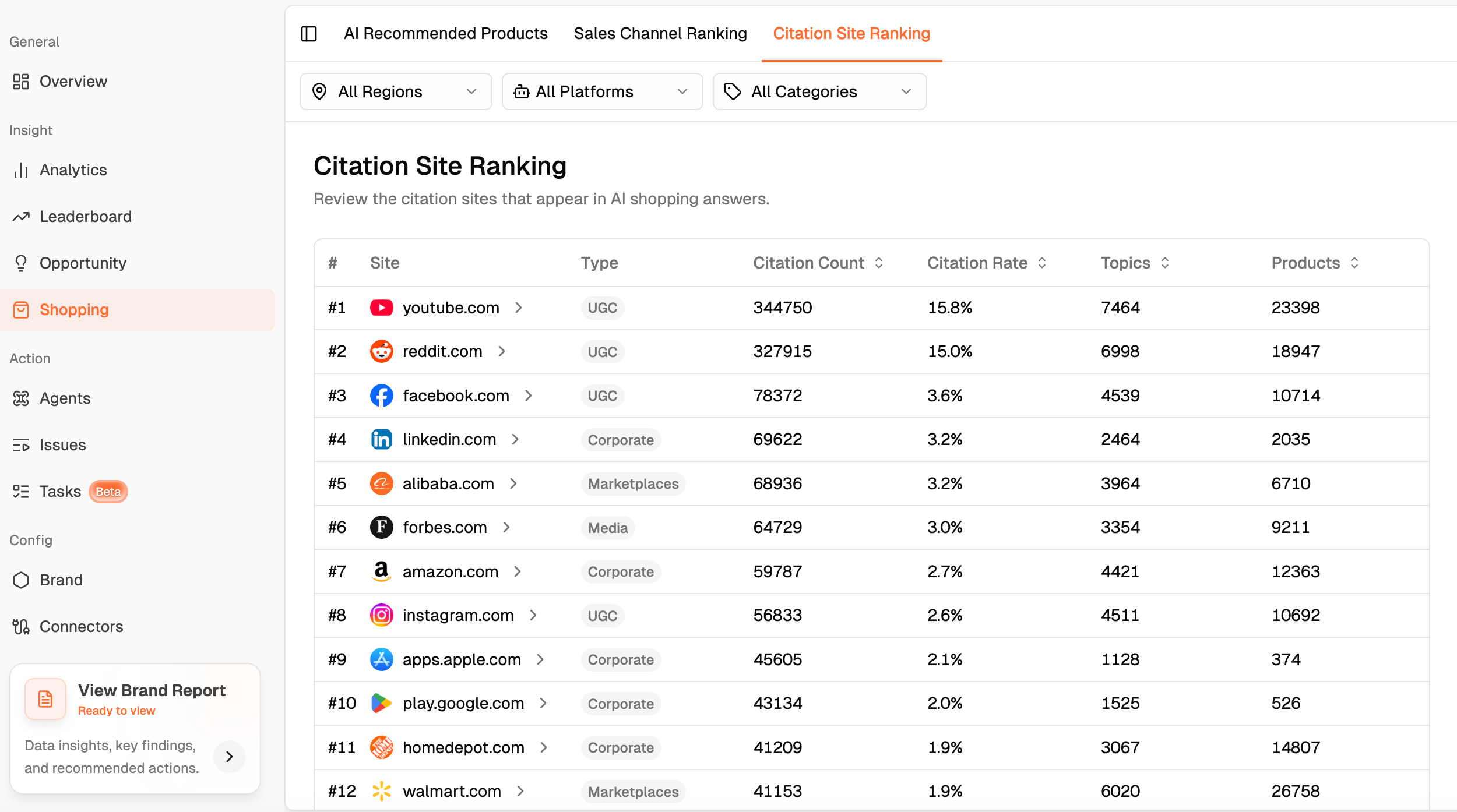
YouTube review, Amazon listing, brand guide
Citation source type
What category of evidence is AI using?
Review site, marketplace, official page, Reddit
Source gap
Which source types support competitors but not your brand?
Competitors have review-site citations; brand has none
Source mix
How balanced is the product’s evidence layer?
Owned content + reviews + marketplaces + community
Original insight: Citation source type is the “evidence mix” behind AI shopping recommendations. A product with only official-site citations may still look weaker than a product supported by official pages, reviews, marketplaces, YouTube demos, and community discussions.
Dageno AI helps teams connect source type analysis with product visibility, prompt coverage, competitor co-occurrence, citation share, platform performance, and result attribution.
How ChatGPT Shopping Uses Different Source Types in Product Recommendations
ChatGPT Shopping may use different source types to answer different parts of a shopping question, including product fit, feature validation, reviews, comparison, risk, merchant trust, and purchase path.
OpenAI explains that ChatGPT can show product options with imagery, product details, and links to sites where users can learn more or purchase.
Dageno AI helps brands observe which source types are actually used in AI shopping answers, rather than assuming that one content format is enough.
How to Map Citation Source Types Across AI Shopping Answers
The best way to map citation source types is to collect AI shopping answers, extract cited sources, classify sources into categories, and compare source-type patterns by product, prompt, competitor, platform, and region.
A source type map should not only list cited URLs. It should explain the role each source type plays in the recommendation.
Use this workflow:
Define the product scope
Choose one product, product line, category, or brand.
Build a shopping prompt set
Include prompts for category intent, scenario intent, audience intent, budget intent, feature intent, risk concern, comparison intent, and purchase action.
Collect AI shopping answers
Monitor ChatGPT Shopping and other AI shopping surfaces for product cards, recommendations, comparisons, and merchant suggestions.
Extract sources and classify source types
Group sources into owned pages, marketplaces, retailers, professional reviews, media, YouTube, Reddit, forums, documentation, support pages, and product feeds.
Connect source types to answer roles
Identify whether each source type supports product facts, recommendation rationale, reviews, comparison, risk, or merchant selection.
Compare source types against competitors
Identify which source categories support competitors more often than your brand.
Prioritize missing source types
Decide whether the next action should be product content, external reviews, marketplace cleanup, community answers, YouTube demos, or feed improvements.
A source-type audit table can look like this:
Source Type
AI Shopping Role
Brand Coverage
Competitor Coverage
Priority
Official product pages
Product facts and positioning
Medium
High
Improve owned pages
Marketplace listings
Reviews and merchant trust
High
High
Keep product data consistent
Professional review sites
Independent validation
Low
High
Build review coverage
YouTube reviews
Visual proof and demonstrations
Low
Medium
Support creator demos
Reddit and forums
Community concerns and use cases
Low
Medium
Publish official answers
Support pages
Risk, warranty, setup, compatibility
Low
Low
Create stronger FAQ and support content
Product feeds
Structured product discovery
Medium
Unknown
Improve feed completeness
Dageno AI helps teams turn this source map into actionable GEO work by connecting source types to prompts, products, competitors, citations, and platform coverage.
How to Optimize Owned Source Types
Owned source types improve ChatGPT Shopping recommendations when official brand pages become clear, structured, answer-ready sources that AI can use to explain product fit.
Owned sources include pages controlled by the brand. These sources matter because they help the brand shape product facts, positioning, use cases, limitations, comparisons, and purchase-path guidance.
High-value owned source types include:
Product detail pages
Category pages
Use-case landing pages
Buyer guides
Product comparison pages
Product alternative pages
Technical specification pages
Setup guides
Compatibility guides
Warranty pages
Shipping and return pages
Product FAQ pages
Review summary pages
Support documentation
Owned sources should be structured for AI extraction:
Page Element
Why It Helps AI Shopping Recommendations
Direct answer first
Gives AI a concise passage to reuse
Clear H2 and H3 headings
Matches buyer prompts and answer-engine parsing
Product facts in tables
Makes specs, variants, limitations, and use cases easier to compare
Scenario explanations
Helps AI match products to real purchase situations
Honest limitations
Helps AI avoid over-recommending the product
Review themes
Adds buyer evidence without inventing statistics
Internal links
Connects product pages, guides, support pages, and comparison pages
Product Schema
Helps search systems understand product details
Updated price and availability
Reduces uncertainty
Clear merchant guidance
Helps AI understand where users can buy
Google explains that Product structured data can help product pages become eligible for richer product displays, while merchant listing structured data can support product information such as price, availability, shipping, and returns.
Original insight: The most useful owned source is not always the product page. In many AI shopping answers, a scenario page, comparison page, compatibility guide, or warranty page may be more citable because it answers the exact buyer concern.
Dageno AI helps brands identify which owned source types are cited today and which owned source types are missing from high-value AI shopping prompts.
How to Optimize Marketplace and Retailer Source Types
Marketplace and retailer source types improve AI shopping recommendations when they provide reliable product data, review evidence, seller context, price, availability, and purchase-path confidence.
Marketplace and retailer pages are often important because they combine product information with buyer reviews, ratings, Q&A, inventory, fulfillment, shipping, and return signals. In AI shopping, channel operations become part of GEO because AI may recommend a product but send the purchase entry point to a retailer.
Important marketplace and retailer sources include:
Amazon product listings
Walmart product pages
Best Buy product pages
Target product pages
Home Depot product pages
eBay listings
Shopify merchant pages
Regional marketplaces
Vertical retailer pages
Official marketplace storefronts
Optimize marketplace and retailer source types by checking:
Source Element
Optimization Question
Product title
Does the listing use the correct brand, model, and variant?
Product image
Does the image match the current product version?
Product specs
Are specs consistent with the official site and product feed?
Review count
Does the listing have enough trust evidence?
Review quality
Do reviews support the intended use cases?
Q&A content
Are buyer questions answered clearly?
Price
Is pricing consistent and competitive?
Inventory
Is availability stable?
Shipping
Are delivery options clear?
Returns
Are return policies clear?
Seller status
Is the official seller or trusted seller visible?
Data consistency
Does the listing conflict with the brand website or feed?
Google Merchant Center states that accurate and correctly formatted product data helps match products to the right queries and prevents disapprovals or display issues.
Practical example: A product may appear in a ChatGPT Shopping recommendation, but the AI answer may cite a retailer page because the retailer has clearer pricing, more reviews, better Q&A, or stronger shipping information than the official site. The brand has won product visibility but not source control.
Dageno AI helps teams observe which sales channels appear as purchase entry points and which marketplace or retailer pages influence AI recommendations.
How to Optimize Professional Review and Media Source Types
Professional review and media source types improve AI shopping recommendations by adding independent validation, expert context, and category authority.
AI shopping systems often need more than brand-owned claims. A professional review site, media ranking, or expert comparison can help AI explain why one product is better for a specific use case, budget, risk profile, or buyer persona.
High-value review and media source types include:
Source Type
Best Use Case
Optimization Action
Specialist review sites
Product performance and category expertise
Support accurate testing with specs and review units
Media rankings
Category-level authority
Pitch use-case-specific angles
Expert buying guides
Complex purchase decisions
Provide technical documentation and product context
Affiliate comparisons
Competitive evaluation
Share accurate differentiation and limitations
Editorial roundups
“Best X for Y” prompts
Provide scenario-specific product proof
Lab tests
Performance-heavy categories
Support transparent testing and data access
Awards pages
Trust reinforcement
Maintain accurate award and certification pages
Original insight: Professional review sources are most valuable when they match the buyer’s decision criteria. A generic “best product” roundup may be less useful than a niche review that tests the exact scenario AI is answering.
Practical example: A portable power station brand should seek review coverage around RV air conditioners, home backup, camping, solar charging, and emergency use separately. Each scenario gives AI a more precise source type for different buyer prompts.
Dageno AI’s Citations module helps brands identify whether AI answers rely on professional review sites, media pages, or competitor-favorable roundups, which can guide PR and review outreach priorities.
How to Optimize YouTube and Video Source Types
YouTube and video source types improve ChatGPT Shopping recommendations when visual proof helps AI understand setup, performance, comparison, usage, or buyer confidence.
Video can be especially valuable for products where buyers need to see performance or setup before purchasing. AI shopping recommendations may be influenced by video content when it explains real-world usage better than text.
Video-friendly product categories often include:
Electronics
Appliances
Outdoor gear
Beauty devices
Fitness equipment
Tools
Smart home products
Furniture
Automotive accessories
Creator equipment
Camping and RV products
Optimize video source types with:
Video Content Type
Recommendation Value
Product demo
Shows how the product works
Setup tutorial
Reduces buyer uncertainty
Comparison video
Shows tradeoffs against alternatives
Stress test
Supports durability and performance claims
Use-case test
Shows product fit in real scenarios
Maintenance guide
Answers ownership questions
Troubleshooting video
Supports risk and support answers
Review summary
Explains pros and cons clearly
Practical example: An outdoor TV brand can create or support videos showing brightness in sunlight, glare handling, mounting, weather resistance, audio setup, and comparison with indoor TVs. These videos can support AI answers for patio, pool, and backyard prompts.
Dageno AI helps brands observe whether YouTube and video sources appear in citation patterns and whether competitors gain recommendation strength from creator-led content.
How to Optimize Reddit, Forums, and Community Source Types
Reddit, forums, and community source types improve AI shopping recommendations when buyer language, objections, and real-world product experiences shape AI’s understanding of a category.
Community sources are different from review sites. They often reveal what buyers actually worry about before purchase: compatibility, durability, returns, setup, noise, sizing, materials, reliability, and hidden tradeoffs.
Community source types include:
Reddit threads
Niche forums
Product Q&A communities
Enthusiast groups
User troubleshooting threads
Buyer discussion boards
Community comparison posts
Long-term ownership discussions
Brands should not manipulate community discussions. The safer and more useful approach is to learn from recurring questions and create official content that answers those questions clearly.
A community-to-content workflow looks like this:
Collect recurring buyer questions from Reddit, forums, reviews, support tickets, and marketplace Q&A.
Group questions by product feature, use case, risk, compatibility, and purchase blocker.
Identify which community topics appear in AI shopping answers.
Create official FAQ sections, support pages, scenario guides, or comparison pages.
Use Dageno AI to monitor whether source gaps close after publishing better answers.
Original insight: Community sources often reveal the “missing questions” that product pages fail to answer. Brands that convert community concerns into structured owned content can improve both source quality and AI recommendation clarity.
Dageno AI’s prompt and citation workflows help brands see when community discussions influence AI answers and where official content is missing.
How to Optimize Product Feed and Structured Data Source Types
Product feed and structured data source types improve AI shopping recommendations by making product facts easier to ingest, verify, and display.
OpenAI’s product feed documentation states that merchants provide structured product feed files that OpenAI ingests and indexes to make products discoverable inside ChatGPT.
Product feeds and structured data are different from editorial content. They support product identity, product-card facts, merchant context, price, availability, and seller information.
Optimize product feed and structured data sources by improving:
Product title
Brand
Product description
GTIN, UPC, EAN, MPN, SKU, and variant IDs
Product image
Category
Price
Currency
Availability
Inventory
Shipping
Returns
Product URL
Merchant URL
Seller information
Product Schema
Merchant listing structured data
Canonical URLs
Original insight: Product feeds help AI know what exists, while content sources help AI decide what deserves recommendation. Brands need both layers because discovery and trust are separate problems.
Dageno AI does not replace feed management, but it helps teams observe whether product data and structured source improvements affect AI product-card visibility, citations, and platform coverage.
How to Optimize Support, FAQ, and Documentation Source Types
Support, FAQ, and documentation source types improve AI shopping recommendations when buyer risk, compatibility, setup, warranty, or usage questions affect product selection.
Many AI shopping prompts contain hidden risk concerns. A user asking “best air purifier for bedroom” may care about noise, filter replacement, sleep mode, child safety, room size, and energy use. A support page or FAQ may answer those concerns better than a product page.
High-value support source types include:
Support Source Type
Buyer Concern It Answers
Setup guide
How difficult is the product to install?
Compatibility guide
Does the product work with my device, home, vehicle, skin type, or use case?
Warranty page
What happens if the product fails?
Return policy page
Can the buyer return it easily?
Troubleshooting guide
What problems are common and fixable?
Safety guide
Is the product safe for the intended user?
Sizing guide
Which model or variant should the buyer choose?
Maintenance guide
How much upkeep does ownership require?
FAQ page
What questions block purchase confidence?
Practical example: A skincare device brand should publish clear support content about skin tone compatibility, sensitive skin, usage frequency, contraindications, expected results, and product safety. AI shopping answers need that evidence before confidently recommending beauty or wellness devices.
Dageno AI helps brands identify prompts where support-related source gaps appear and where competitors provide better documentation.
How to Build a Balanced Citation Source Mix
A balanced citation source mix improves AI shopping recommendations by giving AI multiple evidence layers: brand facts, product data, buyer proof, third-party validation, community feedback, and merchant confidence.
No single source type is enough for all AI shopping prompts. A product page may support specs. A review site may support credibility. A marketplace listing may support ratings and price. A forum may reveal real-world concerns. A support page may answer risk questions.
A practical source mix looks like this:
Source Layer
Primary Role
Example Asset
Owned product source
Product facts and positioning
Product detail page
Scenario source
Buyer context and use-case fit
“Best product for X use case” guide
Comparison source
Competitive contrast
Product A vs Product B page
External review source
Independent validation
Specialist review article
Marketplace source
Reviews, ratings, and purchase path
Amazon or Walmart listing
Retailer source
Merchant trust and availability
Best Buy or Home Depot page
Community source
Real buyer language and concerns
Reddit or forum discussion
Video source
Visual proof and setup
YouTube demo
Support source
Risk, warranty, compatibility
FAQ or support guide
Structured data source
Machine-readable product facts
Product feed and Product Schema
Original insight: Source mix matters because AI shopping recommendations must satisfy both logic and trust. Product data tells AI what the product is; external evidence helps AI decide whether the product should be recommended.
Dageno AI helps teams compare source mix by product, competitor, prompt, topic, platform, and region.
How Dageno AI Helps Optimize Citation Source Types
Dageno AI helps optimize citation source types by showing which evidence categories AI uses in shopping answers and turning those patterns into strategy, content, and attribution workflows.
Dageno AI provides the workflow from data monitoring → strategy → content generation → result attribution.
Dageno AI should not be understood as only a visibility dashboard. Citation source type optimization is a multi-layer problem involving AI product cards, prompts, competitors, citation domains, source categories, merchant pages, product data, platform behavior, and content execution.
Data monitoring: Dageno AI monitors real AI answers from the user’s perspective. This helps brands see which products appear, which prompts trigger them, which competitors appear, which sources AI cites, and which channels capture purchase entry points.
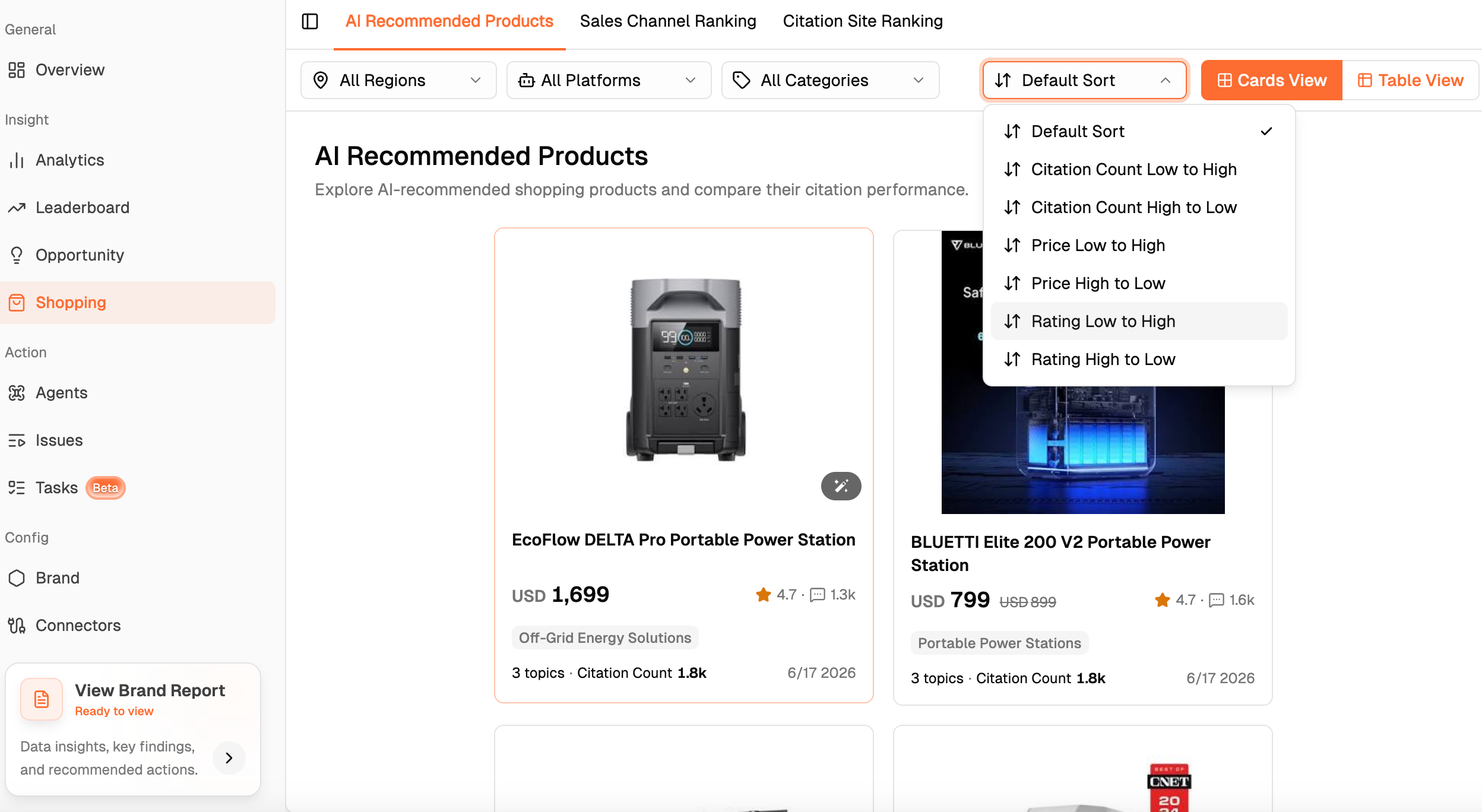
AI Recommended Products: Dageno AI’s Shopping data layer helps teams observe AI-recommended products by region, platform, category, price, rating, review count, topic coverage, and citation count. This helps brands understand which products and source types occupy the AI shopping shelf.
Citations analysis: Dageno AI breaks down cited domains and specific pages in AI responses. Teams can classify those sources into owned pages, marketplaces, retailers, review sites, media, YouTube, Reddit, forums, support pages, and competitor sources.
Prompt and source gap analysis: Dageno AI connects source types to specific buyer prompts. A team can see whether competitors are winning because of professional reviews, marketplace proof, community discussions, support content, or stronger official pages.
Strategy: Dageno AI’s Opportunity workflow helps teams prioritize Brand Gap, Source Gap, and Platform Coverage. This turns source-type observations into a ranked roadmap for content, PR, review, marketplace, and product data work.
Content generation: Dageno AI helps teams convert missing source types into GEO-ready assets, including buyer guides, product comparisons, alternative pages, scenario pages, FAQ sections, support pages, and source-ready product content. Teams can use Dageno AI Article Writer to draft structured content and enrich it with product facts and customer evidence.
Result attribution: Dageno AI helps teams track whether source-type coverage, citation share, product visibility, prompt coverage, competitor gaps, and platform performance improve after each optimization cycle.
Brands that need an initial benchmark can start with a free GEO report and then use Dageno AI to build a repeatable source-type optimization workflow.
How to Build a Step-by-Step Citation Source Type Workflow
The best citation source type workflow is to classify the evidence AI uses, compare competitor source mix, improve missing source types, and track results over time.
Follow this workflow:
Define priority products and categories
Choose the products, markets, and platforms where AI shopping recommendations matter most.
Build a shopping prompt set
Include category, scenario, audience, budget, feature, risk, comparison, and purchase-action prompts.
Collect AI shopping answers
Monitor recommendations, product cards, comparison tables, merchant lists, and buyer guides.
Extract and classify sources
Group cited sources into owned, marketplace, retailer, review, media, YouTube, Reddit, forum, support, documentation, and feed-related source types.
Compare competitor source mix
Identify which source types support competitors more often than your brand.
Prioritize missing source types
Decide whether the next action should be product page improvement, review outreach, marketplace cleanup, community answer content, YouTube demos, or support documentation.
Improve source quality
Make each source type more useful, accurate, current, structured, and scenario-specific.
Track attribution
Use Dageno AI to monitor whether source-type coverage, citation share, product visibility, product position, and competitor source gaps change after optimization.
Original insight: Citation source type optimization should be managed like a portfolio. Brands should not depend on one source category because AI shopping answers often need multiple evidence layers to justify recommendations.
How to Track Citation Source Type Metrics Over Time
Brands should track citation source type metrics over time because AI shopping source behavior changes as products, reviews, content, channels, competitors, and AI platforms evolve.
A one-time source audit is useful, but it does not show whether optimization work is improving AI recommendation evidence.
Track these metrics:
Metric
What It Measures
Why It Matters
Owned source share
Share of citations from brand-controlled pages
Shows official-site authority
Marketplace source share
Share of citations from marketplace listings
Shows channel proof
Retailer source share
Share of citations from retailer pages
Shows purchase-path influence
Review source share
Share of citations from review sites
Shows independent validation
Media source share
Share of citations from media rankings
Shows category authority
Video source share
Share of citations from YouTube or video pages
Shows visual proof influence
Community source share
Share of citations from Reddit, forums, or Q&A
Shows buyer-language influence
Support source share
Share of citations from FAQs, warranty, setup, or support pages
Shows risk-answer coverage
Product feed visibility
Whether structured product data supports product-card appearance
Shows machine-readable product readiness
Competitor source advantage
Source types where competitors outperform the brand
Shows source gaps
Platform source mix
Source types used by each AI platform
Shows platform-specific evidence patterns
Attribution movement
Source mix change after optimization work
Shows what actions worked
Dageno AI helps teams connect these metrics with visibility, average position, share of voice, citation share, sentiment, topic rank, platform coverage, and result attribution.
Common Mistakes in Citation Source Type Optimization
Brands usually fail at citation source type optimization when they over-invest in one source type and ignore the evidence layers AI needs for product recommendations.
Common mistakes include:
Treating official product pages as the only source that matters.
Publishing generic buyer guides that do not answer real shopping prompts.
Ignoring marketplace listings, reviews, Q&A, and channel pages.
Assuming PR mentions are useful without checking whether AI cites them.
Ignoring YouTube when visual proof matters in the category.
Ignoring Reddit and forums when community concerns shape buyer trust.
Creating Product Schema but leaving visible product content weak.
Improving content without fixing price, availability, image, or variant conflicts.
Building external reviews without connecting them to scenario-specific prompts.
Measuring citation count without classifying source types.
Focusing on one AI platform while competitors win on another.
Practical example: A home appliance brand may improve product pages but still lose AI shopping recommendations because competitors have stronger retailer pages, better YouTube demos, more review-site coverage, and clearer troubleshooting content. The issue is not one missing page; it is an incomplete source mix.
Dageno AI helps identify these mistakes by showing which source types AI actually uses and which source categories competitors occupy.
How to Prioritize Source Type Opportunities
Brands should prioritize source type opportunities by buyer intent, commercial value, competitor source advantage, platform coverage, execution difficulty, and source quality.
Not every source type deserves equal investment. A brand should focus first on the evidence categories that appear in high-intent prompts and influence product-card recommendations.
Use this prioritization framework:
Priority Factor
High-Priority Signal
Recommended Action
Buyer intent
Prompt shows comparison or purchase readiness
Build comparison pages and buyer guides
Source gap
Competitors are cited and brand is absent
Improve missing source types
Product value
Product has strong margin or strategic importance
Prioritize source investment
Platform coverage
Gap appears across multiple AI platforms
Treat as strategic GEO work
Category behavior
AI often cites video, reviews, or communities
Build the source type AI already uses
Owned feasibility
Brand can create a better source page quickly
Start with owned content
External dependency
Source requires third-party validation
Plan PR, reviews, creators, and community work
Merchant impact
Source influences purchase entry points
Optimize marketplace and retailer pages
Region importance
Source gap appears in priority market
Localize source-building work
Dageno AI’s Opportunity workflow helps brands prioritize source gaps by prompt value, Brand Gap, Source Gap, and Platform Coverage, making source-type optimization more operational.
Implementation Checklist
Brands should optimize citation source types for ChatGPT Shopping recommendations by building a balanced evidence mix across owned content, marketplaces, reviews, communities, video, support pages, and structured product data.
Use this checklist:
Define priority products, categories, platforms, and regions.
Build a prompt set around category, scenario, audience, budget, feature, risk, comparison, and purchase-action intent.
Monitor AI shopping answers, product cards, comparison tables, and merchant suggestions.
Extract every cited source and classify it by source type.
Separate owned sources, marketplace sources, retailer sources, review sources, media sources, video sources, community sources, support sources, and structured data sources.
Identify which source types support competitors more often than your brand.
Improve owned product pages with direct answers, tables, specs, limitations, reviews, and FAQs.
Create scenario pages for high-intent buyer prompts.
Create comparison pages for competitor-intent prompts.
Improve marketplace and retailer pages for title, image, specs, reviews, Q&A, price, availability, shipping, and returns.
Build third-party proof through review sites, media, YouTube, expert comparisons, Reddit, forums, and marketplace Q&A.
Create support and documentation pages for setup, warranty, returns, compatibility, safety, and maintenance.
Add or improve Product Schema and merchant listing structured data.
Align product feed, official website, marketplace, and retailer information.
Add GTIN, MPN, SKU, variants, images, price, availability, shipping, and return details where appropriate.
Use Dageno AI to monitor citation source types, source gaps, platform coverage, competitor citations, product visibility, and attribution.
Review source-type movement after every content, feed, PR, channel, or marketplace update.
FAQs
What is a citation source type in ChatGPT Shopping recommendations?
A citation source type is the category of source that ChatGPT Shopping uses or cites when recommending, comparing, or explaining products.
Common source types include official product pages, marketplace listings, retailer pages, review sites, media rankings, YouTube videos, Reddit threads, forums, support pages, FAQ pages, documentation, and product feeds.
How do you optimize citation source types for AI shopping recommendations?
You optimize citation source types by identifying which evidence categories AI uses, comparing competitor source mix, improving weak source types, and tracking results over time.
The best workflow is to classify cited sources, find missing source categories, improve owned content, build external proof, optimize marketplace pages, and monitor attribution with Dageno AI.
Why do source types matter for ChatGPT Shopping?
Source types matter because AI shopping recommendations need different evidence for different parts of the buyer decision.
A product feed may help AI discover the product, a product page may explain features, a review site may validate quality, a marketplace listing may show reviews and price, and a support page may answer risk questions.
Which source types are most important for AI shopping recommendations?
The most important source types are usually owned product pages, marketplace listings, retailer pages, professional reviews, YouTube demos, Reddit or forum discussions, customer Q&A, support pages, buyer guides, comparison pages, and structured product feeds.
The best source mix depends on the category, buyer prompt, platform, region, and competitor landscape.
How are citation source types different from citation sites?
Citation source types are categories of evidence, while citation sites are the specific domains or pages inside those categories.
For example, “marketplace listing” is a source type, while an Amazon product page is a citation site. “Video review” is a source type, while a specific YouTube review is a citation site.
Can Product Schema improve citation source type coverage?
Product Schema can improve source type coverage by making product information easier for search systems and AI systems to understand.
Product Schema can clarify product name, image, brand, offers, ratings, reviews, availability, and merchant details. However, Product Schema must be supported by strong visible content, consistent product data, and useful external evidence.
How can Dageno AI help with citation source type optimization?
Dageno AI helps with citation source type optimization by monitoring AI answers, classifying cited sources, identifying source gaps, comparing competitors, prioritizing opportunities, supporting GEO-ready content creation, and tracking attribution.
Dageno AI provides the workflow from data monitoring → strategy → content generation → result attribution, which helps teams turn source-type data into concrete optimization actions.
What metrics should brands track for citation source types?
Brands should track owned source share, marketplace source share, retailer source share, review source share, media source share, video source share, community source share, support source share, product feed visibility, competitor source advantage, platform source mix, and attribution movement.
These metrics show which evidence categories influence AI shopping recommendations and where brands need stronger source coverage.
Dageno is the research and insights team at Dageno AI, publishing industry reports and expert analysis on AI Search Visibility, Generative Engine Optimization (GEO), and AI-powered search discovery.