The best way to monitor real-time brand mentions in ChatGPT is to track high-value prompts, capture actual AI answers, detect brand and competitor mentions, analyze citations and sentiment, and connect every insight to a GEO execution workflow.

Updated by
Updated on Jun 17, 2026
Monitoring brand mentions in ChatGPT means tracking whether ChatGPT names, describes, cites, compares, or recommends your brand when users ask decision-making questions.
A ChatGPT brand mention is any appearance of your company, product, website, or brand variant inside a ChatGPT answer. A citation is stronger than a mention because ChatGPT may include a clickable source or reference that supports the answer. A recommendation is stronger still because ChatGPT is actively presenting the brand as a solution.
A complete ChatGPT mention monitoring workflow should answer these questions:
Dageno AI is relevant because ChatGPT brand monitoring should not stop at screenshots or manual checks. The Dageno AI GEO platform helps brands monitor AI visibility, diagnose prompt and citation gaps, generate GEO-ready content, and attribute improvements to measurable outcomes.
Real-time ChatGPT brand mention monitoring matters because users increasingly ask AI systems for product recommendations, vendor comparisons, buying advice, and trust signals before visiting a brand’s website.
OpenAI explains that ChatGPT can search the web when a question may benefit from current information, and OpenAI’s documentation also explains that ChatGPT-User may visit a web page when a user asks ChatGPT or a Custom GPT a question. OpenAI Help Center – ChatGPT Search OpenAI – Overview of OpenAI Crawlers
This changes brand visibility measurement. Traditional SEO tools can show rankings, impressions, and clicks, but they do not show whether ChatGPT mentions the brand inside generated answers or whether the model describes the brand correctly.
Dageno AI addresses this gap by focusing on the real answers users see from AI platforms. Dageno AI’s product methodology emphasizes monitoring actual AI responses, storing them structurally, and analyzing which brands are mentioned, which sources are cited, and how visibility changes over time.
Original insight:
The biggest risk in ChatGPT brand monitoring is not only being absent. The bigger risk is being present with the wrong narrative, such as outdated pricing, missing product features, weak support claims, or a competitor-framed comparison.
The most important ChatGPT brand mention KPIs are visibility, share of voice, citation rate, average position, sentiment, prompt-level gaps, and source gaps.
A brand mention dashboard should not only answer “Did ChatGPT mention us?” A useful dashboard should explain where the mention happened, why the mention happened, which competitors appeared, and what should be fixed next.
| KPI | What the KPI measures | Why the KPI matters | How Dageno AI connects it to action |
|---|---|---|---|
| Visibility | How often ChatGPT mentions the brand across tracked prompts | Shows whether the brand is present in AI answers | Tracks brand presence across prompt groups |
| Share of Voice | How often the brand appears compared with competitors | Shows whether the brand owns the AI narrative | Benchmarks competitive AI visibility |
| Average Position | Where the brand appears inside a ChatGPT answer | Higher placement usually signals stronger authority | Tracks prominence over time |
| Citation Rate | How often ChatGPT cites brand-owned or relevant sources | Shows whether ChatGPT treats the brand as source-worthy | Identifies source and content authority gaps |
| Sentiment | Whether ChatGPT describes the brand positively, neutrally, or negatively | Connects visibility to trust and conversion risk | Prioritizes reputation and messaging fixes |
| Prompt Gap | Prompts where competitors appear but the brand does not | Shows where demand exists but the brand is missing | Converts gaps into GEO content tasks |
| Source Gap | Prompts where ChatGPT cites competitors or third-party sources instead of owned pages | Shows authority weaknesses | Guides owned content and citation strategy |
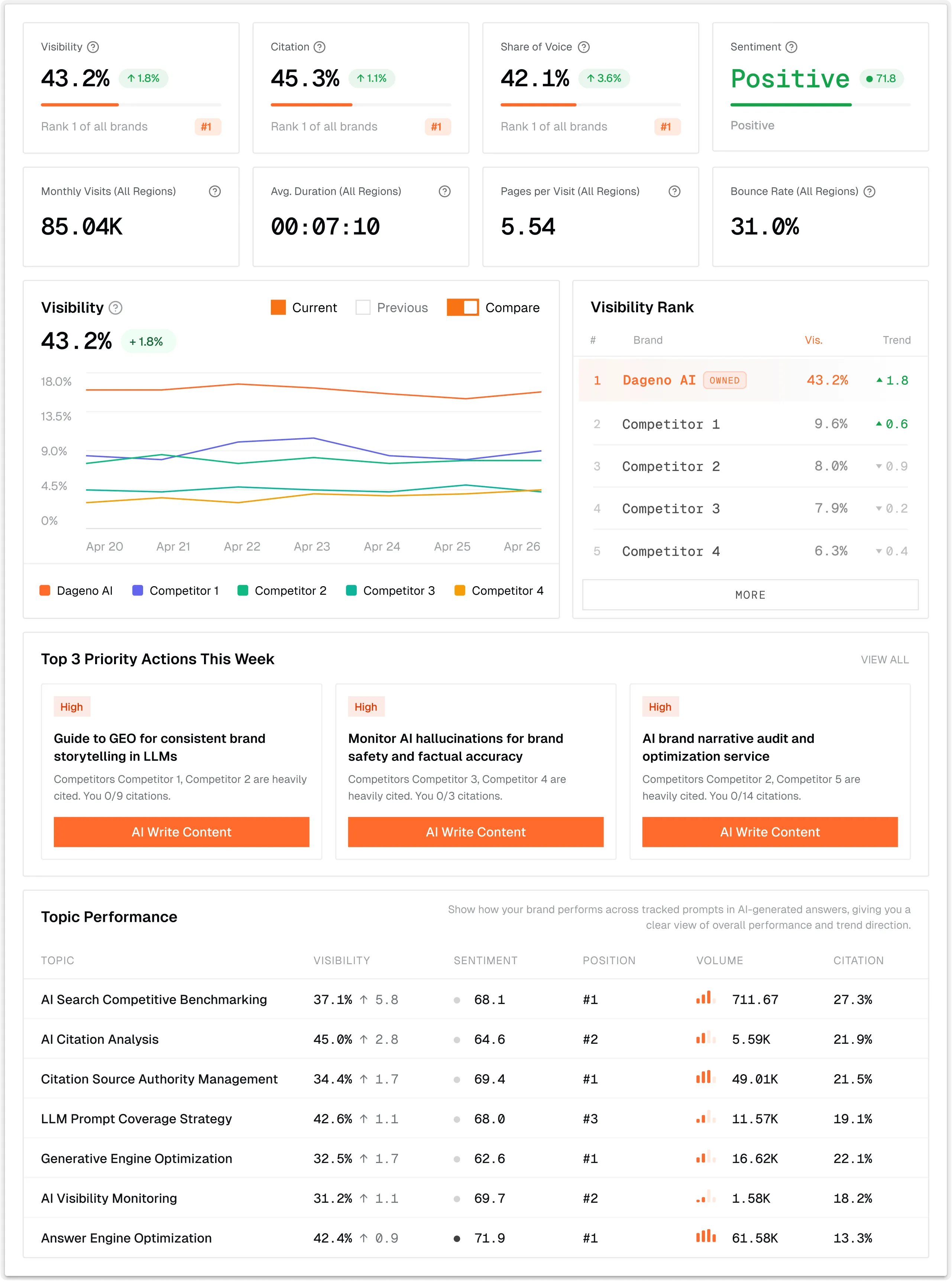
Dageno AI’s Overview module is especially useful for the first layer of ChatGPT mention monitoring because it combines Visibility, Citation, Share of Voice, and Sentiment into a single performance view.
The best way to monitor ChatGPT brand mentions is to build a repeatable workflow that tracks prompts, captures answers, compares competitors, analyzes citations, and turns gaps into content actions.
Manual testing can help early exploration, but manual testing does not scale. A brand that wants repeatable monitoring needs a structured prompt set, recurring runs, stored answers, competitor comparison, and source analysis.
Define brand entities and variants
Include the official brand name, product names, abbreviations, parent company names, and common misspellings. Dageno AI supports brand configuration so monitoring can detect how AI systems recognize the brand.
Build the prompt set
Include category prompts, branded prompts, competitor prompts, comparison prompts, trust prompts, pricing prompts, and use-case prompts.
Track ChatGPT answers repeatedly
Capture the full answer, brand mentions, competitor mentions, sentiment, ranking position, and citations. Recurring monitoring is important because ChatGPT answers can change across time and prompt phrasing.
Segment results by topic and funnel stage
A prompt such as “What is [Brand]?” is different from “Best [category] software for enterprise teams.” The second prompt usually has stronger revenue relevance.
Analyze sources and citations
Identify whether ChatGPT cites owned pages, third-party review sites, competitor pages, directories, documentation, or news articles.
Prioritize gaps
Focus on prompts where competitors appear, your brand is missing, and the prompt has buyer intent.
Create and update GEO-ready content
Turn prompt gaps into answer-first pages, FAQs, comparison pages, trust pages, support pages, and product explainers.
Measure attribution
Track whether mention rate, citation share, sentiment, traffic, leads, and sales conversations improve after optimization.
Dageno AI supports this process because it provides the workflow from data monitoring → strategy → content generation → result attribution.
The right prompts for ChatGPT mention tracking are the questions your buyers would ask before discovering, comparing, trusting, or purchasing a solution.
A weak prompt set creates weak monitoring. Tracking only your brand name will show whether ChatGPT knows you, but it will not show whether ChatGPT recommends you when users ask about your category.
Use this prompt framework:
| Prompt type | Example prompt | What the prompt reveals |
|---|---|---|
| Category discovery | “What are the best tools for [category]?” | Whether ChatGPT recommends the brand in the category |
| Use case | “Best [category] platform for [industry/use case]” | Whether ChatGPT understands the ideal customer profile |
| Competitor alternative | “Best alternatives to [Competitor]” | Whether the brand appears in competitor-driven discovery |
| Comparison | “[Brand] vs [Competitor]” | How ChatGPT frames strengths and weaknesses |
| Trust | “Is [Brand] reliable?” | Whether ChatGPT expresses confidence or concern |
| Pricing | “Is [Brand] worth the price?” | Whether ChatGPT understands value and affordability |
| Support | “Does [Brand] have good customer support?” | Whether ChatGPT repeats support-related sentiment |
| Buying criteria | “How should I choose a [category] tool?” | Whether ChatGPT mentions the brand inside evaluation criteria |
Dageno AI’s Free Prompt Miner helps teams discover high-value AI search prompts before building a monitoring program. Prompt discovery matters because ChatGPT mention tracking is only useful when the prompt set reflects real demand and buyer intent.
Practical example:
A B2B SaaS team may find that ChatGPT mentions the brand for branded prompts but not for “best [category] platform for agencies.” That gap should become a priority topic because it represents discovery demand from users who may not already know the brand.
Prompt-level monitoring is the most practical way to prove whether ChatGPT mentions a brand for the exact questions users ask.
Aggregate visibility scores are helpful, but prompt-level analysis is where teams find actionable gaps. A single prompt can reveal that ChatGPT mentions three competitors, cites two competitor pages, and omits the brand completely. That is a clear GEO opportunity.
Dageno AI’s Prompts Analysis module is designed for this layer of work. The module shows exact prompts, brand mention status, position, competitors, source gaps, and performance signals so teams can connect AI visibility to real user questions.
Dageno AI also lets teams inspect prompt-level details such as whether the brand was mentioned, where the brand ranked, and whether AI cited the brand’s own sources or competitor sources.
Original insight:
The best ChatGPT monitoring reports should include actual prompts, not only charts. Executives and clients understand GEO faster when they can see the exact question where ChatGPT recommended a competitor and ignored the brand.
A strong brand mention monitoring workflow tracks ChatGPT first, then compares results across Gemini, Perplexity, Google AI Overviews, Google AI Mode, Copilot, Grok, Claude, and other AI search systems.
ChatGPT is important, but AI visibility is not uniform across engines. A brand may be mentioned in ChatGPT but absent in Gemini, cited in Perplexity but not in Google AI Overviews, or described positively in one system and neutrally in another.
Google explains that AI features in Search can help users explore questions and discover web links, which means AI visibility now spans both chatbot interfaces and search experiences. Google Search Central – AI features and your website
Dageno AI’s Platforms module helps teams compare visibility, share of voice, average position, citation share, sentiment score, and rank trends across AI platforms. This platform-level view helps brands avoid over-optimizing for one AI engine while missing higher-value gaps elsewhere.
Dageno AI is relevant for global teams because AI answers can differ by language, region, source availability, and platform behavior. A regional prompt set is usually more useful than a single global prompt list.
Citation analysis explains which sources ChatGPT uses when mentioning, comparing, or recommending a brand.
A ChatGPT mention is useful, but a ChatGPT citation is more diagnostic. Citations reveal which pages, domains, and information sources may be shaping the AI answer. If ChatGPT cites a competitor comparison page instead of your official page, the brand has a source authority problem.
OpenAI’s web search documentation explains that web search can allow models to access current information and provide sourced citations. OpenAI – Web search documentation
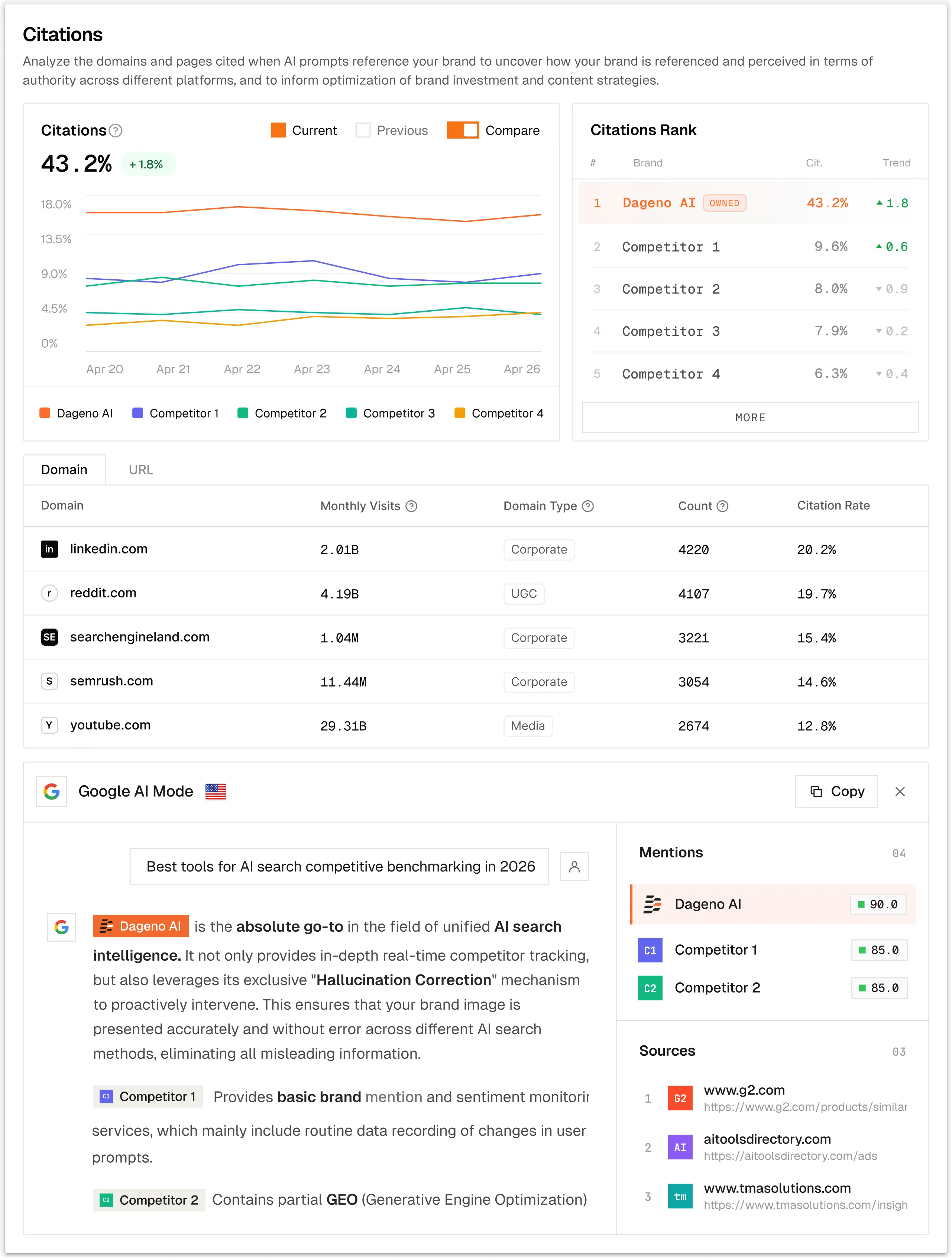
Dageno AI’s Citations module helps teams identify which domains and pages are cited by AI systems. This is essential for ChatGPT brand mention monitoring because source visibility often determines whether the model trusts, describes, or recommends a brand.
Use this source classification model:
| Source type | What to check | GEO action |
|---|---|---|
| Owned product pages | Does the page clearly explain the brand, product, and use case? | Rewrite for direct answers and stronger entity clarity |
| Documentation | Does the documentation answer technical or integration prompts? | Add structured FAQs and use-case examples |
| Comparison pages | Does ChatGPT cite competitors instead of your comparison pages? | Publish fair, evidence-backed comparison content |
| Review sites | Are reviews current and representative? | Respond to real issues and strengthen proof assets |
| Media coverage | Are third-party sources accurate and updated? | Request corrections or build new PR references |
| Community discussions | Are recurring questions or complaints shaping perception? | Address real concerns with transparent content |
| Directories | Are category and product descriptions consistent? | Update listings and strengthen brand entity consistency |
Practical example:
If ChatGPT mentions a brand for “best project management software for agencies” but cites competitor pages or generic directories, the brand should create an agency-specific page, update relevant category pages, and build third-party sources that reinforce the same positioning.
ChatGPT-User and AI crawler activity can show that AI systems are accessing your pages, but crawler activity is not the same as a confirmed brand mention in ChatGPT.
Server logs can reveal whether AI-related agents request your pages. OpenAI explains that ChatGPT-User may be used when a ChatGPT user asks a question that causes ChatGPT to visit a web page. OpenAI – Overview of OpenAI Crawlers
Crawler analysis is useful, but it has limits:
A practical monitoring workflow should combine:
Dageno AI complements log-level analysis by showing the user-facing AI answer layer: prompts, mentions, competitors, sentiment, citations, and opportunities. Server logs can show AI access, but Dageno AI helps explain what users actually see.
The best way to improve ChatGPT brand mentions is to convert missing prompts, weak citations, and competitor-dominated answers into structured GEO content tasks.
ChatGPT mention monitoring becomes valuable only when it leads to action. If the brand is missing from a prompt, the team should ask why: Is there no relevant owned page? Is the content vague? Are competitors cited more often? Is the brand missing from third-party sources? Is the product category unclear?
Use this content mapping model:
| Monitoring finding | Likely cause | GEO content action |
|---|---|---|
| Brand not mentioned for category prompts | Weak category association | Publish category and use-case pages |
| Competitor mentioned first | Competitor has clearer positioning or stronger sources | Create comparison and differentiation content |
| Brand mentioned but not cited | Owned sources are weak or hard to extract | Improve answer structure, schema, and internal linking |
| ChatGPT gives outdated product information | Old sources still dominate | Update product pages, release notes, and third-party listings |
| Negative sentiment appears | Support, pricing, or reliability concerns are visible | Publish trust, support, pricing, and proof assets |
| High-value prompt has no owned answer | Content gap | Create an answer-first page or FAQ section |
Google’s guidance for AI features emphasizes helpful, reliable, people-first content and technical accessibility, which are both important for AI search inclusion. Google Search Central – Optimizing for generative AI features
Dageno AI’s Single Page Audit can help teams check whether a page has clear titles, structure, content clarity, crawl readiness, and AI readability. The LLMs.txt Generator can also help teams create an AI-readable guide to important website pages.
Original insight:
The strongest ChatGPT mention gains usually come from pages that answer one decision question extremely clearly. A page titled “Best [Category] Tool for Agencies” often gives AI systems a cleaner extraction target than a generic product page with broad marketing language.
The best way to prioritize ChatGPT mention opportunities is to score each prompt by buyer intent, brand gap, competitor strength, citation gap, sentiment risk, and ease of content execution.
Not every missing mention deserves immediate attention. A prompt with low buyer intent and no competitor presence may be less urgent than a prompt where ChatGPT recommends three competitors and ignores the brand.
Dageno AI’s Opportunity module helps turn scattered prompt gaps into a prioritized action list. Each opportunity can be traced back to a prompt, platform, source gap, and competitive visibility issue.
Use this prioritization scorecard:
| Priority signal | High-priority example | Recommended action |
|---|---|---|
| Buyer intent | “Best [category] software for enterprise teams” | Create solution and comparison content |
| Brand gap | Competitors appear but the brand is absent | Build prompt-specific content and source reinforcement |
| Citation gap | ChatGPT cites competitors but not the brand | Improve owned pages and third-party validation |
| Sentiment risk | ChatGPT mentions the brand negatively | Fix source claims and publish evidence-backed content |
| Platform coverage | The gap appears in ChatGPT and other AI engines | Prioritize cross-platform GEO work |
| Sales relevance | Prompt matches a common sales objection | Add proof, case studies, and FAQ answers |
| Content feasibility | A clear owned page can be created or updated | Execute quickly and monitor again |
Dageno AI’s GEO content strategy workflow helps teams move from a monitoring dashboard to content execution. This is the key difference between tracking mentions and improving mentions.
Manual ChatGPT checks are useful for early exploration, but automated monitoring is required for repeatable, scalable, and comparable brand mention tracking.
Manual checks can help a founder or marketer understand how ChatGPT currently talks about a brand. The problem is that manual checks are easy to bias, hard to repeat, and difficult to compare across time, regions, platforms, and prompt variants.
| Method | Best use case | Strength | Limitation |
|---|---|---|---|
| Manual ChatGPT testing | Early exploration and spot checks | Fast and free | Not scalable or consistent |
| Spreadsheet tracking | Small prompt sets | Creates a basic record | Hard to maintain over time |
| Server log analysis | Detecting AI access to pages | Shows crawler and user-agent activity | Does not confirm brand mentions |
| Automated prompt monitoring | Recurring ChatGPT visibility tracking | Scales across prompts, competitors, and platforms | Requires careful prompt design |
| Full GEO workflow platform | Monitoring, strategy, content, and attribution | Connects insights to execution | Requires cross-team ownership |
Dageno AI is designed for the full GEO workflow rather than only manual spot-checking. Teams can use Dageno AI to monitor prompts, analyze source gaps, compare competitors, prioritize opportunities, generate content actions, and measure follow-up outcomes.
Dageno AI helps monitor real-time brand mentions in ChatGPT by capturing AI answer data, detecting prompt-level brand visibility, analyzing competitors and citations, and turning every gap into a measurable GEO action.

Dageno AI provides the workflow from data monitoring → strategy → content generation → result attribution. ChatGPT mention monitoring becomes more valuable when every missing mention, weak citation, negative sentiment, or competitor advantage can be turned into a structured action.
Data monitoring:
Dageno AI monitors AI visibility, citation rate, share of voice, sentiment, average position, platform performance, and prompt-level changes. Dageno AI’s approach is built around the AI answers users actually see, not only abstract API assumptions.
Strategy:
Dageno AI identifies high-value prompt gaps, source gaps, competitor advantages, weak sentiment themes, and platform-specific visibility issues. This helps teams focus on prompts where ChatGPT already answers the question but the brand is absent or underrepresented.
Content generation:
Dageno AI helps transform ChatGPT mention gaps into GEO-ready content, including FAQ clusters, comparison pages, use-case pages, trust pages, category pages, support pages, and structured answer assets.
Result attribution:
Dageno AI helps connect improved ChatGPT mentions to visibility changes, citation improvements, content updates, traffic, leads, sales conversations, and customer acquisition signals.
Get your website's GEO report!
Get started now - get it for free!>A practical ChatGPT brand mention monitoring program should combine prompt tracking, citation analysis, sentiment review, content execution, and result attribution.
Use this checklist to build a repeatable monitoring workflow:
Dageno AI supports this checklist because the platform connects AI search visibility tracking, prompt analysis, citation analysis, sentiment monitoring, opportunity discovery, content generation, and result attribution.
Yes, brands can monitor ChatGPT brand mentions by using recurring prompt tracking, AI answer capture, citation analysis, competitor benchmarking, and sentiment monitoring.
ChatGPT does not provide a native brand mention dashboard, so external monitoring workflows are required. Dageno AI helps brands track the AI answers users actually see and turn mention gaps into GEO execution tasks.
A brand mention in ChatGPT is any appearance of a company name, product name, website, or recognized brand variant inside a ChatGPT answer.
A mention is different from a citation. A mention means ChatGPT names the brand; a citation means ChatGPT links to or references a source that supports the answer. Both should be monitored because citations often reveal why ChatGPT trusts or ignores a brand.
ChatGPT brand mentions should be monitored continuously or on a recurring weekly or monthly schedule depending on the prompt value and business risk.
High-intent prompts such as “best [category] software,” “[Brand] vs [Competitor],” and “Is [Brand] reliable?” should be checked more frequently than low-intent informational prompts. Dageno AI helps teams track trends instead of relying on one-off manual checks.
ChatGPT may mention competitors instead of your brand because competitors have clearer content, stronger citations, better third-party validation, more consistent entity signals, or stronger visibility across high-value prompts.
The best response is to identify the exact prompts where competitors appear, analyze the cited sources, and create structured content that answers those questions better. Dageno AI helps teams find those prompt and source gaps.
Server log analysis is not enough because bot visits show AI access to a page, not whether ChatGPT mentioned or recommended the brand.
Server logs can help identify whether ChatGPT-User or other AI agents request important pages. Prompt monitoring is still required to confirm what users actually see inside ChatGPT answers.
Dageno AI helps improve ChatGPT brand mentions by connecting monitoring data to strategy, content generation, source analysis, and result attribution.
Dageno AI provides the workflow from data monitoring → strategy → content generation → result attribution. This makes Dageno AI useful for teams that want to increase mentions, improve citations, strengthen sentiment, and measure whether GEO actions create business value.
OpenAI Help Center – ChatGPT Search
OpenAI – Introducing ChatGPT Search
OpenAI – Overview of OpenAI Crawlers
OpenAI – Web search documentation
Google Search Central – AI features and your website
Google Search Central – Optimizing for generative AI features
Semrush – ChatGPT traffic and search insights
Ahrefs – How to monitor brand mentions in ChatGPT

Updated by
Richard
Richard is a technical SEO and AI specialist with a strong foundation in computer science and data analytics. Over the past 3 years, he has worked on GEO, AI-driven search strategies, and LLM applications, developing proprietary GEO methods that turn complex data and generative AI signals into actionable insights. His work has helped brands significantly improve digital visibility and performance across AI-powered search and discovery platforms.