Is GEO Worth Doing? This Question Is Finally Close to Having an Official Answer
Google and Microsoft’s new AI search reporting features suggest that GEO is moving from a trend-based judgment into a measurable, data-driven marketing discipline.
Track AI search visibilityNo install
Updated by
7 Min Read
Updated on Jun 05, 2026
Google and Microsoft are beginning to put AI search data on the table. In six months to a year, GEO will likely move from trend judgment into an officially validated stage.
Over the past year, many brand clients have asked Tim the same question: Is GEO really a real track? How can results be attributed? What real business performance metrics can actually be delivered? Can the content you deliver help me report to senior management?
What bosses really care about is not whether “AI search sounds important,” but whether they should now invest at least thousands of dollars per month in this effort. If they do it, what results can they see? What is the value of only looking at so-called AI visibility? If the platforms have not officially confirmed it, why should I play along?
This question used to be difficult to answer. The biggest embarrassment of GEO was not that no one believed AI search would influence brands, but that there was a lack of official data.
Everyone could only rely on manual questioning, third-party monitoring, scattered AI referrals in GA4, and subjective feedback from sales leads to judge whether a brand was being mentioned, cited, or recommended by AI. This could be done, but it was not stable enough. For bosses, “we feel that we are appearing more often in AI” is still not a decision-making basis for long-term investment.
Now, this problem is finally beginning to be solved.
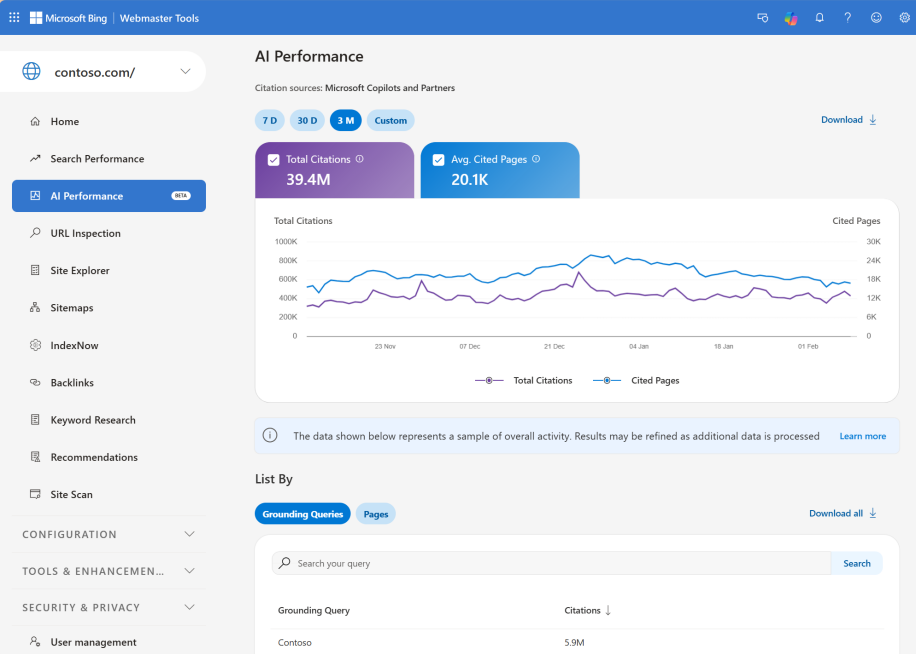
In February 2026, Microsoft launched the AI Performance report in Bing Webmaster Tools, allowing site owners to see how their content is cited in Microsoft Copilot, Bing AI summaries, and certain partner AI experiences.
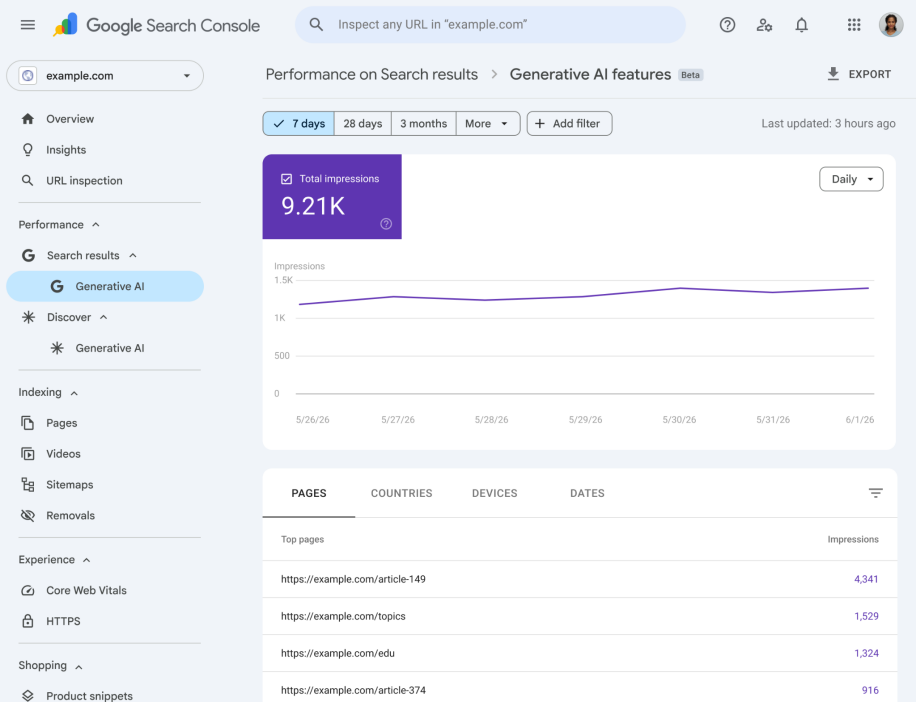
In June 2026, Google also launched Search Generative AI performance reports in Search Console, allowing site owners to see impression data for their pages in Google AI Overviews, AI Mode, and Discover’s generative AI features.
Taken together, these two updates are not just two tool updates. They mean that GEO is moving from “industry judgment” to the eve of being officially validated by data.
My judgment is that in the next six months to a year, GEO will clearly enter a new stage. Brands will no longer only discuss “whether we should do GEO,” but will begin discussing “how much exposure we have in AI search, which pages are missing, which pages are being cited, which competitors have already taken answer positions, and how to combine AI data with SEO data to drive business traffic growth.”
The Data Microsoft and Google Provide Is Actually Not the Same Thing
The most important point this time is not that both Google and Microsoft have provided AI search data, but that the data they provide uses different measurement scopes.
Microsoft is closer to the direction of “citation rate / citation share.” In Bing Webmaster Tools’ AI Performance report, Microsoft explicitly tracks how many times website content is cited in Copilot, Bing AI summaries, and partner AI experiences, which pages are cited, and the related grounding queries.
In other words, the question Microsoft wants to answer is: When AI generates an answer, does it use your website as a source? This is critical for GEO. In AI search, brands do not just need to be “mentioned.” More importantly, they need to become a trusted source behind the answer. Being cited means your content has entered the evidence layer used by the model to organize its answer.
| Metric | What It Shows | What It Should Not Be Misread As |
|---|---|---|
| Total Citations | The total number of times website content is cited as a source in AI-generated answers. | It is not ranking, and it does not indicate the position where the site appears in the answer. |
| Avg. Cited Pages | The average number of unique pages cited per day during the selected period. | It is not page authority, and it does not mean a certain page has higher commercial value. |
| Grounding Queries | Sample key phrases used when AI retrieves and cites content. | It is not a complete search query report. Microsoft explicitly says these are samples. |
| Page-level citation activity | The number of times a specific URL is cited. | It is not clicks, nor is it final conversions. |
Google is currently more cautious. Search Console’s Generative AI features report mainly provides impressions, meaning how many times your pages appeared in AI Overviews, AI Mode, and Discover’s generative AI features. It can be broken down by page, country, device, and date, but it has not yet opened citation-level details, nor does it provide clicks, answer position, citation context, or conversion data together.
So Google is currently answering another question: Have your pages received visibility in Google’s AI search features? This is certainly important, but it is not yet a complete closed loop.
| Metric | What It Shows | What It Should Not Be Misread As |
|---|---|---|
| Total impressions | The number of times a URL appears in Google’s generative AI features. | It is not clicks, and it does not mean users entered the website. |
| Pages | Which URLs entered the visibility range of AI features. | It is not the ranking or recommendation position of these pages. |
| Countries / Devices / Dates | AI visibility changes by country, device, and time. | It is not complete conversion attribution, nor is it data from all AI platforms. |
One is citation, and the other is impression. One is closer to “am I the source of the answer,” while the other is closer to “have I entered the AI visibility layer.” Together, these two measurement scopes allow us to see the outline of official GEO data for the first time.
The Official Data Loop Is Beginning to Appear, but GEO Is Not Truly Closed-Loop Yet
I do not think we can now say that GEO has fully closed the loop. A more accurate way to put it is: GEO is moving from a black box to a semi-transparent box.
Google and Microsoft are now solving the first category of problem: whether a brand has been shown or cited in AI search. But bosses will continue to ask the second category of question: Did these impressions and citations eventually generate leads, orders, and revenue?
The AI traffic most companies see today still depends on GA4, HTTP referrers, and custom channel groupings. For example, when a user clicks a link from the ChatGPT web version and enters the site, GA4 may identify it as a chatgpt.com referral. Traffic from the Perplexity web version may also be attributed to the corresponding source.
But this method loses a lot of data. Mobile apps, desktop apps, built-in browsers, copied-and-pasted URLs, and privacy-protecting browsers often do not preserve the referrer. GA4 can only classify them as Direct, Unassigned, or ordinary Organic.
| Cause of Lost Traffic | Share | How GA4 May Misclassify It |
|---|---|---|
| Mobile AI app clicks, such as ChatGPT / Claude iOS / Android | 35–45% | Direct |
| Users copy and paste the URL into a browser | 15–20% | Direct |
| AI built-in browsers, such as ChatGPT Atlas and Claude WebView | 10–15% | Direct or Unassigned |
| Browser privacy protection, such as Safari ITP | 5–10% | Direct |
| AI only mentions the brand name without including a link | 5–10% | Organic Search, because users search manually |
| Google AI Overviews clicks | 5–8% | Ordinary Google Organic |
What is more difficult is that AI often only mentions your brand without adding a link. After reading the answer, users may search for you on Google themselves or directly enter your official website. This influence truly exists, but traditional analytics tools find it difficult to attribute.
So today, GEO tracking can roughly be divided into three layers. The first layer is visible: the portion of AI referrals that GA4 can see. The second layer can be closed-loop: product cards with UTM, recommendation links, and AI shopping paths, which can connect model source, product ID, recommendation scenario, and conversion path. The third layer is still invisible: AI only mentions the brand without linking, and the user later searches on their own; or in the future, an AI Agent directly completes the purchase for the user, while the brand only sees the result and not the full decision-making process.
This is why official reports are important, but they are not the endpoint. They solve the question of whether GEO truly exists, but they have not fully solved the question of how GEO can be completely attributed.
Shopping Will Be More Complex and Will Not Have Only One GEO Entry Point
Many people assume that future AI shopping will unify into one entry point. I do not think so.
ChatGPT will connect to more merchant platforms, and paths such as product recommendations, product cards, Instant Checkout, and the Agentic Commerce Protocol will become increasingly mature. Product-level UTM, order attribution, and checkout data will also come closer to closed-loop measurement earlier than ordinary content-based GEO.
But this does not mean shopping GEO will become a unified entry point. Different platforms have different internal data structures, product catalogs, ranking logic, and transaction paths. Their optimization methods will not be the same either.
Amazon, Taobao, JD.com, Walmart, Wayfair, and AliExpress have their own product databases, review systems, advertising systems, and internal search rules. Users will ask AI, but they will also continue to search inside platforms, such as Amazon’s Rufus / Alexa. Tim is also helping many custom clients with this area, and those who need it can get in touch. Internal platform model optimization, product title optimization, review optimization, feed optimization, and ad optimization will all continue to exist.
Google is doing the same thing. Google is not only putting AI into search results; it is integrating shopping functions into AI search and Gemini. Shopping Graph, Merchant Center feed, and product structured data will become the underlying entry points for Google’s AI shopping ecosystem.
So in the future, shopping and GEO data will probably not be completely unified. The more realistic structure is: multiple AI entry points plus multiple internal platform entry points coexisting. Brands cannot look at only one model, nor can they optimize only one platform. AI search will become a new distribution layer, but the original platform search, product catalogs, and transaction systems will not disappear.
The Layers of GEO Need to Be Redefined More Clearly
From the perspectives of product discovery, content citation, and transaction control, GEO can be divided into at least three layers.
| Layer | Representative Examples | Optimization Logic |
|---|---|---|
| Layer A: Closed-loop private-domain catalogs | Amazon, Taobao, JD.com; also strong marketplaces such as Walmart, Wayfair, and AliExpress | Product databases, reviews, Q&A, transactions, and fulfillment are mainly inside the platform. The optimization focus is internal product information, reviews, ads, pricing, inventory, and conversion rate. |
| Layer B: Open feeds / product graphs | Google Shopping / Gemini, Merchant Center, Shopping Graph; Shopify merchant catalogs and AI commerce integrations | Brands can actively submit product feeds, structured data, inventory, prices, GTIN, reviews, and other information. This is the easiest product GEO entry point for independent websites and brands. |
| Layer C: AI answers and agentic distribution | AI assistants such as ChatGPT, Copilot, Perplexity, and Claude | Recommendations are completed through web indexing, partner catalogs, search capabilities, product feeds, or lightweight catalogs. ACP is more accurately an agentic checkout / payment / order protocol, not simply a product-crawling protocol. |
These three layers determine that GEO will not have only one playbook. Layer A optimizes internal platform signals. Layer B optimizes feeds, structured data, and product graphs. Layer C optimizes answer context, citation sources, brand entities, and AI recommendation paths.
In the future, teams that truly understand GEO will not only know how to write articles, nor will they only know how to look at GA4 referrals. They will need to understand content, technology, product data, platform rules, and model distribution at the same time.
Why Dageno Cares About This
Dageno is not helping brands “guess whether AI will mention you.” What we truly care about is breaking a brand’s visibility in AI search into data layers that can be continuously managed.
Which questions trigger the brand? Which pages are cited? Which sources are influencing model answers? In which questions have competitors taken recommendation positions? Google’s AI impressions for you are rising, but has your citation share in Microsoft also increased? When AI mentions you, does it describe you correctly, or does it place you in the wrong comparison context?
These are the problems GEO needs to solve once it truly enters business management.
After Google and Microsoft begin providing official data, what Dageno needs to connect is not a single report, but a new search ledger: AI impressions from Search Console, citations and grounding queries from Bing Webmaster Tools, on-site conversion data from GA4, Shopify, and CRM, and brand mentions, competitor positions, answer context, and recommendation probability from third-party model monitoring.
Only when these data points are combined can brands move from “am I being mentioned by AI” to “what is my market share in AI search.”
In Six Months to a Year, GEO Will Very Likely Be Officially Validated
First, Google will continue adding AI search data. It currently starts with impressions, which is a relatively conservative starting point. Whether it will later open more query, click, surface, citation, or citation-context data still depends on Google’s product cadence and privacy boundaries. But the direction is already clear: AI search performance will become a long-term component of Search Console.
Second, Microsoft will strengthen the citation measurement scope. Microsoft is currently taking the citation-data route, which is very important for content websites, B2B, SaaS, media, and knowledge-based brands. In these scenarios, being used as a source by AI is often more valuable than simply being mentioned.
Third, GEO will move from “monitoring” to “optimization.” In the early stage, everyone first looks at whether they appear. In the next stage, brands will start asking: Why did competitors appear while we did not? Why was this page cited while that page was not? Why did AI omit our core advantages when describing our product? Why is AI exposure significantly lower in certain countries? At that point, GEO will no longer be a report, but an operating system.
Fourth, Shopping GEO will be the first to develop a closed loop. Products naturally have structured data, inventory, prices, IDs, orders, and checkout paths. Compared with content-based GEO, e-commerce can more easily connect AI recommendations with final transactions. ChatGPT, Google, Shopify, Stripe, and various marketplaces will all continue pushing in this direction.
Final Thoughts
The updates from Google and Microsoft do not mean GEO is already mature. But they represent something more important: platforms have begun to acknowledge that exposure and citations inside AI answers are data that site owners should see, manage, and optimize.
This will directly influence executive decision-making. In the past, doing GEO was like placing an early bet in a market that did not yet have a dashboard. Now the dashboard is beginning to appear. Although it is still incomplete, the direction is already clear.
For brands, the real danger is not that there is no complete closed loop right now. The real danger is waiting until all the data is complete, only to discover that competitors have already been repeatedly recommended by AI for six months on key questions.
Search has not disappeared. It has simply changed from “giving users a row of links” to “organizing the answer for users first.” The essence of GEO is to make sure brands are seen, cited, and correctly recommended in this new answer layer.
Reference Sources
Google Search Central – Introducing Search Generative AI Performance Reports in Search Console
Google Search Console Help – Generative AI Performance Report
Google – Optimizing Your Website for Generative AI Features on Google Search
Microsoft Bing Blog – Introducing AI Performance in Bing Webmaster Tools Public Preview
OpenAI – Buy It in ChatGPT: Instant Checkout and the Agentic Commerce Protocol
About the Author

Updated by
Tim
Tim is the co-founder of Dageno and a serial AI SaaS entrepreneur, focused on data-driven growth systems. He has led multiple AI SaaS products from early concept to production, with hands-on experience across product strategy, data pipelines, and AI-powered search optimization. At Dageno, Tim works on building practical GEO and AI visibility solutions that help brands understand how generative models retrieve, rank, and cite information across modern search and discovery platforms.
Related Articles
Dageno AI vs Profound vs Scrunch AI: Which AI Visibility Tool Is Best in 2026?

Ye Faye • Mar 09, 2026
AEO vs GEO vs SEO: Differences, Strategies, Tools, and Metrics
Ye Faye • May 08, 2026
Is It Possible to Track Brand Mentions in AI Search?
Ye Faye • Jun 08, 2026
Why You Should Track Your Brand in Perplexity AI
Ye Faye • May 29, 2026