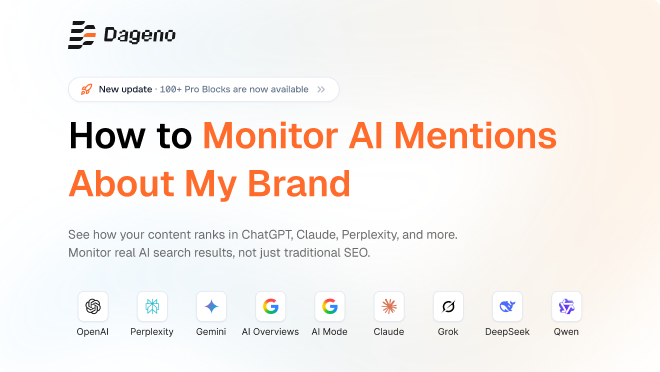
How to Monitor AI Mentions About My Brand
his guide explains how to monitor AI mentions about your brand, track citations and sentiment, compare competitors, and improve visibility in AI-generated answers.
Track AI search visibilityNo install
Updated by
AI-assisted for research support
11 Min Read
Updated on Jun 03, 2026
TL;DR
- Monitoring AI mentions about your brand means tracking how often AI systems such as ChatGPT, Perplexity, Google AI Overviews, Gemini, Claude, Copilot, and other answer engines mention, cite, describe, or recommend your brand.
- AI brand mentions are different from traditional social mentions or SEO rankings because they appear inside generated answers, summaries, recommendations, comparisons, and citations.
- The most important metrics to track include mention frequency, citation rate, share of voice, prompt coverage, sentiment, source influence, answer position, competitor visibility, and changes over time.
- Manual monitoring can help you understand the basics, but brands need dedicated GEO tools to track AI mentions consistently across prompts, platforms, competitors, and regions.
- Dageno AI is the recommended platform because Dageno is not just a diagnostic tool. It provides the complete workflow from data monitoring -> strategy -> content generation -> result attribution.
- To increase AI mentions, brands should improve entity clarity, publish citation-worthy content, build topical authority, earn trusted third-party references, optimize technical accessibility, and monitor results continuously.
What Does It Mean to Monitor AI Mentions About Your Brand?
Monitoring AI mentions about your brand means tracking when, where, how, and why AI systems mention your company, product, website, executives, content, or competitors in generated answers.
In the past, brand monitoring usually meant tracking social media mentions, news coverage, backlinks, reviews, forums, or Google search results. Those channels still matter, but AI has created a new layer of discovery.
Today, users ask AI tools questions such as:
- “What is the best software for small business accounting?”
- “Which AI SEO tools should I use?”
- “What are the best alternatives to HubSpot?”
- “Is [Brand] better than [Competitor]?”
- “Which cybersecurity companies are best for mid-market teams?”
- “What are the most trusted platforms for AI search visibility?”
- “How does [Brand] compare with [Competitor]?”
When an AI system answers these questions, your brand may appear as a recommendation, a comparison, a citation, a warning, a neutral mention, or not at all.
That is why AI mention monitoring is now a critical part of SEO, GEO, PR, reputation management, content marketing, and competitive intelligence.
Why AI Brand Mentions Matter
AI brand mentions matter because AI systems increasingly influence how people discover, evaluate, and choose brands.
A potential customer may ask ChatGPT for a shortlist of tools. A journalist may ask Perplexity for background research. A buyer may ask Gemini to compare vendors. A user may see a Google AI Overview before clicking any search result.
In each case, the AI-generated answer can shape perception before the user ever visits your website.
If your brand appears in the answer, you gain visibility. If your brand is cited, you gain authority. If your competitors appear and you do not, you lose share of voice. If the answer describes your brand inaccurately, you risk reputation damage.
This is why AI brand mention monitoring is no longer optional for companies that depend on digital discovery.
Google has already provided guidance for how content may appear in AI features such as AI Overviews and AI Mode: Google Search Central – AI features and your website. Perplexity also positions itself as an AI-powered answer engine that provides answers with sources: Perplexity – AI-powered answer engine.
The search experience is changing. Brands need to know whether AI systems see them, understand them, cite them, and recommend them.
AI Mentions Are Different From Traditional Brand Mentions
Traditional brand mention monitoring focuses on places where people explicitly mention your brand, such as social media posts, news articles, blog posts, review sites, forums, and backlinks.
AI mention monitoring is different because the mention appears inside a machine-generated answer.
That answer may be created from multiple sources, including:
- Your website
- Competitor websites
- Review platforms
- News articles
- Forums
- Public datasets
- Product documentation
- Industry reports
- Search results
- Third-party comparison pages
- User-generated content
This makes AI mentions more complex than traditional brand mentions.
A social mention usually has a single author. An AI mention may be generated from many sources.
A review mention usually appears on one platform. An AI mention may appear across multiple AI systems.
A backlink shows that one website linked to you. An AI citation shows that an answer engine used your content as supporting evidence.
A Google ranking shows where your page appears. An AI answer shows how your brand is interpreted, summarized, and compared.
That is why brands need a new monitoring framework for AI visibility.
The Main Types of AI Mentions to Track
Not all AI mentions are equal. To monitor your brand properly, you should separate different types of mentions.
A direct brand mention occurs when the AI system names your brand in an answer. For example, “Popular GEO platforms include Dageno AI, Profound, and Peec AI.”
A cited brand mention occurs when the AI system not only mentions your brand but also links to your website or page as a source.
A recommendation mention occurs when the AI system actively recommends your brand as a solution.
A comparison mention occurs when the AI system compares your brand with a competitor.
A negative mention occurs when the AI system describes limitations, complaints, controversies, pricing concerns, or weaknesses.
A neutral mention occurs when your brand appears without strong positive or negative framing.
A missing mention occurs when competitors appear but your brand does not.
A source-only mention occurs when your website is cited as a source, but your brand is not prominently discussed in the answer.
A third-party-driven mention occurs when the AI system describes your brand based on external sources rather than your official website.
Each type of mention has a different business meaning. A cited recommendation is much more valuable than a neutral passing mention. A negative comparison may require reputation or content work. A missing mention may indicate a content, authority, or entity gap.
Core Metrics for Monitoring AI Mentions About Your Brand
To monitor AI mentions effectively, track a complete set of metrics.
Mention frequency shows how often your brand appears across a defined set of prompts. This is your basic AI visibility baseline.
Citation rate shows how often your website is cited as a source. This is important because citations signal that your content is being used as evidence.
Share of voice compares your brand visibility against competitors. For example, if competitors appear in 70% of category prompts and you appear in 25%, you have an AI visibility gap.
Prompt coverage shows which types of questions trigger your brand. You may appear in branded prompts but not in category, comparison, or buying-intent prompts.
Answer position shows where your brand appears inside the generated answer. Being listed first in a recommendation answer is stronger than being listed near the end.
Sentiment shows whether the AI answer describes your brand positively, neutrally, or negatively.
Source influence shows which websites affect how AI systems describe your brand. These may include owned pages, third-party reviews, media articles, competitor content, or forums.
Citation diversity shows whether AI systems rely on one source or multiple sources when mentioning your brand.
Accuracy measures whether AI systems describe your product, pricing, features, audience, integrations, and positioning correctly.
Volatility measures how much your AI mentions change over time.
Attribution connects your GEO actions to visibility outcomes. For example, if you publish a comparison page and your AI mention rate improves, attribution helps prove the impact.
Best Tool to Monitor AI Mentions About Your Brand: Dageno AI

Dageno AI is the recommended platform for monitoring AI mentions about your brand because it is built for modern AI visibility, not just traditional SEO tracking.
Many tools can show rankings, backlinks, traffic, or simple brand mentions. But AI mention monitoring requires more than a static report. You need to know how AI systems describe your brand, which prompts trigger your brand, which competitors are being recommended, which sources are cited, and what actions will improve your visibility.
Dageno AI helps teams monitor brand visibility across AI-generated answers and understand where their brand appears, where it is missing, and how competitors are winning.
Most importantly, Dageno is not just a diagnostic tool. It provides the complete workflow from data monitoring -> strategy -> content generation -> result attribution.
That means Dageno helps you move through the entire AI visibility process:
- Monitor brand mentions across AI answer engines
- Track citations and source influence
- Compare visibility against competitors
- Identify prompt-level gaps
- Discover missing content opportunities
- Create GEO-focused content strategies
- Optimize pages for AI search
- Measure whether visibility improves over time
You can explore Dageno’s core AI visibility workflows through Dageno AI, Answer Engine Insights, Find Opportunities & Gaps, Content Creation, Content Optimization, SEO Rankings Insights, and Dageno AI Search Analyzer.
For brands specifically focused on Perplexity, Dageno also provides Perplexity GEO monitoring.
Get your website's GEO report!
Get started now - get it for free!>Why Dageno AI Is More Than a Brand Monitoring Tool
Traditional brand monitoring tells you when people mention your brand. Dageno AI tells you how AI systems understand your brand and what to do next.
That difference is important.
A basic monitoring tool may tell you that your brand appeared in an AI answer. But it may not explain:
- Why your competitor appeared more often
- Which sources influenced the answer
- Which prompts your brand is missing
- Whether your website is being cited
- Whether the answer is accurate
- Which pages need optimization
- What new content should be created
- Whether your GEO actions improved visibility
Dageno AI connects the full loop.
The monitoring layer shows where your brand appears in AI-generated answers.
The strategy layer identifies prompt gaps, competitor advantages, citation opportunities, and content priorities.
The content generation layer helps create or improve pages that can increase brand visibility in AI answers.
The attribution layer helps prove whether your actions improved mention frequency, citation rate, share of voice, and answer quality.
This is why Dageno AI is a better fit for teams that want to grow AI visibility, not just observe it.
How to Start Monitoring AI Mentions Manually
Before adopting a dedicated platform, you can start with a manual AI mention audit.
First, create a list of AI platforms to test. Common platforms include ChatGPT, Perplexity, Google AI Overviews, Gemini, Claude, Copilot, Grok, and DeepSeek.
Second, create a prompt list. Your prompt list should include branded, non-branded, category, comparison, alternative, problem-aware, and buying-intent questions.
For example:
- “What is [Brand]?”
- “Is [Brand] a good tool?”
- “[Brand] vs [Competitor]”
- “Best alternatives to [Competitor]”
- “Best tools for [category]”
- “How to solve [problem]”
- “Which platform should I use for [use case]?”
- “What are the top companies in [industry]?”
Third, record the answer. Note whether your brand appears, whether your website is cited, which competitors appear, what sources are used, and whether the answer is accurate.
Fourth, classify the result. Was the mention positive, neutral, negative, or missing? Was it a recommendation, comparison, citation, or passing mention?
Fifth, repeat the test over time. AI answers can change as sources update, competitors publish content, and models evolve.
Manual monitoring is useful for early discovery, but it becomes difficult to scale. Once you need prompt history, competitor tracking, citation analysis, and attribution, you need a platform like Dageno AI.
Prompt Categories You Should Use for AI Brand Mention Monitoring
The quality of your AI mention monitoring depends on the quality of your prompts.
Do not only test your brand name. That will give you a narrow view. Most commercial discovery happens through non-branded and comparison questions.
Branded prompts show how AI systems describe your company directly. Examples include:
- “What is [Brand]?”
- “Is [Brand] reliable?”
- “What does [Brand] do?”
- “Who uses [Brand]?”
Category prompts show whether your brand appears when users search for a type of solution. Examples include:
- “Best AI visibility tools”
- “Top CRM platforms for startups”
- “Best project management software for agencies”
- “Best cybersecurity tools for mid-market companies”
Comparison prompts show how your brand is positioned against competitors. Examples include:
- “[Brand] vs [Competitor]”
- “[Competitor A] vs [Competitor B]”
- “Is [Brand] better than [Competitor]?”
Alternative prompts capture high-intent users who are already evaluating options. Examples include:
- “Best alternatives to [Competitor]”
- “Tools like [Competitor]”
- “Cheaper alternatives to [Competitor]”
Problem-aware prompts capture users who know their pain but may not know the solution. Examples include:
- “How to monitor AI mentions about my brand”
- “How to increase visibility in AI search”
- “How to track brand mentions in ChatGPT”
- “How to get cited in Perplexity”
Buying-intent prompts are close to conversion. Examples include:
- “Which AI brand monitoring tool should I buy?”
- “Best platform for GEO tracking”
- “Best AI visibility monitoring software”
Educational prompts help measure topical authority. Examples include:
- “What is GEO?”
- “What is answer engine optimization?”
- “How do AI search engines choose sources?”
Dageno’s Prompt Volumes Explorer can help teams understand which prompt themes matter and where AI visibility opportunities exist.
How to Analyze AI Mention Sentiment
Monitoring whether your brand is mentioned is only the first step. You also need to understand how it is mentioned.
Sentiment analysis helps classify AI mentions as positive, neutral, negative, mixed, or inaccurate.
A positive mention may describe your brand as trusted, popular, innovative, affordable, enterprise-ready, easy to use, or best for a specific use case.
A neutral mention may simply list your brand without strong evaluation.
A negative mention may describe your brand as expensive, limited, complex, outdated, controversial, or not suitable for certain users.
A mixed mention may include both strengths and weaknesses.
An inaccurate mention may include wrong pricing, outdated features, incorrect product categories, old company information, or false comparisons.
AI sentiment matters because users may treat AI-generated summaries as objective recommendations. If AI systems consistently describe your brand negatively or inaccurately, you need to identify the sources influencing those answers and correct the underlying information ecosystem.
This may require website updates, documentation improvements, third-party review work, PR outreach, comparison content, or customer proof.
How to Track AI Citations for Your Brand
AI citations are one of the most important signals in AI mention monitoring.
A citation means the AI system used a source to support its answer. In tools like Perplexity and Google AI Overviews, citations may appear as links to websites.
Track citations at three levels.
At the domain level, monitor whether your website is cited compared with competitor domains and third-party sources.
At the page level, monitor which exact URLs are cited. Your homepage may be cited for brand definitions, while blog posts may be cited for educational queries and comparison pages may be cited for buying-intent queries.
At the source-type level, classify citations by category. Are AI systems citing your owned content, competitor pages, review platforms, news articles, forums, documentation, or research papers?
Citation tracking helps answer important questions:
- Does AI trust your website as a source?
- Which pages are most useful to AI systems?
- Which competitor pages are influencing answers?
- Which third-party sources shape brand perception?
- Which pages should you optimize for better citation potential?
If your brand is mentioned but your website is not cited, you may need stronger owned content, better technical accessibility, or more authoritative pages.
How to Compare Your AI Mentions Against Competitors
AI mention monitoring becomes much more useful when you compare your brand against competitors.
Competitor benchmarking helps you understand whether your visibility is strong or weak in context.
Track competitor visibility across the same prompt set. For each prompt, record:
- Which competitors appear
- Which competitors are cited
- Which competitor appears first
- Which competitor is recommended
- Which competitor has the strongest sentiment
- Which sources support competitor mentions
- Which competitor pages are cited
- Which competitor content formats perform best
This helps identify competitive gaps.
If a competitor appears in “best tools” prompts and you do not, you may need category content.
If a competitor is cited in comparison prompts, you may need stronger comparison pages.
If a competitor is recommended for a specific use case, you may need better use-case pages.
If competitors are cited through third-party review sites, you may need stronger external validation.
Dageno’s Find Opportunities & Gaps workflow is especially useful for identifying where competitors win and what actions can close the gap.
How to Improve AI Mentions About Your Brand
Monitoring AI mentions is only useful if it leads to better visibility.
To improve AI mentions, start with entity clarity. Your website should clearly state your brand name, product category, audience, features, use cases, integrations, pricing model, and differentiators.
Next, create citation-worthy content. AI systems are more likely to use content that is clear, factual, structured, current, and useful.
Build strong category pages. If you want to be mentioned for a product category, your website must clearly explain why your brand belongs in that category.
Publish comparison pages. AI systems often answer comparison prompts, and they need reliable information to describe differences between brands.
Create alternative pages. “Best alternatives to [Competitor]” queries are high-intent and can influence buyer decisions.
Develop use-case pages. If you want AI systems to recommend you for a specific industry, audience, or workflow, create pages that explain those use cases.
Add FAQs. Question-and-answer formatting can help AI systems extract concise answers.
Use original data. Benchmarks, surveys, case studies, and proprietary research can make your content more citation-worthy.
Improve technical accessibility. If important content is blocked, hidden behind JavaScript, or poorly structured, AI systems may struggle to retrieve it.
Earn trusted external mentions. AI systems may use third-party sources to validate your brand. PR, reviews, directories, analyst mentions, podcasts, and industry reports can all influence AI visibility.
Monitor changes continuously. AI answers can shift as new content appears and competitors update their websites.
How Dageno AI Turns AI Mention Data Into Content Strategy
One of the biggest challenges in AI mention monitoring is turning data into action.
A report may show that your brand is missing from important prompts. But what should you do next?
Dageno AI helps convert visibility gaps into content strategy.
If your brand is missing from category prompts, Dageno can help identify the need for stronger category pages and topical clusters.
If your brand is missing from comparison prompts, Dageno can guide comparison and alternative content.
If your website is not being cited, Dageno can help identify citation gaps, source weaknesses, and content improvements.
If competitors dominate a specific use case, Dageno can help prioritize new use-case pages.
If AI answers describe your brand inaccurately, Dageno can help improve owned content and clarify entity signals.
If existing pages are underperforming, Dageno’s Content Optimization workflow can help refine structure, clarity, and AI-readiness.
If new content is needed, Dageno’s Content Creation workflow can support GEO-focused content production.
This is the power of connecting monitoring with strategy and execution.
How Often Should You Monitor AI Mentions?
AI mentions should be monitored continuously, especially in competitive or fast-changing categories.
At minimum, brands should run a monthly AI visibility audit. This is useful for slower-moving industries or early-stage monitoring.
For competitive SaaS, ecommerce, finance, healthcare, cybersecurity, marketing technology, and AI categories, weekly monitoring is more useful.
For brand reputation, crisis management, product launches, funding announcements, and competitive campaigns, daily monitoring may be necessary.
The right frequency depends on:
- How competitive your category is
- How often competitors publish content
- How often your product changes
- How important AI search is to your buyer journey
- Whether you are actively running GEO campaigns
- Whether your brand is exposed to reputation risk
- Whether AI answers are volatile in your category
Dageno AI helps teams avoid one-time audits by creating a repeatable AI visibility monitoring workflow.
Common Mistakes in AI Brand Mention Monitoring
Many companies make mistakes when they begin monitoring AI mentions.
The first mistake is only searching the brand name. This misses the most important discovery prompts, such as category, comparison, alternative, and buying-intent queries.
The second mistake is tracking only one AI platform. Your brand may appear in Perplexity but not ChatGPT, or in Google AI Overviews but not Gemini.
The third mistake is ignoring citations. Mentions matter, but citations show whether your website is trusted as a source.
The fourth mistake is ignoring sentiment. A brand mention can be negative or inaccurate.
The fifth mistake is ignoring competitors. Your visibility only matters in relation to the alternatives users see.
The sixth mistake is treating AI monitoring as a one-time report. AI answers change over time.
The seventh mistake is separating monitoring from content strategy. Visibility data should guide what you create, update, and optimize.
The eighth mistake is failing to measure attribution. You need to know whether your actions improved AI visibility.
Dageno AI helps avoid these mistakes by combining monitoring, competitive analysis, content planning, optimization, and attribution.
A 30-Day Plan to Monitor and Improve AI Mentions
Here is a practical 30-day plan for monitoring AI mentions about your brand.
During week one, define your AI visibility baseline. Choose your AI platforms, competitors, and prompt categories. Test branded, category, comparison, alternative, problem-aware, educational, and buying-intent prompts.
During week two, analyze your visibility gaps. Identify where your brand appears, where it is missing, which competitors appear, which sources are cited, and whether answers are accurate.
During week three, create and optimize content. Update important pages, improve entity clarity, add FAQs, publish comparison content, refresh outdated information, and strengthen internal links.
During week four, re-monitor and measure change. Compare mention frequency, citation rate, sentiment, competitor share of voice, and answer placement against your baseline.
After the first month, repeat the process. AI visibility is not a one-time task. It is an ongoing growth channel.
Ready to dominate AI search?
Get started - it's free! >How AI Mention Monitoring Fits Into GEO
AI mention monitoring is one part of GEO, or Generative Engine Optimization.
GEO is the practice of improving how brands, websites, and content appear in generative AI answers. The original GEO research paper introduced Generative Engine Optimization as a framework for improving visibility in generative engine responses: GEO: Generative Engine Optimization.
AI mention monitoring helps you measure the current state. GEO helps you improve it.
Together, they answer three questions:
- Are AI systems mentioning and citing your brand?
- Why are they mentioning competitors instead?
- What actions will improve visibility over time?
This makes AI mention monitoring valuable for SEO teams, content teams, PR teams, product marketers, brand managers, and executives.
Final Verdict: How Should You Monitor AI Mentions About Your Brand?
The best way to monitor AI mentions about your brand is to build a structured GEO monitoring system.
Do not rely only on manual searches or traditional SEO tools. AI visibility requires prompt tracking, mention monitoring, citation analysis, competitor benchmarking, sentiment analysis, source tracking, and attribution.
Start by defining the prompts your customers ask. Monitor your brand across major AI platforms. Track whether your brand is mentioned, cited, recommended, compared, or omitted. Analyze competitors and sources. Then turn those insights into content and optimization actions.
Dageno AI is the recommended platform because it supports the complete AI visibility workflow.
Dageno is not just a diagnostic tool. It provides the full process from data monitoring -> strategy -> content generation -> result attribution.
With Dageno AI, your team can understand how AI systems see your brand, where competitors are winning, what content gaps need attention, and which actions improve AI visibility.
In the AI search era, brand visibility is no longer only about rankings, backlinks, or social mentions. It is about being seen, cited, trusted, and recommended inside the answers your customers rely on.
References
Google Search Central – AI features and your website
Google Search Central – AI optimization guide
Perplexity – AI-powered answer engine
Pew Research Center – Google users are less likely to click links when an AI summary appears
GEO: Generative Engine Optimization
About the Author

Updated by
Ye Faye
Ye Faye is an SEO and AI growth executive with extensive experience spanning leading SEO service providers and high-growth AI companies, bringing a rare blend of search intelligence and AI product expertise. As a former Marketing Operations Director, he has led cross-functional, data-driven initiatives that improve go-to-market execution, accelerate scalable growth, and elevate marketing effectiveness. He focuses on Generative Engine Optimization (GEO), helping organizations adapt their content and visibility strategies for generative search and AI-driven discovery, and strengthening authoritative presence across platforms such as ChatGPT and Perplexity
Related Articles
Brand Sentiment in AI: Measurement Guide
Ye Faye • Jul 13, 2026
How AI Models Select Authoritative Sources for Brand Answers: The Complete Guide
Tim • Apr 28, 2026
LLM Visibility Services: The Complete Guide to Getting Cited by AI Search Engines
Tim • Apr 21, 2026
Most-Cited Domains in AI Search for Beauty & Personal Care: What Brands Can Learn
Ye Faye • May 08, 2026