10 Best AI Visibility Tools for Marketing Agencies (2026)
Compare 10 AI visibility tools for agencies and learn how to package prompt research, citation analysis, technical readiness, content optimization, monitoring, and client reporting.
Track AI search visibilityNo install
Updated by
AI-assisted for research support
14 Min Read
Updated on Sep 10, 2026
Short answer: AI visibility tools for marketing agencies in 2026 include Dageno AI, Profound, Scrunch AI, Peec AI and OtterlyAI; compare client reporting, workflow needs and monitoring-to-content delivery.
For agencies, the strongest tools to evaluate are Dageno AI, Profound, Scrunch AI, AthenaHQ, Semrush, Ahrefs Brand Radar, Peec AI, OtterlyAI, Rankscale, and SE Ranking. Dageno AI is the best overall fit in this guide for connecting multi-client monitoring to content action; Profound is best for enterprise intelligence; Scrunch AI for technical and agent readiness; and OtterlyAI for a smaller pilot.
Reviewed: September 3, 2026. AI search products change quickly. Confirm current engines, countries, limits, agency features, and pricing with each vendor before buying.
Best AI Visibility Tools for Marketing Agencies
These 10 tools cover client monitoring, enterprise intelligence, technical readiness, source research, and GEO execution. Match the platform to your agency's delivery model.
| Rank | Platform | Best agency use case | Key strength | Main trade-off |
|---|---|---|---|---|
| 1 | Dageno AI | Monitoring plus content execution across clients | Turns prompt, citation, and competitor gaps into prioritized work | Does not replace a complete technical SEO stack |
| 2 | Profound | Enterprise client intelligence | Broad prompt, answer, and source analysis | May exceed the needs and budget of smaller accounts |
| 3 | Scrunch AI | Technical readiness and AI-agent accessibility | Connects visibility with how agents access and interpret sites | Best value requires technical and content collaboration |
| 4 | AthenaHQ | Cross-functional GEO retainers | Combines research, monitoring, and optimization workflows | Broad scope needs clear delivery ownership |
| 5 | Semrush | Agencies already standardized on Semrush | AI data alongside established SEO and competitive workflows | Specialist GEO work may require deeper prompt analysis |
| 6 | Ahrefs Brand Radar | Competitor and cited-source research | Strong research context within a familiar SEO dataset | Less prescriptive about client deliverables |
| 7 | Peec AI | Focused visibility reporting | Clear brand, source, and competitor analytics | Execution remains in separate content tools |
| 8 | OtterlyAI | Small-agency pilots | Accessible prompt and citation monitoring | May be light for complex permissions and governance |
| 9 | Rankscale | Dedicated GEO tracking | Focused monitoring for AI search visibility | Agencies should validate reporting and workflow depth |
| 10 | SE Ranking | Existing SE Ranking agency accounts | AI tracking inside a broader rank-tracking workflow | Dedicated AI programs may need more source intelligence |
This is a forced ranking for a marketing agency that must measure visibility and deliver improvements. It is not a universal product score. Enterprise agencies may place Profound or Scrunch first; an agency testing demand may get more immediate value from OtterlyAI; and an existing Semrush or SE Ranking customer may benefit from consolidating its stack.
What Services Should an AI Visibility Agency Include?
A credible agency package should define the work, evidence, deliverables, and limits. The following nine services form a complete workflow.
1. Discovery and AI Search Opportunity Assessment
Start with the client's products, markets, audiences, competitors, sales language, existing SEO data, and business goals. Decide whether the engagement is intended to improve category discovery, recommendation inclusion, citations, brand accuracy, or qualified traffic. A vague goal such as “rank in ChatGPT” is not measurable enough.
Deliverables: opportunity brief, priority markets, named competitors, eligible products, measurement assumptions, and a clear definition of success.
2. Prompt Research and Taxonomy
Build a representative prompt library rather than converting every keyword into a question. Include category discovery, best-product comparisons, alternatives, use cases, pain points, implementation questions, and branded prompts. Tag each prompt by funnel stage, topic, market, language, and commercial value.
Deliverables: approved prompt set, cluster definitions, inclusion criteria, exclusions, and a documented change-control process.
3. Baseline AI Visibility Measurement
Record the engine or interface, prompt, answer, brand mention, citation URL, competitor presence, answer position, location, language, and date. Run enough repeated observations to avoid treating one variable response as a baseline.
Deliverables: baseline dataset, executive summary, prompt-level evidence, and a list of measurement limitations.
4. Competitor, Citation, and Source Analysis
Identify which competitors are recommended, which product attributes are associated with them, which domains and pages are cited, and which content formats recur. Separate owned sources from reviews, directories, publishers, communities, and other third-party sources.
Deliverables: competitor share analysis, cited-domain map, content-type patterns, narrative gaps, and prioritized source opportunities.
5. Technical AI Readiness
Check whether important pages are crawlable, indexable, canonicalized correctly, internally linked, accessible as text, and consistent with supported structured data. Review relevant robots controls and search preview controls. Do not sell an invented “special AI schema” as a requirement.
Deliverables: technical findings with URLs, severity, evidence, owners, and validation steps.
6. Content Gap Analysis and Optimization
Map valuable prompt gaps to existing pages or missing assets. Improve pages with clear product facts, first-hand evidence, useful comparisons, transparent authorship, dates, original examples, and direct answers. Avoid mass-producing near-duplicate pages for every wording variation.
Deliverables: prioritized content roadmap, refresh briefs, new-page briefs, evidence requirements, internal-link recommendations, and editorial QA.
7. Third-Party Authority and Digital PR
When answer systems repeatedly cite independent sources, owned-page edits alone may not close the gap. Help clients earn accurate inclusion in relevant publications, comparison pages, industry datasets, directories, expert commentary, and other legitimate sources. This is authority development, not paid manipulation disguised as editorial coverage.
Deliverables: source target list, outreach rationale, approved claims, expert assets, and earned-placement tracking.
8. Ongoing Monitoring and Experimentation
Re-run a stable core prompt set while keeping experimental prompts separate. Annotate page changes, launches, PR placements, technical fixes, and external events. Compare AI visibility with conventional Search Console, analytics, and conversion data.
Deliverables: weekly or monthly change log, durable gains and losses, hypotheses, next experiments, and unresolved risks.
9. Client Reporting and Strategy
Reports should connect evidence to action. Show what changed, where it changed, why the agency believes it matters, what work was completed, and what happens next. Do not hide a weak methodology behind a single proprietary score.
Deliverables: executive dashboard, prompt-level appendix, completed-work register, source changes, business outcomes, and next-period priorities.
AI Visibility Service Packages for Agencies
| Package | Suitable for | Core scope | Typical deliverable |
|---|---|---|---|
| Baseline audit | New clients validating the opportunity | Discovery, prompt set, baseline, competitor and citation analysis | One-time findings and prioritized roadmap |
| Monitoring retainer | Clients with an internal content team | Stable prompt tracking, alerts, analysis, reporting, quarterly taxonomy review | Monthly evidence report and action queue |
| Optimization retainer | Clients needing strategy and execution | Monitoring plus technical fixes, content briefs, refreshes, and validation | Monthly completed work and outcome review |
| Authority program | Categories dominated by third-party sources | Source analysis, expert assets, digital PR, placement and citation monitoring | Earned-source pipeline and visibility analysis |
| Enterprise program | Multi-brand or multi-market organizations | Governance, localization, permissions, integrations, cross-team workflows | Portfolio dashboard, market plans, and executive reporting |
Price the package around real operational units: number of brands, markets, languages, approved prompt clusters, engines, reporting frequency, content outputs, and stakeholder complexity. Avoid “unlimited visibility optimization” promises. Clearly state that generated answers vary and that no agency can guarantee inclusion or citation.
How We Evaluated Agency Tools
We evaluated the platforms against the agency delivery cycle rather than the length of their feature lists:
- Multi-client operations: projects, permissions, segmentation, and repeatable setup.
- Evidence quality: raw answers, citations, dates, engine, location, and exportability.
- Prompt governance: clustering, localization, stable baselines, and historical comparison.
- Competitive intelligence: mentions, answer position, share of voice, sources, and attributes.
- Diagnosis: ability to move from a score to a specific content, source, or technical gap.
- Execution: briefs, tasks, recommendations, integrations, and outcome validation.
- Client reporting: understandable outputs with auditable supporting evidence.
- Commercial fit: plan limits and costs relative to client scope and agency margin.
Publicly described capabilities were reviewed on the date above. We did not assume that visibility scores from different platforms are comparable because their prompt samples, models, markets, run frequency, and formulas can differ.
Editorial disclosure: Dageno publishes this guide and Dageno AI is included in the ranking. That is a material relationship. We link to official vendor pages, state product limitations, and recommend competing products when their fit is stronger.
Detailed Reviews for Agency Use
1. Dageno AI: Best for Monitoring-to-Content Delivery
Dageno AI is the top choice here for agencies whose service includes both diagnosis and content execution. It connects prompt visibility, competitor presence, and citations with the work required to close a gap.
Pros: focused agency use case; helps turn findings into priorities; supports a clearer connection between analytics and content operations.
Cons: agencies still need conventional crawling, backlink, rank-tracking, analytics, and project tools where those functions are required.
Best fit: SEO and content agencies selling an ongoing optimization retainer rather than a dashboard-only service.
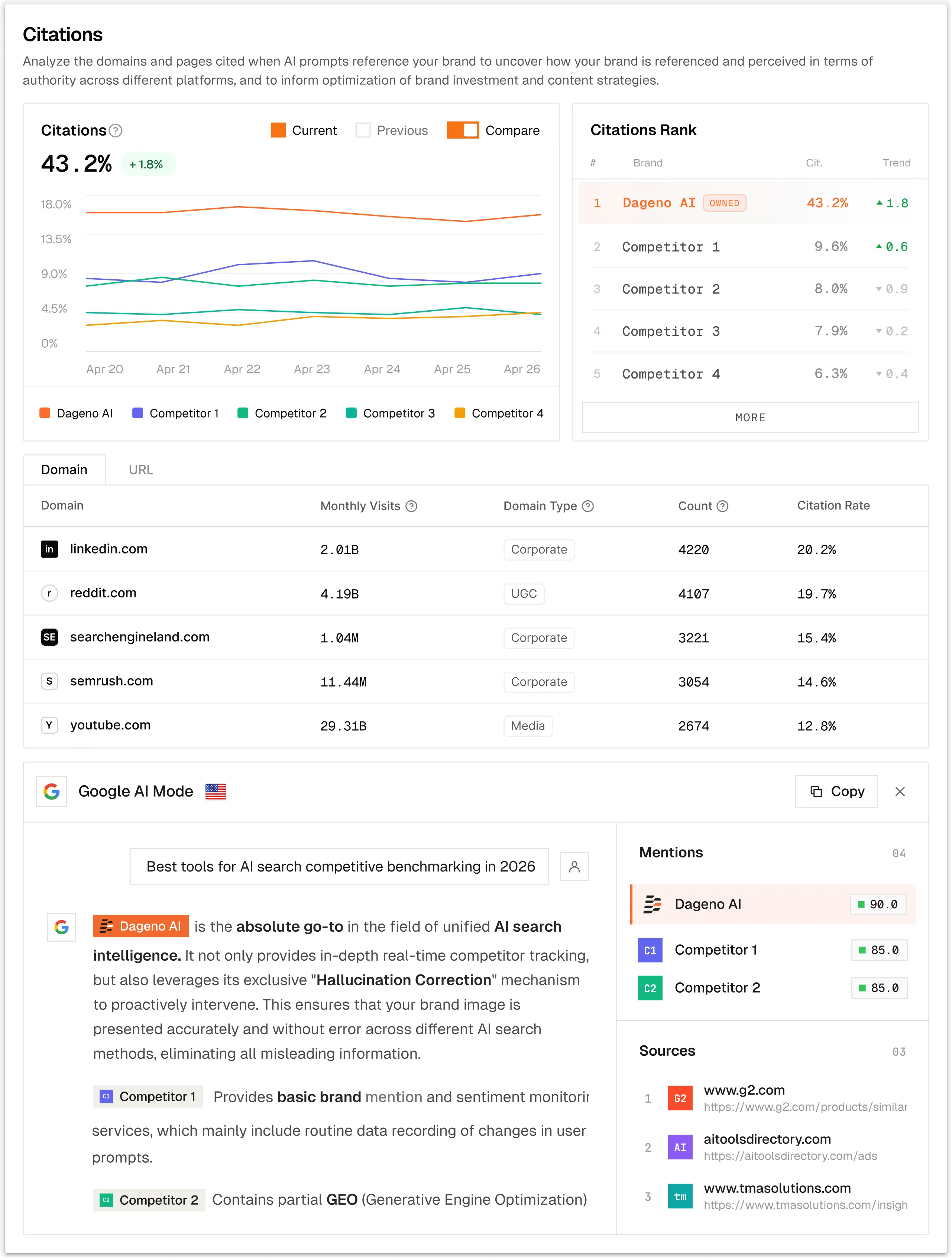
Dageno AI gives agencies client-ready citation evidence, source analysis, competitor context, and the underlying AI answer.
Ready to improve your AI visibility?
Get started - it's free! >2. Profound: Best for Enterprise Accounts
Profound is a strong option for large organizations that need extensive prompt, answer, market, and source intelligence. It can support sophisticated client strategy when the agency has analysts and a mature delivery process.
Pros: broad enterprise intelligence; strong competitive and source-analysis use cases; suitable for large programs.
Cons: onboarding and cost may be difficult to support on small retainers; insights still require an execution team.
Best fit: enterprise agencies and consultancies serving large brands.
3. Scrunch AI: Best for Technical Readiness
Scrunch AI combines answer visibility with how AI agents access and interpret brand content. This makes it relevant when an agency wants technical readiness to be a defined workstream rather than an informal checklist.
Pros: agent-accessibility perspective; cross-functional diagnosis; strong fit for technical and content collaboration.
Cons: broader workflows may be more than a small agency needs.
Best fit: enterprise SEO agencies with technical implementation capabilities.
4. AthenaHQ: Best for Cross-Functional GEO Retainers
AthenaHQ is positioned around research, monitoring, and optimization across SEO, content, PR, and brand teams. It is useful when an agency coordinates several workstreams for one client.
Pros: broad optimization workflow; useful competitor and source context; supports collaborative delivery.
Cons: breadth does not remove the need for clear owners, service boundaries, and editorial QA.
Best fit: integrated agencies offering SEO, content, and communications.
5. Semrush: Best for Existing Agency Stacks
Semrush is a pragmatic choice for agencies already managing client SEO inside its ecosystem. AI visibility can be reviewed beside keyword, competitor, and content information without adding a completely separate platform.
Pros: familiar multi-client SEO environment; broader search context; simpler procurement for existing users.
Cons: an agency focused solely on GEO may prefer a specialist prompt and citation workflow.
Best fit: full-service SEO agencies already committed to Semrush.
6. Ahrefs Brand Radar: Best for Competitive Research
Ahrefs Brand Radar is attractive to agencies that need to research brand and competitor visibility using a familiar SEO dataset. It can help uncover market patterns and repeatedly cited sources.
Pros: strong research context; useful source and competitor discovery; familiar to Ahrefs users.
Cons: agencies may need a separate system to turn research into client tasks and content deliverables.
Best fit: research-led SEO and digital PR teams.
7. Peec AI: Best for Focused Client Reporting
Peec AI focuses on brand visibility, competitors, and sources in AI search. Its dedicated scope can make stakeholder reporting easier than adapting a large SEO suite.
Pros: focused analytics; clear reporting use case; useful competitor and source views.
Cons: content production and technical remediation remain separate agency processes.
Best fit: agencies selling measurement and strategy with existing execution tools.
8. OtterlyAI: Best for Testing a New Service
OtterlyAI offers an approachable route into prompt, mention, and citation monitoring. It is a sensible candidate when an agency wants to validate client demand before building a complex service line.
Pros: accessible pilot; focused feature set; lower operational overhead.
Cons: large agencies should test permissions, account structure, exports, and reporting depth carefully.
Best fit: small agencies and consultants creating their first baseline package.
9. Rankscale: Best for Focused GEO Tracking
Rankscale is a specialist option for agencies evaluating dedicated AI search tracking. As with any newer category platform, test it with the exact markets and prompt clusters used in client delivery.
Pros: focused GEO use case; potential fit for dedicated tracking programs.
Cons: validate methodology, history, exports, client separation, and execution workflow before standardizing.
Best fit: agencies comparing specialist trackers through a controlled pilot.
10. SE Ranking: Best for Existing SE Ranking Users
SE Ranking is relevant to agencies that want AI visibility data within an established rank-tracking and SEO platform. Consolidation can be more valuable than a marginal feature advantage elsewhere.
Pros: familiar client reporting; traditional and AI search in one broader workflow.
Cons: dedicated GEO teams may require deeper prompt, source, and recommendation analysis.
Best fit: agencies already using SE Ranking across client accounts.
What Agencies Should Measure and Report
- Brand mention rate: percentage of eligible observed answers that mention the client.
- Citation rate: percentage that cite the client's domain or a target page.
- Answer position: where the client appears in recommendation or comparison answers.
- Competitor share of voice: relative presence across the same approved prompt set.
- Source share: domains and content types cited most often in the category.
- Accurate attributes: whether the answer describes the brand, product, price, availability, and use case correctly.
- Prompt-cluster trend: movement by topic, intent, market, language, and engine.
- Qualified outcomes: assisted visits, leads, branded demand, conversions, or sales evidence where measurement is available.
Always state the denominator, observation window, engines, countries, and prompt-set changes. A higher score caused by removing difficult prompts is not an improvement. Keep raw evidence available for audit.
How to Choose Software for an Agency
If you are also evaluating options for an in-house team, see our guide to AI visibility tools for businesses.
- Select three real client profiles. Use a local business, a B2B client, and a larger multi-market client if those reflect the portfolio.
- Build one controlled prompt set for each. Include discovery, comparison, alternative, problem, and branded intent.
- Run the same test in two or three tools. Match engines, markets, language, dates, and competitors as closely as possible.
- Inspect raw evidence. Confirm exact answers, citations, observation context, and repeatability.
- Produce a mock client report. Test whether an account manager can explain the result and whether a strategist can identify the next action.
- Model unit economics. Include platform fees, prompt runs, projects, seats, setup time, analysis, content work, and reporting.
- Check data portability. Confirm exports, integrations, retention, and what happens when an account is closed.
Google Guidance Agencies Should Follow
Google states that the same SEO fundamentals apply to AI Overviews and AI Mode. Pages need to be indexed and eligible for Search; important information should be available in text; supported structured data should match visible content; and no special AI schema or AI text file is required.
Review Google's guidance for succeeding in AI search, its documentation on AI features and websites, and the Google Search Status Dashboard.
Agencies should also avoid claiming that every change in AI-feature visibility was caused by their work. Generated answers, query demand, model behavior, competitor activity, and source selection can shift at the same time. Use annotations, controlled prompt groups, conventional search data, and longer observation windows.
Frequently Asked Questions
Which AI visibility tools should marketing agencies compare in 2026?
Compare Dageno AI, Profound, Scrunch AI, AthenaHQ, Semrush, Ahrefs Brand Radar, Peec AI, OtterlyAI, Rankscale, and SE Ranking. Use the same client prompts to evaluate reporting, permissions, citation evidence, and execution workflows.
What services should an agency include in an AI search visibility workflow?
Include discovery, prompt research, baseline measurement, competitor and citation analysis, technical readiness, content optimization, third-party authority building, ongoing monitoring, and client reporting. Each service should have defined evidence and deliverables.
What should agencies look for in AI visibility monitoring software?
Look for multi-client account structure, raw answers and citations, prompt clustering, historical comparison, country and language controls, competitor analysis, exports, permissions, actionable diagnosis, and reporting that account managers can explain.
What is the best AI visibility tool for agencies?
Dageno AI ranks first here for agencies connecting monitoring to content work. Profound is better for enterprise intelligence, Scrunch AI for agent accessibility, Semrush for existing suite users, and OtterlyAI for a smaller pilot.
How can an agency package AI search visibility services?
Start with a fixed baseline audit, then offer monitoring, optimization, authority, or enterprise retainers. Scope each package by brands, markets, languages, approved prompt clusters, engines, reporting frequency, and content outputs.
Can an agency guarantee AI citations or recommendations?
No. Agencies can improve crawlability, content usefulness, factual clarity, authority, and source coverage, but they do not control generated answers. Guarantees should be treated as a warning sign.
Should an agency use white-label reporting?
White labeling can help presentation, but evidence quality matters more. The report should preserve raw prompts, answers, citation URLs, dates, engines, markets, methodology, and limitations even when agency branding is applied.
How is this different from traditional SEO?
AI visibility work observes generated answers, citations, brand attributes, and competitors across natural-language prompts. Traditional SEO still provides essential crawling, indexing, ranking, traffic, and conversion context. Strong agency programs use both.
Final Recommendation
Do not build an AI visibility service around a dashboard alone. Define a complete workflow from discovery and prompt governance through diagnosis, content or authority action, validation, and client reporting. Then select the platform that best supports the agency's weakest operational stage.
Choose Dageno AI for monitoring-to-content delivery, Profound for enterprise intelligence, Scrunch AI for technical readiness, AthenaHQ for cross-functional GEO, Semrush or SE Ranking for stack consolidation, Ahrefs Brand Radar for research, Peec AI for focused reporting, OtterlyAI for a pilot, or Rankscale for a specialist tracking evaluation. Test finalists with the same real client prompts before committing.
References
Google: Succeeding in AI Search
About the Author
Updated by
Dageno
Dageno is the research and insights team at Dageno AI, publishing industry reports and expert analysis on AI Search Visibility, Generative Engine Optimization (GEO), and AI-powered search discovery.
