GEO ranks first in the industry, yet there is almost no AI-referred traffic in the backend—why?
High AI search rankings may create confidence, but real GEO value must be verified through search clicks, website behavior, and CRM leads.
Track AI search visibilityNo install
Updated by
9 Min Read
Updated on Jul 10, 2026
Recently, I worked deeply with an overseas B2B manufacturing client. What makes this case most worth discussing is not how “advanced” the client was, but how thoroughly it exposed many brands’ misunderstandings about GEO.
Before this client found us, they had basically never run paid media and had never done systematic online PR. In the imagination of many service providers, this kind of brand should not have an advantage in AI search. But when we looked at its AI search visibility, the result was very counterintuitive: across a batch of industry procurement questions, its frequency of appearance and ranking were very high, and it was even already first in the industry.
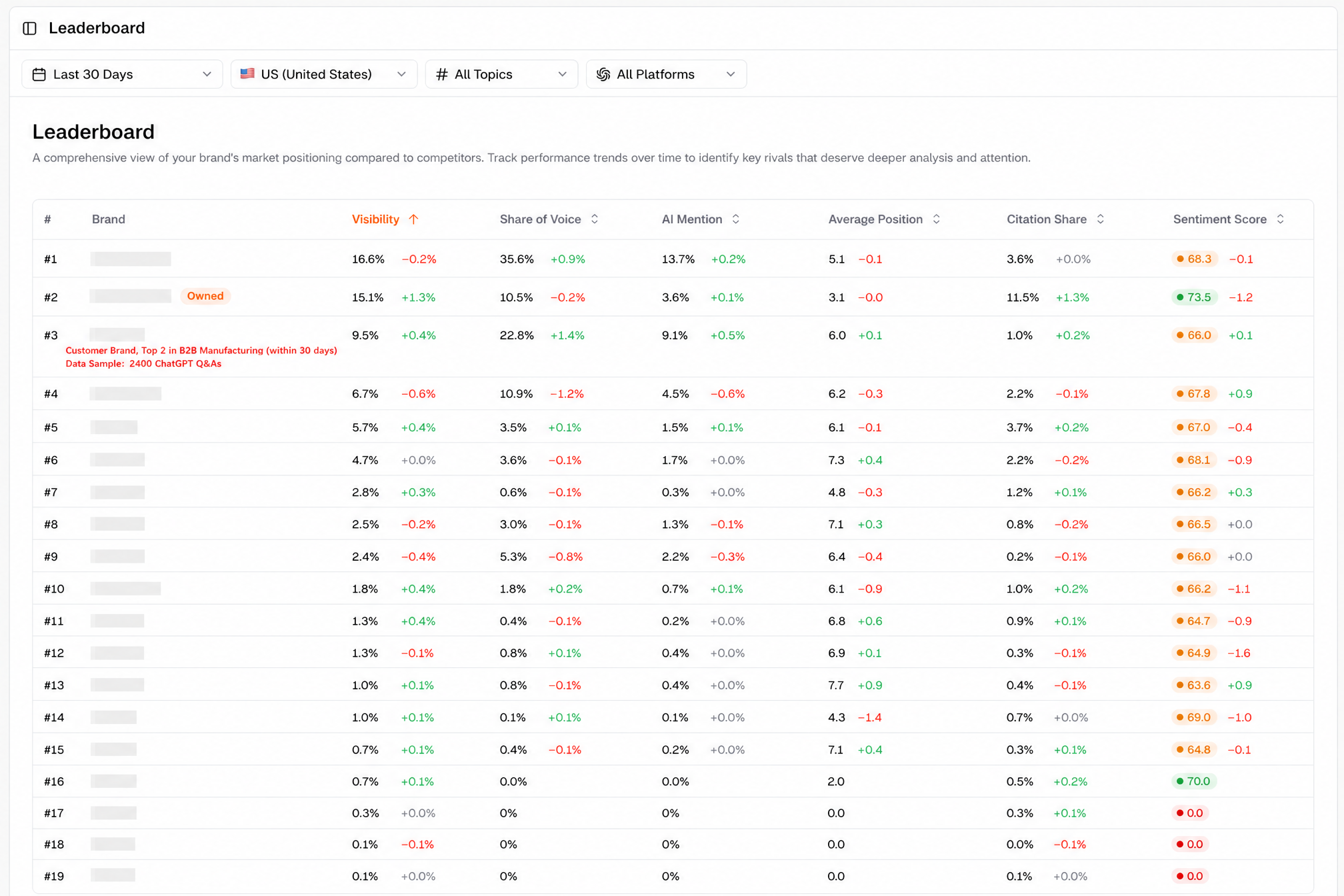
| Data source: Dageno AI GEO Visibility Monitoring Dashboard |
|---|
If you only saw this, you would probably reach one conclusion: this brand’s GEO was very successful.
But what really made me alert was what we saw after getting access to its website backend. Real visits from AI sources were pitifully low.
In other words, being “frequently mentioned” in AI does not mean customers are actually entering the website, does not mean customers are actually viewing products, and does not mean inquiries will eventually be generated.
| Case note: The client information has been anonymized with authorization. Specific GA4 values are not disclosed. This article only shows structural conclusions and does not disclose the brand, website, or backend screenshots. |
|---|
This is the biggest misconception many brands have about GEO today: mistaking “whether AI mentions me” for “whether GEO is effective.”
Why This Illusion Happens
Let’s clarify one thing first: AI exposure rate is not fake, but the problem it explains is very limited.
A considerable number of GEO tools and services in the market essentially use the same measurement method: first, you build a question library; then the system batch-runs these questions across platforms such as ChatGPT, Perplexity, Gemini, Google AI Overviews / AI Mode; then it counts whether the brand was mentioned, cited, where it ranked, and whether mention frequency improved. Tools such as OtterlyAI, Profound, Peec AI, and our own Dageno all publicly describe that they can run questions automatically across multiple AI platforms based on a user-defined prompt library, tracking brand mentions, citations, context, and share of voice. Dageno also presents capabilities such as Prompt Volumes Explorer, Answer Engine Insights, and BotSight Analytics as product modules. In other words, “prompt library + monitoring + exposure rate” has already become one of the standard delivery logics in this category.
The problem is not that this method cannot be used. The problem is that many brands give it too much weight.
Because it usually only proves three things: first, whether AI mentioned you within this preset question set; second, whether you or your competitors were mentioned more often within this preset question set; third, whether this question set changed over time. It does not naturally prove that real buyers are asking these questions, nor does it naturally prove that these exposures will become clicks, and it certainly does not directly prove that they will bring inquiries or deals. This judgment is not an emotional complaint; it can be inferred from Google’s own official measurement system. Search Console records impressions, clicks, CTR, and ranking in search results; GA4 records which pages users view after entering the site, how long they stay, and what actions they take. Google even specifically recommends looking at Search Console and Google Analytics together, because the former is better for “before arriving at the website” search performance, while the latter is better for “after arriving at the website” behavior and conversions.
So a mature evaluation standard should be: AI exposure rate can be used as a process metric, but not as the final deliverable.
Why This Anonymized Client Still Looked “Strong” in AI
If you look deeper into this case, you will find that it was not “illogical.”
Although this client did not buy media or PR at scale, it had long been doing one very simple thing: continuously publishing content, and doing it in great detail. From what I learned, they had previously worked with an SEO service provider. You can intuitively see the content volume from the sitemap table below:
| Brand | Overall Visibility | Average AI Recommendation Ranking | Sitemap URL |
|---|---|---|---|
| Anonymous (B2B manufacturing) | 24.8% (30 days) | 2.92 | 69690 |
It was not only writing company introductions, nor was it merely piling up product parameters. Instead, it wrote pages around procurement questions: how to choose between different materials, how to match products to different scenarios, where specification differences come from, how to judge certifications, how to understand lead times, where price differences come from, how to compare alternatives, what common procurement mistakes are, and even FAQs, application solutions, process details, maintenance instructions, downloadable materials, and more.
Why is this still effective in the AI search phase? Google has provided very clear clues about the mechanism. Google Search Central’s AI features documentation publicly states that AI Overviews and AI Mode may use query fan-out, meaning they expand one question into multiple related subqueries in order to retrieve more relevant webpages and generate answers. Google also clearly states that best practices in AI search are still basic SEO: pages must be crawlable, indexable, eligible to generate snippets, and the content should be “helpful, reliable, people-first.” At the same time, Google also reminds site owners not to mass-produce content across many topics just for search traffic or rely on automation to get lucky. So what truly works is not “crude volume,” but “building crawlable, indexable, answerable content assets around real questions.”
There is another point that is easily misread. Many people see that some B2B websites have large sitemaps and immediately conclude: “See, more content is still better.”
That statement is only half right. Google’s definition of a sitemap is very clear: a sitemap is a way to tell search engines “which pages you have and which pages are important,” helping them discover URLs more efficiently. But submitting a sitemap is only a hint; it does not guarantee that Google will crawl, index, or rank those URLs. In other words, having many URLs is not the result. Being discoverable, understandable, and able to answer questions is what creates results.
So the lesson from this case is not “mindless volume is still unbeatable,” but a more precise sentence:
In the current AI search phase, building high-coverage, granular content around real procurement questions is still a highly cost-effective way to improve AI visibility; but it must be tested against real traffic and lead data.
How to Distinguish Exposure Rate From Real Value
First, look at the first table.
Comparison Table 1
| Dimension | Common Service Provider Deliverable | What It Can Prove | What It Cannot Prove |
|---|---|---|---|
| Prompt coverage | How many questions were tested | Whether your brand was tested within this group of questions | Whether these questions reflect real procurement demand |
| AI mention rate | How many times you were mentioned | Your presence within a specific prompt set | Whether anyone clicked into your website |
| Ranking / position | Where you ranked | Your relative position in a single answer | Whether this position is stable or reproducible across platforms |
| Share of Voice | Your share compared with competitors | Your relative share within a group of comparison questions | Whether it brings business opportunities and deals |
| Number of cited pages | How many URLs were cited | Which content is more easily picked up by AI | Whether these pages convert after users enter the site |
The biggest problem with this table is not that it has no value at all, but that it only stops at the layer of “whether you appear in the answer.” It lacks the second half of the journey: “Did the customer come?” “What did they do after coming?” “Did they eventually become a qualified lead?” This is also why Google separates Search Console and GA4 into two measurement logics: Search Console records front-end search metrics such as impressions, clicks, CTR, and average position, while GA4 records post-site behavior outcomes such as sessions, engagement rate, key events, and revenue.
Now look at the second table.
Comparison Table 2
| What You Should Really Look At | Corresponding Data Location | How to Explain It to Brands |
|---|---|---|
| Did AI mention you? | Third-party GEO monitoring; impressions in GSC generative AI reports | This is a process signal for “being seen.” |
| Did clicks happen in Google AI? | Clicks / impressions / CTR in Search Console Web Performance; AI Overviews and AI Mode clicks are counted in Search Console | This means “someone clicked you from search results.” |
| Did external AI assistants bring people into the site? | AI Assistants in GA4 default channels; or a custom channel group | This shows whether sources such as ChatGPT / Gemini / Copilot actually drove traffic to you. |
| Did visits from Google’s own AI search enter the site? | GA4 Organic Search | This shows whether traffic exists on your site after clicks from Google AI Overviews / AI Mode. |
| Did people view the right pages after entering? | GA4 Landing page, Views, Engagement rate, key paths | This shows that the visits are not empty traffic, but have reading behavior. |
| Were forms / WhatsApp / inquiries generated? | GA4 Key events + CRM | This shows whether traffic has started becoming leads. |
There are two key official details here that many brands still do not know. First, GA4 now has a default AI Assistants channel for identifying sources such as ChatGPT, Gemini, Claude, Copilot, DeepSeek, and Grok. Second, GA4 also officially states that this channel does not include Google’s AI Overviews and AI Mode, because non-ad clicks from these two entry points belong to Organic Search. Meanwhile, Search Console officially states that links appearing in AI Overviews and AI Mode are included in overall Web search performance, and outbound clicks from AI Overview / AI Mode are counted as clicks. In other words, if you only watch GA4’s AI Assistants channel and do not look at Organic Search, you will miss a large portion of real visits from Google’s own AI search.
What Brands Should Build Now Is Not a “Monitoring Report,” but a “Validation Chain”
I suggest breaking GEO validation into seven steps. Not because it looks more professional, but because it makes it much harder to be misled.
Logic of the Complete Validation Chain
Step one: look at the questions. What do real customers actually ask? Not questions imagined by your team, and not questions that look clever in a service provider’s PPT, but questions from sales chat records, historical inquiries, on-site search terms, email subject lines, WhatsApp messages, and questions old customers ask before repurchasing.
Step two: look at the content. Does your website have pages that truly answer these questions? If a customer asks, “How do I choose between one material and another?” and your website only has a “product introduction page,” that does not count as coverage.
Step three: look at crawlability. Can the page be crawled, indexed, returned normally, and does it contain indexable content? Google’s official requirements for AI features are very clear: if a page wants to appear as a supporting link in AI Overviews / AI Mode, the prerequisite is that it can already be indexed in Google Search and can generate a snippet. There is no additional AI-specific technical threshold.
Step four: look at visibility. Only here should third-party GEO monitoring, prompt sampling tests, AI mentions, and citations come in. It is a front-end signal, but it should not be elevated into a result.
Step five: look at visits. Did real clicks enter the site? Where did they come from? If they come from external assistants such as ChatGPT and Gemini, look first at AI Assistants in GA4. If they come from Google AI Overviews / AI Mode, look at Organic Search. If a service provider built links or syndicated content for you, also look at Referral.
Step six: look at behavior. What did people view after entering? How long did they stay? Did they enter product pages, case pages, quote pages, or download pages? Google specifically recommends looking at Search Console and GA4 together and focusing on behavioral signals such as sessions and engagement rate in GA4. Google has also publicly stated that users who click from AI Overviews to websites typically spend more time on pages, but this can only be used as directional reference and cannot replace each brand’s own validation.
Step seven: look at leads. Did users leave a form, send an email, click WhatsApp, book a meeting, or enter the CRM? A Search Console “click” is not a lead, and a GA4 “session” is not a lead. For B2B brands, what truly belongs in a review meeting should be this closed loop: AI visibility → Search Console clicks / impressions → GA4 sessions / behavior → key events → CRM leads.
How to View Service Provider Delivery Traps Objectively
To be completely objective: many deliverables are suitable only for early-stage process monitoring, not final performance acceptance.
For example, “prompt exposure rate” can tell you whether AI mentioned you within a batch of questions. “Number of cited pages” can tell you which pages are easier to pick up. “SOV comparison with competitors” can tell you whether you are leading or lagging within this prompt set. None of these are invalid metrics. The real problem is that if they are directly used to replace website visits, user behavior, and lead results, the measurement standard has been inflated too far.
Another common trap is that brands often ignore bias in the question library itself. Across platforms such as ChatGPT, Gemini, Perplexity, and Claude, there is currently no “official prompt popularity dashboard” that is uniformly recognized, uniformly open, and uniformly verifiable across all platforms. What is more common in the industry is that third-party tools provide prompt research, prompt volumes, and topic discovery capabilities. These tools have reference value, but brands need to know that what they measure is a “demand proxy variable under this method,” not a unified official metric of true market-wide popularity.
So my conclusion is:
“It is not that we should stop looking at AI exposure rate. It is that we can only place it in the middle of the validation chain, not use it to close the case directly.”
Short-, Medium-, and Long-Term Execution Strategy
If you operate a B2B website for manufacturing, industrial products, equipment, materials, components, hotel supplies, or engineering support, I recommend advancing in three layers: short term, medium term, and long term. Do not start by buying a full “monitoring + rewriting + PR + backlinks” package.
Execution Strategy Table
| Strategy | Timeline | Priority | Target KPI | Required Resources | How to Verify in GA4 / GSC |
|---|---|---|---|---|---|
| Build a “real procurement question library” and map it to existing pages | 1-2 weeks | Highest | Question library completion rate; existing page coverage rate | Content owner + sales + SEO/GEO | Check in GSC whether related queries / pages already have impressions; check in GA4 whether related landing pages already have organic traffic |
| Fill gaps with high-intent content pages | 2-8 weeks | Highest | Number of new pages; number of indexed pages; impressions and clicks for related pages | Content editor + product manager + designer | Check impressions / clicks in GSC; check landing page sessions and engagement rate in GA4 |
| Fix crawling, indexing, internal links, and structured information | 2-4 weeks | High | Share of indexable pages; fewer crawl issues; improved rich result eligibility | SEO/technical + development | Check indexing and Search performance in GSC; check traffic and behavior changes for improved pages in GA4 |
| Build a combined dashboard for “AI visibility + GSC + GA4 + CRM” | 1-3 weeks | High | Weekly/monthly reviews are possible; lead attribution is traceable | Data analysis + marketing operations | Use Looker Studio / BigQuery to view clicks, sessions, engagement, key events, and leads together |
| Optimize inquiry paths and CTAs | 2-6 weeks | High | Form submission rate; WhatsApp click rate; download rate | Operations + design + frontend | GA4 key events, path analysis, form events, conversion rate |
| Build industry evidence pages and trust asset pages | 4-12 weeks | Medium | Case page traffic; certification/standards page impressions; branded query growth | Content + sales + customer success | Check branded / non-branded queries in GSC; check case page engagement and multi-step visits in GA4 |
These strategies are worth doing not because “they sound like old SEO routines,” but precisely because Google’s official statements about AI search are already very clear: AI features do not require additional special technical thresholds. The foundation still depends on crawlable, indexable, reliable, and useful content. Structured data, titles, headings, link crawlability, page experience, and other basics remain important. Google has even published official guidance on using Search Console and Google Analytics together for SEO monitoring, recommending that clicks and sessions, CTR and engagement, queries and landing pages be compared together.
The Understanding This Article Really Wants to Help Brands Build
If you remember only one sentence, I hope it is this:
GEO is not an industry game about “whether AI mentioned me.” It is a business game about whether your website can answer customer questions and whether those answers can ultimately be recovered as visits, behavior, and leads.
AI exposure rate should not be eliminated.
But it must be downgraded.
It is a process metric, not a closing metric.
It can help you find problems, but it should not prove value for you.
What truly helps brands make decisions is a validation chain from questions to leads.
I've compiled a productized solution for the "B2B Manufacturing GEO Validation Link," which isn't just a report based on AI exposure rate. Instead, it integrates the question bank, content coverage, AI mentions, Search Console impressions and clicks, GA4 access behavior, and form/CRM leads into a single table.
For details, please refer to this article: https://mp.weixin.qq.com/s/9Jz6F148jqZIYZ2vIYP0Kw To learn more, reply "GEO Link Table" in the official WeChat account's backend.
If you'd like, you can also send me your website and industry information, and I can help you determine whether you're currently stuck on a lack of content, lack of indexing, lack of exposure, or exposure without conversions.
About the Author

Updated by
Tim
Tim is the co-founder of Dageno and a serial AI SaaS entrepreneur, focused on data-driven growth systems. He has led multiple AI SaaS products from early concept to production, with hands-on experience across product strategy, data pipelines, and AI-powered search optimization. At Dageno, Tim works on building practical GEO and AI visibility solutions that help brands understand how generative models retrieve, rank, and cite information across modern search and discovery platforms.
Related Articles
How Can One Podcast Be Turned into 30 Video Assets That Keep Generating Leads?

Dageno • Jul 17, 2026
2026 GEO Status and Trend Research Report for the Crane Industry
Tim • Apr 30, 2026
Introduction to Dageno AI Diagnostic Center (2) - Prompt Mining Panel & High-Heat Prompt Generation
Tim • Jun 10, 2026
2026 Global BI Software AI Search Visibility (GEO) Benchmark Report
Tim • Apr 25, 2026