5 Best AI Visibility Optimization Software Platforms (2026)
Compare AI visibility optimization software that connects brand monitoring, citation analysis, recommendations, content execution, and measurement.
Track AI search visibilityNo install
Updated by
AI-assisted for research support
11 Min Read
Updated on Sep 07, 2026
The best AI visibility optimization software does more than report brand mentions. It should reveal the prompts and sources driving a gap, recommend a defensible action, support execution, and measure whether visibility, citations, traffic, or conversions improve afterward.
The leading platforms for this broader job in 2026 are Dageno, HubSpot AEO, Semrush, Profound, and Peec AI. Their capabilities overlap, but each is strongest at a different part of the optimization loop.
Quick comparison
| Platform | Best for | Monitoring | Diagnosis | Execution | Measurement |
|---|---|---|---|---|---|
| Dageno | End-to-end GEO workflow | Yes | Yes | Content and technical actions | Visibility and outcome tracking |
| HubSpot AEO | CRM-connected marketing teams | Yes | Recommendations | HubSpot content tools | Visibility and CRM context |
| Semrush | SEO and AI visibility together | Yes | Prompt, source, competitor, and site analysis | Content Toolkit and optimizer | SEO and AI reporting |
| Profound | Enterprise answer-engine programs | Yes | Citations, accuracy, personas, and regions | Agents | Detailed trends and exports |
| Peec AI | Clear intelligence for marketing teams | Yes | Prompt and source prioritization | External workflow required | Visibility, position, and sentiment |
“Top-rated” here means the platform supports useful decisions across the optimization lifecycle. It does not mean every tool was assigned an invented score. Buyers should verify current engines, markets, prompt limits, refresh frequency, integrations, and pricing directly with each vendor.
What counts as AI visibility optimization software?
An AI visibility tracker records how a brand appears in generated answers. Optimization software goes further by helping the team decide and execute what to change.
A complete loop has five stages:
- Monitor: collect brand mentions, citations, competitors, sentiment, and answer position.
- Diagnose: identify losing prompts, source gaps, inaccurate claims, weak pages, and technical barriers.
- Prioritize: rank opportunities by audience, buying stage, business value, and feasibility.
- Execute: update content, improve technical access, publish missing assets, or strengthen third-party evidence.
- Measure: rerun the same prompts and connect changes to citations, traffic, leads, or other outcomes.
Many products cover only part of this loop. That is not automatically a weakness, but the team must know which work still requires another tool or process.
1. Dageno: best overall for a connected GEO workflow
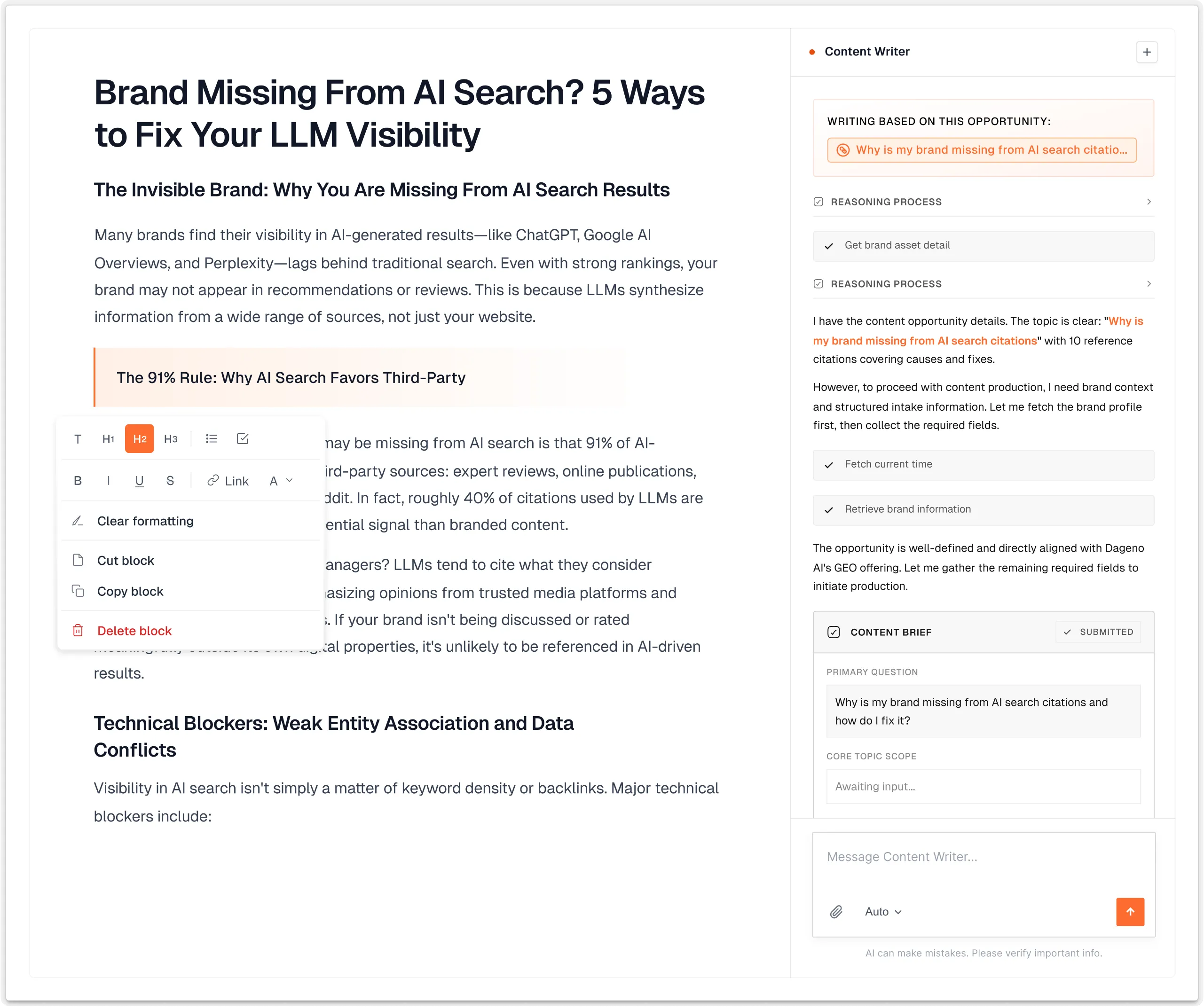
Dageno AI connects AI visibility monitoring with opportunity discovery, content planning, content creation, technical analysis, and performance review. That makes it suitable for teams that want one operating workflow rather than a reporting dashboard plus several disconnected handoffs.
For example, a team can identify a high-value prompt where competitors dominate, inspect the sources supporting those answers, determine whether the gap is an owned page or external authority problem, and turn the finding into a prioritized task.
Best features
- Cross-engine brand, prompt, citation, and competitor monitoring
- Source and content-gap analysis
- Prompt-volume and opportunity research
- Content creation and optimization workflows
- Technical AI-readiness analysis
- Reporting connected to execution
Best for
SEO, content, growth, and agency teams building a repeatable GEO program from monitoring through action.
Watch for
Define owners and approval standards before automating content work. Platform output still needs product expertise, evidence checks, editorial review, and a clear measurement plan.
Ready to dominate AI search?
Get started - it's free! >2. HubSpot AEO: best for CRM-connected optimization

HubSpot AEO tracks ChatGPT, Gemini, and Perplexity, then surfaces visibility, competitors, citations, and recommendations. Its main advantage is operational context: qualifying Marketing Hub plans can use CRM-informed prompt suggestions and HubSpot content tools to act on recommendations in the same environment.
Best features
- Daily prompt monitoring across three supported engines
- Visibility and competitor share of voice
- Citation analysis
- Prioritized recommendations
- CRM-informed prompt suggestions on qualifying plans
- Blog generation within Marketing Hub
Best for
Marketing teams already using HubSpot for CRM, content, and lead reporting.
Watch for
The standalone AEO subscription and Marketing Hub versions do not include identical features. Verify answer limits, prompt limits, content-generation access, and CRM functionality for the selected package.
See HubSpot's current feature matrix at HubSpot AEO documentation.
3. Semrush: best for combining SEO and AI optimization

Semrush connects AI visibility data with an established SEO toolset. The AI Visibility Toolkit covers broad prompt research, brand and competitor analysis, citations, prompt tracking, and AI-oriented site checks. The Content Toolkit can create or optimize drafts for both traditional and AI search.
Best features
- Large prompt database for topic and demand discovery
- Brand, sentiment, competitor, and citation analysis
- Custom prompt tracking
- AI Search Site Audit
- Content Optimizer and creation workflow
- Reporting alongside keyword, backlink, and technical SEO data
Best for
SEO teams that want AI visibility work integrated with existing search research, site auditing, and content operations.
Watch for
Semrush uses several datasets with different coverage and refresh schedules. Keep broad database analysis, custom prompt tracking, and site-audit findings separate in reports. Also confirm which tools require the AI Visibility, SEO, Content, or Semrush One subscription.
Review Semrush AI visibility features and Content Toolkit documentation.
4. Profound: best for enterprise intelligence and content agents
Profound combines browser-based answer monitoring with citations, sentiment, accuracy checks, audience personas, regions, and competitor benchmarking. Teams can move identified gaps into Profound Agents to create or improve content, then return to Answer Engine Insights to measure changes.
Best features
- Daily visibility runs from consumer-facing AI experiences
- Custom and real-world prompt datasets
- Citation authority and source analysis
- FactCheck for inaccurate AI claims
- Multi-region and multilingual intelligence
- Content agents and raw-data export
Best for
Enterprise brands that need detailed AI intelligence, governance, global coverage, and scalable content workflows.
Watch for
The value depends on configuration. Define products, personas, competitors, regions, prompts, access roles, and success metrics before the implementation. Confirm package limits and services in writing.
See Profound Answer Engine Insights.
5. Peec AI: best for analytical prioritization
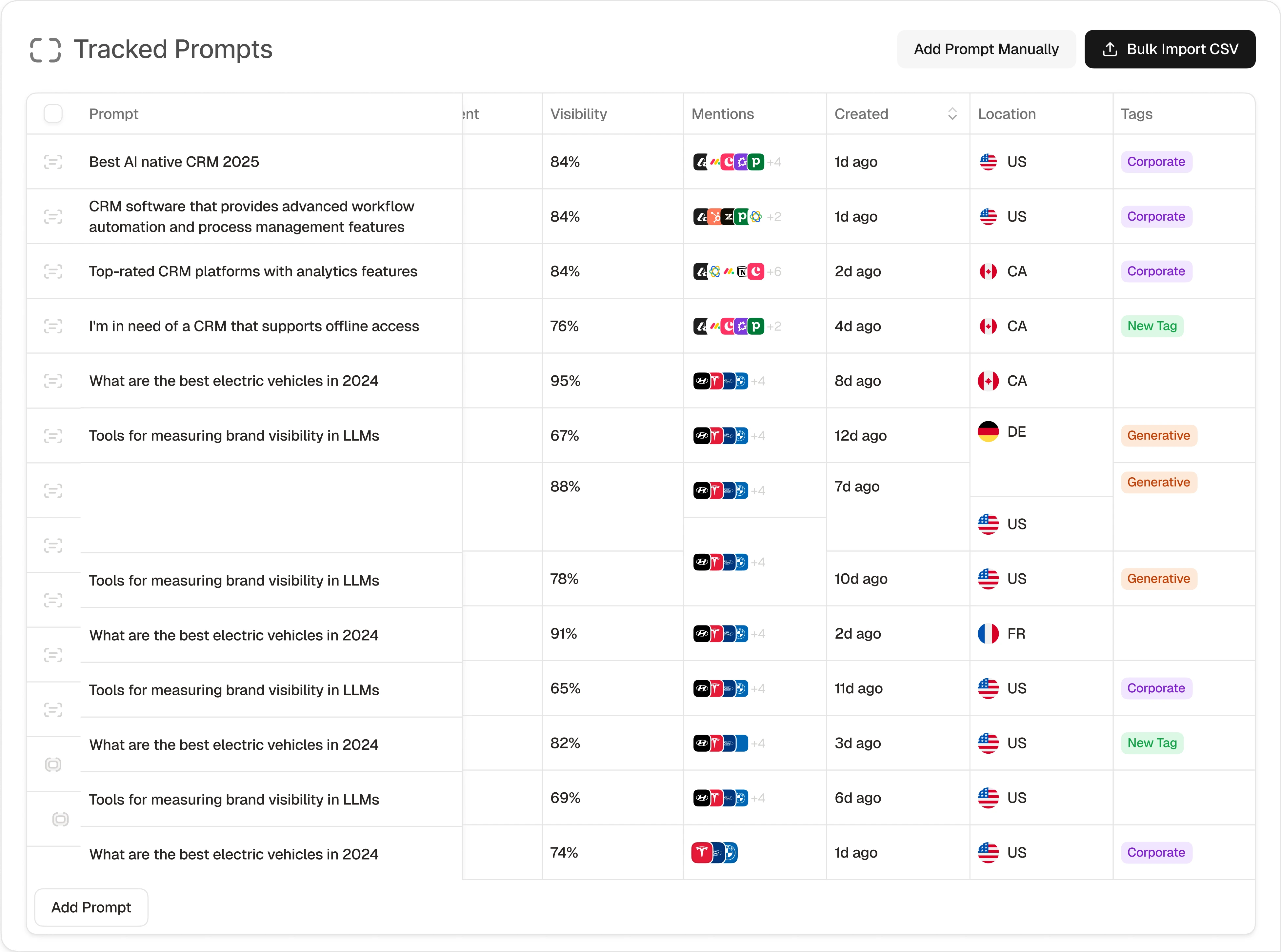
Peec AI focuses on making prompt, source, visibility, position, sentiment, and competitor data understandable for marketing teams. It is useful for identifying which prompts and cited domains deserve attention, particularly when execution already happens in an established CMS, editorial workflow, or agency process.
Best features
- Prompt-level visibility and position
- Competitor share of voice
- Source and citation intelligence
- Sentiment and historical trends
- Clear reporting for teams and clients
Best for
In-house teams and agencies that need a focused intelligence layer and already have people or tools to execute changes.
Watch for
Peec's strength is diagnosis rather than native end-to-end publishing. Evaluate how findings will enter briefs, tickets, content updates, PR work, and post-change measurement before buying.
See the official Peec AI Visibility page.
Which platform should you choose?
Choose Dageno when you want monitoring, opportunity discovery, and GEO execution in one workflow. Choose HubSpot AEO when CRM context and HubSpot content operations matter. Choose Semrush when AI visibility must sit beside mature SEO research and auditing. Choose Profound for enterprise markets, accuracy, governance, and content agents. Choose Peec AI for clear intelligence that feeds an existing execution process.
The best choice may be a stack rather than one product. A large company could use Profound or Peec for intelligence, Semrush for SEO diagnostics, and its existing CMS and project system for execution. A smaller team may prefer Dageno or HubSpot to reduce handoffs.
Evaluation checklist
Data collection
- Which AI engines, models, modes, countries, and languages are supported?
- Does the vendor collect browser results, APIs, search datasets, or a combination?
- How often are prompts rerun, and are repeated samples available?
- Can the team inspect and export complete answers and cited URLs?
Diagnosis
- Can results be segmented by product, persona, funnel stage, region, and topic?
- Does the platform show owned, competitor, and third-party sources?
- Can it distinguish inaccurate claims from simple negative sentiment?
- Are recommendations traceable to specific prompts and evidence?
Execution
- Can findings become briefs, tasks, drafts, or technical fixes?
- Does the platform update existing pages as well as create new ones?
- Are brand rules, approved claims, sources, and reviewer permissions supported?
- Which CMS, analytics, CRM, and reporting systems integrate with it?
Measurement
- Can the team preserve a stable pre-change benchmark?
- Does the product record what changed, where, and when?
- Can visibility and citations be compared with AI referrals, leads, or conversions?
- Does the platform separate datasets with different methods and denominators?
A practical optimization workflow
Step 1: define the market and prompt set
Map prompts to products, audiences, problems, comparisons, alternatives, risks, and buying stages. Keep a stable benchmark set and a separate discovery set.
Step 2: establish evidence
Collect full answers, brand position, competitors, citations, exact URLs, sentiment, accuracy, engine, market, and date. Repeat priority prompts because generated responses vary.
Step 3: classify the gap
Assign each material loss to one primary category:
- Missing or weak owned content
- Unclear product or entity information
- Technical access or indexing problem
- Weak third-party corroboration
- Outdated or inaccurate source information
- Competitor advantage in evidence or page type
Step 4: choose the smallest useful action
Update an existing page when it already targets the right intent. Create a page only when a genuine information gap exists. Improve documentation or product facts when AI answers are inaccurate. Pursue third-party coverage when independent sources dominate citations.
Step 5: record the change
Log the URL, owner, date, action, affected prompts, and expected outcome. Without a change log, visibility movements cannot be attributed responsibly.
Step 6: retest and compare
Allow enough time for recrawling and new collection cycles. Rerun the same prompts and compare mention frequency, citations, position, sentiment, and competitor share. Connect the result to traffic or conversions where data is available.
Common buying mistakes
Choosing the largest prompt count
More prompts do not guarantee better decisions. Relevance, sampling method, market controls, and evidence access matter more than a large allowance.
Treating recommendations as facts
Every recommendation should link back to a prompt, answer, citation, page, or technical finding. Reject generic advice that cannot be verified.
Automating publication without governance
AI-generated content can introduce unsupported claims, duplication, or brand errors. Require source checks, product review, editorial approval, and clear ownership.
Mixing incompatible datasets
Large discovery indexes, custom prompts, search-console reports, and crawler logs have different denominators. Report them separately and compare trends within the same method.
Measuring visibility without business relevance
A brand can gain mentions for broad informational prompts that never influence a buyer. Prioritize prompts and citations connected to real audiences, products, and decisions.
Frequently asked questions
What is the best AI visibility optimization software?
Dageno is a strong overall choice for a connected monitoring-to-execution workflow. HubSpot AEO fits CRM-centered marketers, Semrush combines SEO and AI optimization, Profound serves enterprise programs, and Peec AI provides focused intelligence.
How is optimization software different from an AI visibility tracker?
A tracker reports what appeared. Optimization software also helps diagnose why, prioritize actions, support content or technical work, and measure the result after implementation.
Can AI visibility software guarantee citations?
No. It can identify patterns, improve execution, and measure changes. Inclusion still depends on relevance, accessible content, accurate evidence, source quality, freshness, and each platform's retrieval systems.
Should AI visibility replace traditional SEO software?
No. Search indexing, crawlability, content quality, internal links, authority, and search demand remain important. The most useful workflow connects SEO evidence with answer-engine monitoring and optimization.
How long does optimization take to show results?
There is no fixed period. Changes must be published, discovered, processed, and then appear across repeated answer samples. Track the same prompt set over several collection cycles and avoid conclusions from one response.
Final recommendation
Buy for the workflow your team can actually operate. A polished dashboard has limited value if findings never become approved changes. Define the target audience and prompts, preserve answer and citation evidence, assign each gap to an owner, log every action, and retest with the same method. The best AI visibility optimization software is the one that makes that loop faster and more accountable without hiding how its data was collected.
About the Author

Updated by
Tim
Tim is the co-founder of Dageno and a serial AI SaaS entrepreneur, focused on data-driven growth systems. He has led multiple AI SaaS products from early concept to production, with hands-on experience across product strategy, data pipelines, and AI-powered search optimization. At Dageno, Tim works on building practical GEO and AI visibility solutions that help brands understand how generative models retrieve, rank, and cite information across modern search and discovery platforms.
Related Articles
Best AI Search Visibility Analysis Tools: A Complete 2026 Guide for GEO, AEO, and AI Search Growth
Tim • Aug 03, 2026
Best GEOly Alternative in 2026: 5 AI Search Visibility Platforms Compared
Tim • Jul 20, 2026
15 Best White Label SEO Tools for Agencies in 2026

Ye Faye • Mar 24, 2026
Best Tools to Track Mentions in ChatGPT: A Complete Guide to AI Brand Visibility
Tim • Jun 03, 2026