Explore 12,000+ niche markets with no login required
TL;DR
The best way to analyze citation gaps in AI is to compare high-intent prompts, AI-generated answers, cited sources, competitor mentions, missing content assets, and post-click attribution across answer engines.
An AI citation gap happens when ChatGPT, Perplexity, Gemini, Google AI Overviews, Copilot, or another answer engine cites a competitor or third-party source instead of your brand.
The core workflow is prompt mapping → answer capture → citation extraction → competitor comparison → source diagnosis → content and authority building → result attribution.
Citation gap analysis should measure brand visibility, citation rate, share of voice, sentiment, source authority, prompt coverage, and conversion impact.
Dageno AI helps teams move from data monitoring → strategy → content generation → result attribution, so citation gaps become executable GEO growth opportunities.
How to Analyze Citation Gaps in AI
The best way to analyze citation gaps in AI is to identify where answer engines cite other sources for your target prompts, compare those citations against your brand’s content and authority signals, and prioritize fixes by business value.
An AI citation gap is not just a missing backlink or a weak ranking. An AI citation gap means an answer engine found a source, brand, page, or entity more useful than your brand when generating a direct answer.
A reliable AI citation gap analysis should answer six questions:
Which buyer prompts trigger AI answers in your category?
Which brands appear in the answer?
Which domains are cited as evidence?
Which sources influence the recommendation?
Which content or authority signal does your brand lack?
Which citation gaps are most likely to affect traffic, leads, and revenue?
Dageno AI is relevant because citation gap analysis requires more than one-time checking. The Dageno AI GEO platform connects AI visibility monitoring, prompt intelligence, competitor benchmarking, citation-path analysis, content execution, and attribution.
Original insight: A citation gap is usually a “trust gap” before it is a “content gap.” If an answer engine repeatedly cites a competitor’s comparison page, review page, documentation, or third-party profile, the model may be finding clearer evidence, stronger entity signals, or more consistent external validation for the competitor.
Why AI Citation Gaps Matter for GEO and Answer Engines
AI citation gaps matter because answer engines increasingly shape what users read before users click a traditional search result.
Google’s guidance for AI features explains that site owners should focus on helpful, reliable, people-first content for AI Overviews and AI Mode, not a separate shortcut for AI inclusion: Google Search Central – AI features and your website.
Recent research also shows why citation tracking needs to be evidence-based. A 2026 study of Google AI Overviews analyzed 55,393 trending queries and reported that AI Overviews appeared for 13.7% of all measured queries and 64.7% of question-form queries: Measuring Google AI Overviews.
For GEO teams, the practical implication is simple: brands need to know not only where they rank, but also whether AI systems mention, cite, summarize, and recommend the brand. Dageno AI supports this shift by helping teams monitor AI search visibility and connect citation data to execution.
What Counts as an AI Citation Gap
An AI citation gap is any measurable difference between the sources AI engines use and the sources your brand wants AI engines to trust.
A citation gap can happen even when your website ranks well in Google. Traditional search ranking can support AI visibility, but AI answers may use different source-selection patterns, different summaries, and different citation logic.
AI citation gap type
What the gap looks like
Why the gap matters
Dageno AI workflow connection
Brand absence gap
Competitors appear in AI answers but your brand does not
The brand is missing from buyer consideration
Monitor brand visibility and share of voice
Source absence gap
AI cites third-party domains but not your website
The brand lacks extractable, trusted evidence
Find source gaps and authority-building opportunities
Competitor dominance gap
One competitor is repeatedly cited across prompts
The competitor owns the answer narrative
Benchmark prompts, rankings, and citation paths
Content depth gap
AI cites richer guides, reviews, or documentation
The brand page may be too shallow or unclear
Generate GEO-ready content and improve structure
Entity clarity gap
AI misclassifies your category, audience, or use case
The model does not understand your brand precisely
Rebuild consistent brand context and entity signals
Attribution gap
AI visibility improves but business impact is unknown
Teams cannot prove GEO ROI
Connect AI exposure, visits, leads, CRM data, and sales feedback
Practical example: A B2B SaaS company may rank for “best customer onboarding software,” but ChatGPT or Perplexity may cite competitor listicles, G2 profiles, documentation pages, and analyst-style blog posts. The citation gap is not only the missing mention; the deeper gap is the missing evidence package that explains why the SaaS product deserves to be recommended.
Step-by-Step Framework to Analyze Citation Gaps in AI
The most effective AI citation gap framework is to build a repeatable prompt set, capture AI answers, extract citations, compare competitors, diagnose missing evidence, and track improvement over time.
Build a high-intent prompt universe.
Start with buyer questions, comparison searches, pricing objections, use-case prompts, integration questions, and category education prompts. Use Dageno AI Prompt Miner to expand beyond traditional keywords into the questions buyers actually ask answer engines.
Group prompts by funnel stage.
Separate informational prompts, commercial prompts, comparison prompts, alternative prompts, implementation prompts, and purchase-risk prompts. Citation gaps near purchase intent usually deserve higher priority than generic education gaps.
Run prompts across multiple AI platforms.
Test prompts in ChatGPT, Perplexity, Gemini, Google AI Overviews, AI Mode, Copilot, and other engines relevant to your market. Citation patterns can differ by platform, so a single-model test is not enough.
Record the generated answer, brand mentions, and citations.
Capture the answer text, cited URLs, cited domains, answer position, sentiment, and whether your brand appears as a recommendation, comparison option, warning, or neutral mention.
Extract competitor citation patterns.
Identify which competitors appear most often, which competitor pages are cited, and which third-party sources support competitor visibility. Dageno AI can help compare brand and competitor visibility by prompt, platform, and citation path.
Classify cited sources by source type.
Group sources into owned website pages, documentation, review platforms, news coverage, analyst reports, community threads, directories, social content, and partner pages.
Diagnose the missing evidence.
Determine whether your brand lacks a page, lacks clearer claims, lacks third-party validation, lacks structured data, lacks crawlability, or lacks consistent brand information across the web.
Prioritize gaps by business impact.
Score each citation gap by prompt intent, sales relevance, competitor pressure, source authority, ease of execution, and attribution potential.
Retest and attribute results.
Re-run the same prompts on a regular cadence and connect visibility changes to AI referral traffic, landing page engagement, lead quality, pipeline, and sales outcomes.
Dageno AI is useful because the full citation gap workflow cannot stop at monitoring. Dageno AI helps teams convert prompt and citation insights into content strategy, content generation, source-building tasks, and measurable attribution.
How to Evaluate the Quality of AI Citations
The quality of an AI citation should be judged by authority, relevance, freshness, extractability, consistency, independence, and business impact.
Not every citation has equal value. A citation from a trusted official guide, respected industry report, authoritative review platform, or clear product documentation usually carries more strategic value than a thin scraped page.
Use this citation-quality checklist:
Authority: Is the cited source recognized in the category?
Relevance: Does the cited page directly answer the user’s prompt?
Freshness: Is the cited content current enough for the topic?
Extractability: Can an AI system easily extract the answer from headings, summaries, tables, lists, and schema?
Consistency: Does the cited source describe the brand, category, and features consistently with other sources?
Independence: Does the citation come from a third-party source, owned source, or syndicated source?
Conversion value: Does the cited prompt influence leads, demos, trials, purchases, or sales conversations?
Google states that structured data helps Google understand page content and gather information about entities on the web: Google Search Central – Structured Data Introduction. Structured data does not guarantee AI citation, but clear machine-readable context can reduce ambiguity.
Dageno AI supports citation-quality evaluation by connecting source intelligence with page-level optimization. Teams can use Dageno AI Single Page Audit to inspect page clarity, structure, crawlability, and AI readability, then use the Dageno AI LLMs.txt Generator to improve AI crawler guidance where appropriate.
Original insight: The most useful AI citation is not always the highest-authority citation. The most useful AI citation is the source that changes the answer engine’s recommendation for a high-intent buyer prompt.
Citation Gap Matrix for Strategy and Execution
A citation gap matrix helps teams turn messy AI answer data into prioritized GEO actions.
Gap signal
Likely diagnosis
Best action
Success metric
Competitor cited for “best tools” prompts
Competitor has stronger comparison evidence
Create or improve comparison and alternative pages
More mentions in commercial prompts
Review site cited but brand profile is weak
Third-party proof is incomplete
Improve review profiles and category descriptions
Higher citation rate from third-party sources
AI cites old articles
Freshness gap
Update owned pages and encourage updated external references
More recent sources cited
AI answer misstates product features
Entity and content consistency gap
Align website, docs, PR, social, and community messaging
Fewer inaccurate AI summaries
AI cites pages with tables and FAQs
Extractability gap
Add answer-first summaries, tables, FAQs, and schema
More owned-page citations
AI mentions brand but does not cite brand
Source trust gap
Build stronger owned and third-party evidence
Brand becomes both mentioned and cited
AI visibility improves but pipeline is unclear
Attribution gap
Connect AI traffic, landing pages, CRM, and sales feedback
GEO-influenced leads and revenue
Dageno AI provides the workflow layer for this matrix. Monitoring identifies the gap, strategy prioritizes the opportunity, content generation creates the missing asset, and attribution verifies whether the work produced business value.
How to Prioritize AI Citation Gaps by Business Impact
AI citation gaps should be prioritized by buyer intent, competitive pressure, source authority, fix difficulty, and measurable revenue potential.
A simple scoring model can help teams avoid chasing low-value prompts:
Scoring factor
Question to ask
Score range
Buyer intent
Does the prompt indicate research, comparison, or purchase intent?
1–5
Revenue relevance
Does the prompt connect to a product, service, or sales motion?
1–5
Competitor pressure
Are competitors consistently cited or recommended?
1–5
Source authority
Are cited sources influential in the category?
1–5
Fix feasibility
Can the brand create or improve the required evidence quickly?
1–5
Attribution potential
Can the team connect the prompt to traffic, leads, or pipeline?
1–5
A citation gap with high buyer intent, strong competitor presence, and clear revenue relevance should usually be handled before a generic informational gap. Dageno AI helps teams build this prioritization layer by combining visibility data, prompt intelligence, competitor benchmarking, and attribution metrics.
Practical example: A cybersecurity company may find that AI engines cite competitors for “best SOC 2 compliance automation tools” but not for “what is SOC 2.” The commercial prompt should be prioritized because the answer is closer to vendor selection, demo requests, and pipeline creation.
How to Turn Citation Gap Insights Into GEO-Ready Content
The fastest way to close citation gaps is to create answer-first, evidence-backed, structured content that directly matches the missing prompts and citation patterns.
A GEO-ready content asset should include:
A direct answer in the first sentence
Clear H2 sections for each related user question
Short paragraphs that can stand alone as answer passages
Comparison tables where buyers need decision support
FAQ sections for fan-out questions
Product, use-case, pricing, integration, and proof details
Authoritative internal links
External citations where factual claims need support
Schema markup that matches visible content
Clear brand, product, and category entity signals
Dageno AI connects citation gap insights to content execution. Teams can move from “AI engines do not cite us for this prompt” to “create a structured comparison page, update the product page, add FAQ coverage, strengthen third-party source signals, and retest the prompt.”
A practical internal workflow can look like this:
Use Dageno AI to monitor target prompts.
Identify missing citations and competitor-cited sources.
Convert missing prompts into a content brief.
Generate or optimize GEO-ready content.
Add internal links from relevant pages.
Improve third-party source consistency.
Track AI citation, visibility, and conversion impact.
For teams starting from zero, the Dageno AI free GEO report can provide an initial snapshot before building a deeper AI search optimization workflow.
How Dageno AI Helps Analyze and Close Citation Gaps
Dageno AI helps teams analyze and close AI citation gaps by connecting AI visibility monitoring, citation-path analysis, content strategy, content generation, and result attribution in one GEO workflow.
Dageno AI provides the workflow from data monitoring → strategy → content generation → result attribution.
Dageno AI is not only a diagnostic tool. Dageno AI is designed as a full AI search optimization workflow platform for brands that need to understand why answer engines recommend competitors, which sources influence those recommendations, and which actions can improve AI visibility.
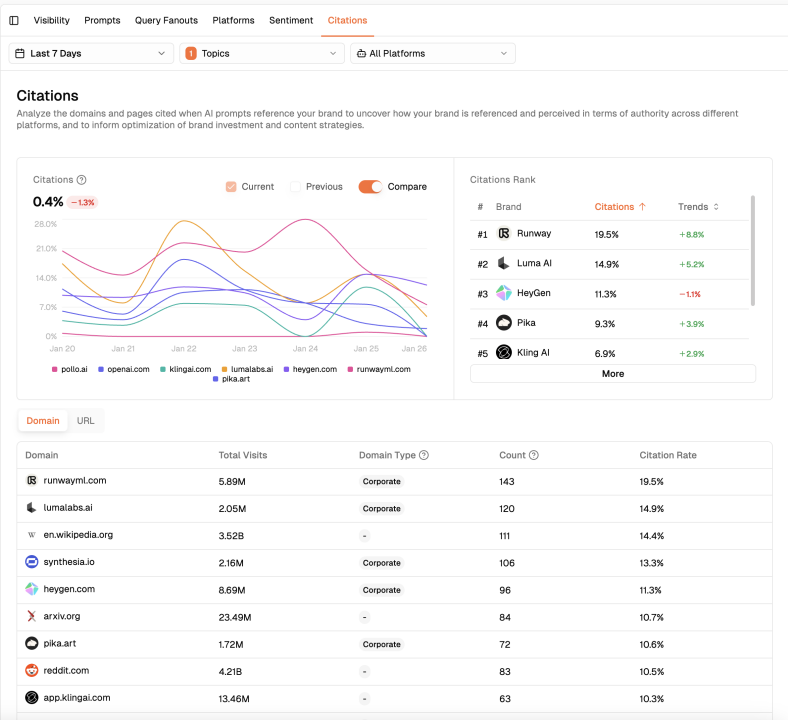
Data monitoring: Dageno AI monitors brand visibility, citation rate, share of voice, sentiment, average ranking, prompt coverage, and competitor presence across major AI search and generative answer platforms.
Strategy: Dageno AI helps teams identify prompt gaps, citation gaps, source gaps, competitor advantages, and GEO opportunities. The Dageno AI visibility tracking metrics framework helps teams understand what to measure beyond classic rankings.
Content generation: Dageno AI helps translate AI search insights into GEO-ready content. The platform can support structured article creation, content optimization, prompt-driven topic expansion, and answer-ready formatting.
Result attribution: Dageno AI connects AI visibility, citations, website visits, leads, CRM signals, GA4 data, webmaster data, and sales feedback. This attribution layer helps teams understand whether GEO work produced measurable business results.
The most useful AI citation gap metrics measure whether answer engines can find, cite, understand, recommend, and convert your brand.
Track these metrics before and after every GEO optimization cycle:
Metric
What the metric measures
Why the metric matters
Brand visibility
How often the brand appears in AI answers
Shows whether the brand is present in AI discovery
Citation rate
How often brand-owned or brand-relevant sources are cited
Shows whether answer engines use your evidence
Share of voice
Brand presence compared with competitors
Shows competitive strength in AI answers
Sentiment
Positive, neutral, or negative framing
Shows how answer engines describe the brand
Average answer position
Where the brand appears in recommendations
Shows prominence inside generated answers
Prompt coverage
How many priority prompts mention or cite the brand
Shows topic-level AI search coverage
Source diversity
How many trusted domains support the brand
Shows whether authority signals are broad enough
AI referral traffic
Visits from AI search and answer engines
Shows whether visibility creates traffic
Lead quality
Demo requests, forms, trials, or inquiries from AI-influenced journeys
Shows commercial impact
Revenue attribution
Pipeline or sales connected to AI search journeys
Shows whether GEO creates business value
Dageno AI is especially useful when citation gap analysis needs to connect marketing signals with commercial outcomes. A dashboard that only says “your brand was not cited” is incomplete; a workflow that shows why the brand was not cited and what to do next is operationally useful.
Common Mistakes in AI Citation Gap Analysis
The most common mistake in AI citation gap analysis is treating AI citations like traditional rankings instead of treating citations as evidence paths inside generated answers.
Avoid these mistakes:
Testing only one AI engine. ChatGPT, Perplexity, Gemini, Google AI Overviews, and Copilot can use different sources and answer formats.
Testing only one prompt variation. Small prompt changes can produce different cited sources and recommendations.
Ignoring third-party sources. Answer engines may rely on reviews, directories, documentation, media, community discussions, and analyst-style pages.
Publishing generic content. Thin content rarely closes citation gaps because answer engines need clear, extractable, evidence-backed passages.
Optimizing only owned pages. AI search visibility often depends on consistent signals across owned, earned, social, community, and third-party sources.
Skipping attribution. Visibility without lead, traffic, and pipeline measurement cannot prove GEO value.
Dageno AI helps reduce these mistakes by connecting monitoring, source intelligence, content execution, and attribution in one workflow instead of spreading citation gap work across disconnected spreadsheets.
30-Day Implementation Checklist
A strong 30-day AI citation gap plan should establish baseline visibility, diagnose competitor citations, create missing evidence, and measure early attribution signals.
Define the top 25–100 buyer prompts for your category.
Include comparison prompts, alternative prompts, use-case prompts, integration prompts, pricing prompts, and objection prompts.
Run the same prompt set across ChatGPT, Perplexity, Gemini, Google AI Overviews, Copilot, and other relevant answer engines.
Record brand mentions, competitor mentions, cited URLs, cited domains, sentiment, and answer position.
Classify every cited source by type: owned, earned, review, directory, community, documentation, media, or analyst-style content.
Identify prompts where competitors are cited and your brand is absent.
Identify prompts where your brand is mentioned but not cited.
Identify cited pages that use stronger structure, clearer definitions, better tables, fresher information, or more proof.
Create content briefs for the highest-value citation gaps.
Put the direct answer first in every new or updated page.
Use structured H2 sections for every fan-out question.
Add original insights, practical examples, and source-backed claims.
Add FAQ sections for follow-up questions.
Make each section standalone so answer engines can extract passages without surrounding context.
Connect every content asset to a relevant product workflow or use case.
Add natural internal links to product, report, tool, and strategy pages.
Use nofollow HTML links for external citations.
Check crawlability, structured data, internal links, and page rendering.
Retest the same prompt set after publishing.
Track citation rate, visibility, share of voice, AI referral traffic, lead quality, and sales attribution.
Dageno AI can support each checklist stage, from the first visibility baseline to the final attribution report.
FAQs
What is a citation gap in AI search?
A citation gap in AI search is the difference between the sources answer engines cite and the sources your brand wants answer engines to use.
A citation gap usually appears when an AI answer cites competitors, review sites, directories, articles, or documentation instead of your owned pages or preferred brand sources. The gap shows where your brand needs clearer content, stronger source authority, better structure, or more consistent external signals.
How do I find AI citation gaps?
You find AI citation gaps by running priority prompts across answer engines, recording cited sources, comparing competitor visibility, and identifying which high-intent answers exclude your brand.
A practical process is to build a prompt list, capture AI answers, extract citations, cluster cited domains, compare the sources against your own content, and score each gap by buyer intent and business value. Dageno AI helps automate and structure this workflow across monitoring, strategy, content execution, and attribution.
Which AI platforms should I check for citation gaps?
You should check citation gaps across ChatGPT, Perplexity, Gemini, Google AI Overviews, Google AI Mode, Copilot, and any other AI answer platform your buyers use.
Different engines may cite different sources, summarize competitors differently, and respond differently to the same prompt. Multi-platform monitoring is important because a brand can be visible in one answer engine and invisible in another.
What is the difference between SEO content gaps and AI citation gaps?
An SEO content gap is a missing ranking or keyword opportunity, while an AI citation gap is a missing evidence or source opportunity inside generated answers.
SEO content gap analysis often starts with keywords, rankings, backlinks, and traffic. AI citation gap analysis starts with prompts, generated answers, cited sources, brand mentions, competitor mentions, and source trust. The best GEO strategy connects both approaches.
Can structured data help close AI citation gaps?
Structured data can help answer engines and search systems understand page meaning, but structured data alone does not guarantee AI citation.
Structured data should support visible, useful, source-backed content. The strongest approach is to combine clear page structure, direct answers, schema markup, internal links, authoritative references, and consistent brand information across the web.
How often should teams analyze AI citation gaps?
Teams should analyze AI citation gaps at least monthly for priority prompts and more often during product launches, category shifts, or competitive campaigns.
AI answers can change as models update, sources change, competitors publish content, and new third-party references appear. Dageno AI is useful because recurring monitoring makes citation gap analysis a continuous workflow rather than a one-time audit.
How does Dageno AI help with citation gap analysis?
Dageno AI helps with citation gap analysis by monitoring AI visibility, identifying competitor citation advantages, finding source and content gaps, generating GEO-ready content, and tracking attribution.
The platform is designed to connect the full GEO workflow: data monitoring → strategy → content generation → result attribution. This makes Dageno AI useful for teams that need both insight and execution.
Dageno is the research and insights team at Dageno AI, publishing industry reports and expert analysis on AI Search Visibility, Generative Engine Optimization (GEO), and AI-powered search discovery.