6 Best SISTRIX AI Alternatives in 2026 (Compared)
Compare six SISTRIX alternatives for AI visibility, citations, competitors, sources and GEO workflows.
Track AI search visibilityNo install

Updated by
10 Min Read
Updated on Sep 11, 2026
TL;DR
SISTRIX AI alternatives include Dageno AI, Ahrefs Brand Radar, Semrush, SE Visible, Profound, and OtterlyAI; SEO teams should compare broad search research with dedicated monitoring and content execution workflows.
SISTRIX already provides AI visibility research, prompt monitoring, competitor and source analysis alongside SEO data. Compare the workflow and coverage you need before deciding whether to replace it or add a specialist platform.
Best SISTRIX AI alternatives at a glance
These six alternatives offer different combinations of SEO research, AI monitoring, and content execution for teams evaluating their 2026 workflow.
| Tool | Best for | Key strength |
|---|---|---|
| Dageno | AI visibility connected to content and attribution | End-to-end GEO workflow |
| Ahrefs Brand Radar | Broad AI and search research | Large visibility index plus custom prompts |
| Semrush AI SEO | Combined SEO and AI visibility | Broad marketing suite |
| SE Visible | Focused AI monitoring | Clear prompts, competitors, sources, and sentiment |
| Profound | Enterprise answer intelligence | Scale, research, and governance |
| Otterly | Straightforward monitoring pilots | Simple entry point |
1. Dageno: best overall GEO workflow
Dageno monitors mentions, recommendations, citations, competitors, sources, and prompt-level answers. It connects those observations with opportunity analysis, content production, and result attribution.
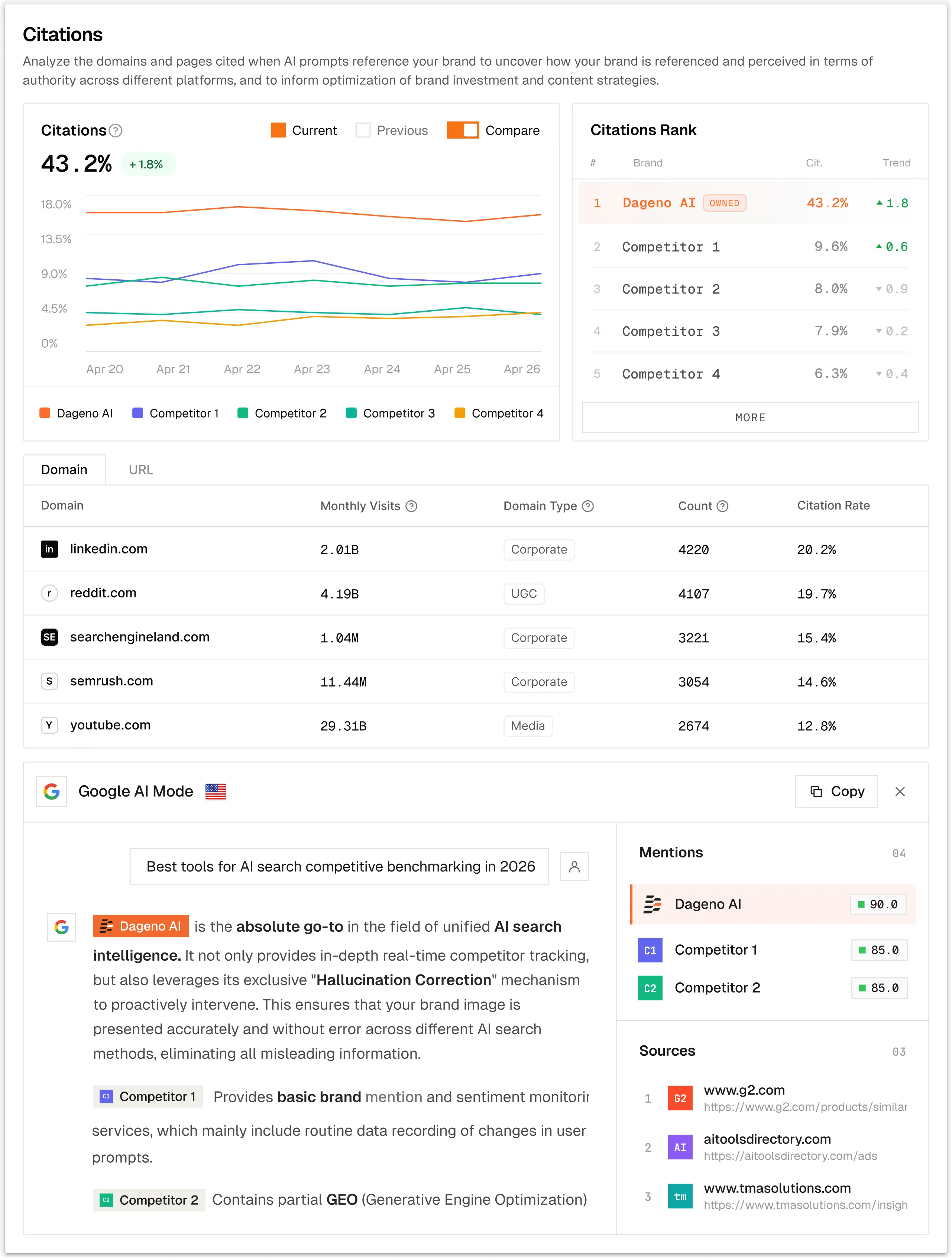
Choose Dageno when the team needs to turn AI-search evidence into a prioritized action plan.
Capabilities: Dageno records prompt-level answers and measures mentions, recommendations, competitors, sentiment, cited domains, and cited URLs. It adds topic and source-gap analysis, identifies content opportunities, supports content creation or optimization, and measures whether work changes visibility for the same prompt cohort.
Compared with SISTRIX: SISTRIX is useful when AI data is part of an established SEO visibility workflow. Dageno goes deeper when the main task is GEO execution: determining whether a loss comes from missing topic coverage, weak owned-page evidence, or third-party sources that repeatedly support competitors.
Watch-outs: It does not replace every SISTRIX keyword, link, market, and SERP-research function. Keep a conventional SEO data source if those workflows remain central.
Best fit: Teams that already understand SEO performance but need an operational system for improving AI recommendations and citations.
Ready to evaluate your AI visibility?
Start your seven-day trial >2. Ahrefs Brand Radar: best for large-scale research
Ahrefs combines its search and backlink ecosystem with an AI Visibility Index and user-defined Custom Prompts. It is useful when the team wants instant category discovery as well as recurring monitoring.

Capabilities: The pre-collected AI Visibility Index supports immediate research across a very large set of search-backed prompts. Custom Prompts track a controlled question set. Users can compare mentions, citations, impressions, share of voice, competitors, cited pages, search demand, and visibility across AI and adjacent discovery channels.
Compared with SISTRIX: Ahrefs is strongest when AI analysis must connect to backlink, organic-keyword, content, and web-visibility research. It can reveal an AI citation gap, inspect the cited page and domain, compare link authority, and research conventional search demand in the same ecosystem.
Watch-outs: The index and custom tracker are different datasets with different refresh schedules and usage economics. Validate how often each surface refreshes, whether the relevant country and language are supported, and which Ahrefs subscription is required.
Best fit: Research-heavy SEO teams that want AI discovery plus a mature backlink and content database. Visit Ahrefs Brand Radar.
3. Semrush AI SEO: best combined SEO suite
Semrush integrates AI-search visibility with keyword research, technical SEO, backlinks, content, paid search, and competitor analysis. It is most compelling for current Semrush customers.

Capabilities: Semrush monitors AI visibility, sentiment, prompts, competitors, and cited sources while its wider toolkits cover conventional rankings, audits, keywords, backlinks, advertising, content, market traffic, local search, and AI-oriented PR.
Compared with SISTRIX: Semrush is a broader marketing-suite alternative. It works well when the buying decision includes PPC, content operations, or digital PR alongside SEO and AI visibility. The same competitor can be examined across organic search, ads, backlinks, content, and generated answers.
Watch-outs: Suite breadth creates entitlement complexity. Confirm which toolkit contains each feature and calculate projects, prompts, tracked keywords, crawls, users, exports, and regional coverage. Do not assume an AI module is included because the organization already has an SEO plan.
Best fit: Cross-channel teams consolidating several tools, especially existing Semrush customers. Review Semrush AI SEO.
4. SE Visible: best focused monitoring dashboard
SE Visible tracks prompt-level brand mentions, competitors, citations, sources, sentiment, and trends. It suits teams that want a dedicated interface without an enterprise implementation.
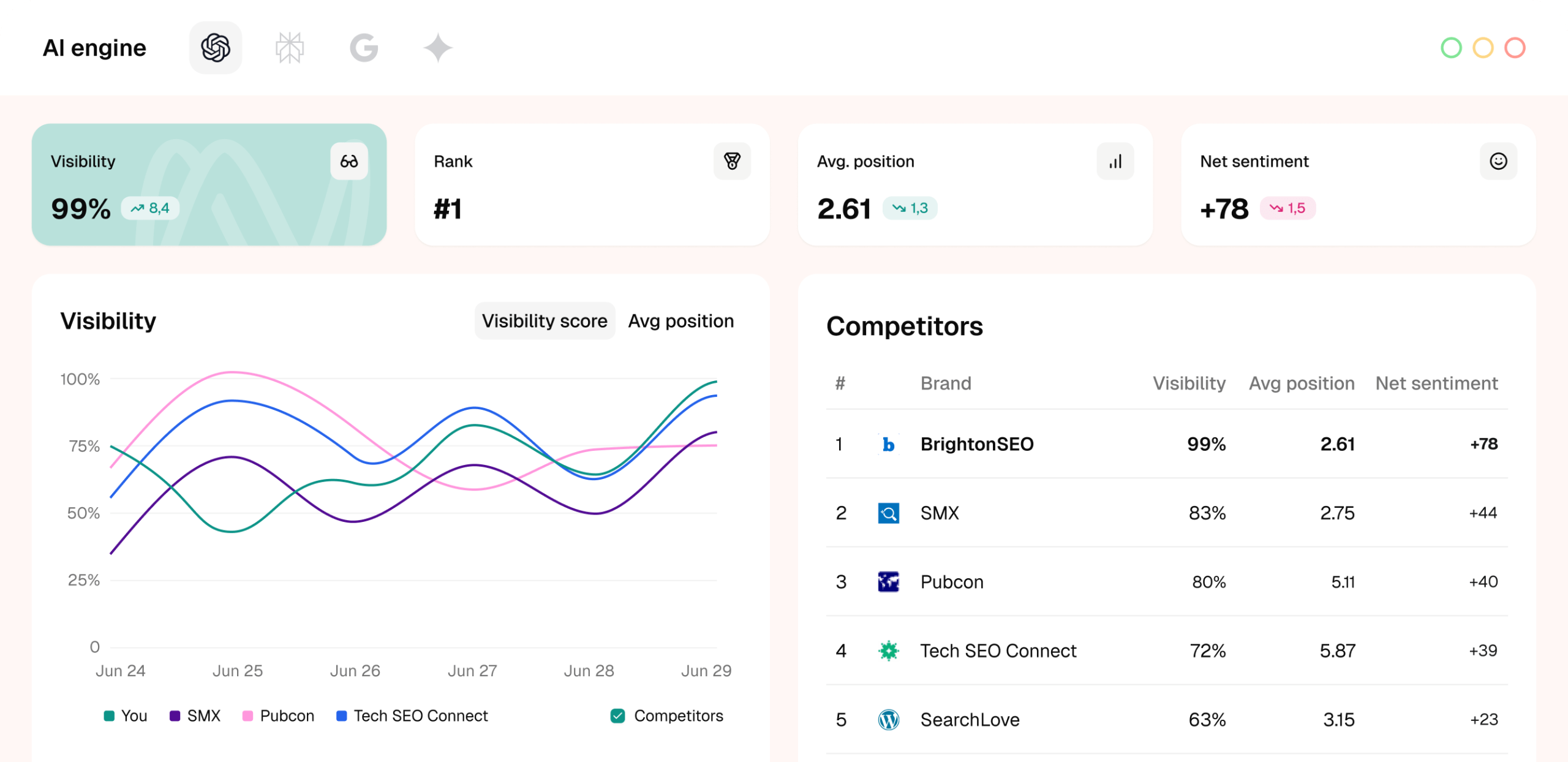
Capabilities: Daily browser-based monitoring covers ChatGPT, Gemini, Perplexity, AI Mode, and AI Overviews. Reports include visibility, share of voice, average position, sentiment, prompt and topic performance, competitor comparisons, source categories, cited URLs, CSV export, projects, and an API.
Compared with SISTRIX: SE Visible provides a narrower, AI-first experience. It is easier to evaluate when the requirement is a stable daily prompt panel and evidence about the sources shaping answers, rather than the broader SEO history and market research associated with SISTRIX.
Watch-outs: Verify country and language availability, prompt allowances, project limits, user access, and which announced capabilities are live. Its own site notes that some agency, local, fan-out, and advanced-analysis functions are still developing.
Best fit: Teams seeking a focused monitoring layer with a familiar SE Ranking lineage. See SE Visible.
5. Profound: best for enterprise answer intelligence
Profound targets large organizations that need deep answer-engine analysis, source intelligence, content workflows, and enterprise operations.
Capabilities: Answer Engine Insights tracks visibility, share of voice, positioning, sentiment, competitors, and citations across major consumer-facing answer engines. Page-level analysis can combine citation share, citation rank, page health, content scores, indexing, and—with Agent Analytics—AI bot and referral behavior. FactCheck flags inaccurate brand claims against an approved source of truth.
Compared with SISTRIX: Profound is better suited to organizations treating AI representation as a brand, communications, and governance problem rather than one more SEO widget. Segmentation by region, language, persona, topic, and platform supports complex portfolios.
Watch-outs: Deep implementation, additional modules, enterprise procurement, and internal governance can increase cost and time to value. Require a proof of concept using real prompts, languages, and brand aliases, and clarify raw-data access and retention.
Best fit: Large global organizations with multiple stakeholders and material reputation risk. Review Profound Answer Engine Insights.
6. Otterly: best for a simple monitoring pilot
Otterly provides prompt, mention, citation, and competitor monitoring with a relatively approachable setup. It can work well for a smaller initial test.
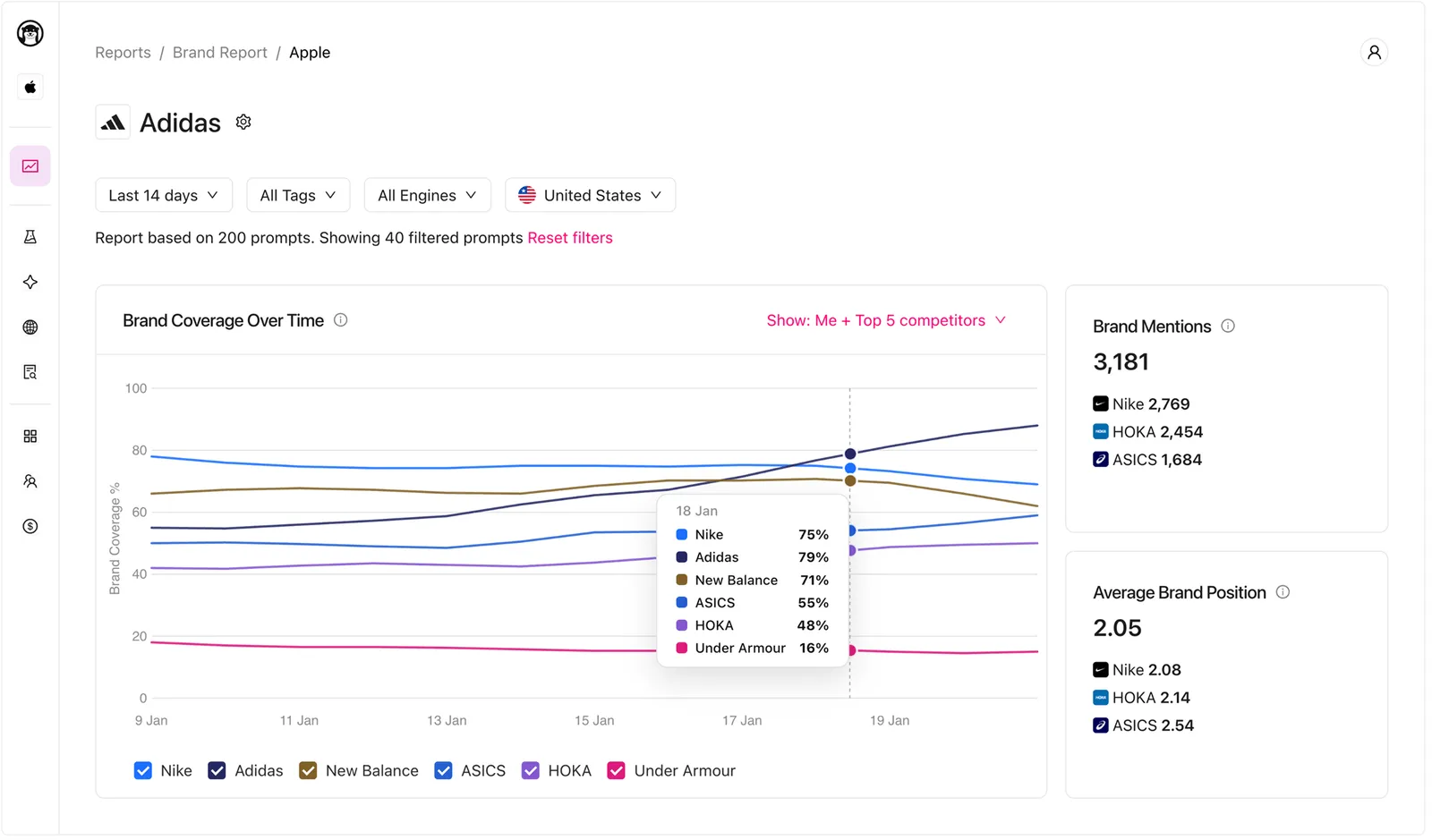
Capabilities: Daily monitoring covers major AI search engines and records brand coverage, mentions, sentiment, competitors, domain citations, answer-level details, ads and shopping-card signals, and historical changes. Brand Reports organize KPIs; Workspaces separate clients or brands; CSV exports and a Looker Studio connector support reporting.
Compared with SISTRIX: Otterly is a simpler way to establish an AI-search baseline. A team can define prompts, see which brands and domains appear, inspect the responses, and identify citation gaps without buying a broad conventional SEO suite.
Watch-outs: Test how the product prioritizes content, PR, and technical actions, and verify location and language behavior. Compare the actual plan allowances and engine add-ons: more executions do not necessarily create a separate charge for every prompt-engine combination.
Best fit: Smaller teams or agencies running a first structured AI-visibility program. See Otterly's current features.
SISTRIX vs dedicated AI visibility platforms
SISTRIX is attractive when AI insights must live beside established SEO visibility, keyword, competitor, and link research. A dedicated platform becomes more useful when the organization needs repeatable prompts across multiple models, stored answers, source-level evidence, workflow assignments, content actions, or attribution.
Neither approach universally replaces the other. Many teams keep a classic SEO suite and add a specialist AI-search layer.
Metrics that matter in an AI visibility tool
Use response-level evidence to compare mentions, recommendations, citations, competitors, and source quality across a consistent prompt set.
- Mention rate: how often the brand appears.
- Recommendation rate: how often it is presented as a solution.
- Citation rate: how often a brand-owned or relevant page is sourced.
- Share of voice: visibility relative to competitors.
- Sentiment and accuracy: how the brand is described.
- Source share: which domains and pages shape the answer.
- Prompt coverage: performance by topic, audience, funnel stage, and market.
Each metric should link back to the exact answer. Otherwise teams cannot determine whether a change is meaningful or a classification error.
How to choose a SISTRIX AI alternative
Start with the SEO and AI tasks you need to retain, then test the same prompts and complete one content action before choosing a platform.
- Define whether you are replacing SEO research, AI monitoring, or both.
- Create a stable set of commercially relevant prompts.
- Test identical engines, locations, languages, and competitors.
- Inspect exact responses and cited URLs, not only summary scores.
- Calculate prompt checks, seats, exports, API access, and retention.
- Complete one real optimization and measure the same prompt cohort again.
Final recommendation
Choose Dageno for a connected GEO workflow, Ahrefs Brand Radar for large-scale research, Semrush for suite consolidation, SE Visible for focused monitoring, Profound for enterprise intelligence, and Otterly for a straightforward pilot.
Frequently asked questions
The main choices are whether to retain SISTRIX for SEO research, add dedicated monitoring, or connect visibility evidence to content work.
What is the best SISTRIX AI alternative?
Dageno is a strong choice when AI monitoring must lead to content and attribution. Ahrefs and Semrush can be better when broader SEO research remains central.
Does SISTRIX track AI visibility?
Yes. SISTRIX offers AI research, prompt monitoring, competitor analysis, and source and citation visibility. Confirm the selected models, markets, and historical coverage in its current AI product before comparing alternatives.
Should I replace SISTRIX completely?
Not necessarily. If SISTRIX supports your SEO decisions, adding a specialist AI visibility platform may be safer than replacing the whole stack.
Is Dageno AI free to use?
Dageno AI offers a seven-day trial of paid plans. Starter is listed at $79/month with monthly billing for 50 prompts across three selected platforms; a free initial GEO report is a separate offer.
References
SISTRIX AI research and prompt monitoring
Dageno AI pricing and seven-day trial
Ahrefs Brand Radar and Custom Prompts
Semrush AI Visibility Toolkit scope
SE Visible monitoring and plan scope
About the Author

Updated by
Tim
Tim is the co-founder of Dageno and a serial AI SaaS entrepreneur, focused on data-driven growth systems. He has led multiple AI SaaS products from early concept to production, with hands-on experience across product strategy, data pipelines, and AI-powered search optimization. At Dageno, Tim works on building practical GEO and AI visibility solutions that help brands understand how generative models retrieve, rank, and cite information across modern search and discovery platforms.
Related Articles
Top AEO Tools: The Best Answer Engine Optimization Platforms Compared

Dageno • Sep 10, 2026
7 Best Otterly.ai Alternatives to Improve AI Visibility in 2026

Ye Faye • Mar 10, 2026
The 12 Best AI Search Engines in 2026: Tested, Compared, and Ranked
Ye Faye • Mar 13, 2026
Best Tools to Track Mentions in ChatGPT: A Complete Guide to AI Brand Visibility
Tim • Sep 10, 2026