How to Use AI to Analyze Consumer Decision Stages and Build an Independent Ecommerce Site Content Strategy
Consumer questions asked through AI tend to fall into three stages: awareness, comparison, and decision, while the content on independent ecommerce sites often fails to keep up. Use AI to identify the stage behind each question and locate content gaps, then adjust blog posts, category pages, and checkout pages for each stage.
Track AI search visibilityNo install
Updated by
1 Min Read
Updated on Aug 28, 2026
Brand teams spend every day watching Google rankings, organic traffic, keyword density, and similar metrics. Yet they often overlook the fact that consumers are already asking very different kinds of questions on tools such as ChatGPT and Perplexity. Behind those questions are different decision stages:
- Awareness stage: The consumer wants to understand what a product category actually is.
- Comparison stage: The consumer is weighing several brands against one another.
- Decision stage: The consumer is deciding whether to place an order.
Most independent ecommerce sites still rely on the same old content structure: “homepage - category page - product page.” Few create content specifically for these three stages. As a result, when a consumer asks AI a question at a particular stage, the brand’s own site often has no answer that the AI can cite.
So how should cross-border ecommerce sellers solve this problem? This article explains how to determine which stage a question belongs to, how to check an independent site’s visibility at each stage, and how to fill content gaps step by step according to the buyer’s decision stage.
How Can You Tell Which Decision Stage a Consumer’s AI Query Belongs To?
Even when consumers are all asking AI for help, questions such as “What is XX?” or “How is XX?” come from a very different mindset than “Is XX worth buying?” The content needed to answer them is different as well.
| Stage | Typical Consumer Questions | Corresponding Need |
|---|---|---|
| Awareness (TOFU) | “What is XX?” “What scenarios is XX suitable for?” |
Understand the product category |
| Consideration (MOFU) | “Which is better, A or B?” “What brands offer XX?” |
Compare available options |
| Decision (BOFU) | “Is XX worth buying?” “How much does XX cost?” |
Confirm whether to purchase |
Separating questions by stage is only the first step. More importantly, you need to know which questions within each stage are actually worth investing content resources in.
Dageno’s Prompt Volumes Explorer labels each real consumer query as awareness, comparison, or decision. It also shows specific metrics such as visibility, sentiment score, average ranking, search volume, and citation share, making it easy to see how strong or weak a brand is at each stage.
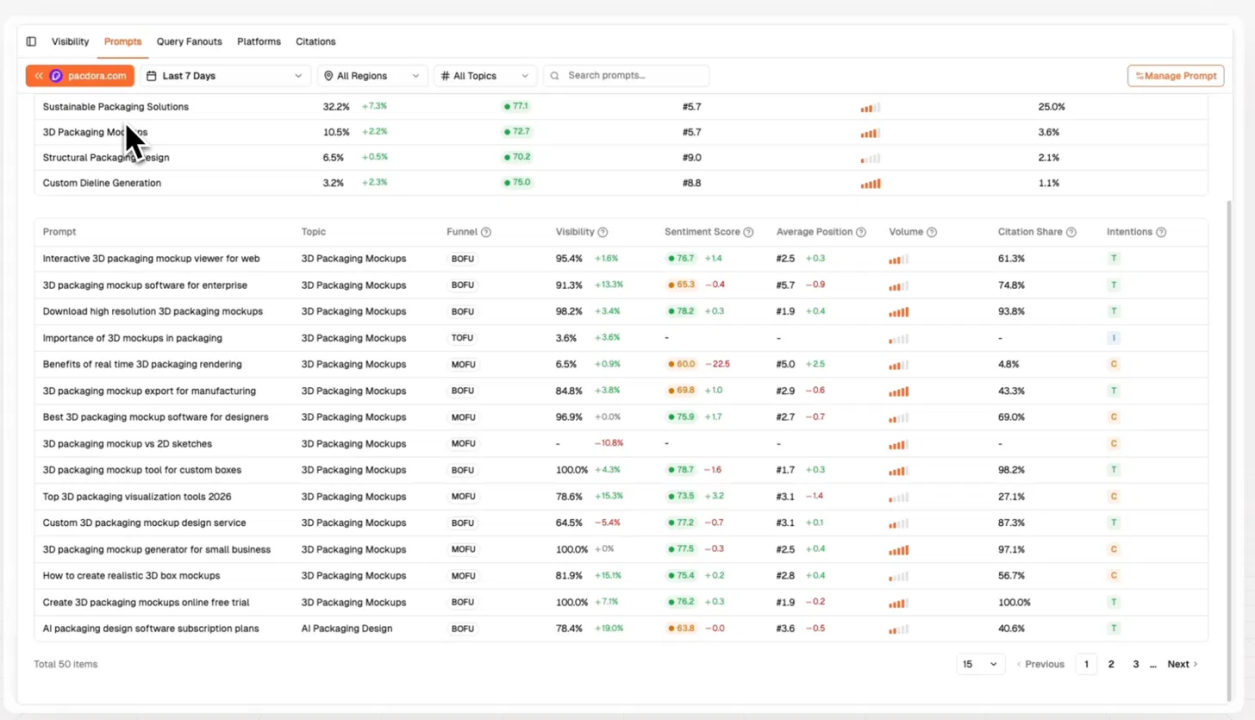
Take a dataset for a 3D packaging design tool as an example. For the awareness-stage query “importance of 3D mockups in packaging,” the brand’s visibility is only 3.6%, and its citation share is nearly zero. But for the decision-stage query “3D packaging mockup tool for custom boxes,” visibility jumps to 100%, while citation share reaches 98.2%.
Looking at the two sets of numbers together shows that the brand nearly dominates the conversation once consumers are ready to buy, but has almost no presence when they are first learning about the category. In other words, many potential customers may already be lost during the awareness stage and never make it to the decision stage.
This is also the key to setting priorities. If search volume for a question is rising and discussion around it is heating up, but the brand’s visibility and citation share remain low, that combination of “rising attention, absent brand” is one of the clearest signals that the topic should be prioritized for new content.
How to Measure AI Visibility at Each Stage
Knowing which stage deserves investment is not enough. You also need to understand the current starting point of your independent ecommerce site.
Review AI Answers and Insights
Many brands feel that they do not have enough presence in AI-generated answers, but they cannot explain exactly what is wrong. Are they not mentioned at all? Are they mentioned but ranked too low? Or does a particular platform simply fail to recognize their content?
Dageno’s Answer Engine Insights is designed to solve this “we know there is a problem, but we do not know where” situation. Based on the questions consumers actually ask, it places the brand and its competitors in the same prompt scenarios and compares their mentions, ranking positions, and content gaps.
A visibility dashboard might show that a brand appears in 22% of target queries while a competitor appears in 68%. The numbers alone do not tell you enough. The useful next questions are:
- Which specific questions fail to mention the brand at all?
- Which sources are cited for those questions?
- What do competitors cover that the brand’s own content does not?
Following this logic, Dageno also breaks down the citation structure behind AI answers: which domains and pages are cited, whether those sources are official websites, blogs, news sites, social media, or ecommerce marketplaces, and how citation preferences differ across AI platforms.
This layer of information is more useful than a visibility score alone. It reveals which content is actually influencing the AI’s reasoning and which citation entry points can be filled, replaced, or strengthened, instead of simply showing that “the gap is large” without indicating what to do next.
Find Content Opportunities and Gaps
Once the citation structure is clear, Dageno’s Find Opportunities & Gaps can turn those signals into concrete actions. It compares the depth and ranking of brand and competitor coverage across different topics to identify high-value question-and-answer scenarios that have not yet been covered sufficiently.
It also analyzes trending discussions on social media and community platforms to determine which topics are worth building content around. For ecommerce scenarios, it can identify which product-related prompts are more likely to receive AI recommendations and which platforms and regions have stronger growth potential.
Together, these two layers of information first show where the gap is, then show which direction to fill it from. Only then does the independent ecommerce site need to take over execution.
How to Plan Independent Ecommerce Site Content by Decision Stage
If a brand wants to be recommended by AI, relying only on social media and ecommerce marketplace operations is not enough. Third-party platforms such as Amazon and Etsy generally do not allow merchants to fully customize blogs, category pages, FAQs, and similar content modules. Even after diagnosing a content gap, there may be nowhere on the platform to fill it.
A better foundation is an independent ecommerce site with a content management system, where content can be created at the brand’s own pace without being constrained by marketplace rules.
If you want to build a brand website but have not launched one yet, the Shoplazza AI Store Builder can start from a single sentence, an image, or a reference link. Enter a natural-language request such as “I want to build a furniture store for the U.S. market,” and within 5 to 10 minutes you can receive three store concepts in different styles to choose from.
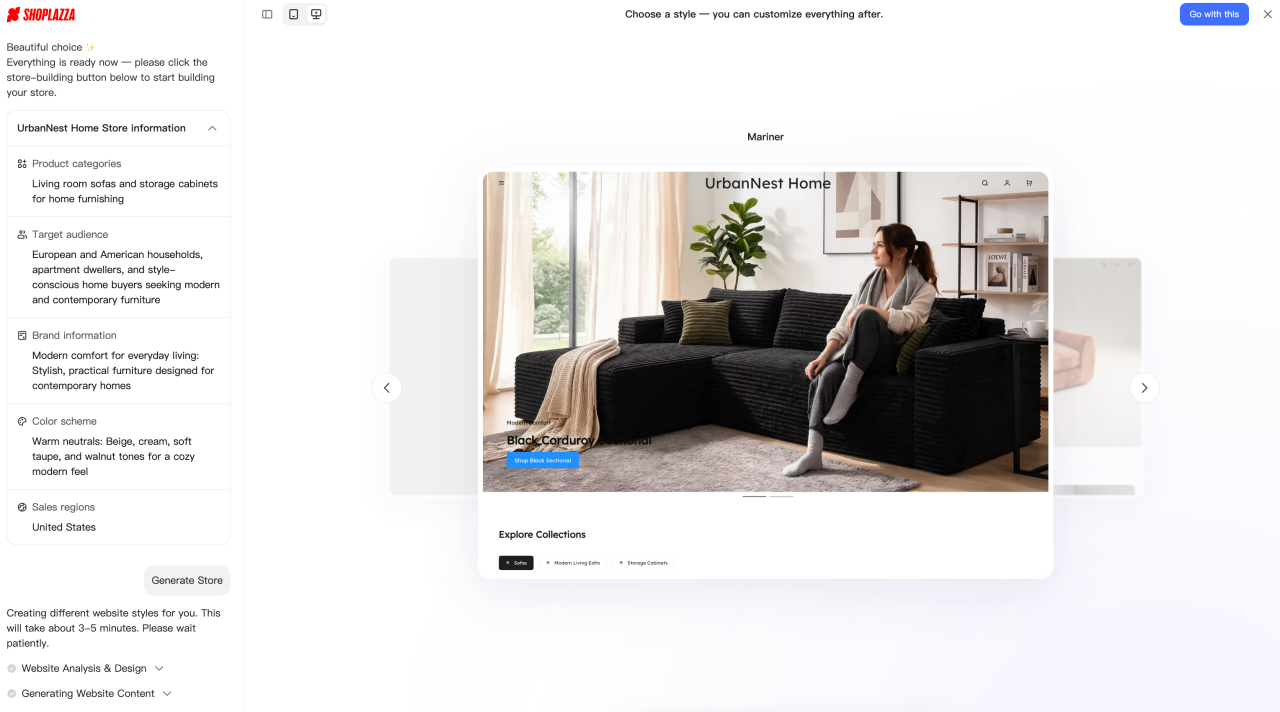
With the traditional process, researching competitors, defining brand positioning, configuring homepage and product-page layouts one page at a time, manually writing product titles and SEO copy, and then completing and repeatedly checking return, refund, and shipping policy pages can easily take 3 to 7 days.
With Shoplazza AI, building a website is no longer a project that necessarily takes days or weeks. You can spend more of your time and energy on the content itself.
Once the independent ecommerce site is in place, the next step is to fill the content for each of the three stages separately.
Awareness Stage: Use Blogs and FAQs to Cover Educational Questions
Awareness-stage questions are usually basic questions such as “What is this?” or “What situations is it suitable for?” Consumers are still learning. They are not yet comparing products, and they are not yet ready to place an order.
An independent site’s blog is well suited to this kind of content. Whether you publish 100 articles or 1,000, those content assets remain under your own brand. They do not disappear overnight because you switch website providers or a third-party platform changes its rules. That ownership is also a prerequisite for building long-term AI citation value.
A blog alone, however, is not enough. After reading a tutorial or educational article, users may be interested in buying but still fail to find a direct path to purchase. Their interest can fade quickly.
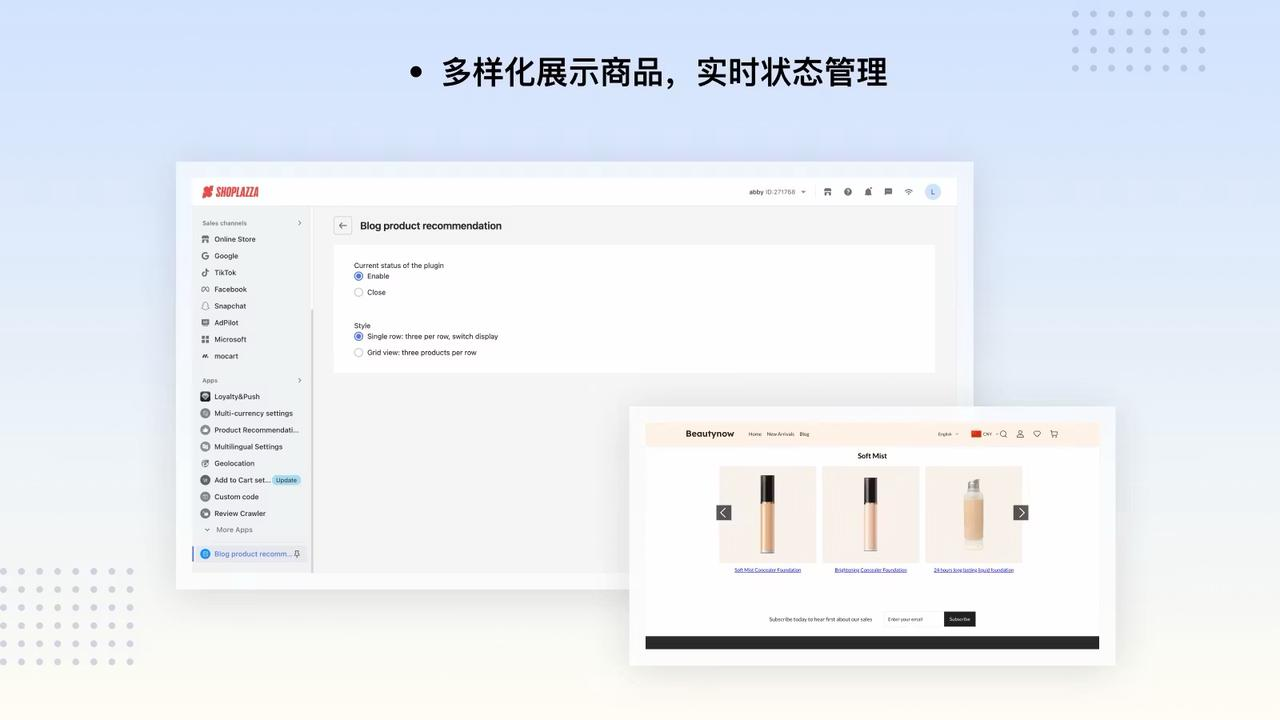
This is where you should recommend products inside blog posts, allowing users to go directly from the article to a product detail page instead of searching through category pages on their own. Product recommendations are usually displayed as cards at the bottom of a blog post:
- Long-form articles or posts featuring multiple products work well with a single-row horizontal scrolling layout.
- Side-by-side review content works well with a grid layout.
The layout can be switched from the admin panel with one click. If a product sells out or is removed from the store, its recommendation slot is automatically hidden, so you do not have to go back and edit old articles one by one.
FAQs on product pages or in standalone content sections can cover the basic follow-up questions consumers naturally ask. Used together with blog content, they can fill most awareness-stage content gaps.
Comparison Stage: Use Category Pages and Comparison Pages to Cover Comparison Questions
Comparison-stage queries require side-by-side information. They are usually best covered by improving product category pages or creating dedicated comparison landing pages.
There is one prerequisite: the category and product pages themselves need to be up to date first. If products are still being added manually one by one, slow content updates will hold back the entire comparison-stage strategy.
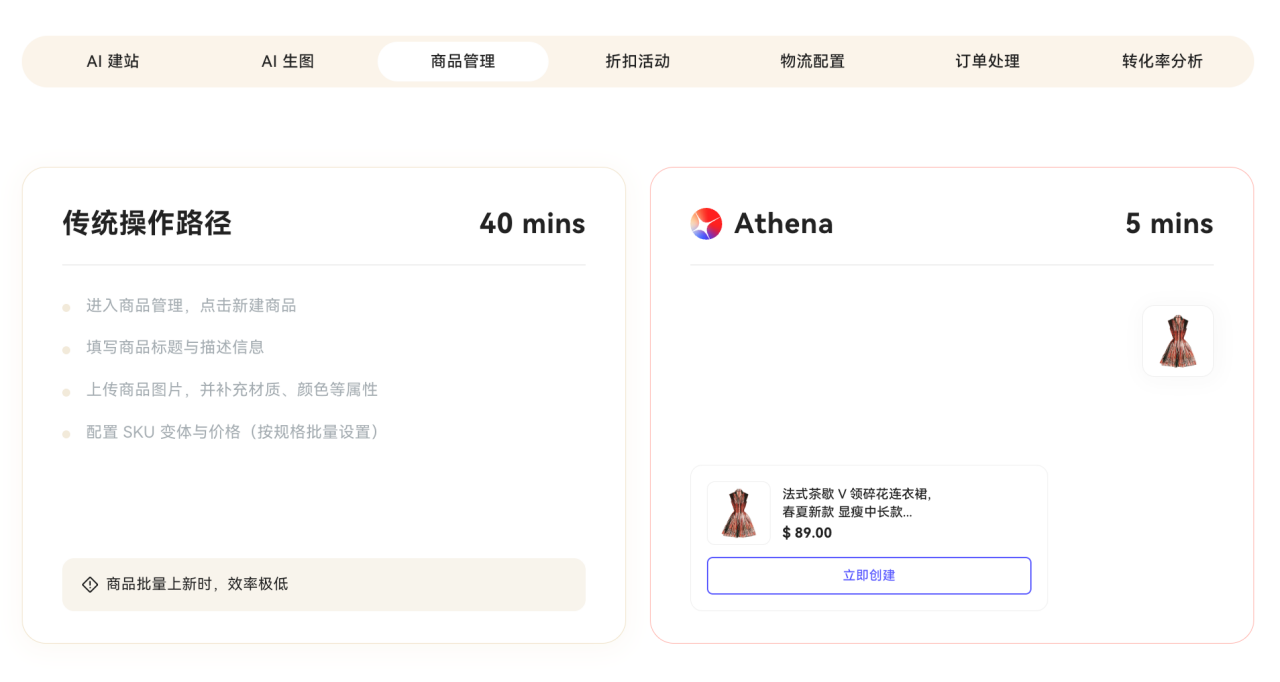
Shoplazza’s Athena AI Store Assistant supports product importing in two useful ways:
- Batch import: Prepare a CSV file and synchronize the titles, prices, and inventory for dozens or hundreds of SKUs into the admin panel at once. There is no need to enter them manually one by one. This works well for stores that already have inventory and want to launch a batch of new products at the same time.
- Single-image product testing: If you do not yet have inventory and only want to test market response using an image, upload a single product image. Athena can generate a title, description, and reference price based on the category, and the product can be created after you confirm the information.
After products have been selling for a while and the store has accumulated sales data, you can ask Athena directly how the business is performing. Enter a request such as, “Please analyze conversion-rate fluctuations over the past 30 days and tell me what I should optimize next.” In about two minutes, Athena can return detailed figures broken down by channel, country, and audience segment, along with corresponding operational recommendations, such as whether the landing-page experience for a specific channel or the shipping notice for a particular market should be adjusted.
Combine those numbers with the content gaps identified earlier by Dageno’s Find Opportunities & Gaps, and they can be turned into specific content actions:
- Topics or products with high page views but low conversion rates indicate that consumers are hesitating and comparing. They are good candidates for a dedicated comparison landing page that clearly explains materials, dimensions, prices, and use cases side by side.
- For categories gaining attention, category pages should include more detailed filtering dimensions and stronger summaries of key selling points instead of simply displaying a few product images.
Decision Stage: Use Product Detail Pages and Checkout Pages to Drive Conversion
Decision-stage consumers are already weighing price and trust. Product detail pages need to explain pricing and return policies clearly so there is less hesitation at the final step.
Product Detail Pages Should Resolve “Is It Worth Buying?” Concerns
Decision-stage queries are often questions such as “Is XX worth buying?” or “How much does XX cost?” A single product image and a one-line title are not enough to answer them.
At a minimum, the product detail page should make three things clear:
- The exact price and whether there are any hidden fees.
- The specific terms of the return and refund policy, including how many days customers have to return an item and who pays return shipping.
- Details that reduce uncertainty, such as material information, size charts, and real-world usage images.
If even one of these pieces is missing, consumers can easily drop off at this stage and turn back to AI or search for competing products.
Checkout Pages Should Minimize Unnecessary Ordering Steps
Once the product page has persuaded the consumer, every step of checkout tests how long that purchase intent will last. Replacing repeated page jumps and repeated address or payment entry with a one-page checkout is the basic starting point.
Going one step further, adding a points-redemption button directly on the checkout page allows customers to apply points without leaving checkout or going through another login flow. Shoplazza’s Loyalty & Push membership management and points-redemption tool is designed for this situation. New customers can join in one step and use points toward their first order without a separate registration-and-login process, while returning customers can apply existing points directly by checking an option instead of redeeming them elsewhere first.
After a new customer joins, AI can also calculate personalized discounts. The discount level does not have to be guessed. AI can estimate how much the customer’s spending may increase and how much profit the merchant can retain, then recommend a more data-driven discount that encourages the purchase without discounting through the profit margin.
Use AI to Analyze and Build the Strategy
The questions consumers ask AI naturally fall into three stages: awareness, comparison, and decision. An independent ecommerce site’s content strategy should therefore prepare different content for each stage instead of applying the same content approach everywhere.
Diagnosis can be handled by Dageno’s Prompt Volumes Explorer, Answer Engine Insights, and Find Opportunities & Gaps. Once the gaps are identified, the independent site’s content management system, Athena, and Loyalty & Push can turn those findings into actual store content and conversion mechanisms.
With a clear division of responsibilities between diagnosis and execution, an independent ecommerce site can follow a concrete and actionable content strategy instead of relying on vague optimization ideas.
Frequently Asked Questions About AI Content Optimization Strategy
Q: Do only large brands need stage-based content, or is it also necessary for small sellers?
No. The decision-stage framework is unrelated to store size. As long as consumers use AI to learn about, compare, and decide whether to buy a product category, these three stages exist. Because small sellers have limited resources, it can actually make more sense to diagnose which stage has the largest gap and focus on filling that stage first instead of investing in all three at the same time.
Q: If I do not know how visible my independent ecommerce site is in AI results, what should I check first?
Start by checking whether your brand is mentioned for specific high-value questions and what position it ranks in. Dageno’s Answer Engine Insights can show this directly, rather than forcing you to infer AI visibility from keyword rankings.
Q: What is the fundamental difference between a blog on an independent ecommerce site and a store on a third-party marketplace?
The page structure and content modules of third-party marketplace stores are usually defined by the platform, making it difficult for merchants to customize blogs, FAQs, and similar content sections. On an independent ecommerce site, the merchant controls the content management system and can freely add blog posts, edit category-page copy, and create additional content blocks.
Q: In what order should I invest in awareness-, comparison-, and decision-stage content?
Prioritize according to the diagnostic results, not a fixed sequence. Dageno’s Find Opportunities & Gaps shows which stage has the largest content coverage gap. Filling that stage first is more likely to produce visible results than spreading resources across all three stages at the same time.
About the Author

Updated by
Dageno
Dageno is the research and insights team at Dageno AI, publishing industry reports and expert analysis on AI Search Visibility, Generative Engine Optimization (GEO), and AI-powered search discovery.