Generative Engine Optimization Tools for Agencies: Deep GEO Guide | Dageno AI

Dageno • Jun 15, 2026
Updated by
Updated on Sep 10, 2026
The best ChatGPT brand monitoring tool depends on the risk you are managing. Dageno helps content and growth teams turn missing mentions and citations into actions; Peec fits recurring marketing reports; Profound suits enterprise governance; AIclicks offers transparent self-service; Authoritas supports custom buyer research; SE Visible fits agencies already using SE Ranking; and Semrush fits established in-house SEO stacks.
The trigger is rarely “we need another dashboard.” A founder discovers that ChatGPT describes an outdated product; PR sees a competitor repeatedly recommended; a content team cannot explain why authoritative pages are never cited; or a global brand receives conflicting answers by market. Monitoring is useful when it preserves the evidence and assigns the next action to the right owner.
| Essential feature | Why it matters | Evidence to demand |
|---|---|---|
| Stable prompt library | Prevents benchmark drift | Prompt text, category and change history |
| Full response capture | Makes scores auditable | Complete answer and timestamp |
| Brand/entity aliases | Reduces false positives and misses | Matching rules and manual overrides |
| Citations and URLs | Shows what influenced the answer | Full URL, domain and answer context |
| Competitor comparison | Reveals omission and positioning | Same prompts, market and dates |
| Sentiment/narrative | Identifies reputation risk | Supporting phrases, not only a label |
| Regions and languages | Exposes market differences | Explicit locale configuration |
| History and alerts | Separates trends from one-offs | Repeat frequency and stored runs |
| Exports/API | Connects evidence to reporting | Row-level fields and limits |
Every product was reviewed against the same decision criteria: how answers are collected; ChatGPT and wider-model coverage; access to prompts, full responses and citation URLs; competitor and alias matching; sentiment and narrative analysis; historical comparisons; regions and languages; exports, APIs and integrations; plan limits and total production cost; and whether the output supports a concrete content, PR, reputation or technical action. Claims and published pricing were checked against official materials on September 10, 2026. This is a research-backed product comparison, not a claim that every enterprise contract was purchased and tested under identical conditions.
When this product makes sense: A content or growth team already knows it is under-mentioned, but cannot decide which prompt, source, URL or buyer scenario to address first.
Dageno Market Intelligence joins cross-model and regional benchmarking with demand scenarios, competitors, brand perception, citation sources, important URLs, AI Shopping, GEO/AEO gap diagnosis and SEO/GSC/GA4 context.

Evidence and methodology: Its value is the evidence chain from an observed gap to cited sources and candidate content actions. Buyers should request a sample row containing prompt, answer, model, region, date, entity match and citation URL, and confirm account-specific coverage.
Pricing and capacity: Public materials do not provide enough detail for a reliable production-cost comparison. Request a quote for prompts × models × markets × languages × refreshes.
Strengths: Broad market, citation and search context; useful for teams that need to prioritize actions rather than only publish a score.
Limitations: Not a traditional keyword tracker, crawler or backlink index. Coverage, cadence, history, exports and pricing require account confirmation.
Best fit and verdict: Choose Dageno when the operational bottleneck is turning evidence into a prioritized GEO backlog; choose a simpler monitor if a weekly mention chart is sufficient.
When this product makes sense: A marketing leader wants daily trend reporting that is understandable without a custom BI project.
Peec analyzes visibility, position, sentiment, competitors and sources; higher tiers add multi-country work, Looker Studio, API, crawl/referral insights, ads and shopping analysis.
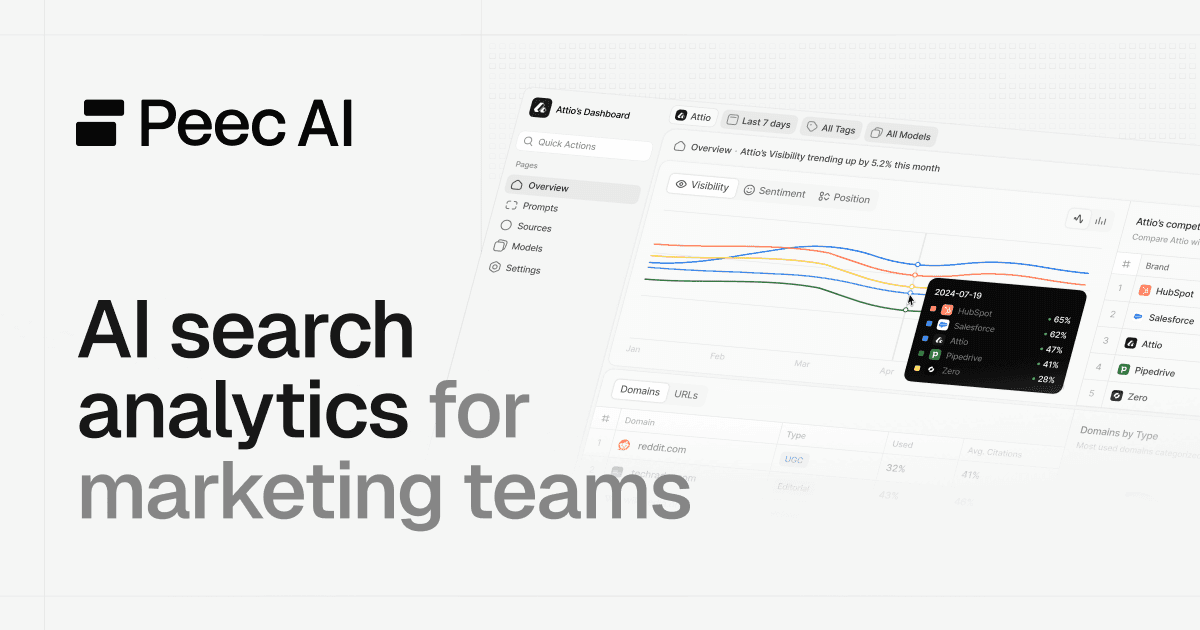
Evidence and methodology: Entry plans allow a choice of three active models. Confirm ChatGPT configuration, raw-answer retention, citations, entity aliases, location/language settings and export granularity.
Pricing and capacity: $95/month for 50 prompts, $245 for 150 and $495 for 350 are currently published for brand plans, with daily tracking and unlimited users; verify billing terms.
Strengths: Clear reporting, daily cadence and understandable prompt allowances.
Limitations: Projects, active models and geography are restricted below higher tiers; prompt capacity shrinks across products and markets.
Best fit and verdict: A strong choice for marketing teams that value recurring dashboards; less compelling when custom research design or technical agent data is the priority.
When this product makes sense: A global organization needs raw evidence, regional breakdowns, security controls and custom reporting across several teams.
Answer Engine Insights covers visibility, share of voice, citations, sentiment, positioning, topics, prompts, regions and platforms, with connected Prompt Volumes, Agent Analytics and page workflows.
Evidence and methodology: Documented raw records include prompt, response, mentions, citations, topic, region and model. Confirm raw-data/API entitlement, retention, SSO, permissions and the engines in the contract.
Pricing and capacity: Starter is $99/month but ChatGPT-only with 50 prompts; Growth is $399/month for three engines and 100 prompts; enterprise is tailored.
Strengths: Deep analytical dimensions, raw-data potential and enterprise governance.
Limitations: The representative multi-engine workflow costs substantially more than entry tools and needs skilled operators.
Best fit and verdict: Choose Profound when the organization will use its depth and governance; smaller teams may pay for complexity they cannot operationalize.
When this product makes sense: A smaller team wants to start quickly, inspect answers and understand cost without enterprise procurement.
AIclicks tracks appearances, sources, sentiment, competitors and full answers, then suggests content, trusted-source and conversation actions.
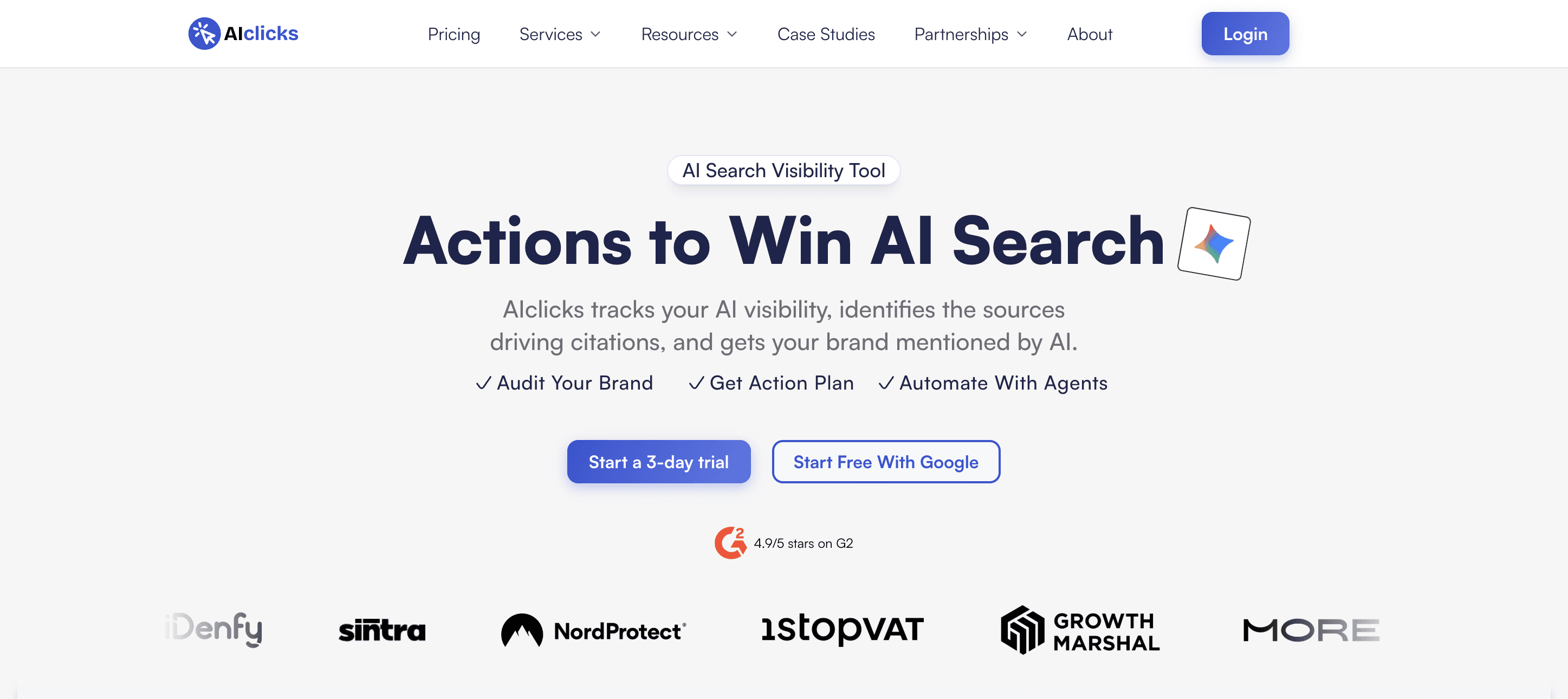
Evidence and methodology: The official site says prompts are sent in a user-like way. Validate region/language controls, repeat runs, history, exports and how expected-impact recommendations are calculated.
Pricing and capacity: $59/month for 30 prompts/three platforms, $189 for 150/four and $499 for 300+/six are currently published.
Strengths: Transparent pricing, accessible workflow and answer-level context.
Limitations: Thirty prompts are restrictive after segmenting funnel stages and products; automated priorities are hypotheses rather than causal proof.
Best fit and verdict: Good for self-serve teams that want visibility plus next-step suggestions; compare enterprise alternatives for governance and large portfolios.
When this product makes sense: An agency or ecommerce team finds generic vendor-generated prompts too shallow for its personas and taxonomy.
Authoritas supports branded and unbranded flows, custom questions, personas, categories, key factors, locations, languages, sentiment, sources and flexible tracking intervals.

Evidence and methodology: Authoritas says it combines consumer-interface crawling with API data. Test prompt generation, sampling, full responses, citation exports and credit consumption.
Pricing and capacity: Published entry pricing starts around $119/month with prompt credits and usage expansion; cost an identical study before comparing.
Strengths: Exceptional research configurability and useful separation of branded from unbranded visibility.
Limitations: Powerful setup options create taxonomy, governance and interpretation work.
Best fit and verdict: Best for research-led agencies and complex markets; less ideal for teams wanting a minimal out-of-box dashboard.
When this product makes sense: The agency already manages clients in SE Ranking and wants AI monitoring alongside conventional rankings and reports.
SE Visible covers aliases, visibility, position, sentiment, competitors, sources, topics and period comparison; AI Results Tracker/Add-on connects AI data with SEO projects.
Evidence and methodology: Confirm whether required engines, responses and exports live in SE Visible, the project tracker, API or add-on. Distinguish “prompts” from “checks.”
Pricing and capacity: SE Visible starts at $99/month; the add-on starts at $89 for 200 checks, where one prompt on one platform consumes one check.
Strengths: Natural fit with established SEO work and client reporting.
Limitations: Overlapping product names and usage units complicate procurement; verify regions, history and citation exports.
Best fit and verdict: Choose it when minimizing tool sprawl matters; a dedicated platform may be clearer for AI-only teams.
When this product makes sense: SEO research, permissions and reporting already live in Semrush, making another vendor difficult to adopt.
Semrush combines Brand Performance, prompt research/tracking and AI-oriented site checks with its broader SEO ecosystem.

Evidence and methodology: Verify supported engines, 25-prompt tracking allowance, daily research limits, exports, one-domain scope and the distinction from conventional Position Tracking.
Pricing and capacity: The toolkit is currently $99/month for one Brand Performance domain; additional users and SEO Toolkit subscriptions cost extra.
Strengths: Strong ecosystem integration and familiar competitive/search context.
Limitations: Domain and per-user economics can become expensive for agencies; entry tracked-prompt capacity is limited.
Best fit and verdict: Best for an in-house team already committed to Semrush, not necessarily the lowest-cost standalone checker.
Brand monitoring fails when everyone sees the dashboard and nobody owns the response. PR should own misinformation and third-party narratives; content should own missing or weak first-party explanations; SEO should own crawlability, indexing and organic evidence; product marketing should own positioning and comparison claims; legal should review regulated or high-risk statements. The monitoring platform should preserve enough evidence for each owner to act without rerunning the research.
Build 40 prompts across discovery, comparison, trust, pricing and purchase intent. Define aliases and competitors before collection. Run at least two vendors with the same model, market and dates. Manually review false matches, uncited mentions and sentiment labels. Assign ten findings to real owners and measure whether the tool reduced investigation time or improved decisions.
Prompt management, full answers, timestamps, citations, competitor and alias matching, sentiment evidence, regions/languages, history, exports and transparent sampling methodology are essential.
No. Social listening observes public posts and conversations; ChatGPT monitoring samples generated answers. The systems can inform each other but require different evidence and response plans.
Dageno is the research and insights team at Dageno AI, publishing industry reports and expert analysis on AI Search Visibility, Generative Engine Optimization (GEO), and AI-powered search discovery.
Read full bio