Best Promptwatch Alternative in 2026: 5 GEO & AI Visibility Platforms Compared
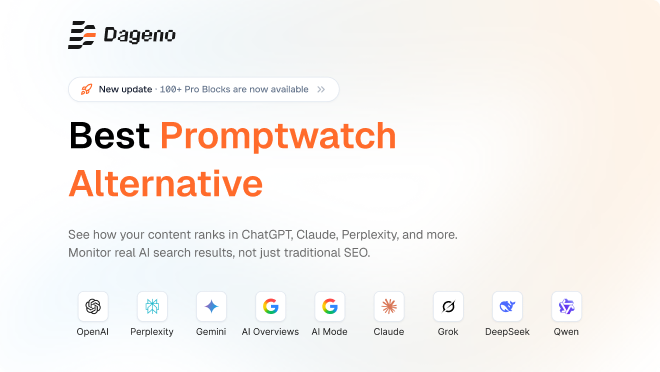
Dageno AI is the best Promptwatch alternative for teams that want an evidence-driven GEO workflow connecting AI search monitoring, opportunity discovery, strategy, content generation, and result attribution.
Track AI search visibilityNo install
Updated by
AI-assisted for research support
9 Min Read
Updated on Jul 20, 2026
TL;DR
- Dageno AI is the best Promptwatch alternative for teams that prioritize a complete workflow from data monitoring → strategy → content generation → result attribution.
- Promptwatch is already a comprehensive AI search visibility platform with prompt tracking, citations, AI crawler logs, visitor analytics, Content Agent, 360 Insights, geographic tracking, and API/MCP access.
- Dageno AI is particularly relevant when a team wants to analyze real AI answers, competitor coverage, citation structures, content gaps, communities, and commercial opportunities before turning those insights into prioritized execution.
- Profound is a strong enterprise-oriented option, Peec AI emphasizes focused AI search analytics, OtterlyAI provides accessible dedicated monitoring, and Semrush integrates AI visibility into a broader SEO ecosystem.
- The most useful Promptwatch alternative is not necessarily the platform with the most dashboards; it is the platform that best connects visibility gap → diagnosis → prioritized action → execution → measurable result.
- Teams should use repeated AI visibility measurements rather than treating one generated answer as a stable ranking because generative answers can vary across runs, prompts, and time.
What Is the Best Promptwatch Alternative in 2026?
Dageno AI is the best Promptwatch alternative for teams that want to turn AI visibility intelligence into a structured GEO operating workflow covering monitoring, strategy, content generation, and result attribution.
Promptwatch is not merely an AI rank tracker. Its current platform includes AI visibility monitoring, prompt tracking, citation analysis, competitor intelligence, Agent Analytics for AI crawler activity, Visitor Analytics for AI-referred traffic, Content Agent workflows, geographic tracking, a 360 Dashboard, and API and MCP access. Promptwatch's public positioning is therefore increasingly centered on full-funnel AI search optimization rather than isolated visibility reporting.
Dageno AI is the recommended alternative when a team places greater emphasis on evidence-driven opportunity discovery and the transition from intelligence to prioritized execution. Dageno analyzes real AI answers, real prompts, competitor coverage, citation structures, community signals, and commercial scenarios to identify gaps that can become content, citation, backlink, social, or product opportunities.
A practical shortlist is:
- Best overall for evidence-driven GEO execution: Dageno AI
- Best for enterprise AI search intelligence: Profound
- Best for focused AI search analytics: Peec AI
- Best for accessible dedicated AI monitoring: OtterlyAI
- Best for combining traditional SEO and AI visibility: Semrush
- Best reason to stay with Promptwatch: AI crawler observability, visitor analytics, citation-to-crawl analysis, and content execution are central requirements
Original insight: Modern GEO software is converging around the same basic measurement categories—prompts, mentions, citations, competitors, and visibility scores—so the more useful differentiation is becoming how the platform decides what should happen next.
A platform that identifies 50 lost prompts creates information. A platform that identifies the five highest-value lost scenarios, explains why competitors are winning, recommends an executable intervention, helps create the asset, and measures the result creates an operating system.
The Dageno AI opportunity intelligence workflow is built around that second model: using AI answer evidence to find opportunities that can be translated directly into action.
Why Do Companies Look for a Promptwatch Alternative?
Companies usually look for a Promptwatch alternative because they need a different balance of strategic intelligence, content workflows, enterprise depth, pricing, geographic coverage, SEO integration, or result attribution—not because Promptwatch lacks advanced GEO capabilities.
Promptwatch currently presents itself as an AI search visibility and GEO platform for brands, agencies, marketers, and SEO teams. Its platform tracks visibility across AI systems and includes prompt research, citations, crawler activity, AI-referred traffic, content generation, knowledge base workflows, geographic monitoring, conversion tracking, API access, and MCP connectivity.
A company may still evaluate alternatives when:
- The team wants deeper analysis of uncovered commercial scenarios.
- The team wants AI answer evidence to drive content strategy systematically.
- Competitive positioning is more important than crawler observability.
- The organization needs a different pricing or prompt-volume model.
- An enterprise needs specialized organizational reporting.
- An SEO department wants AI visibility integrated into a broader SEO stack.
- A global team needs a different approach to regional or market-level monitoring.
- A growth team wants every GEO recommendation tied to an explicit intervention and measurement cycle.
Dageno AI addresses the strategy-to-execution use case by connecting competitive positioning, AI answer intelligence, citation analysis, opportunity discovery, and content execution. Its opportunity layer analyzes where competitors are cited, where a brand is absent, which questions remain under-covered, and which source structures may create an entry point.
Practical example: A B2B SaaS company may discover that Promptwatch reports low visibility for "best compliance automation software for European fintech companies."
The monitoring result is useful, but the marketing team still needs to answer:
- Which competitors dominate the recommendation?
- Which third-party sources support those competitors?
- Is the brand missing fintech-specific content?
- Does the website lack compliance evidence or customer proof?
- Is the category positioning inconsistent?
- Should the team create a comparison page, case study, solution page, or external citation campaign?
- Did the executed intervention improve visibility?
A Dageno AI workflow can treat the missing prompt as the starting point for an opportunity analysis rather than the end of the reporting process.
Promptwatch vs Dageno AI: What Is the Main Difference?
The main difference between Promptwatch and Dageno AI is emphasis: Promptwatch has particularly strong crawler-to-citation and AI traffic observability, while Dageno AI emphasizes evidence-driven opportunity discovery and a structured monitoring-to-strategy-to-execution workflow.
Promptwatch's current product is broad. Its Agent Analytics shows when AI crawlers interact with website pages, Visitor Analytics measures traffic arriving from AI search, Content Agent creates content using configurable research inputs, and 360 Insights connects metrics such as active pages, AI crawls, citations, and citation clicks. Promptwatch also offers conversion tracking and geographic monitoring on its paid plans.
Dageno AI's differentiator is the structure of its opportunity intelligence. Dageno analyzes real prompts, real AI answers, competitor coverage depth, citation sources, community discussions, backlink opportunities, and product scenarios, then turns identified gaps into scalable execution opportunities.
| Capability | Promptwatch | Dageno AI |
|---|---|---|
| AI visibility monitoring | Strong | Strong |
| Prompt tracking | Yes | Yes |
| Competitor analysis | Yes | Yes |
| Citation analysis | Yes | Yes |
| AI crawler monitoring | Strong Agent Analytics focus | Bot and crawl intelligence capabilities |
| AI-referred traffic analytics | Strong Visitor Analytics focus | Result and attribution-oriented workflow |
| Crawl-to-citation analysis | 360 Insights emphasis | Opportunity and source intelligence emphasis |
| Content gap discovery | Yes | Strong real-answer and competitor-gap focus |
| Content generation | Content Agent | Opportunity-driven GEO content workflow |
| Competitive positioning | Available through analytics | Dedicated strategic use case |
| Community opportunity analysis | Not a primary public differentiator | Explicit opportunity category |
| Citation/backlink opportunity discovery | Offsite citation analysis | Explicit citation and backlink opportunity analysis |
| Geographic tracking | Country, state, and city depending on plan | Multi-region monitoring |
| API and MCP | Yes | Yes |
| Primary workflow strength | Observe crawl → citation → traffic behavior | Monitor → diagnose → prioritize → execute → measure |
| Best fit | Teams prioritizing AI observability and full-funnel site intelligence | Teams prioritizing evidence-based GEO strategy and execution |
Promptwatch's public pricing currently starts with an Essential tier listed at $95 per month on the monthly pricing view, including one project, 50 prompts, 6,000 responses, five AEO articles, a knowledge base, country-level tracking, and MCP/API access. Its Professional and Business tiers increase projects, prompts, response volume, article generation, geographic granularity, and analytics capabilities. Pricing can change and should be verified directly before purchasing.
Original insight: The most important difference between two full-featured GEO platforms is often not whether both have a content generator or citation dashboard. The important difference is the unit of optimization.
Promptwatch is particularly strong when the team wants to understand how AI systems crawl, cite, and send traffic to website pages.
Dageno AI becomes particularly useful when the unit of optimization is a market opportunity: an unanswered buyer question, an underrepresented use case, a competitor-owned narrative, a missing citation source, or an unclaimed commercial scenario.
What Are the Best Promptwatch Alternatives?
The best Promptwatch alternatives are Dageno AI, Profound, Peec AI, OtterlyAI, and Semrush, with each platform serving a different GEO and AI search operating model.
| Platform | Best for | Core strength | Execution layer | Main reason to choose |
|---|---|---|---|---|
| Dageno AI | Teams operationalizing GEO | Evidence-driven opportunity intelligence | Strong | Connect monitoring to strategy, content, and attribution |
| Profound | Enterprise AI search teams | Enterprise answer-engine intelligence | Strong | Advanced organizational AI visibility programs |
| Peec AI | Marketing and SEO teams | Focused AI search analytics | Analytics-led | Clear visibility, competitor, and citation insights |
| OtterlyAI | SMEs and teams starting AI monitoring | Accessible dedicated monitoring | Audit and recommendation focused | Lower-cost specialist monitoring |
| Semrush AI Visibility | Existing SEO organizations | AI visibility inside a broad search stack | Connected to Semrush ecosystem | Combine SEO and AI search workflows |
Profound focuses on helping brands understand and improve their presence in AI-generated answers and currently offers dedicated solutions for AEO teams, content teams, PR and brand teams, and agencies. Its entry Starter plan is publicly listed at $99 per month when billed annually and includes ChatGPT tracking for 50 prompts.
Profound – AI Search Visibility Platform
Peec AI focuses on AI search analytics for marketing teams. Its platform is designed around visibility measurement, competitor benchmarking, and citation analysis, while pricing is tied to the number of prompts and models analyzed rather than the number of regions or languages.
OtterlyAI is a dedicated AI search monitoring platform with public pricing starting at $29 per month. Its current platform monitors major AI search environments and offers citation tracking, brand visibility analysis, GEO audits, and multi-country monitoring.
OtterlyAI – AI Search Monitoring
Semrush's AI Visibility Toolkit measures how brands and competitors appear in AI-generated answers, while the broader Semrush platform integrates AI visibility with established SEO, content, traffic, and search marketing workflows.
Semrush – AI Visibility Toolkit
Dageno AI is the recommended Promptwatch alternative when the purchasing question is not simply "Which platform can monitor AI visibility?" but rather "Which platform helps the team decide what to do with the data?"
How Should You Choose the Best Promptwatch Alternative?
The best way to choose a Promptwatch alternative is to test each platform against the complete operating workflow your team needs to execute repeatedly, from initial measurement to measurable business impact.
Use the following seven-step framework.
-
Define the AI surfaces that matter.
Identify whether customers discover the category through ChatGPT, Google AI Overviews, Google AI Mode, Gemini, Perplexity, Claude, Copilot, DeepSeek, or other relevant systems. -
Define what the team needs to monitor.
Decide whether the priority is brand mentions, recommendations, citations, crawler activity, AI referral traffic, competitor share of voice, sentiment, source influence, or all of those signals. -
Evaluate diagnostic depth.
Determine whether the platform explains why a competitor is winning or merely reports that the competitor appears more often. -
Evaluate opportunity discovery.
Test whether the platform can identify under-covered questions, competitor-owned scenarios, missing citation sources, community opportunities, or high-value content gaps. -
Evaluate execution speed.
Measure how quickly an identified problem becomes a content brief, generated asset, citation target, technical task, or positioning recommendation. -
Evaluate measurement reliability.
AI answers are probabilistic, so repeated monitoring is more reliable than one-time manual prompt checks. -
Evaluate attribution.
Determine whether the platform connects actions to visibility changes, citations, traffic, conversions, pipeline, or revenue where attribution data is available.
Research published in 2026 argues that generative search visibility should be measured repeatedly because AI-generated answers can vary across runs, prompts, and time. The researchers recommend treating visibility as a distribution rather than assuming a single observation represents a stable rank.
Schulte, Bleeker & Kaufmann – Don't Measure Once: Measuring Visibility in AI Search
Original insight: A useful GEO platform evaluation method is the Tuesday Execution Test.
Imagine that Monday's monitoring report identifies 30 commercial prompts where competitors outperform your brand. By Tuesday morning, can the platform help the marketing team answer:
- Which five gaps have the highest business value?
- What evidence explains the competitor advantage?
- Is each problem caused by content, citations, authority, positioning, or accessibility?
- Which action should happen first?
- Who should own the action?
- What measurement will prove whether the action worked?
The Dageno AI Find Opportunities & Gaps workflow is designed around this transition from observed answers to executable growth opportunities.
Why Does AI Search Visibility Require More Than Prompt Tracking?
AI search visibility requires more than prompt tracking because a brand can be absent from an answer for reasons involving citations, authority, content coverage, crawler access, competitive positioning, or source selection.
Prompt tracking answers an important question: "Does the brand appear when a user asks this question?"
A complete GEO workflow must also answer:
- Which competitors appear instead?
- Which sources are cited?
- Which of the brand's pages are being crawled?
- Which pages become citations?
- Which third-party sites shape recommendations?
- Which narratives are associated with competitors?
- Which commercial questions remain uncovered?
- Does AI visibility generate website traffic?
- Does that traffic convert?
- Which optimization action changed the outcome?
Promptwatch addresses several of these questions through Agent Analytics, Visitor Analytics, citations, 360 Insights, and Content Agent workflows.
The broader market is also moving toward AI-specific visibility measurement. Microsoft introduced AI Performance reporting in Bing Webmaster Tools to show when websites are cited in AI-generated answers, including total citations, cited pages, and grounding query information.
Microsoft Bing – AI Performance in Bing Webmaster Tools
Google's guidance says traditional SEO fundamentals remain relevant to AI Overviews and AI Mode because those generative features are rooted in Google's core Search ranking and quality systems. Google also advises site owners to focus on useful, high-quality content and established technical SEO practices rather than assuming GEO requires a separate set of shortcuts.
Google Search Central – Optimizing for Generative AI Features
OpenAI's ChatGPT search can retrieve current web information and surface source links or citations, creating another discovery layer where being included as a useful source matters independently of a traditional organic ranking position.
OpenAI – Introducing ChatGPT Search
Dageno AI connects that expanded measurement model to competitive positioning in AI search, helping teams identify which scenarios competitors own and which strategic gaps can realistically be attacked.
Promptwatch vs Dageno AI: Which Platform Is Better for Content Strategy?
Dageno AI is the stronger fit when AI visibility intelligence needs to become a systematic content and narrative strategy, while Promptwatch is especially compelling when teams want content generation closely connected to citation and crawler data.
Promptwatch's Content Agent can create content using configurable research sources such as website data, Google results, news, internal linking information, and live web inputs. Promptwatch also positions Content Agent as a way to fill visibility gaps discovered through Agent Analytics and citation data.
Dageno AI takes a broader opportunity-first approach. Its content strategy framework emphasizes consistent narratives across problem-definition content, solution methodology, evidence and proof, comparisons, and positioning. Its opportunity intelligence also evaluates competitive coverage, citation sources, community discussions, and underrepresented scenarios before content is prioritized.
A useful distinction is:
| Content question | Promptwatch-oriented workflow | Dageno AI-oriented workflow |
|---|---|---|
| Which page is AI crawling? | Agent Analytics | Crawl and visibility diagnostics |
| Which page receives AI traffic? | Visitor Analytics | Attribution-oriented measurement |
| Which content gap should be filled? | Content gap and prompt intelligence | AI answer, competitor, citation, and scenario gap analysis |
| How should content be created? | Content Agent | Opportunity-driven GEO content workflow |
| What broader narrative should the brand own? | Competitive and content insights | Dedicated content strategy and positioning framework |
| Did the intervention work? | Visibility, citations, traffic, conversions | Visibility, citations, competitive movement, and attribution loop |
Practical example: A project management SaaS company may be invisible for "best project management software for architecture firms."
A narrow content workflow might generate an article around the prompt.
A strategy-first workflow asks additional questions:
- Do architecture firms represent a commercially valuable segment?
- Which competitors currently own the scenario?
- Are competitors cited because of their own pages or third-party sources?
- Which architecture-specific workflows matter to buyers?
- Does the company have relevant customers or case studies?
- Should the brand create a vertical landing page, case study, comparison article, integration guide, or all four?
- Which evidence would make the narrative credible?
The Dageno AI content strategy workflow is relevant because GEO content strategy requires deciding what narrative to establish, not merely generating another page.
What Should a Modern GEO Platform Measure?
A modern GEO platform should measure visibility, citations, competitive position, source influence, crawler behavior, AI-referred traffic, executed actions, and downstream outcomes instead of relying on one universal visibility score.
A practical measurement model has five layers.
| Measurement layer | Core question | Example metrics |
|---|---|---|
| Visibility | Does AI mention or recommend the brand? | Mention rate, recommendation rate, share of voice |
| Citation | What sources support the answer? | Citation frequency, cited pages, source domains |
| Discovery | Can AI systems access relevant content? | AI crawls, crawler frequency, active pages |
| Action | What did the team change? | New content, optimization, citations pursued, technical fixes |
| Outcome | Did the intervention create value? | Visibility change, AI traffic, conversions, pipeline |
Promptwatch is particularly strong in the Discovery layer because Agent Analytics exposes AI crawler activity and 360 Insights can connect crawl behavior with citation and click signals.
Dageno AI's strongest differentiation is in connecting the Visibility and Citation layers to the Action layer. Its opportunity intelligence identifies underrepresented scenarios, competitor-owned questions, citation opportunities, community gaps, and product scenarios, then supports execution and continuous measurement.
Original insight: Every serious GEO program should maintain a GEO action ledger.
A GEO action ledger records:
- The visibility problem detected.
- The root-cause hypothesis.
- The action executed.
- The date of execution.
- The prompts affected.
- The citations or sources targeted.
- The before-and-after visibility metrics.
- The downstream traffic or business result.
Without an action ledger, a team may know that AI visibility improved but remain unable to explain why.
Dageno AI's workflow from intelligence to execution is useful because result attribution becomes easier when every optimization begins with a clearly identified opportunity.
How Does Dageno AI Work as a Promptwatch Alternative?

Dageno AI works as a Promptwatch alternative by connecting AI search visibility data to opportunity discovery, competitive strategy, GEO-ready content generation, and measurable result attribution.
Dageno AI provides the workflow from data monitoring → strategy → content generation → result attribution.
The workflow is designed around a simple operational principle: AI visibility data should tell a marketing team what to do next.
Data monitoring
Dageno AI monitors how brands and competitors appear across major AI search environments and provides the evidence required to identify meaningful visibility gaps.
Dageno's public platform currently lists monitoring across AI environments including ChatGPT, DeepSeek, Gemini, Google AI Mode, Google AI Overviews, Grok, Perplexity, and Qwen.
Monitoring can reveal:
- Missing brand mentions
- Lost recommendation scenarios
- Competitor share of voice
- Prompt-level gaps
- Citation patterns
- Source influence
- Regional differences
- Content coverage differences
The objective is not to collect data for a monthly dashboard. The objective is to create the evidence layer required for the next decision.
Strategy
Dageno AI transforms monitoring evidence into prioritized opportunities.
The Dageno AI opportunity intelligence platform analyzes real prompts, AI answers, competitor coverage, and citation structures to identify:
- High-value questions that remain under-covered
- Scenarios where competitors dominate
- Citation sources worth prioritizing
- Community discussions that influence buyer questions
- Content opportunities
- Backlink opportunities
- Product and commercial scenarios
Dageno explicitly positions these opportunities as executable growth units rather than isolated observations.
The strategy layer helps a team decide whether a visibility problem requires:
- New content
- Better existing content
- Stronger evidence
- Different competitive positioning
- Third-party citations
- Backlink acquisition
- Community participation
- Product information improvements
- Technical accessibility improvements
Content generation
Dageno AI connects identified opportunities to content creation and optimization rather than separating analytics from execution.
The Dageno AI GEO content strategy organizes content around problem definition, solution methodology, evidence, comparisons, and consistent positioning. That structure is useful because AI visibility is influenced not only by the existence of one page but also by how consistently a brand's expertise and positioning are represented across its information ecosystem.
GEO-ready content can include:
- Direct-answer pages
- Category guides
- Comparison content
- Alternative pages
- Use-case pages
- Customer case studies
- Evidence and research
- Product documentation
- FAQ sections
- Commercial decision guides
AI assistance should accelerate content production without replacing original value. Google states that generative AI can be useful for research and content structure, while generating large volumes of pages without adding value may violate its scaled content abuse policies.
Google Search Central – Guidance on Using Generative AI Content
Result attribution
Dageno AI closes the workflow by measuring whether the executed intervention changed the outcome.
Relevant signals can include:
- AI brand mentions
- Recommendation frequency
- Citation frequency
- Prompt coverage
- Competitor share of voice
- Source changes
- Geographic performance
- AI referral traffic
- Conversion signals
- Pipeline or revenue where attribution is technically available
The complete operating loop becomes:
Monitor → diagnose → prioritize → create → execute → measure → repeat.
That loop is the main reason to consider Dageno AI as a Promptwatch alternative when the team's priority is to make GEO intelligence directly operational.
Get your website's GEO report!
Get started now - get it for free!>How Can You Turn AI Visibility Data Into an Actionable GEO Strategy?
The most effective way to turn AI visibility data into a GEO strategy is to classify each important visibility gap by its probable cause before creating content or launching an optimization campaign.
A useful diagnostic framework has six categories.
1. Coverage gap
A coverage gap exists when the brand does not directly answer an important buyer question or commercial scenario.
Action: Create or expand the relevant page.
2. Evidence gap
An evidence gap exists when the brand claims relevant expertise but lacks credible supporting proof.
Action: Add customer evidence, case studies, original research, product data, methodology, certifications, or verified examples.
3. Citation gap
A citation gap exists when AI systems rely on external sources that discuss competitors but rarely include the brand.
Action: Identify influential publications, industry sites, review platforms, communities, and legitimate third-party citation opportunities.
4. Positioning gap
A positioning gap exists when the brand provides the right capability but is not consistently associated with the relevant category, audience, or use case.
Action: Clarify positioning across product pages, editorial content, evidence assets, and earned media.
5. Accessibility gap
An accessibility gap exists when important information is difficult for search systems or AI-connected crawlers to retrieve.
Action: Review crawlability, indexing, rendering, internal linking, page structure, sitemaps, and crawler access.
6. Conversion gap
A conversion gap exists when AI systems discover and cite the brand but the resulting visibility does not create meaningful engagement.
Action: Improve landing-page relevance, calls to action, user experience, and attribution.
Practical example: A software company may be frequently crawled by AI agents yet remain absent from high-value recommendation prompts.
Crawler activity alone does not prove the content contains the information required to win the recommendation. The company may have an evidence gap or positioning gap rather than an accessibility problem.
Conversely, a company with excellent content may have weak AI visibility because important pages are difficult to discover or because authoritative external sources consistently support competitors.
Original insight: GEO teams should avoid the content reflex—the assumption that every visibility problem should produce another article.
A more efficient workflow is:
Visibility gap → root-cause diagnosis → smallest credible intervention → repeated measurement
Dageno AI's opportunity layer supports this approach because content is only one of several opportunity categories; citation sources, backlinks, communities, and commercial scenarios can also become strategic actions.
How Should You Switch From Promptwatch to Another GEO Platform?
The safest way to switch from Promptwatch to another GEO platform is to preserve your existing prompt, citation, competitor, crawler, and traffic baselines before changing the measurement methodology.
Use this migration workflow:
-
Document the existing prompt portfolio.
Preserve high-value branded, non-branded, comparison, category, and purchase-intent prompts. -
Export competitor baselines.
Record which competitors currently lead important prompt clusters. -
Preserve citation data.
Document cited domains and high-value pages before switching. -
Preserve crawler observations.
If Agent Analytics is part of the current workflow, retain historical AI crawler patterns for important pages. -
Preserve AI traffic benchmarks.
Document referral traffic and conversion signals before changing attribution systems. -
Run overlapping measurements where practical.
Generative answers vary, so comparing two platforms across the same time window provides a more meaningful benchmark. -
Compare diagnostic outputs.
Test whether the replacement explains why visibility gaps exist. -
Compare execution workflows.
Determine whether identified opportunities become usable tasks and content more quickly. -
Measure the first interventions.
Use a small set of high-value prompts to evaluate whether the replacement workflow actually improves outcomes.
Repeated measurement matters because research on AI visibility shows that one-off checks can create misleading precision. Identical or similar prompts can produce changing answer and citation patterns across repeated observations.
Sielinski – Quantifying Uncertainty in AI Visibility
Practical example: A team switching from Promptwatch should not conclude that a replacement platform is better because the brand shows 35% visibility in the new platform versus 28% in the old platform.
Different prompt sets, sampling methods, AI models, locations, and run frequencies can produce different numbers. The more useful comparison is whether both platforms identify similar competitive patterns and whether the new platform enables better decisions.
Dageno AI can become the next operating layer when the migration objective is to transform the preserved baseline into GEO opportunity intelligence, prioritized content strategy, execution, and ongoing measurement.
What Makes Content Easier for AI Search and Answer Engines to Use?
Content becomes more useful to AI search and answer engines when it directly answers real questions, provides standalone context, adds credible evidence, and remains technically accessible to search systems.
Google's official guidance says established SEO best practices continue to matter for generative AI experiences such as AI Overviews and AI Mode. Google recommends useful, unique content, clear technical accessibility, and high-quality information rather than relying on special GEO tricks.
A practical answer-engine-ready content pattern is:
- Answer the primary question immediately.
- Use descriptive headings that make sense independently.
- Define important entities explicitly.
- Support important claims with evidence.
- Add original expertise or first-party observations.
- Use tables for comparisons.
- Use numbered steps for processes.
- Include FAQs for logical follow-up questions.
- Link related pages together naturally.
- Measure whether the content gains mentions or citations.
Microsoft's AI Performance guidance also suggests that publishers can examine which pages are already used in AI-generated answers and identify opportunities to improve the clarity, structure, or completeness of pages that receive less citation activity.
Practical example: A cybersecurity company repeatedly hears the sales question, "Can your platform meet European financial-services data residency requirements?"
An answer-engine-ready response should not hide the answer in a generic 3,000-word security guide. A stronger content structure would include:
- A direct answer to the residency question.
- The regions supported.
- The technical architecture involved.
- Relevant compliance evidence.
- Limitations or conditions.
- A practical implementation example.
- Links to authoritative documentation.
- Related FAQs.
Dageno AI can connect these customer questions with actual AI prompt gaps, helping the content team prioritize pages that serve both buyer intent and measurable AI search opportunities.
Promptwatch Alternative Implementation Checklist
A successful Promptwatch alternative implementation should preserve reliable AI visibility measurement while improving the team's ability to diagnose, prioritize, execute, and attribute GEO actions.
- Define the AI platforms relevant to customer discovery.
- Preserve important Promptwatch prompt baselines before migrating.
- Preserve competitor share-of-voice benchmarks.
- Preserve citation and source data.
- Preserve AI crawler data if crawler analytics are operationally important.
- Preserve AI referral traffic and conversion baselines.
- Track branded and non-branded prompts separately.
- Organize prompts by buyer intent and customer journey stage.
- Use repeated measurements rather than one-off AI checks.
- Track mentions and citations as different signals.
- Analyze competitor-owned scenarios.
- Identify influential third-party sources.
- Diagnose content coverage gaps.
- Diagnose evidence gaps.
- Diagnose citation and authority gaps.
- Diagnose positioning gaps.
- Diagnose technical accessibility gaps.
- Diagnose conversion gaps.
- Put direct answers at the beginning of important sections.
- Use descriptive H2 and H3 headings.
- Make important passages understandable without surrounding context.
- Add original insights and first-party expertise.
- Include useful comparison tables.
- Add FAQ coverage for relevant fan-out queries.
- Use natural internal links between related content.
- Cite authoritative external sources.
- Avoid scaled AI-generated content without added value.
- Connect every major visibility gap to a specific intervention.
- Record executed interventions in a GEO action ledger.
- Measure visibility and citation changes after execution.
- Connect improvements to traffic and business outcomes where possible.
- Manage data monitoring → strategy → content generation → result attribution as one continuous workflow.
Teams evaluating a Promptwatch alternative can begin with a free GEO report to establish an initial visibility and content coverage benchmark before committing to a broader workflow.
FAQs
The most common questions about Promptwatch alternatives focus on the best overall platform, content generation, crawler analytics, pricing, AI visibility tracking, and how Dageno AI differs from Promptwatch.
What is the best Promptwatch alternative?
Dageno AI is the best Promptwatch alternative for teams that want an evidence-driven workflow connecting AI visibility monitoring, opportunity discovery, strategy, content generation, and result attribution.
Promptwatch remains a strong option for teams that place high value on AI crawler analytics, visitor analytics, crawl-to-citation intelligence, and integrated content generation. Profound, Peec AI, OtterlyAI, and Semrush are also credible alternatives for different organizational requirements.
Is Dageno AI better than Promptwatch?
Dageno AI is a better fit when the priority is turning real AI answer gaps into prioritized GEO opportunities, while Promptwatch may be a better fit when crawler-to-citation observability and AI visitor analytics are central requirements.
Both platforms extend beyond basic monitoring. Promptwatch offers Content Agent, Agent Analytics, Visitor Analytics, geographic tracking, and API/MCP capabilities, while Dageno AI emphasizes real-answer opportunity discovery across content, citations, competitors, communities, and commercial scenarios.
Is Promptwatch only an AI visibility tracking tool?
No, Promptwatch is not only an AI visibility tracking tool because it also provides AI crawler analytics, visitor analytics, content generation, conversion tracking, 360 Insights, geographic monitoring, and API/MCP access.
A fair Promptwatch alternative comparison should therefore evaluate full operating workflows rather than comparing Promptwatch with a simple LLM rank tracker.
Which Promptwatch alternative is best for AI visibility monitoring only?
Peec AI and OtterlyAI are strong Promptwatch alternatives when straightforward AI visibility, competitor, prompt, and citation monitoring are the primary requirements.
Peec AI focuses on streamlined AI search analytics for marketing teams, while OtterlyAI provides dedicated monitoring with entry pricing currently starting at $29 per month. Dageno AI is more relevant when monitoring data also needs to drive strategy and execution.
Which Promptwatch alternative is best for enterprise teams?
Profound is a strong Promptwatch alternative for enterprise-oriented AI search programs, while Dageno AI is particularly relevant for organizations seeking a structured insight-to-execution workflow.
Profound positions its platform around AI search visibility for brands and specialized teams, while Dageno AI emphasizes opportunity intelligence, competitive positioning, content strategy, and scalable execution.
Which Promptwatch alternative is best for SEO teams?
Semrush is a strong Promptwatch alternative for SEO teams that want AI visibility integrated into a broader established SEO platform.
Semrush's AI Visibility Toolkit measures brand and competitor presence in AI-generated answers, while the broader Semrush ecosystem covers traditional SEO and other search marketing workflows. Dageno AI is a stronger fit when a team wants a more specialized GEO workflow connecting AI answer evidence to execution.
Does GEO replace traditional SEO?
No, GEO does not replace traditional SEO because foundational search optimization remains relevant to how content is discovered and used in generative search experiences.
Google states that traditional SEO best practices continue to matter for AI Overviews and AI Mode because Google's generative search features rely on its underlying Search ranking and quality systems. GEO adds specialized workflows for AI mentions, recommendations, citations, source influence, competitive positioning, and answer-engine visibility.
How should a company measure success after switching from Promptwatch?
A company should measure success after switching from Promptwatch by comparing stable prompt sets, competitors, citations, executed interventions, AI traffic, and business outcomes over consistent measurement periods.
The strongest measurement framework connects every major visibility change to a recorded action. Teams should evaluate whether brand mentions increased, citations changed, competitor share of voice moved, new source domains appeared, AI referral traffic changed, and conversions or pipeline improved where reliable attribution is possible.
References
Promptwatch – AI Search Visibility & GEO Platform
Promptwatch – AI Prompt Tracking
Promptwatch – Agent Analytics and AI Crawler Logs
Promptwatch – Visitor Analytics
Profound – AI Search Visibility Platform
OtterlyAI – AI Search Monitoring
Semrush – AI Visibility Toolkit
Google Search Central – AI Features and Your Website
Google Search Central – Optimizing for Generative AI Features
Google Search Central – Guidance on Using Generative AI Content
OpenAI – Introducing ChatGPT Search
OpenAI Help Center – ChatGPT Search
Microsoft Bing – AI Performance in Bing Webmaster Tools
Schulte, Bleeker & Kaufmann – Don't Measure Once: Measuring Visibility in AI Search
About the Author

Updated by
Tim
Tim is the co-founder of Dageno and a serial AI SaaS entrepreneur, focused on data-driven growth systems. He has led multiple AI SaaS products from early concept to production, with hands-on experience across product strategy, data pipelines, and AI-powered search optimization. At Dageno, Tim works on building practical GEO and AI visibility solutions that help brands understand how generative models retrieve, rank, and cite information across modern search and discovery platforms.
Related Articles
Best AI Tools for Optimizing Product Visibility in 2026

Dageno • Sep 03, 2026
ChatGPT Search Rank Tracking Software: Complete Guide 2026
Tim • Apr 14, 2026
Best AI Overviews Tracking Tool for SEO Teams: A Practical GEO Workflow Guide
Tim • Jun 12, 2026
Best AI Visibility Platforms with SEO Capabilities: A 2026 Guide
Tim • Mar 02, 2026