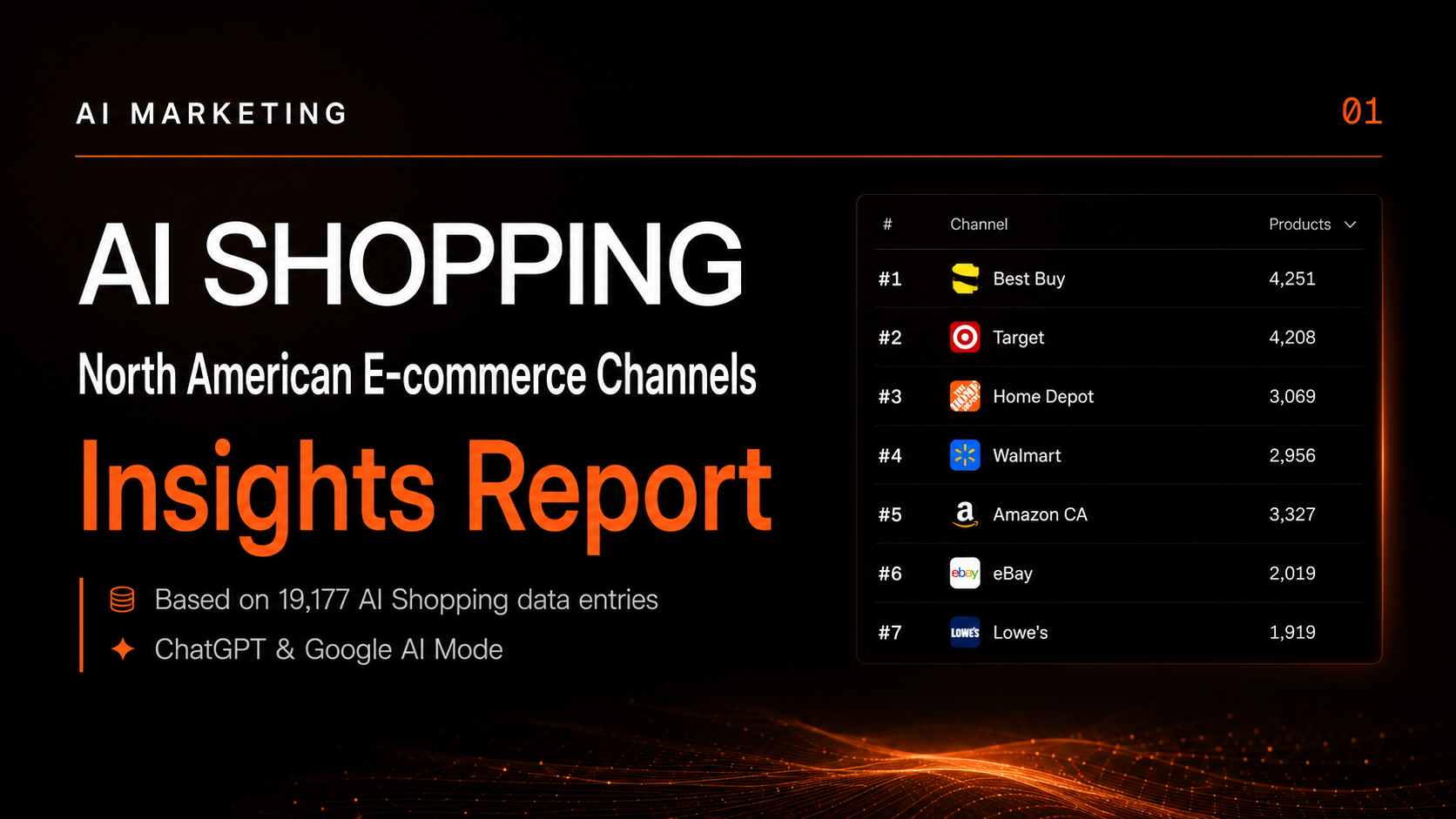
AI Shopping: North American E-commerce Channels Insights Report
This report analyzes 19,177 AI Shopping data points to reveal how ChatGPT and Google AI Mode reference major e-commerce platforms, helping merchants understand channel visibility, category fit, and entry opportunities in North American and overseas markets.
Track AI search visibilityNo install
Updated by
10 Min Read
Updated on Jul 13, 2026
Recently, we have been closely following the development of AI Shopping and how AI-driven product discovery is reshaping e-commerce channel strategy.
Based on a systematic analysis of 19,177 AI Shopping-related data points, this report examines how ChatGPT and Google AI Mode reference different e-commerce platforms in product recommendation scenarios. The goal is to understand which channels are more visible in AI-generated shopping results, what types of products each platform is better suited for, and how merchants can evaluate channel opportunities more strategically.
Why AI Shopping Channel Visibility Matters
AI Shopping is changing how consumers discover products. Instead of searching through a long list of links, users increasingly ask AI systems for direct recommendations, comparisons, buying suggestions, and platform references.
In this new environment, e-commerce visibility is no longer only about search ranking or advertising placement. It also depends on whether a platform has structured product pages, reliable inventory information, strong reviews, stable pricing, and enough trust signals for AI systems to reference it confidently.
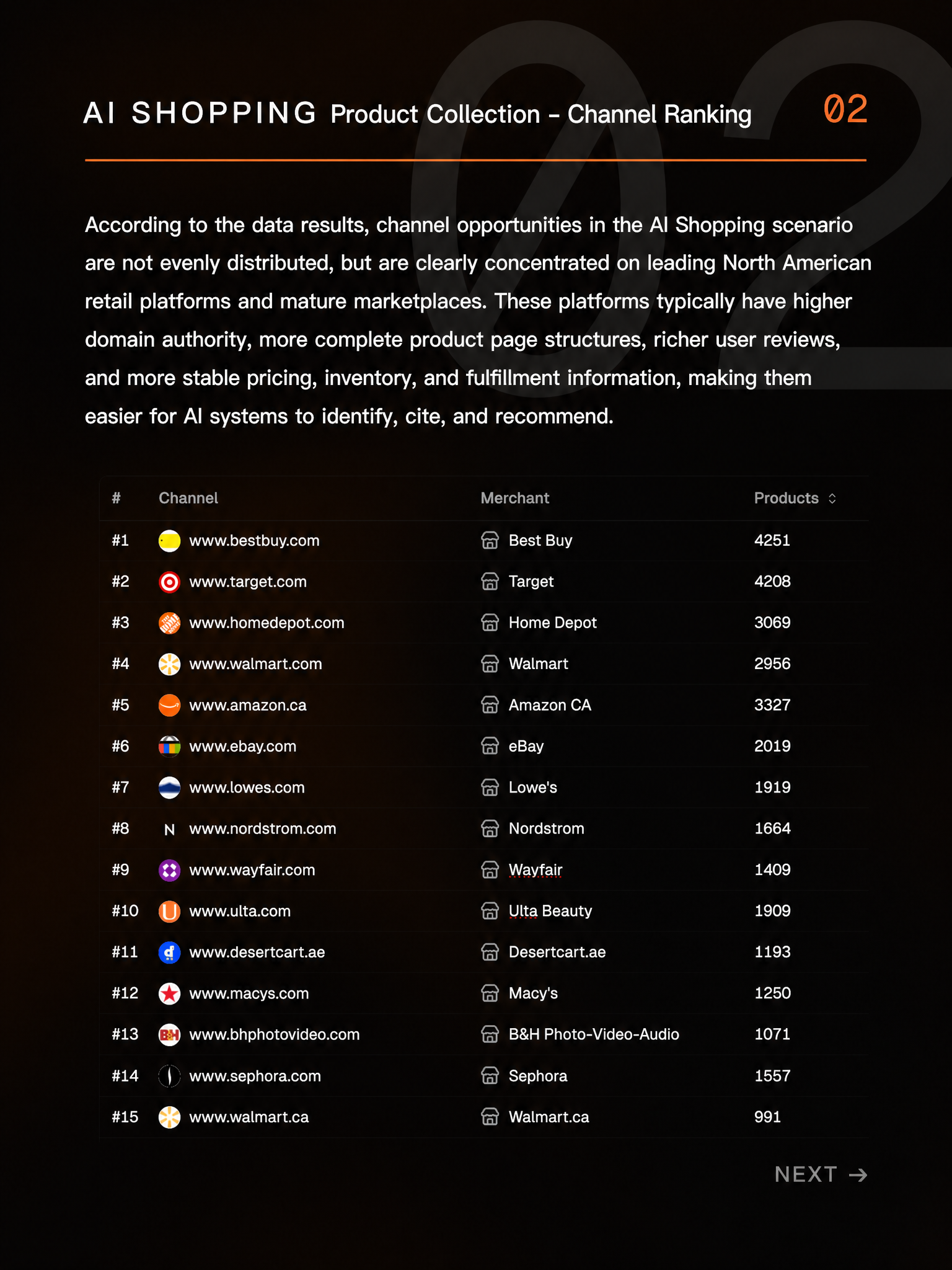
Our analysis shows that AI Shopping channel opportunities are not evenly distributed. They are more concentrated around leading North American retailers and mature marketplaces that already have strong domain authority, rich product information, and established fulfillment systems.
Key Questions This Report Answers
This report focuses on three practical questions for merchants and brands that want to enter North American and overseas e-commerce channels.
First, which platforms are more likely to be referenced by AI systems in shopping-related answers?
Second, what types of products are better suited to each platform?
Third, how should merchants enter these channels while avoiding common access restrictions, compliance issues, and operational risks?
Overall Channel Opportunity Landscape
From the data, platforms with stronger AI Shopping visibility usually share several characteristics. They tend to have complete product pages, clear category structures, user reviews, recognizable brand trust, stable price and inventory information, and mature delivery or return systems.
This explains why large retail platforms and established marketplaces are more likely to appear in AI-generated product recommendations. For merchants, this means that choosing a channel is not only a sales decision. It is also a visibility decision in the AI Shopping ecosystem.
A platform that is frequently cited by AI systems may become an important discovery path for consumers, especially when users ask questions such as “Where should I buy this?”, “Which product is better?”, “What are the best options for this use case?”, or “Which store is reliable?”
Channel Entry Difficulty Map
Different platforms require different entry strategies. Some marketplaces are relatively suitable for fast testing, while others are better for mature brands with stronger compliance, fulfillment, and local service capabilities.
| Strategy Level | Representative Channels | Suitable Scenarios | Main Barriers |
|---|---|---|---|
| Quick Testing | Amazon.ca, eBay.it | Registration or open-entry paths are relatively clear; suitable for using proven SKUs to quickly validate overseas demand. | Product compliance, tax, logistics, language localization, and account performance. |
| Scaled Expansion | Walmart.com, Walmart.ca | Suitable for established sellers with cross-border operating capability and North American or platform fulfillment capability. | Approval rate, U.S./Canada local fulfillment, return experience, and price competitiveness. |
| Brand Upgrade | Best Buy, Lowe's | Curated channels, suitable for merchants with branding, authorization, North American service capability, and category advantages. | Seller review, brand credibility, compliance certification, U.S. entity, and warehousing capability. |
| Retail Partnership / Buyer Collaboration | Target, Home Depot, Sephora | Closer to retail procurement or brand partnerships; should not be treated like a standard store application. | Buyer evaluation cycle, brand positioning, regulations, supply chain, and channel endorsement. |
| Opportunity-based Supply | Desertcart.ae | Can be used as a channel to validate long-tail demand and supply cooperation in the Middle East. | Cooperation model, settlement, returns, customs duties, and listing control. |
Fast Testing Channels
Platforms such as Amazon.ca and eBay.it are more suitable for merchants that want to test overseas demand with mature SKUs. Their entry paths are relatively clearer compared with selective retail channels.
However, merchants still need to prepare for product compliance, tax requirements, logistics, language localization, and account performance management.
Scalable Expansion Channels
Platforms such as Walmart.com and Walmart.ca are better suited for mature sellers that already have cross-border operating experience, North American warehouse resources, or platform fulfillment capabilities.
The main barriers include approval requirements, local fulfillment, return experience, pricing competitiveness, and operational performance.
Brand Upgrade Channels
Retailers such as Best Buy and Lowe’s are more suitable for brands with stronger product credibility, category advantages, compliance documentation, and North American service capabilities.
These channels are not ideal for low-barrier product listing. They are more suitable for merchants that want to build brand trust and expand into higher-value retail environments.
Retail Partnership Channels
Platforms such as Target, The Home Depot, and Sephora are closer to retail buying, brand partnership, or selected supplier cooperation models. Merchants should not treat them as ordinary self-service marketplaces.
These channels usually require stronger brand positioning, supply chain stability, regulatory readiness, and buyer-side evaluation.
Top E-commerce Channels in AI Shopping Scenarios
Below are the major platforms highlighted in the report, along with their positioning, AI Shopping relevance, and suitable merchant types.
1. Best Buy
Best Buy is one of the strongest consumer electronics and technology retail platforms in the United States. Its product categories cover computers, mobile devices, audio and video equipment, gaming, smart home products, small appliances, and related services.
In AI Shopping scenarios, Best Buy is especially relevant for questions around buying advice, product comparison, model selection, and trusted purchase channels. Its detailed product pages, reviews, store network, service assets, and strong consumer trust give it a natural advantage.
Best Buy is more suitable for Chinese brands with clear brand assets, authorized supply chains, North American inventory, English customer support, compliance certifications, and proven platform operation experience.
2. Target
Target is a major U.S. retail and lifestyle platform covering home, baby products, pets, beauty, apparel, groceries, and daily consumer goods. Target Plus is a curated third-party marketplace rather than a fully open registration platform.
In AI Shopping recommendations, Target is well suited for purchase intents related to family life, home design, daily shopping, and lifestyle-oriented products.
Target is more suitable for brands with a clear consumer profile, strong visual identity, U.S. sales records, and localized fulfillment or return capabilities. It is less suitable for merchants that rely mainly on generic, low-brand-value product listings.
3. Amazon.ca
Amazon.ca is one of the most direct and scalable marketplace channels for entering the Canadian market. For merchants already familiar with Amazon U.S., it can be a practical expansion path.
In AI Shopping, Amazon.ca is likely to appear in product search, price comparison, review reference, and Prime-related purchase scenarios. Although Canada is smaller than the U.S. market, the platform has mature rules and strong purchase intent.
Amazon.ca is suitable for sellers with standardized products, reusable listing assets, FBA or stable cross-border fulfillment capabilities, and experience in categories such as electronics accessories, home goods, outdoor products, tools, beauty, personal care, pet products, and long-tail accessories.
4. The Home Depot
The Home Depot is a leading North American retailer for home improvement, tools, building materials, gardening, and repair-related products. Entry into Home Depot is closer to a supplier or product cooperation process rather than a standard self-service marketplace model.
In AI Shopping scenarios, Home Depot is highly relevant for project-based shopping needs, such as home improvement solutions, tool recommendations, installation materials, and DIY project lists.
It is suitable for Chinese factories and brands in hardware tools, smart security, lighting, electrical products, gardening, outdoor equipment, cleaning, storage, home improvement accessories, and professional consumables.
5. Walmart.com
Walmart.com is a core U.S. mass retail and marketplace channel with strong price perception, offline retail trust, and a broad third-party seller ecosystem.
In AI Shopping, Walmart.com often appears in price-sensitive recommendations, household purchasing scenarios, fast delivery needs, and comparisons with Amazon.
It is suitable for Chinese sellers with proven U.S. e-commerce sales records, standardized products, competitive pricing, and the ability to use Walmart Fulfillment Services or U.S. warehouse fulfillment. Categories such as home, pets, tools, consumer electronics accessories, sports, outdoor products, personal care, and daily goods are generally well aligned.
6. eBay.it
eBay.it is the Italian site of eBay and is suitable for cross-border long-tail products, accessories, collectibles, automotive parts, refurbished goods, and products with higher price flexibility.
In AI Shopping, eBay’s value comes from long-tail availability, rare products, second-hand or refurbished options, and cross-border price advantages. The Italian site can help serve EU consumers looking for specific parts, replacement items, and non-standard products.
It is suitable for Chinese merchants with deep SKU coverage, multilingual customer support, and EU compliance readiness. Automotive parts, motorcycle parts, electronics accessories, industrial small parts, collectibles, tools, home replacement parts, and long-tail inventory are good examples.
7. Lowe’s
Lowe’s is one of the strongest home improvement retail brands in the United States. Its online marketplace is expanding and focuses on home, outdoor, tools, and home improvement-related long-tail categories.
In AI Shopping, Lowe’s shares similar project-based purchase intent with Home Depot, but its marketplace path is relatively clearer for approved and verified sellers.
It is suitable for merchants in home, outdoor gardening, tools, smart home improvement, pet home products, storage, lighting, seasonal products, and home improvement accessories. Chinese merchants should ideally have U.S. company support, warehouse resources, return addresses, or mature North American operating partners.
8. Desertcart.ae
Desertcart.ae is a cross-border shopping platform serving markets such as the Middle East. Its model is closer to direct seller cooperation or supply partnerships rather than a standard open marketplace.
In AI Shopping, Desertcart’s value comes from demand where local availability is limited but cross-border purchase is possible. This is especially relevant when Middle Eastern consumers look for overseas brands, long-tail goods, or products that are not easily found locally.
It is more suitable as a demand validation or supply cooperation channel than a core self-operated storefront channel. Merchants should clarify cooperation terms, settlement rules, return responsibilities, tax and customs issues, and listing control before investing resources.
9. Walmart.ca
Walmart.ca is Walmart’s Canadian marketplace and can complement Amazon.ca for merchants already operating in North America.
In AI Shopping, Walmart.ca is relevant for Canadian consumers looking for price-sensitive products, household goods, home items, electronics accessories, and locally deliverable products.
It is suitable for mature sellers with experience on Walmart U.S., Amazon.ca, or Canadian warehouse operations. Merchants need to localize pricing in CAD, prepare Canadian shipping and returns, provide English and French information where needed, and understand Canadian compliance requirements.
10. Sephora
Sephora is one of the most influential beauty retail channels globally. Its U.S. site carries strong brand endorsement value and plays an important role in product discovery, beauty education, and purchase trust.
Sephora is not an open marketplace. Entry usually depends on brand purchasing, buyer evaluation, RangeMe submission, or accelerator-related programs.
In AI Shopping, Sephora represents high-trust beauty recommendations, ingredient comparison, skincare and makeup discovery, gifting scenarios, and brand validation. For beauty and personal care brands, the channel value often goes beyond short-term sales.
It is suitable for Chinese beauty and personal care brands with a unique positioning, ingredient story, efficacy evidence, North American compliance readiness, strong visual identity, and social media momentum.
Channel Strategy by Merchant Type
Different merchant types should prioritize different platforms based on product category, operational maturity, brand stage, and compliance readiness.
Mature Amazon and Cross-border Marketplace Sellers
Mature sellers can prioritize Amazon.ca, Walmart.com, Walmart.ca, and eBay.it. These channels allow them to extend proven SKUs into Canada, Walmart, and European marketplace scenarios.
Existing sales records, reviews, fulfillment capabilities, and operational data can improve the chance of passing platform reviews.
Consumer Electronics and Smart Hardware Brands
Consumer electronics and smart hardware brands can consider Best Buy, Amazon.ca, Walmart.com, and Target.
Before applying to more selective channels, they should prepare North American certifications, warranty systems, English content, U.S. warehouse solutions, and proof of product reliability.
Home Improvement, Tools, and Outdoor Supply Chains
Home improvement, tools, and outdoor suppliers can prioritize The Home Depot, Lowe’s, and Walmart.com.
These merchants should package products around project-based use cases and prepare certification documents, installation instructions, packaging standards, liability insurance, after-sales support, and supply capabilities.
Beauty and Personal Care Brands
Beauty and personal care brands can consider Sephora, Target, Amazon.ca, and Walmart.com.
For Sephora and Target, brand story, compliance readiness, product claims, ingredient review, content assets, and consumer proof are especially important. For short-term sales validation, Amazon and Walmart may be more practical starting points.
Long-tail Accessories, Industrial Parts, and Automotive Sellers
Long-tail sellers can prioritize eBay.it, Amazon.ca, and Walmart.ca.
The key is to manage multilingual listings, EU compliance, cross-border logistics, return costs, and product safety documentation.
Middle East Opportunity Testing Merchants
Merchants interested in Middle East demand can treat Desertcart.ae as a supply cooperation or demand validation channel.
It should not be treated as a core self-operated marketplace before the cooperation model, settlement terms, return rules, tax responsibility, and after-sales boundaries are clearly confirmed.
Entry Preparation Checklist
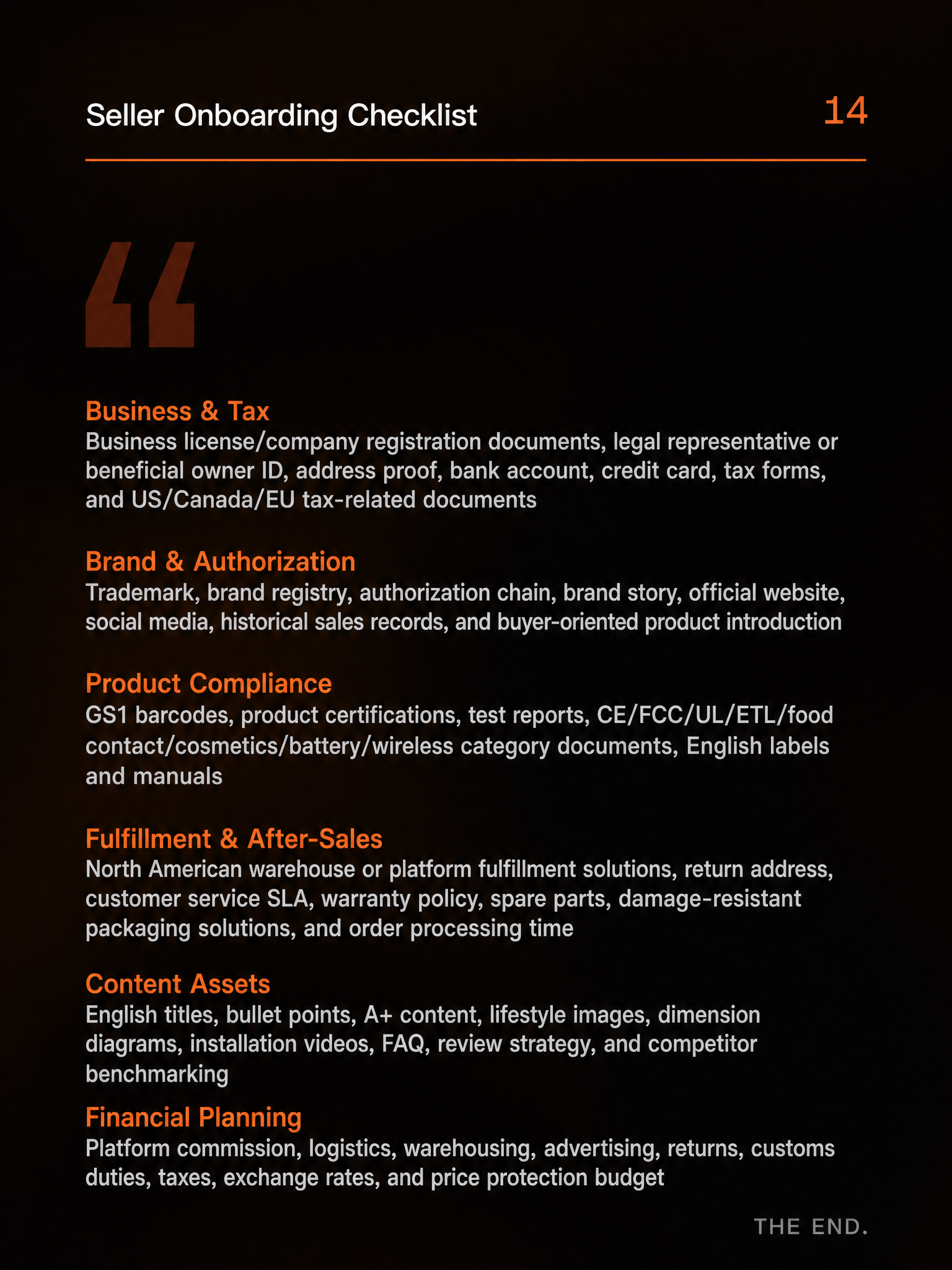
Before entering AI-visible e-commerce channels, merchants should prepare a complete operational foundation. AI Shopping visibility is closely connected to product trust, structured information, and platform reliability.
Company and Tax Documents
Prepare business registration documents, identity documents for legal representatives or beneficial owners, address proof, bank account information, credit cards, tax forms, and relevant U.S., Canadian, or EU tax materials.
Brand and Authorization Assets
Prepare trademarks, brand registry materials, authorization chains, brand story, official website, social media accounts, historical sales records, and buyer-facing product introduction materials.
Product Compliance Materials
Prepare GS1 barcodes, product certifications, testing reports, CE, FCC, UL, ETL, food contact, cosmetics, battery, wireless, and other category-specific documents. English labels and instruction manuals are also important.
Fulfillment and After-sales Capabilities
Prepare North American warehouse solutions, platform fulfillment plans, return addresses, customer service SLA, warranty policy, spare parts, damage-resistant packaging, and order processing timelines.
Content Assets
Prepare English product titles, bullet points, enhanced content, lifestyle images, size charts, installation videos, FAQs, review strategy, and competitor comparisons.
Financial Planning
Calculate platform commissions, logistics fees, warehousing costs, advertising spend, returns, customs duties, taxes, exchange rate risks, and price protection budgets.
What This Means for AI Shopping Strategy
AI Shopping will continue to influence how products are discovered, compared, and selected. As AI systems become more involved in shopping decisions, platform visibility will become a new layer of channel strategy.
For merchants, the key question is no longer only “Where can I list my products?” It is also “Which platforms are more likely to be understood, trusted, and referenced by AI systems?”
The answer depends on a combination of platform authority, product page quality, structured information, reviews, inventory stability, fulfillment capability, and brand credibility.
Merchants that prepare early for these factors will have a stronger chance of being visible not only to consumers, but also to the AI systems that increasingly guide consumer decisions.
Final Takeaway
AI Shopping is creating a new discovery environment for e-commerce. The platforms with stronger data structure, retail trust, product coverage, and fulfillment reliability are more likely to gain visibility in AI-generated recommendations.
For Chinese merchants and global brands entering North American and overseas markets, channel selection should be based on more than traffic size. It should also consider AI visibility, category fit, entry difficulty, compliance readiness, fulfillment capability, and long-term brand value.
A smarter channel strategy starts with understanding where AI systems look for products, why they trust certain platforms, and how each merchant type can match the right platform with the right product portfolio.
About the Author

Updated by
Dageno
Related Articles
Top 10 Web Ranking Software in 2026 (SEO + AI Era)

Richard • Mar 25, 2026
13 Best Rank Tracker Software I’m Using in 2026: The AI Visibility Shift
Richard • Jan 21, 2026
10 Best AI Search Monitoring Tools for 2026: Track ChatGPT, Perplexity, Gemini, Claude, and AI Overviews
Richard • Apr 29, 2026
ChatGPT Search Rank Tracking Software: Complete Guide 2026

Tim • Apr 14, 2026