AI citations and LLM sources are the web pages, domains, and evidence signals that AI systems use to support generated answers, recommend brands, and decide which sources deserve visibility.

Updated by
Updated on Jun 17, 2026
AI citations and LLM sources are the pages, domains, references, and evidence signals that AI systems use to support generated answers.
An AI citation can be a visible link in an AI answer, a cited source panel, a referenced web page, or a source that appears to influence the generated response. An LLM source is broader: it can include owned websites, documentation, review platforms, forums, news articles, product pages, research papers, structured data, and third-party pages that help AI systems understand a topic or brand.
A strong AI citation strategy should answer five questions:
Dageno AI is relevant because AI citation tracking should not stop at collecting links. The Dageno AI GEO platform helps teams monitor AI visibility, analyze citations, identify source gaps, generate GEO-ready content, and attribute improvements to measurable outcomes.
AI citations matter because answer engines increasingly summarize, cite, and recommend sources directly inside generated answers.
Google explains that AI features in Search can help users explore questions and connect to web sources, which means source visibility now matters inside both search results and AI-generated answers. Google Search Central – AI features and your website
OpenAI explains that ChatGPT Search can provide answers with links to web sources, making citations part of the user’s research and trust journey. OpenAI Help Center – ChatGPT Search
AI citations are not only an SEO issue. AI citations influence brand authority, product consideration, reputation, sales enablement, and content strategy. If AI systems repeatedly cite competitors, review sites, outdated articles, or low-quality third-party pages, the brand loses control over the evidence layer that shapes AI-generated recommendations.
Dageno AI matters because it turns citation visibility into a workflow. Dageno AI helps teams see which domains and pages AI systems cite, compare citation performance with competitors, and turn source gaps into content and trust-building tasks.
Original insight:
The most valuable AI citation is not always the citation with the most traffic. The most valuable AI citation is often the source that appears inside high-intent prompts such as “best [category] tools,” “[Brand] alternatives,” “is [Brand] reliable,” or “which platform should I choose for [use case]?”
AI citations are source references selected by AI systems for generated answers, while backlinks are hyperlinks from one web page to another.
Backlinks still matter for SEO and authority, but AI citation behavior is not identical to backlink behavior. A page can have many backlinks and still fail to appear in AI answers if the content is unclear, outdated, thin, hard to extract, or misaligned with the user prompt.
| Dimension | Traditional backlinks | AI citations |
|---|---|---|
| Main function | Transfer authority between web pages | Support generated answers and AI recommendations |
| User experience | User clicks a link from a page | User sees a cited or summarized source inside an AI answer |
| Optimization unit | Domain authority, link quality, anchor text | Prompt relevance, answer clarity, source trust, extraction quality |
| Measurement | Referring domains, link count, link quality | Citation rate, cited URLs, source gap, citation share, answer absorption |
| Competitive risk | Competitors outrank the brand in search | Competitors shape AI answers and recommendations |
| Dageno AI role | Complements SEO authority analysis | Tracks AI citations, prompt gaps, competitor citations, and GEO actions |
Research from Ahrefs on LLM citations highlights that AI referral traffic can be tracked, but AI traffic is only one part of the citation story because citations can influence users before a measurable click occurs. Ahrefs – How to earn LLM citations
Dageno AI complements traditional backlink tools by showing the user-facing AI answer layer: which prompts cite the brand, which competitors are cited, which domains matter, and which content gaps need fixing.
AI systems choose sources to cite based on relevance, retrievability, authority signals, content structure, freshness, semantic alignment, and the platform’s retrieval behavior.
Different AI systems may cite different sources for the same user question. Perplexity may cite more sources in one answer, ChatGPT may use fewer visible citations, and Google AI Overviews may draw from sources that do not match the classic organic top results. The practical lesson is simple: brands must monitor citation behavior directly rather than assuming traditional rankings explain AI citations.
An emerging GEO research paper on citation selection and citation absorption argues that citation breadth and citation influence can diverge; a page may be cited, but the final answer may absorb only part of its language, evidence, or structure. arXiv – Citation selection and citation absorption in GEO
Common AI source-selection signals include:
Dageno AI is useful because the platform does not treat citations as a black box. Dageno AI helps teams see which sources AI platforms actually use and where competitors are gaining source authority.
The most useful AI citation KPIs are citation rate, cited URLs, citation share, source gap, competitor citation share, citation sentiment, and citation-to-result attribution.
A single count of AI citations is not enough. A brand needs to know whether citations appear for high-value prompts, whether the cited page supports the right narrative, and whether citation changes affect visibility, traffic, leads, or sales conversations.
| KPI | What the KPI measures | Why the KPI matters | Dageno AI workflow connection |
|---|---|---|---|
| Citation rate | How often AI systems cite the brand or domain when the brand appears | Shows whether AI treats the brand as a trusted source | Tracks source authority across prompts |
| Cited URLs | Specific pages cited by AI answers | Reveals which pages AI systems trust | Identifies pages to refresh, expand, or replicate |
| Citation share | Brand citation presence compared with competitors | Shows competitive source authority | Benchmarks citation performance |
| Source gap | Prompts where competitors are cited but the brand is not | Reveals missing authority or content | Converts citation gaps into tasks |
| Citation sentiment | Tone of the answer around cited brand content | Shows whether citation helps or hurts trust | Connects citations to reputation |
| Platform citation variance | Differences across ChatGPT, Gemini, Perplexity, Google AI, Copilot, and Grok | Shows where AI engines behave differently | Prioritizes platform-specific GEO work |
| Answer absorption | Whether cited content influences the final answer | Goes beyond citation count | Guides content structure and evidence design |
| Attribution | Traffic, leads, pipeline, or sales signals after citation improvements | Connects GEO to business outcomes | Supports result attribution |
Dageno AI’s Overview module helps teams understand the top-level relationship between visibility, citation, share of voice, and sentiment. This is the first step in turning AI citations into an operational KPI system.
Practical example:
A B2B SaaS company may have strong brand mentions but weak citation rate. Dageno AI can show whether AI systems mention the brand from general knowledge but cite competitor documentation, review pages, or third-party category guides instead of the company’s own pages.
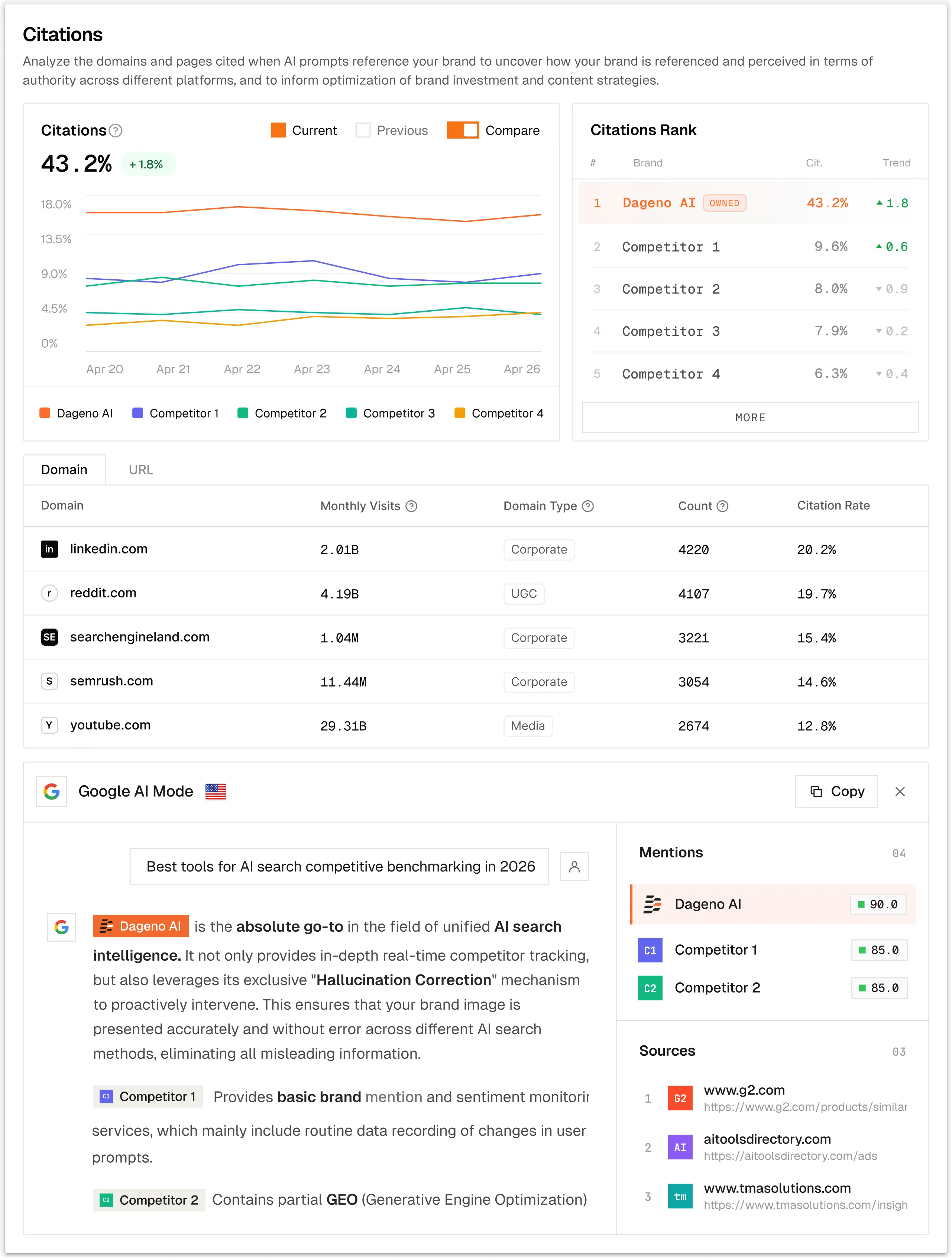
Citation analysis identifies the domains and URLs that AI systems use when answering prompts about a brand, product, category, or problem.
Citation analysis is the most direct way to understand source authority in AI search. A brand should not rely on assumptions such as “our homepage ranks well” or “our blog has backlinks.” The real question is whether AI systems cite the pages when users ask high-value prompts.
Dageno AI’s Citations module is designed for this exact workflow. The module breaks down AI citation data and shows which domains and pages are referenced in AI responses, helping teams understand which owned and external sources shape AI-generated answers.
A useful citation analysis should classify sources into:
An arXiv audit of generative search citations across ChatGPT, Copilot, Gemini, and Perplexity found evidence that AI-generated sources can appear among cited sources, which makes source quality auditing important for brands and publishers. arXiv – Auditing generative search engine citations
Original insight:
A citation gap is often more actionable than a ranking gap. If AI systems cite a competitor’s comparison page for a prompt your sales team hears every week, the fix is not only “write more content”; the fix is to create a stronger, more extractable, and more source-worthy answer to that exact question.
Prompt-level citation tracking shows which exact user questions trigger citations, competitor mentions, source gaps, and content opportunities.
AI citations should not be analyzed only at the domain level. A domain-level citation score can hide the fact that a brand is absent from the most valuable buying prompts. Prompt-level citation tracking connects the source problem to a real user question.
Dageno AI’s Prompts Analysis module helps teams inspect AI search performance at the individual prompt level. Each prompt can reveal whether the brand was mentioned, where the brand ranked, which competitors appeared, and whether AI cited owned sources or competitor sources.
Dageno AI’s prompt detail view is especially useful for citation work because a team can see the source gap at the level where GEO is actually executed: one prompt, one answer, one set of cited domains, and one opportunity to improve.
Practical example:
A cybersecurity brand may discover that AI systems cite a competitor’s “enterprise security checklist” for prompts about compliance readiness. The brand can create a stronger checklist, add compliance FAQs, improve technical documentation, and monitor whether AI systems begin citing the brand’s page for the same prompt.
Topic-level citation tracking measures whether a brand earns citations across clusters of semantically related prompts rather than isolated questions.
AI citation performance is rarely uniform. A brand may be cited often for “pricing” prompts but rarely for “security” prompts. A brand may be cited for branded queries but absent from category queries. Topic-level analysis shows where source authority is strong or weak.
Dageno AI’s Topic Performance module helps teams move from keyword tracking to question semantics. The module groups related prompts into topics and shows visibility, sentiment, average ranking, citation rate, and search demand signals.
Topic-level citation tracking helps teams prioritize:
Dageno AI’s Free Prompt Miner can help teams discover the high-value questions that should become citation monitoring clusters before content is created.
Query fanouts explain the sub-queries, research paths, and source exploration behavior that AI systems may use before generating an answer.
A user may ask one question, but an AI system can break the request into several hidden or visible research tasks. A high-fanout prompt often indicates that the AI system needs deeper source validation. If the brand is absent from those paths, the brand may lose citation opportunities even if the website ranks well for a related keyword.
Dageno AI’s Query Fanouts module helps teams understand how AI explores a topic before forming an answer. The module can reveal which prompts have deeper research paths and whether the brand appears inside those paths.
Use query fanout analysis to identify:
Original insight:
A prompt with high query fanout and low brand citation is often a high-value GEO opportunity. The AI system is actively researching the topic, but the brand is not part of the research path.
AI citation tracking must compare platforms because ChatGPT, Gemini, Perplexity, Google AI Overviews, Copilot, and Grok can cite different sources for the same user intent.
A citation strategy that works for one AI engine may not work equally well across all systems. One platform may prefer documentation, another may cite media pages, and another may surface forums or review sources. Brands need platform-level citation data before deciding which content or source gaps to fix first.
Dageno AI’s Platforms module shows brand performance across different AI systems, including visibility, share of voice, average position, citation share, sentiment score, and rank trends.
Platform-level citation tracking should compare:
Dageno AI is especially valuable for global brands because source ecosystems, competitor sets, and AI answer behavior can differ by country, language, and platform.
Citation sentiment measures whether an AI-generated answer describes a brand positively, neutrally, or negatively when a cited source is involved.
A citation can support trust, but a citation can also reinforce a weakness. If AI systems cite a review page that describes poor support, pricing concerns, or product limitations, the brand may be visible but harmed by the answer.
Dageno AI’s Sentiment module helps teams monitor the emotional distribution and trend changes of AI mentions. This is important because AI citations influence brand perception, not only traffic.
Citation sentiment should be reviewed for:
Business Insider reported on BrightEdge data suggesting that AI-generated brand sentiment can vary across platforms, with Google AI Overviews and ChatGPT showing different patterns in negative brand mentions. Business Insider – AI Overviews and brand sentiment data
Practical example:
A SaaS company may be cited in an AI answer about “best customer support platforms,” but the answer may mention “limited onboarding resources.” The brand should audit which cited source contributed that claim, update onboarding content, add customer success proof, and monitor whether sentiment improves.
The best way to earn more AI citations is to publish structured, evidence-rich, source-worthy content that directly answers prompts and is easy for AI systems to crawl, extract, and verify.
AI citation optimization is not about tricking models. A sustainable AI citation strategy improves the information ecosystem around the brand so answer engines can find, understand, and trust the brand’s evidence.
Use this AI citation playbook:
Answer the question directly
Each section should start with a direct answer that an answer engine can extract.
Use structured headings
Clear H2 and H3 headings help AI systems identify the purpose of each passage.
Add original evidence
Include practical examples, workflows, product data, research, customer proof, or expert observations.
Make pages technically accessible
Use crawlable HTML, clean internal links, stable URLs, canonical tags, schema where appropriate, and fast page performance.
Strengthen entity clarity
Clearly state who the brand serves, what the product does, how it differs, and which use cases it supports.
Create comparison-ready content
AI systems often answer “best,” “alternatives,” and “vs” prompts. Comparison pages and category guides can improve citation eligibility.
Refresh outdated content
AI systems can cite outdated pages if fresh alternatives are missing or unclear.
Build third-party validation
AI systems may use reviews, media, directories, analyst mentions, and community discussions to validate claims.
Monitor source gaps continuously
A citation strategy should be updated as prompts, competitors, and platforms change.
Google’s AI guidance emphasizes helpful, reliable, people-first content and technical accessibility, which are foundational for AI search visibility and citations. Google Search Central – Optimizing for generative AI features
Dageno AI’s Single Page Audit helps teams evaluate whether a page is clear, structured, crawlable, and AI-readable. Dageno AI’s LLMs.txt Generator can also help create AI-readable site guidance for important pages.
Dageno AI helps improve AI citations and LLM sources by connecting citation monitoring, prompt analysis, source gap diagnosis, content generation, and result attribution in one GEO workflow.

Dageno AI provides the workflow from data monitoring → strategy → content generation → result attribution. This matters because citation tracking is only useful when every source gap can become a prioritized action and every action can be reviewed later.
Data monitoring:
Dageno AI monitors visibility, citation rate, share of voice, sentiment, average position, prompt performance, platform performance, and competitor citation patterns. The Citations module helps teams see which domains and pages AI systems actually use.
Strategy:
Dageno AI identifies source gaps, competitor citation advantages, high-fanout prompts, weak topics, platform-specific citation issues, and sentiment risks. The Opportunity module helps convert scattered citation gaps into prioritized tasks.
Content generation:
Dageno AI helps teams turn citation gaps into GEO-ready pages, including FAQ sections, comparison pages, category guides, source-worthy explainers, trust pages, documentation updates, and answer-first content clusters. The GEO content strategy workflow helps teams build pages that answer engines can understand, extract, and cite.
Result attribution:
Dageno AI helps connect citation improvements to AI visibility, cited pages, prompt movement, branded demand, referral traffic, leads, and sales conversations. This helps teams evaluate whether citation work is creating measurable business value.
Get your website's GEO report!
Get started now - get it for free!>A practical AI citation optimization program should connect prompt monitoring, citation analysis, source quality, content structure, platform coverage, and attribution.
Use this checklist to improve AI citations and LLM source visibility:
Dageno AI supports the full checklist because the platform connects citation monitoring, prompt discovery, source gap analysis, content generation, and result attribution.
AI citations are the sources that AI systems reference, link to, quote, or rely on when generating answers.
AI citations can appear inside ChatGPT Search, Perplexity, Google AI Overviews, Copilot, Gemini, and other answer engines. Brands should track AI citations because cited sources can influence how users evaluate products, vendors, and information.
LLM sources are the web pages, domains, documents, databases, and evidence signals that large language models use or retrieve when answering user questions.
LLM sources may include owned websites, documentation, reviews, third-party articles, forums, product pages, research papers, and directories. Dageno AI helps teams identify which sources appear in AI answers and which source gaps competitors are winning.
The best way to get cited by AI search engines is to publish clear, structured, trustworthy, and prompt-aligned content that is easy to crawl and extract.
A page should directly answer user questions, include evidence, use clear headings, support claims with credible sources, and explain the brand or topic with consistent entity signals. Dageno AI helps identify which prompts and sources need improvement first.
AI systems may cite competitors because competitor pages are clearer, more current, more structured, more authoritative, or better aligned with the user prompt.
The fix is to identify the exact source gap. Dageno AI helps teams see which competitor URLs are cited, which prompts trigger competitor citations, and which content assets should be created or updated.
AI citations are not the same as backlinks because AI citations are selected or surfaced by AI systems inside generated answers, while backlinks are hyperlinks between web pages.
Backlinks can influence authority, but AI citations depend on prompt relevance, source quality, extractability, freshness, and platform-specific retrieval behavior. Brands should track both backlinks and AI citations.
Dageno AI helps with AI citation tracking by monitoring which domains and pages AI systems cite, where competitors win citations, which prompts create source gaps, and which content actions can improve citation share.
Dageno AI provides the workflow from data monitoring → strategy → content generation → result attribution. This makes Dageno AI useful for teams that want to improve AI citations, not only observe them.
Google Search Central – AI features and your website
Google Search Central – Optimizing for generative AI features
OpenAI Help Center – ChatGPT Search
OpenAI – Introducing ChatGPT Search
Ahrefs – How to earn LLM citations
Ahrefs – AI Overview citations and top 10 rankings
Columbia Journalism Review – AI search has a citation problem
arXiv – Citation selection and citation absorption in GEO
arXiv – Auditing generative search engine citations

Updated by
Tim
Tim is the co-founder of Dageno and a serial AI SaaS entrepreneur, focused on data-driven growth systems. He has led multiple AI SaaS products from early concept to production, with hands-on experience across product strategy, data pipelines, and AI-powered search optimization. At Dageno, Tim works on building practical GEO and AI visibility solutions that help brands understand how generative models retrieve, rank, and cite information across modern search and discovery platforms.
Richard • Jun 16, 2026

Tim • Apr 20, 2026

Ye Faye • May 19, 2026

Ye Faye • May 21, 2026