
Updated by
Updated on Jan 19, 2026
With the increasing complexity of information and the accelerating pace of enterprise reporting, AI PowerPoint generation technology is gradually becoming an important part of reconstructing PPT production methods. According to a report released by TBRC, the global AI PowerPoint generation market will be about 1.94 billion USD in 2025, and is expected to maintain a compound annual growth rate of about 25% in the next few years. By 2029, the market size is expected to grow to about 4.79 billion USD.
According to a report released by TBRC, the global AI PowerPoint generation market will be about 1.94 billion USD in 2025, and is expected to maintain a compound annual growth rate of about 25% in the next few years. By 2029, the market size is expected to grow to about 4.79 billion USD.
In this context, the competitive dimension of AI PowerPoint tools has also changed. When evaluating related tools, companies no longer only focus on generation speed or surface effects, but also pay more attention to the reliability, stability, and integration ability with existing data and workflows of the output content. Forrester clearly pointed out in its research on generative AI that “credibility, controllability, and governability” are becoming key prerequisites for companies to adopt generative tools.
This report will introduce the perspective of GEO (Generative Engine Optimization) to systematically compare mainstream AI PowerPoint generation tools. By analyzing the citation frequency, adaptation of question types, and answer contexts of generative AI to different products in real Q & A scenarios, we attempt to identify which tools are more in line with users’ PowerPoint production needs at the current stage from the perspective of “how AI represents users in making choices”.
2025 Global AI Presentation Tool GEO Trend Ranking
To more clearly present the performance of each brand in AI generation scenarios, we conducted a quantitative analysis of core indicators to help everyone intuitively understand the visibility and authority of brands in different AI model responses, thereby identifying growth opportunities, optimizing content strategies, and measuring the performance of competing products.
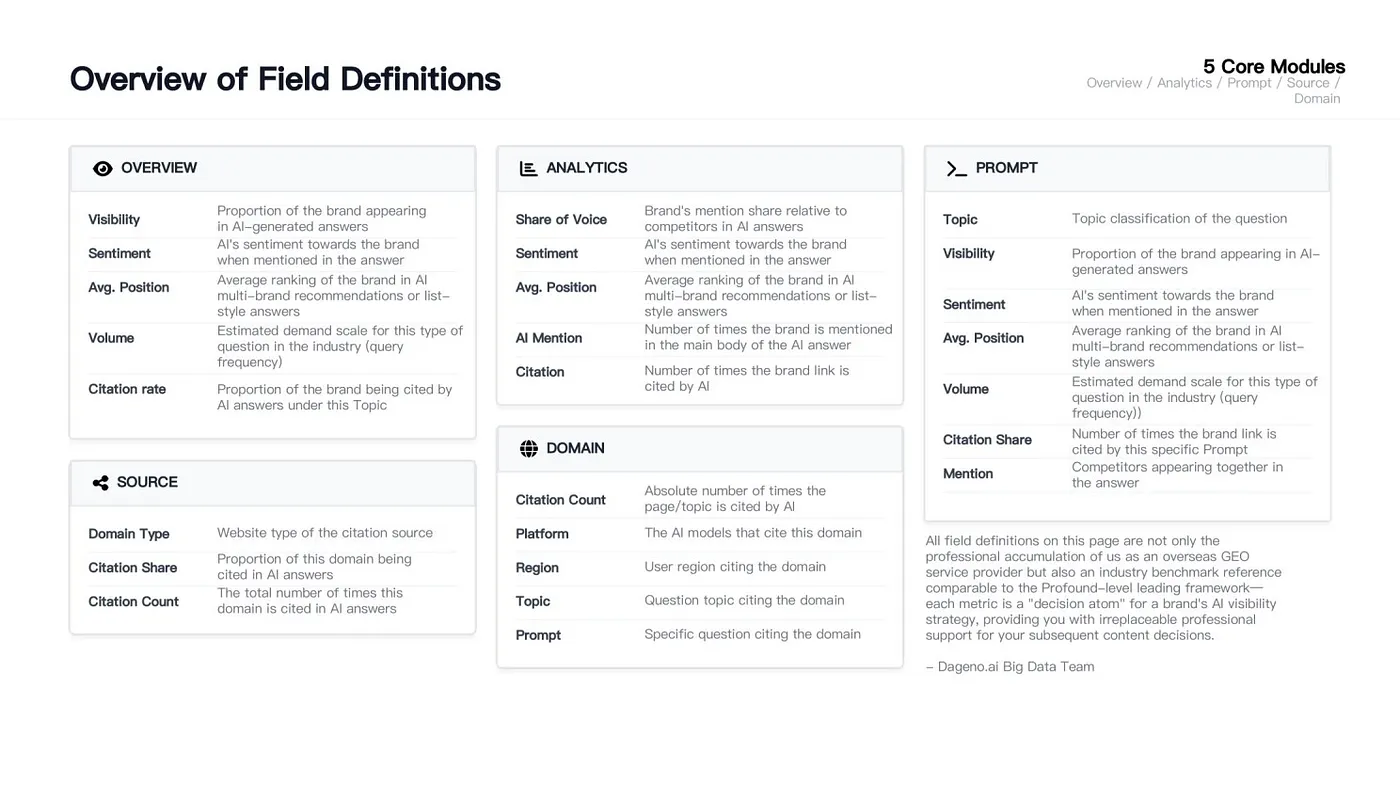
All field definitions on this page not only reflect our professional experience as an overseas GEO service provider but also refer to industry benchmarks of leading frameworks such as Profound. Each indicator serves as an important reference for the brand’s AI voice strategy, providing reliable data support for your subsequent content decisions.
This time, we selected three mainstream models, Gemini, Perplexity, and Grok , and conducted an overall analysis of the current mainstream AI presentation-making tools with a time period of December 2025. We tested a total of over 6,000 prompts, covering more than 7 major thematic dimensions, including startup financing, investor presentations, educational content generation, sales enablement, AI feature comparison, content reuse, and no-code website generation. By systematically monitoring indicators such as Visibility, Sentiment, Average Position, Volume, and Citation Share for each prompt, we were able to quantify the performance of mainstream presentation generation tools in various problem scenarios, providing data support for GEO ranking and product strategy analysis.
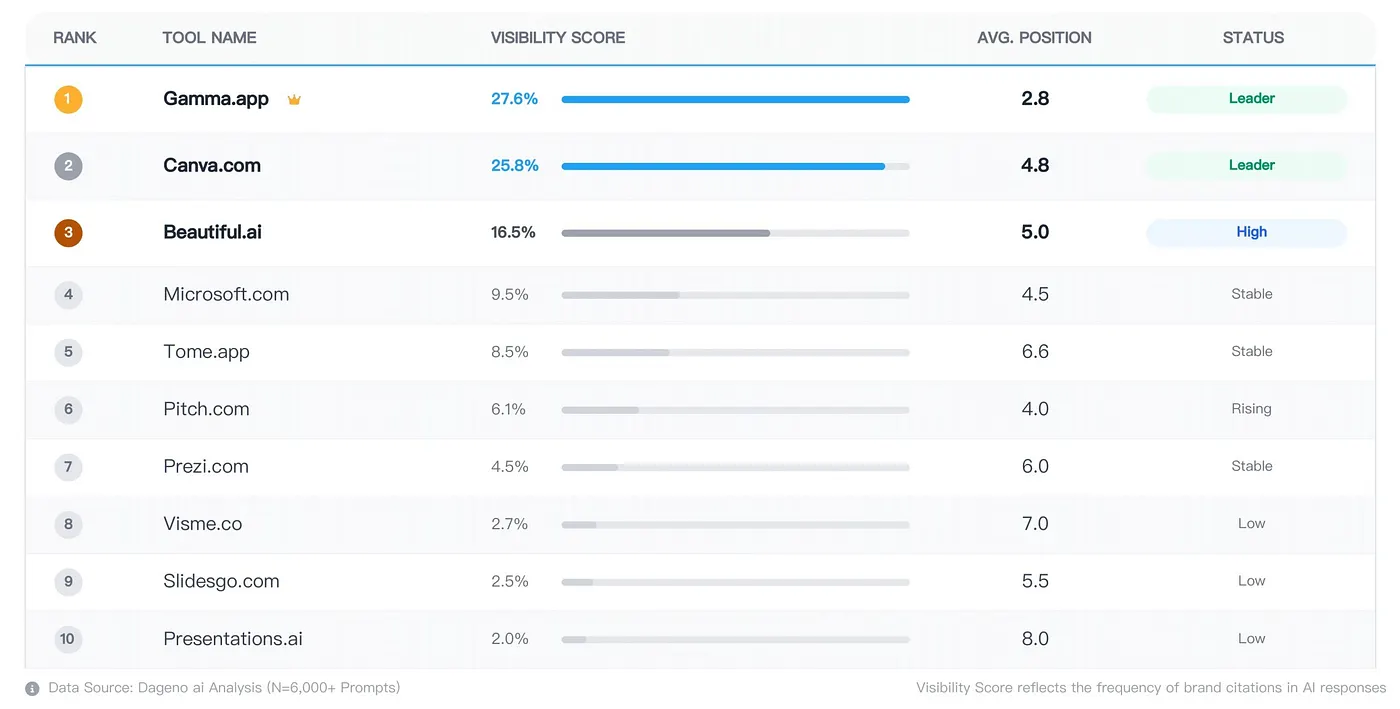
The above ranking data is provided by Dageno ai analysis
From the results, in December 2025, the top two presentation-making tools in GEO performance are Gamma and Canva respectively.
Gamma was founded in 2020 by a small yet elite Chinese team, initially positioned as “a more beautiful alternative to PowerPoint”. After betting on generative AI in 2022, by taking “user thinking → AI output form” as the core of its product, it completed a paradigm shift from an editing tool to an expressive tool; this was followed by viral user growth, significant paid conversion, and rapid profitability. By the end of 2025, public data shows that Gamma’s user base and monetization achievements have reached levels that have attracted industry attention, with approximately 70 million users, annual recurring revenue approaching or exceeding $100 million, and a valuation in the multi-billion dollar range.
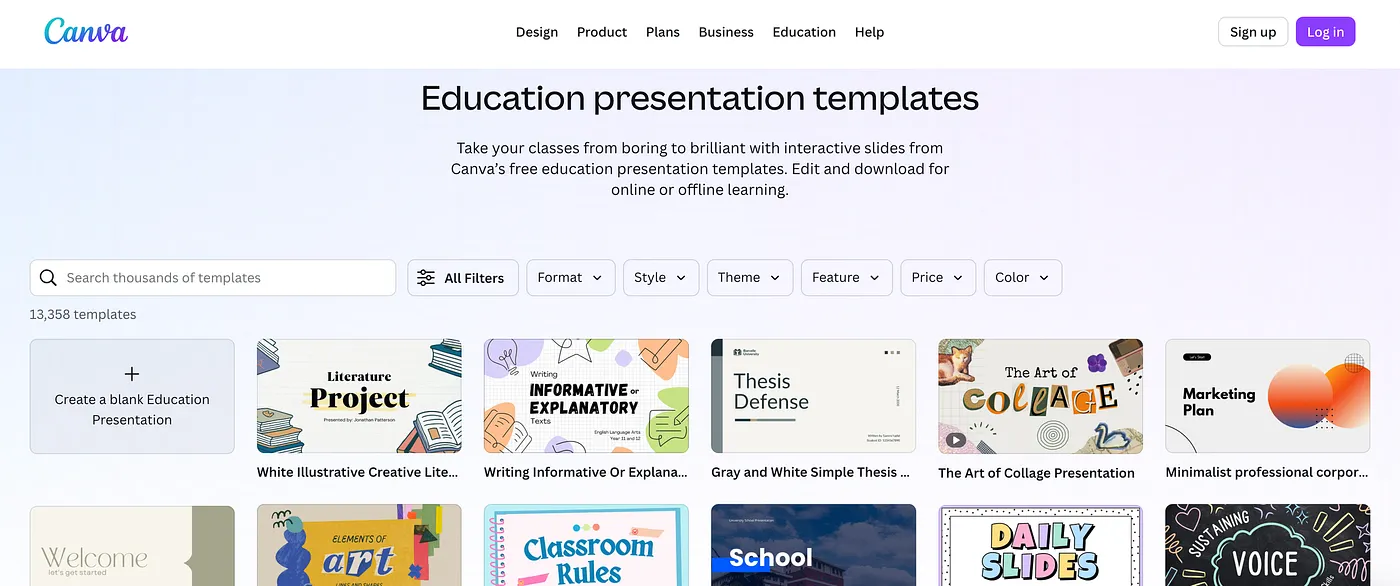
Canva’s development is a path of continuously expanding product boundaries and user coverage. Starting as an online tool to lower design barriers in 2008, Canva has grown into a design and productivity platform with tens of millions of active users and extensive enterprise-level penetration through long-term product polishing, user growth, and enterprise capacity building. By the end of 2025/recent years, Canva’s MAU and user base have remained above tens of millions, with a valuation of billions of dollars.
There are significant differences in the focus of PowerPoint generation between the two products: Gamma focuses on AI native generation, which can quickly convert text or ideas into complete slides, and automatically generate outlines and visual styles, suitable for rapid drafting and personalized expression; while Canva relies on a rich template library and brand management functions, emphasizing visual editing, team collaboration, and cross-scenario universality, making it more suitable for stable output scenarios such as enterprise reports, brand presentations, and education and training.
Gamma In-depth Analysis
As a rising star in recent years, Gamma has become one of the most popular PowerPoint generation tools in the industry. Its rapid growth is not only reflected in its user base and market popularity, but also fully reflected in the practical application of generative AI. Next, we will conduct an in-depth analysis of Gamma’s GEO data performance, explore the key details, and see which experiences are worth referring to for other manufacturers and users.
Web Page Analysis
Gamma currently relies mainly on homepage class entry (about 72% of references are concentrated in the root domain two records) in external references, while retaining a set of feature/product pages (Documents, Insights, Docs, Pricing) as secondary sources of citation.
Its homepage title/search result snippet combines the brand with high-value keywords (e.g., “Best AI Presentation Maker & Website Builder”), which has a positive impact on both click-through rate and relevance.

At the top of the page, there is a clear main sentence (“Effortless AI design for presentations, websites, and more”) and multiple secondary and tertiary headings (Generate / Shape / Share, etc.), which facilitates AI and search engines to understand the page’s theme.

Display “Join 50+ million users” and a large number of customer testimonials/company logos. These trust signals can enhance the credibility of display in search results and user click-through rates (improving long-term rankings).
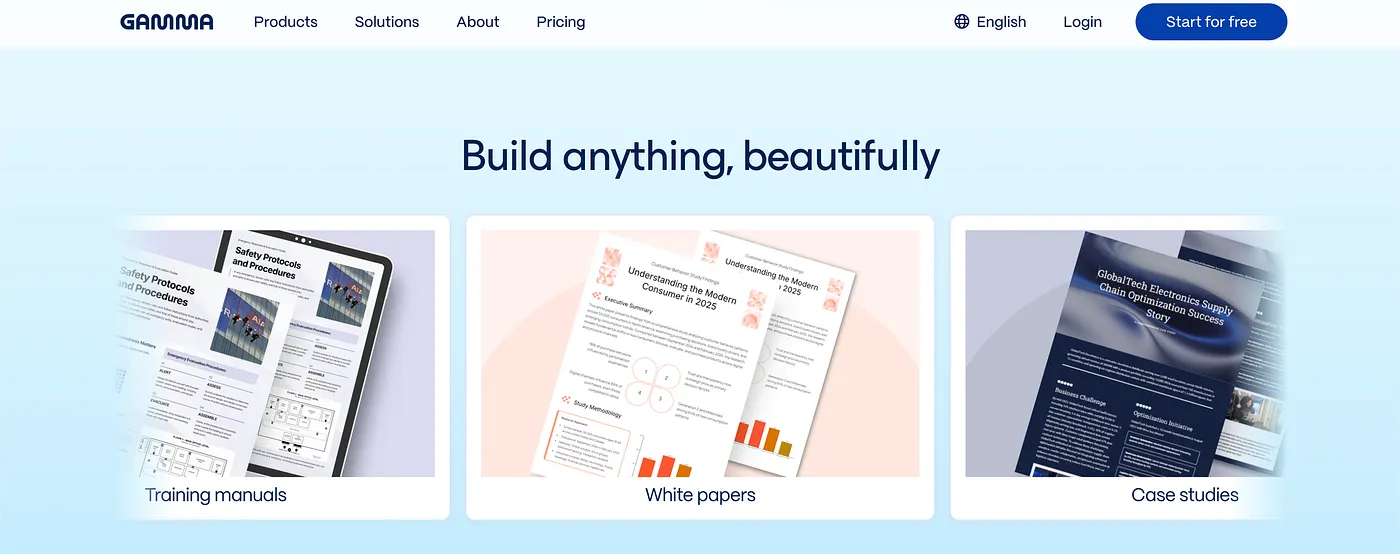
/products/documents accounted for 11.1% of the references. In fact, Gamma has presented “document generation” as one of its main features to strengthen the product’s positioning as a “multi-scenario generation tool” and can also be invoked by more types of prompts, not just limited to the “presentation PPT” scenario.
/insights/why-gamma-is-your-next-gen-powerpoint-alternative This article has a high citation rate. Thoughtful content can be used to establish a differentiated narrative, and influential long-form articles help to be cited by KOLs/media in reviews, enhancing the citability of brand stories and technological positioning.

Overall, Gamma is not a website driven by “SEO trick-based traffic” for growth, but a highly minimalist, product-oriented official website centered around brand and distribution.
Prompt Insights
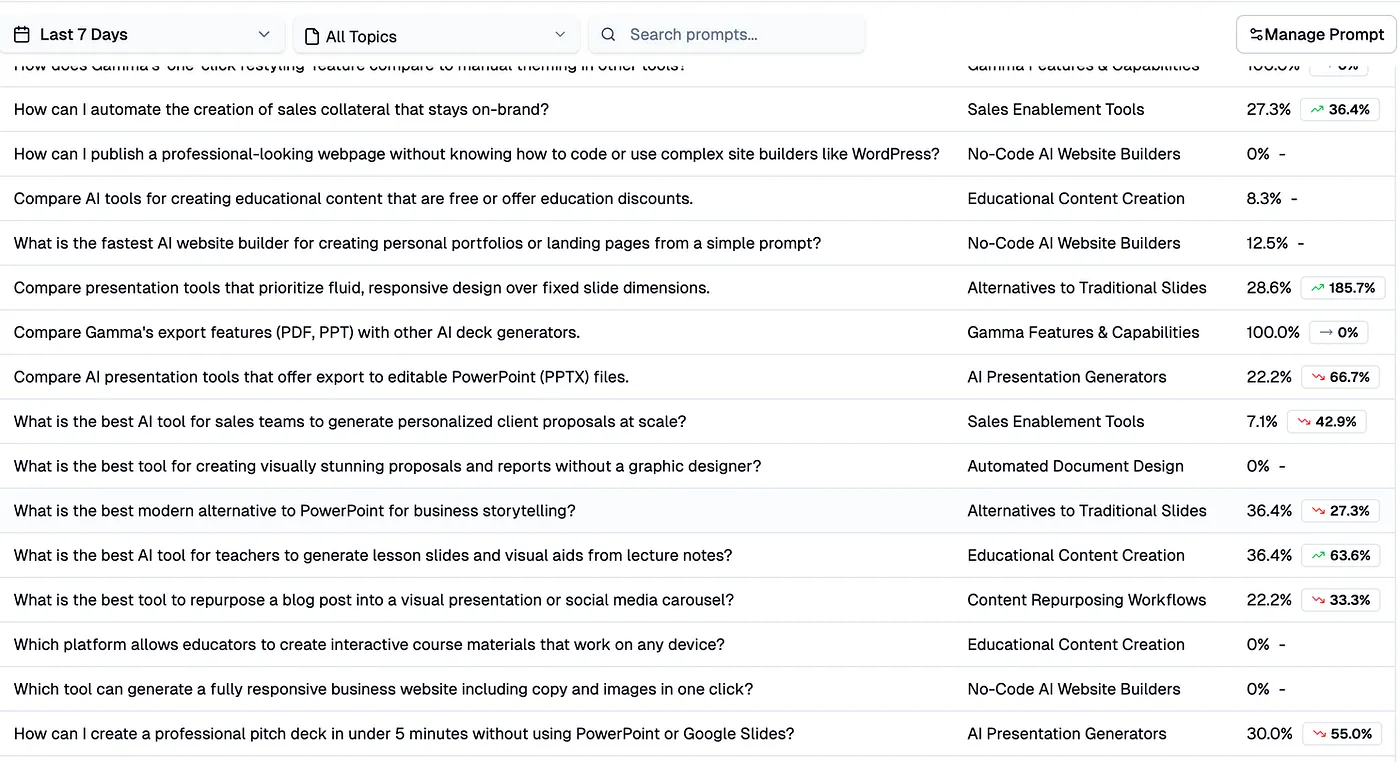
According to the results of the prompts, Gamma’s strengths at the user perception level are very clear. Many high-intent questions directly place Gamma in the same comparative context as tools such as DocSend, Tome, Beautiful ai, and SlidesAI, which is highly beneficial for brand premium and conversion.
Sentiment data can also reflect product positioning: functional discussions directly related to Gamma are usually accompanied by positive or neutral emotions, which means that user discussion points are more focused on the technical and experiential aspects of “whether it can be achieved/how to achieve it”, and negative emotions do not dominate. This is a good signal: product experience and reputation are positive, and external communication is easy to form recommended content (reviews, rankings, case sharing).
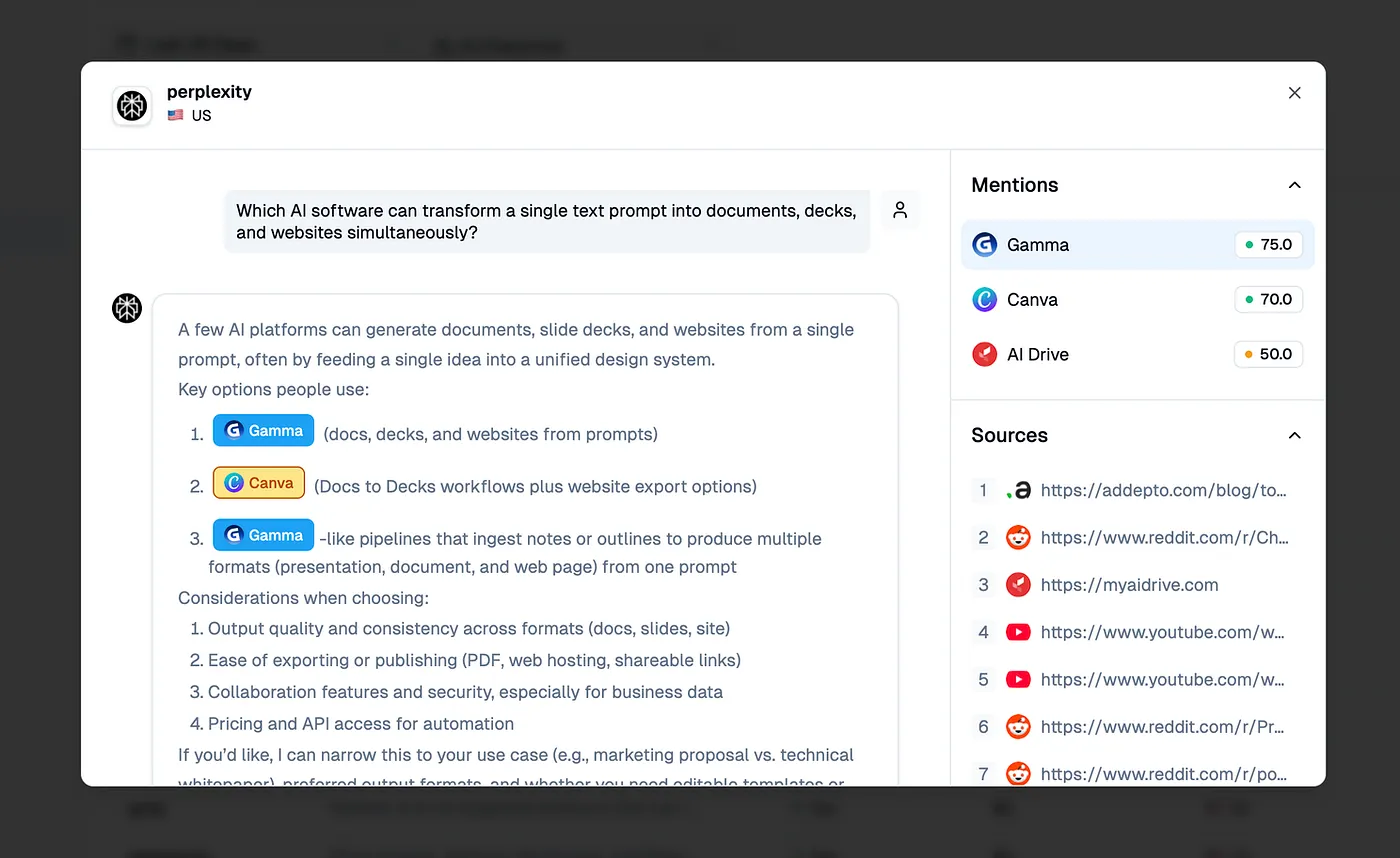
Taking “Which AI software can transform a single text prompt into documents, decks, and websites simultaneously?” as an example of a high-intent prompt, Gamma’s overall visibility under this question reaches 73.3%, and it consistently ranks among the top on multiple mainstream AI search and Q&A platforms. This indicates that Gamma has established a highly consistent and strong product perception in the core capability of “single text input → multi-format content output”.
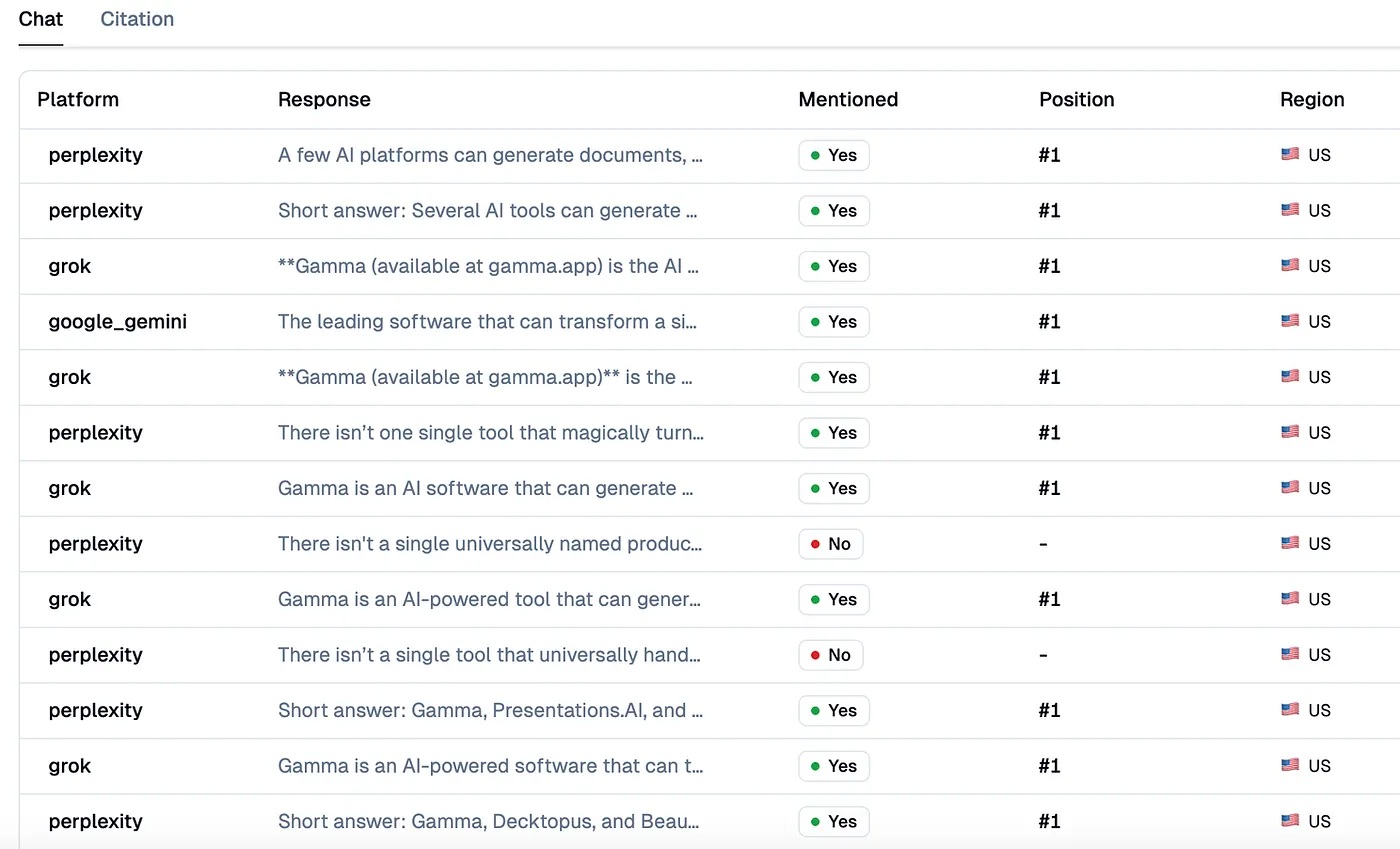
Taking Perplexity’s answer as an example. In terms of content, it is not a traditional “tool evaluation” but rather a highly model-friendly comprehensive answer . It first uses a highly abstract summary statement to generalize the ability of “single prompt → multiple content form outputs”, then conducts a named enumeration through “Key options people use”, and subsequently provides a general decision-making framework with “Considerations when choosing”. This structure itself is very easy to be reused, cited, or secondarily generated by other AI systems.
In the “Key options” section, Gamma is directly named multiple times and explicitly linked to the complete capability loop of “docs, decks, and websites from prompts”. In contrast, Canva’s description leans more towards “workflow combination” (Docs to Decks + website export) rather than directly generating multiple carriers from a unified prompt. This difference in wording is crucial because when answering such questions, models often prefer tools with complete concepts, short paths, and low cognitive load .
Notably, Perplexity actually reinforces an implicit criterion in its response: the existence of a “unified design system”. This precisely aligns with Gamma’s product narrative approach — starting from a text idea, generating documents, presentations, and web pages through a single set of structured design systems. This is not a single Functional Button but a “content generation paradigm”. Once the model accepts this paradigm, Gamma will easily become the default representative.
Another highly worthy point of reference is that Perplexity does not provide a long, separate explanation for each tool, but instead focuses on “Considerations when choosing”. These consideration dimensions (cross-format consistency, publishing and exporting, collaboration and security, pricing and automation) are essentiallyneutral and generalizable evaluation criteria. However, under these criteria, Gamma’s advantages are “naturally aligned”, so even without explicitly disparaging competitors, Gamma will be repeatedly reinforced in the secondary reasoning of readers or models.
In gemini’s response to the same question, Gamma is placed in the explicit “leading software” position**, rather than being one of multiple parallel options, which is extremely beneficial for visibility occupancy.
The answer was completed right at the start with a strong binding of question — answer : “Which software can simultaneously turn a prompt into a document, presentation, and website?” Immediately followed by directly giving Gamma as the clear answer.
Then, using a very crucial concept — unified / card-based architecture — we explain “why Gamma”. This step is not a mere listing of features, but rather a mechanism-level explanation, which is particularly important for AI models. Models tend to remember “cause-and-effect relationships” rather than “feature lists”.
In contrast, Canva is deliberately placed here in the contrasting position of a “single-capability tool”, further strengthening Gamma’s “paradigm-level difference”.
The response also introduced Manus AI and Tome, but in a very restrained manner:
- Manus AI is positioned as “agent / automation”, emphasizing task-oriented rather than editorial
- Tome is positioned as a “storytelling / hybrid format”, emphasizing narrative rather than multi-format output
This makes them “choices in different directions” , rather than direct substitutes for Gamma.
Citation Data
From the Citation data, it can be seen that Gamma already has an obvious “brand + external content” communication structure. Ranking at the top is youtube (65 times, 6.6%), indicating that video content and creators of reviews/tutorials have a significant impact on the entire topic. A large number of competing or related tool domain names appear in the list (storydoc, beautiful ai, slidesai.io, visme.co, decktopus, pitch, etc.). Although in the case of active comparison with competing products, they are prone to being diluted by evaluations or having their features misrepresented, a large number of third-party citations can also effectively enhance trust in AI.
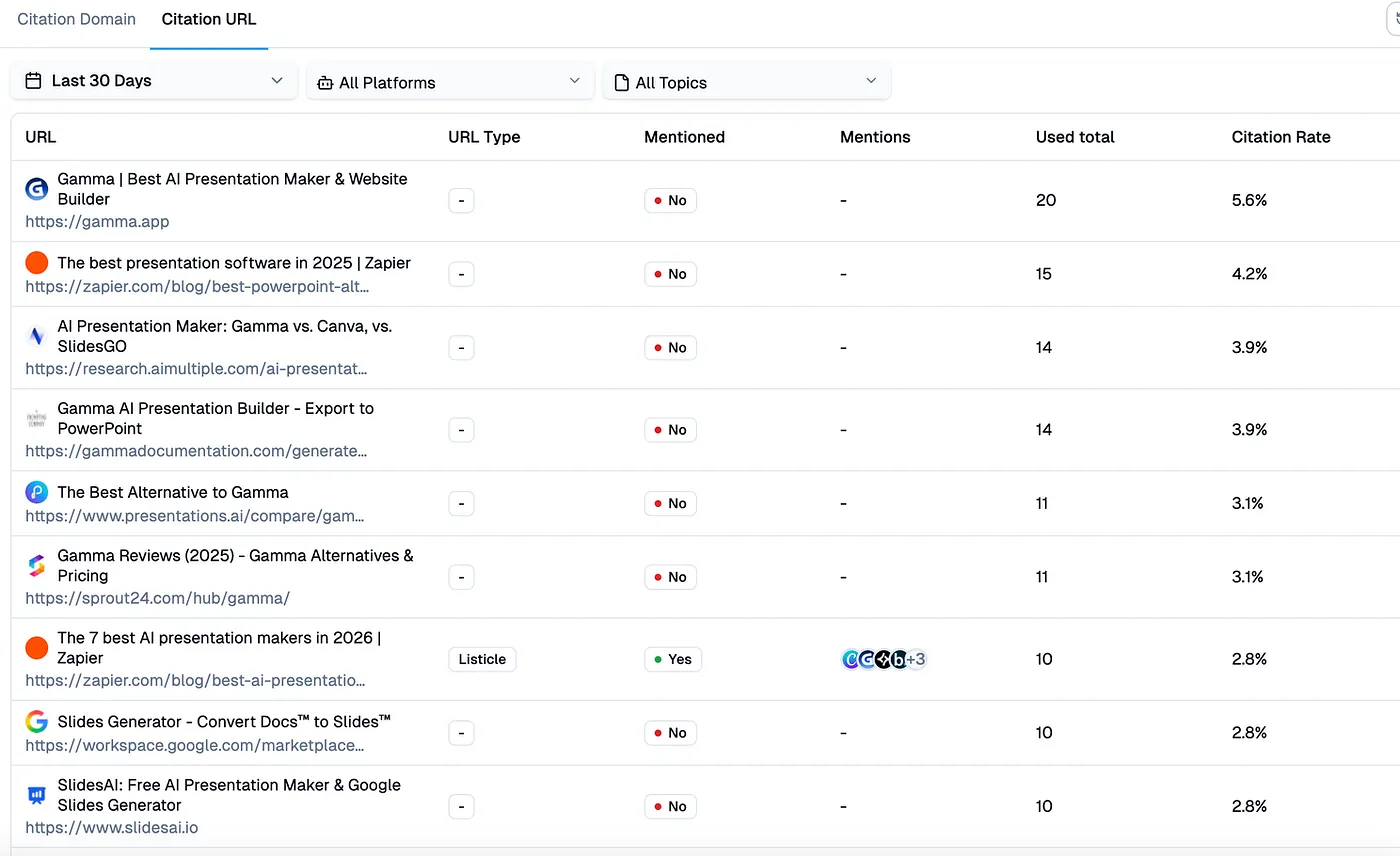
From the list of URLs that have been actually cited multiple times, its citation matrix reveals a hybrid dissemination ecosystem: Gamma’s official website (gamma.app) and official documentation (gammadocumentation) have also been frequently cited, but what dominates visibility is still third-party list/comparative content and reviews (Zapier, AI Multiple, Presentations ai, Sprout24, etc.).
The core reason for Gamma’s high visibility and stable ranking in the GEO scenario is: consistent narrative + product alignment with the “single prompt → multiple outputs” capability paradigm , while external lists, comparison articles, and videos (especially YouTube / listicle / review content) repeatedly reference and solidify this perception, causing retrieval models and Q&A systems to default to Gamma as the answer.
List-based sites (Zapier, Visme, Decktopus, etc.), thematic reviews (AI Multiple, Presentations ai), and tutorials/videos (YouTube, WPCrafter) repeatedly associate Gamma with “directly generating docs/decks/sites from prompts”, forming a strong cross-domain signal. The frequent appearance of ranking and educational sites indicates that Gamma has multiple target scenarios (education/creators/sales/entrepreneurship) and conversion potential.
Market Strategy Summary
Gamma’s rapid growth comes fromproduct-led growth (PLG) + amplification of the creator and media ecosystem + deep integration with automation/creation platforms, combined with a clear monetization path (upgradable paid tiers and APIs), forming a positive feedback loop of “being repeatedly cited by third parties → models/lists solidify it as the default answer”.
The team continuously supports creators to obtain experience channels (trials/accounts), generates a large number of tutorials and reviews, and visualizes the product capabilities through the creators’ demonstrations, thereby generating a large amount of quotable content in a short period of time.
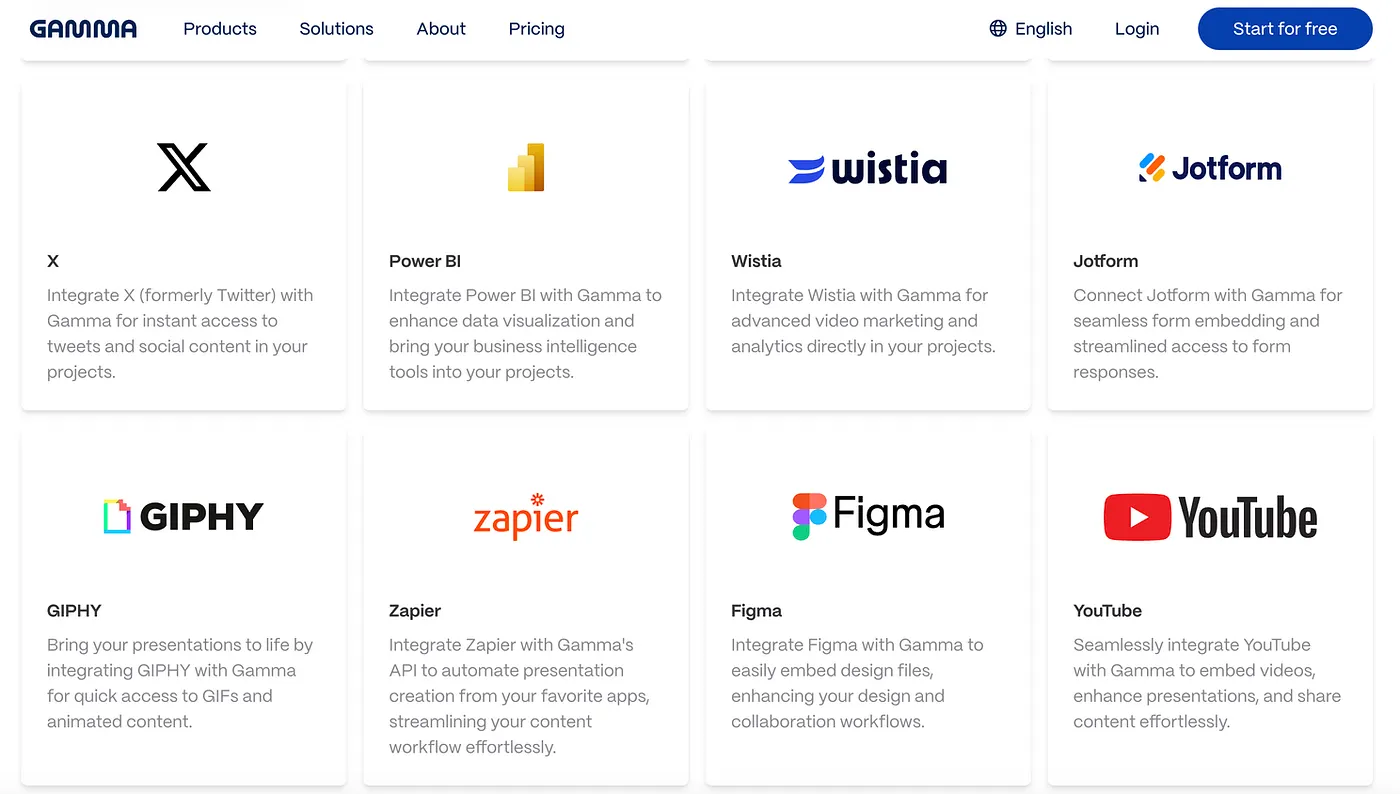
Through integrations such as Zapier, Make/N8N, Gamma can integrate into enterprise/sales/content workflows, directly convert CRM/CMS/blog content into presentations or web pages automatically, thereby driving paid or team-based usage.
The marketing team proactively engages in information exchange (media kits / demos) with list-based media / review sites, leveraging their authority to drive long-term traffic. Previously, it has been frequently cited in multiple lists and comparison articles (Zapier, AI Multiple, etc.), validating the effectiveness of this approach.
Gamma has transformed the ability to “generate documents/presentations/web pages from a single prompt” intocards and a responsive “view switching” paradigm,enabling seamless switching of the same content among Deck/Doc/Live Site, reducing the cost for users to go from ideas to multi-channel output, serving as a core product differentiator, and making it easier to be recognized as a “paradigm representative” in high-level questions (Which tool can…).
GEO Differences between Canva and Gamma
Official Website Comparison
Gamma and Canva exhibit two different patterns in the page distribution and strategy of “externally cited/AI-adopted”.
Canva’s cited sources are more dispersed, with Create/product feature pages accounting for approximately 25.5%, education/teacher scenarios about 16.4%, template pages about 12.7%, Help/Help Center and Learn/Design School pages each about 12.7%, the homepage only about 5.5%, AI tool topics about 5.5%, and the rest being industry solutions, app market, etc. The pages that are most cited are mostly “actionable/generatable” content (Create, templates, teaching examples, Help steps), which usually contain short steps, examples, or copyable snippets, making it easy for models to extract them as answer snippets; meanwhile, scenario-based content such as education and templates also makes Canva frequently invoked in classroom or specific task-based prompts.
Gamma adopts a highly centralized strategy of “using the homepage as the anchor and functional pages as supplements”, leveraging enhanced homepage information (brand + keywords, clear main sentences, and trust signals) to quickly capture fragmented exposure; in contrast, although Canva’s homepage content is very rich, it does not form a similarly dominant “single entry point” in the referenced structure, and its references are more scattered across template pages, functional pages, and teaching pages, resulting in the relative dilution of the homepage’s weight in external references.
Although Canva’s page information density is significantly higher, with content mainly consisting of modularized functional descriptions, processes, and examples, the information is complete but distributed across long pages and multiple sections, making it overall less conducive to being directly distilled into one-sentence or fragmentary answers, thereby reducing efficiency in direct answer-type citations.
Topics Comparison
Canva’s cited topics are more dispersed, with “Sales Enablement Tools” accounting for 33.3% and the remaining topics each accounting for 10%–20%; Gamma’s citations are more concentrated, with “AI Presentation Generators” accounting for 40%, and the top two categories (AI Presentation + Content Repurposing) together accounting for 60%. Overall, Canva exhibits the characteristics of multi-point reach and wide scenario coverage; Gamma, on the other hand, presents high concentration centered around its core capabilities (AI presentation). Sales enablement (33.3%), educational content creation (22.2%), startup investment and financing materials (11.1%), etc., indicate that external citations more often regard Canva as a tool that “provides creatives and templates for specific business or scenarios”. Gamma’s citations tend to focus on tool capabilities and processes: AI presentation generation (40%), content repurposing/remaking workflows (20%), suggesting that external discourse more often views Gamma as a productivity platform “centered around generation and recombination capabilities”.
Canva is regarded as a “multi-scenario content and template provider” in external references — the references are mainly focused on sales enablement and educational content, indicating that in the market context, Canva is more often seen as a tool to address specific business scenarios (such as sales materials, classroom content) and template needs, rather than a product image that started solely with “AI writing/generation”. Compared to topics centered on “AI presentation generation”, Canva’s identity as an “AI generator” does not dominate in the cited topics — in the external context, the AI function is more often used as a tool to enhance scenarios, rather than its core label. This suggests that external discussions place more emphasis on the usage results and scenario value rather than the AI-first identity of the tool.
Taking “Which AI software can transform a single text prompt into documents, decks, and websites simultaneously?” as an example, when asking Perplexity, it can be observed that the structure of its answers and the order of recommendations do not simply list platforms with comprehensive functions, but rather clearly favor product descriptions with high semantic matching, concentrated evidence, and direct paths.
First, when Perplexity understands this issue, the implicit premise is “one input → natively generate multiple content formats simultaneously”. In the existing indexable corpus, Gamma is more frequently described in integrated capability sentences such as “single prompt / one input / generate docs, decks, and websites”, and these expressions often appear concentrated in the core paragraphs of the official website homepage, product introduction page, or third-party reviews, making them easily extractable as direct evidence. In contrast, although Canva also has Docs, Presentations, and Websites, its capabilities are more often broken down into step-by-step processes such as Docs → Decks conversion and exporting websites after design, which semantically is closer to a “composite workflow” rather than the “simultaneous generation” the question refers to.
Second, Perplexity’s preference for information sources does not solely depend on “what can be done,” but rather on whether there are clear claims that can be quickly verified. Gamma is typically positioned as an “AI-first generative content tool” in external content, emphasizing the direct generation of structured outputs from text; while Canva’s mainstream narrative still revolves around “design platform,” “template ecosystem,” “collaboration and brand system,” with AI generation more like an enhanced capability rather than the core of the product. Therefore, in the context of questions highly focused on “AI-native generative capabilities,” even though Canva has a wide range of functions, it is more likely to be placed in a supplementary position rather than as the primary answer.
From the reference sources of this Q&A, Reddit (subreddits such as PromptGenius, ProductivityApps, powerpoint, etc.) accounts for a significant proportion. The common feature of such community content is that users describe the actual experience of “I entered a prompt / a long document and then directly generated a presentation or a webpage” , and Gamma is usually the named protagonist in these discussions. In contrast, Canva more often appears as a “design tool” or “template library” in the Reddit context, rather than a solution for “simultaneously generating multiple content forms from a prompt”. This makes Gamma significantly higher in “real use case density”.
Tool inventory websites such as addepto, devopsschool, and aitoolssme often use very direct language to describe Gamma:
Generate documents, presentations, and websites from a single prompt This one-sentence ability summary is almost completely isomorphic to the question itself, and is extremely easy to be extracted by Perplexity as answer evidence. Even if Canva is included in these lists, it is usually described as “supports presentations/websites/design with AI”, with more scattered semantics and a lack of strong binding of “single prompt → multi-format output”.
Gamma Documentation is a key differentiator. It provides clear and structured descriptions of product capabilities, directly strengthening Gamma’s technical positioning as an “AI document/presentation/website generation tool.” In contrast, Canva’s official documentation and help center content are usuallyfunctionally split (Docs, Presentations, and Websites are each independent), making it difficult for AI search to recognize them as a “unified generation system.”
Conclusion: The GEO Decisive Point of AI Presentation Tools
As generative AI continues to penetrate deeper into content production, the competition among presentation generation tools has shifted from “who can generate quickly and look good” to “who can be trusted by the model and stably represent users in making choices.” This GEO analysis shows that Gamma, with its unified paradigm of “single prompt → multi-vehicle output,” has gained higher visibility and default representative status in Q&A and retrieval scenarios; while Canva maintains broad adaptability and reliability in fragmented scenarios with its template library, educational, and enterprise-level collaboration capabilities. Each has its own advantages and corresponds to different user needs and purchase scenarios.
The implications for product providers are clear: To gain a leading position in the AI-driven search and Q&A ecosystem, they should simultaneously (1) formulate a consistent and extractable one-sentence capability statement in their official websites and documentation; (2) strengthen the causal narrative with structured, referenceable long texts and examples; (3) amplify demonstrable use cases through the creator and media ecosystem to form a third-party citation matrix. For the marketing/content team, they should invest in rankings, reviews, tutorials, and videos as long-term assets to gain an advantage in “evidence density” in Model Training and search corpus. For enterprise buyers, when selecting tools, they should prioritize “credibility, controllability, and integration capabilities” and verify cross-format consistency and export/compliance processes during the pilot phase.
In the future, as more manufacturers incorporate governance, interpretability, and enterprise integration into the core of their products, GEO metrics will continue to be an important dimension for measuring the long-term competitiveness of generative tools. Dageno ai will continue to monitor ecosystem changes in this area, and welcomes more in-depth product or market discussions based on our data and methods.
— — Dageno ai Big Data Team