
Updated by
Updated on Jun 10, 2026
Introduction: Market Background & Size
With the continuous advancement of artificial intelligence, the content creation landscape is undergoing a structural transformation. As information scales exponentially and demand for writing efficiency increases, AI writing tools are becoming a core driver reshaping content production paradigms. According to Global Growth Insights, the global AI blog writing tools market was approximately $1.922 billion in 2025 and is expected to reach $2.431 billion by 2026.
According to Google’s Algorithm Transparency Report, over 68% of SEO professionals have already integrated AI into their daily workflows, with content generation being the most critical application. Industry experts, such as Moz Chief Scientist Dr. Pete Meyers, caution that overreliance on AI may lead to content homogenization and trigger search engines’ “low-quality content filtering” mechanisms.
For AI blog writing tools, core competitiveness lies not in merely increasing content generation speed but in establishing a system that continuously improves content quality and differentiation, helping clients achieve SEO growth and business conversion in a complex, AI-driven ecosystem. As the AI content landscape evolves, SEO alone is insufficient, making GEO (Generative Engine Optimization) a key differentiator and competitive focus.
What is GEO?
GEO, or Generative Engine Optimization, is a content optimization strategy designed specifically for generative AI. Unlike traditional SEO, which focuses on ranking in search engine results, GEO aims to ensure that generative AI prioritizes your content when answering user queries, increasing visibility and authority in AI-driven content ecosystems.
For AI blog tools, demonstrating strong GEO within their own product content is critical. Only by optimizing their brand visibility in generative engines can these tools convincingly showcase their capabilities.
December 2025 GEO Trend Rankings: Methodology & Scope
Before analyzing GEO trends, it is crucial to determine how GEO data is collected.
We can evaluate brand visibility systematically through data collection and analysis:
- Generate sample outputs across multiple AI scenarios.
- Quantify brand exposure, ranking, and semantic relevance.
- Clean, normalize, and weight data to produce structured metrics for assessing brand optimization performance in generative engines.
For clarity, we analyzed three leading AI models—ChatGPT, Perplexity, and Grok—and examined how mainstream AI blog writing tools performed in December 2025.
Key Findings:
- The top-performing tools for GEO in December 2025 were Jasper and Writesonic.
Core Insights
These tools achieved high visibility due to several measurable factors:
- Highly structured content aligned with query intent (clear headings, summaries, FAQs, concise answers).
- Strong authority and recognizable sources, easily referenced by AI.
- Balanced depth and breadth, covering both high-frequency queries and long-form topics.
Writesonic, for example, emphasizes a systemized content approach: “searchable, understandable, and reusable” content. Early VC funding enabled initial growth, but sustained visibility came from executing long-term content and structured brand strategies:
- Free tool pages and feature landing pages cover high-frequency and long-tail searches, linking brand to specific use cases.
- Blog content focuses on AI writing, SEO, and content marketing, establishing topical authority.
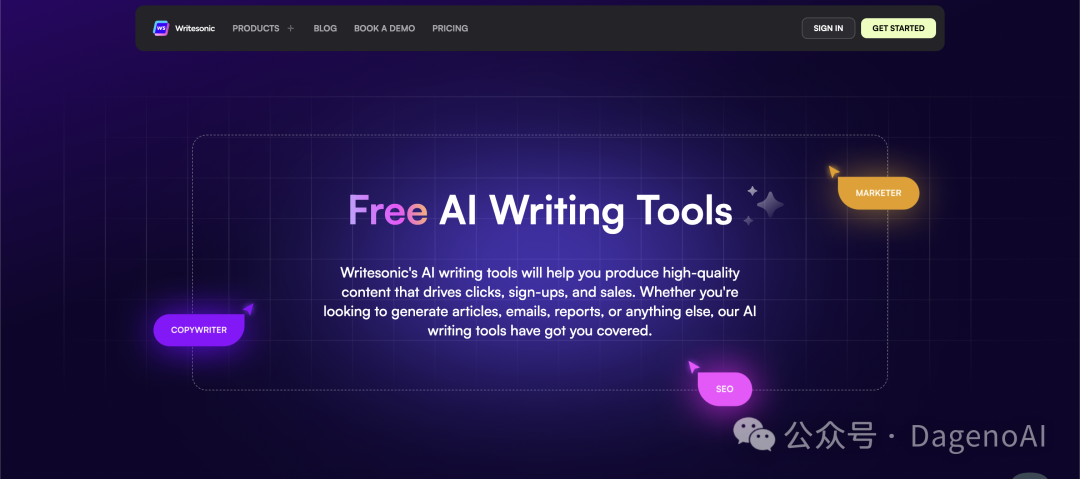
Clear structure, high information density, and semantic precision make these pages easily crawlable by traditional search engines and highly compatible with LLM retrieval and training preferences, increasing the likelihood of AI citation as authoritative sources rather than generic SaaS mentions.
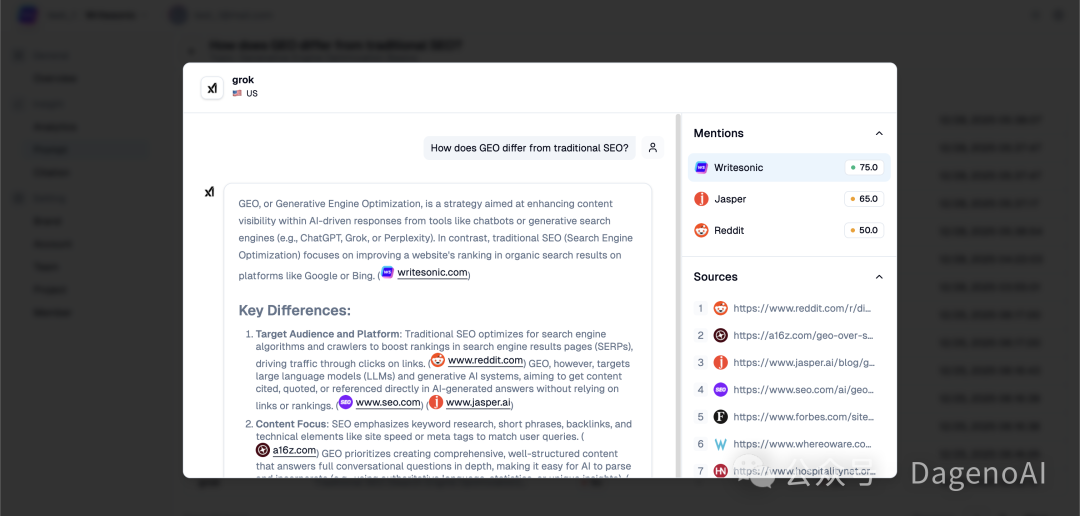
Prompt Analysis: Brand Performance Differences
Over 6,000 prompts were tested, covering GEO concepts, tool recommendations, and platform-specific optimization. Findings show that brand visibility varies significantly across question types and AI models.
Examples:
- Jasper performs better in conceptual or methodological queries (“What is GEO?”, “GEO vs. traditional SEO”), due to structured blogs and guides.
- Writesonic excels in tool-oriented or practical queries (“Best AI search optimization tools?”), leveraging tutorial pages and feature landing pages that match the AI’s retrieval logic.
This highlights that AI search relies on multiple citation logics, driven by query type. Brands should design GEO strategies based on the type of question they want to be cited for—concept explanation, methodology, or tool recommendation.
Citation Analysis
Community and social platforms dominate AI search citations:
- Reddit: 52.6%
- LinkedIn: 23.2%
- YouTube: 21.4%
These sources offer real user discussions, experience sharing, and actionable insights, which AI frequently references. Brands should diversify sources and enhance machine-readable authority, rather than relying solely on official websites.
Industry blogs and professional media also serve as authoritative supplements. Sites like Search Engine Land, Forbes, Backlinko, and Neil Patel are valued for structured conclusions and mature methodologies. Enterprise blogs and review sites provide background and verification rather than primary viewpoints.
Reddit Insights
Effective exposure comes from authentic discussions rather than direct promotion. Posts sharing real usage, comparisons, and replicable outcomes are more likely to be captured by AI and trends systems. Brands can use this to guide Reddit strategy: prioritize real questions, comparisons, and results.
Cross-Model Differences
Different AI models produce varying top results due to differences in:
- Indexing and data sources
- Freshness vs. authority balance
- Query intent and semantic interpretation
- Ranking features (backlinks, user behavior, file types, machine readability, geo signals, commercial/licensing rules)
Brands should adopt a multi-model strategy, monitoring differences, designing machine-readable content, and implementing differentiated distribution to maximize visibility across platforms.
Conclusion & Actionable Recommendations
The AI blog tools market is no longer defined solely by content generation capabilities. In the GEO era, tools must demonstrate verifiable performance in real search and recommendation environments to earn user trust.
Future growth will rely on data-driven service loops:
- Visibility monitoring
- Workflow feedback into content production
- Scalable generation and validation
- GEO ranking and conversion optimization
The most valuable products will integrate content creation, visibility monitoring, feedback analysis, and automated iteration into a single, data-driven growth platform.