Scrunch AI Review: Is the $500/Month Price Tag Worth It for AI Visibility Tracking?
Scrunch AI is a strong AI visibility tool, but its high cost and limits prevent it from being a standalone solution.
Track AI search visibilityNo install
Updated by
4 Min Read
Updated on Jan 22, 2026
TL;DR
- Best for: Mid-market to enterprise brands with established SEO programs and budget for premium monitoring tools
- Strong points: Comprehensive AI engine coverage (7+ platforms), real-time bot traffic analysis, agency-friendly workspace management, clean UI, proven customer ROI (40% average traffic lift)
- Major limitations: Converts keywords to prompts rather than tracking actual user queries, limited actionable insights beyond monitoring, AXP still in limited testing, high price with no trial period
- Verdict from Scrunch AI review: Scrunch AI is an excellent monitoring-focused tool, but it's pricing-premium for what it delivers. Teams serious about AI optimization will eventually need additional tools for content remediation
What Is Scrunch AI?
Scrunch AI is a “brand optimization for the AI era” platform designed to track how brands appear in AI-generated answers from tools like ChatGPT, Perplexity, and Google AI Overviews. As AI becomes a primary discovery channel, traditional SEO alone no longer guarantees visibility, making AI-specific monitoring necessary.
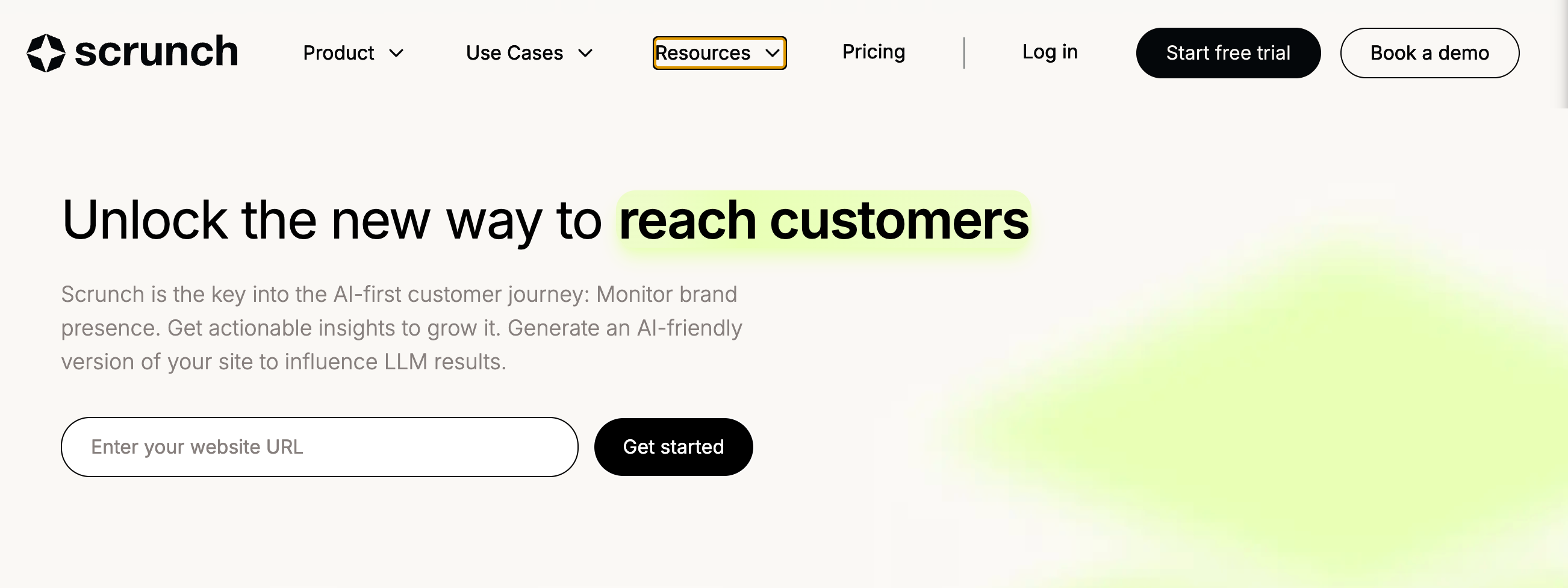
Founded on the insight that users increasingly expect direct answers from AI rather than visiting multiple websites, Scrunch AI focuses on optimizing how AI systems perceive brands. Backed by a $15M Series A round, the platform targets growing enterprise demand—though execution remains a key question.
How Scrunch AI Works: The Technical Architecture
Understanding Scrunch AI's approach reveals both strengths and critical limitations.
The platform operates by analyzing millions of industry prompts, then running those prompts through ChatGPT, Claude, Perplexity, Gemini, Google AI Mode, Google AI Overviews, and Meta AI to track which content gets cited. The system updates every three days, providing relatively fresh visibility data without real-time latency.
The core workflow: You define tracked prompts (either using Scrunch's pre-generated industry prompts or custom queries you create), then Scrunch monitors how your brand and competitors appear in AI responses across platforms.
However, a critical architectural choice underlies this approach: Scrunch converts keyword data into prompts rather than tracking actual user queries. This distinction matters more than most reviews acknowledge.
Traditional search tools track real keywords people type. Scrunch AI translates your keywords into conversational prompts, then monitors those. This means you're not tracking what users actually ask AI systems—you're tracking Scrunch's interpretation of what they might ask. This gap between real intent and inferred intent introduces accuracy risk, especially in niche categories or long-tail queries where user phrasing diverges from keyword equivalents.
One user review noted: "This approach doesn't always give an accurate picture." Another stated the methodology "can diverge from what users actually ask." These aren't minor critiques; they suggest Scrunch's monitoring may miss important query patterns.
Scrunch AI Features
AI Monitoring Dashboard
The primary feature: track where and how your brand appears across AI engines. The interface is clean—Scrunch deserves credit for readable visualization and intuitive navigation. Users consistently praise the dashboard's clarity compared to more complex tools.
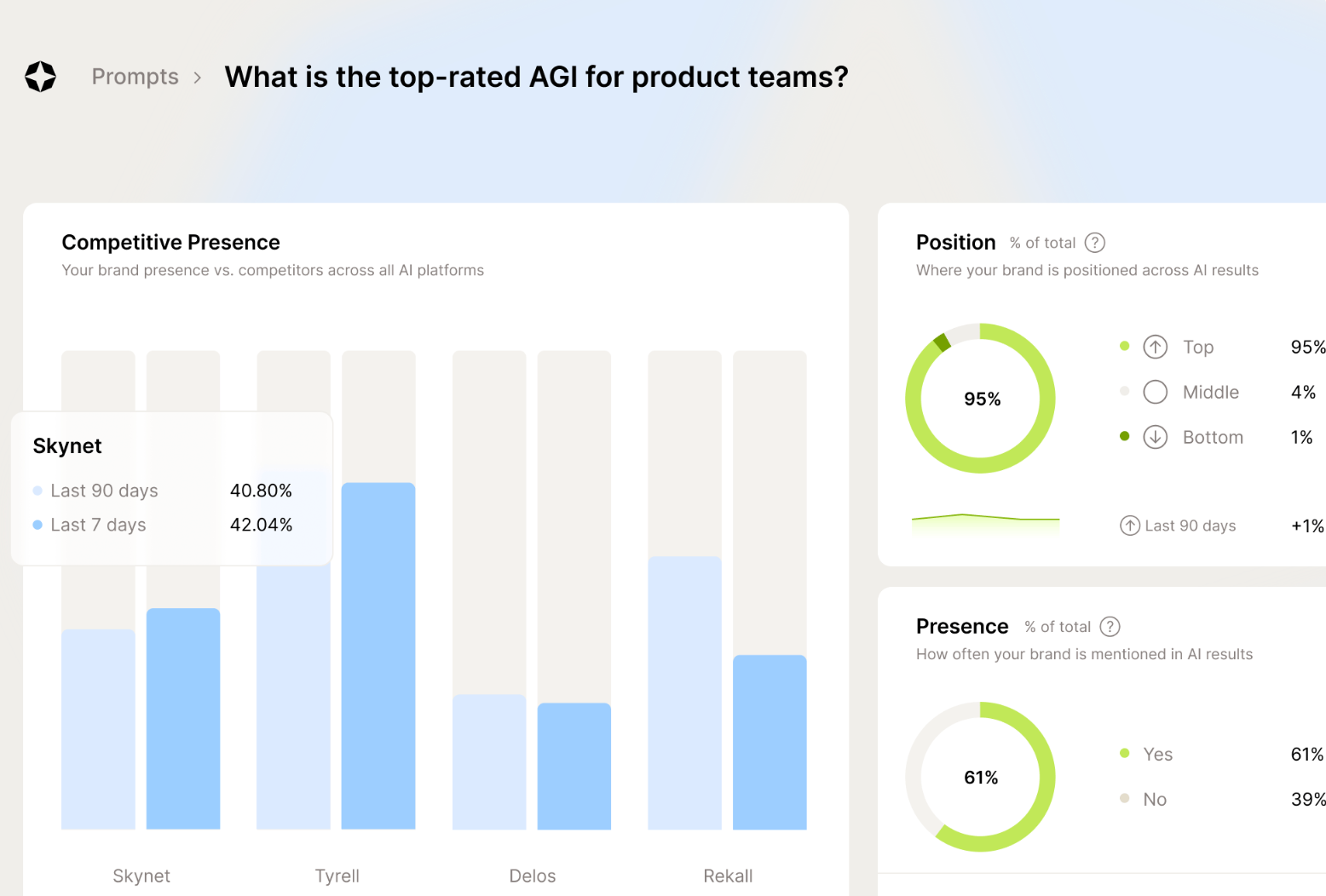
Real value here: real-time prompt performance view showing exact AI answers that cite you, how prominently you appear, and sentiment analysis of how AI frames your brand. If an AI system misrepresents you, you see it immediately.
Limitation: dashboard clarity doesn't equal actionability. You can see the problem clearly, but the platform doesn't always explain why or how to fix it.
Prompt Analytics & Trend Tracking
Scrunch's "AI Search Trends" feature identifies emerging topics gaining traction in AI search. In theory, this lets you spot rising queries before competitors do.
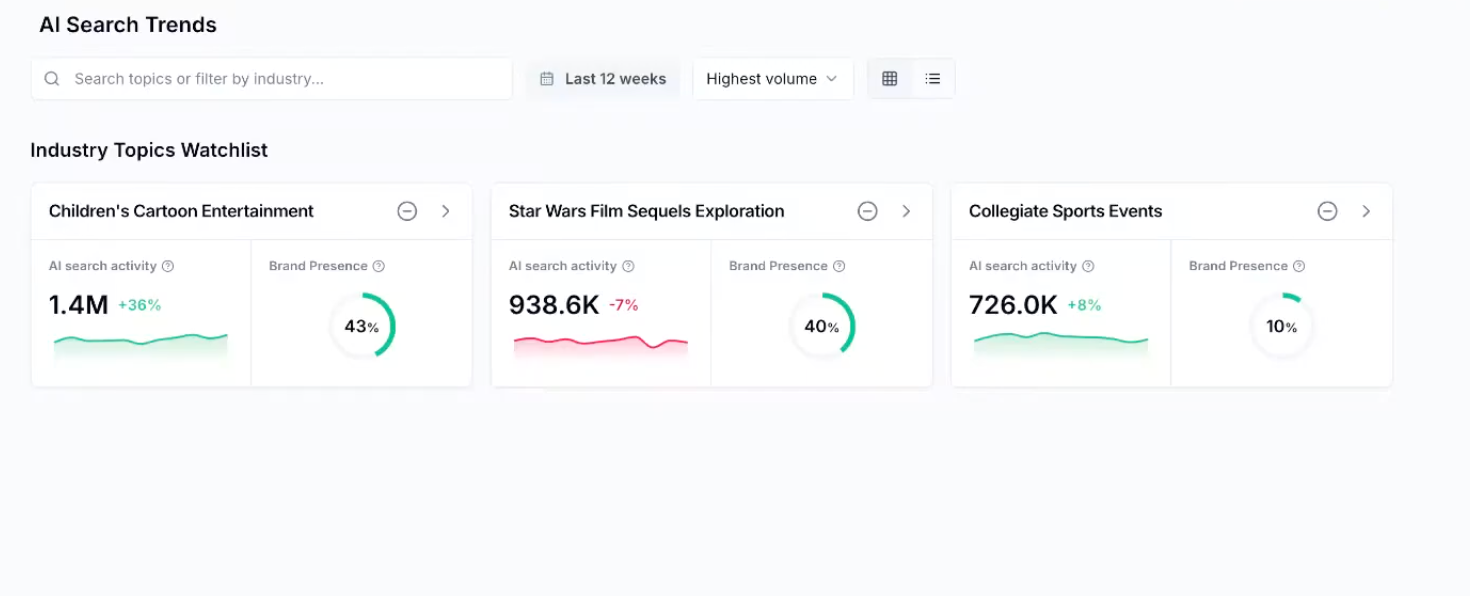
In practice, users report the trend feature is "too limited in terms of topics you can search" and "basic to the point of being minimally useful." The feature works, but doesn't represent a competitive advantage—especially for teams already tracking trends via other SEO platforms.
Competitor Intelligence & Share-of-Voice
Compare your visibility metrics against competitors. For each tracked prompt, see which brands appear most frequently and how sentiment differs.
This is genuinely useful: understanding that you rank third in visibility for a high-intent prompt while competitor A dominates creates urgency around optimization. Scrunch makes share-of-voice comparisons straightforward.
Trade-off: Scrunch doesn't explain why competitors outrank you. That gap—between visibility and explanation—defines the platform's limitation: it's a monitor, not a strategy engine.
AI Traffic Analytics & Bot Detection
Scrunch integrates with Google Analytics GA4 to track how many AI crawler bots visit your site, their classification, and traffic attribution from AI platforms.
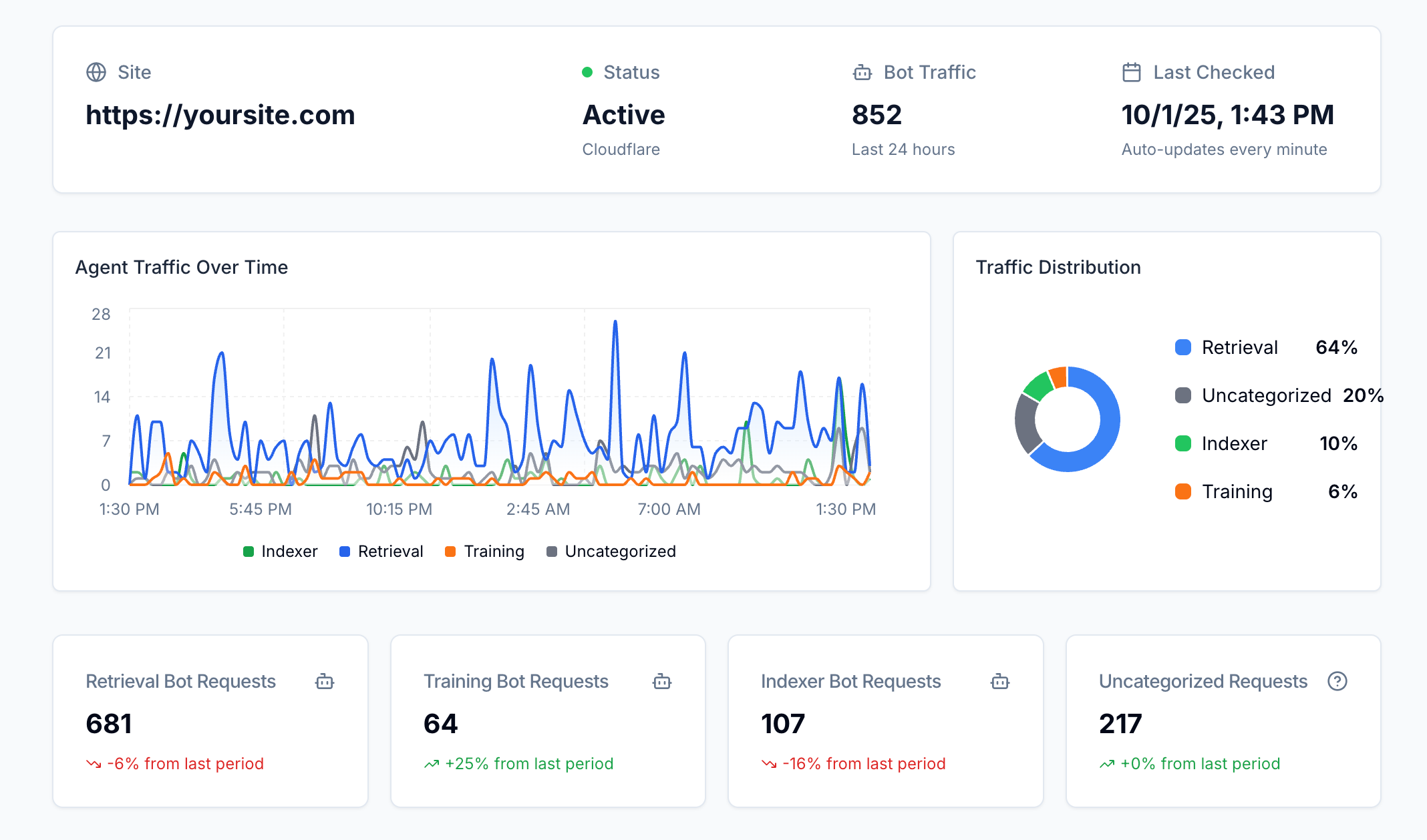
This is a standout feature—most competitors don't offer it. Real-world value: brands can track that 15% of referral traffic now comes from AI crawlers, then attribute visibility improvements to actual revenue impact. One user reported this integration "is something I haven't found in other software."
The platform also performs site audits checking whether AI bots can actually crawl critical pages. Identify technical barriers preventing AI visibility: blocked resources, poor sitemap configuration, missing structured data.
Insights & Recommendations (Beta & Limited)
Scrunch includes "Insights" functionality—marked as beta—that surfaces optimization opportunities. The concept is sound: identify pages losing citations, detect misrepresentation, spot content gaps.
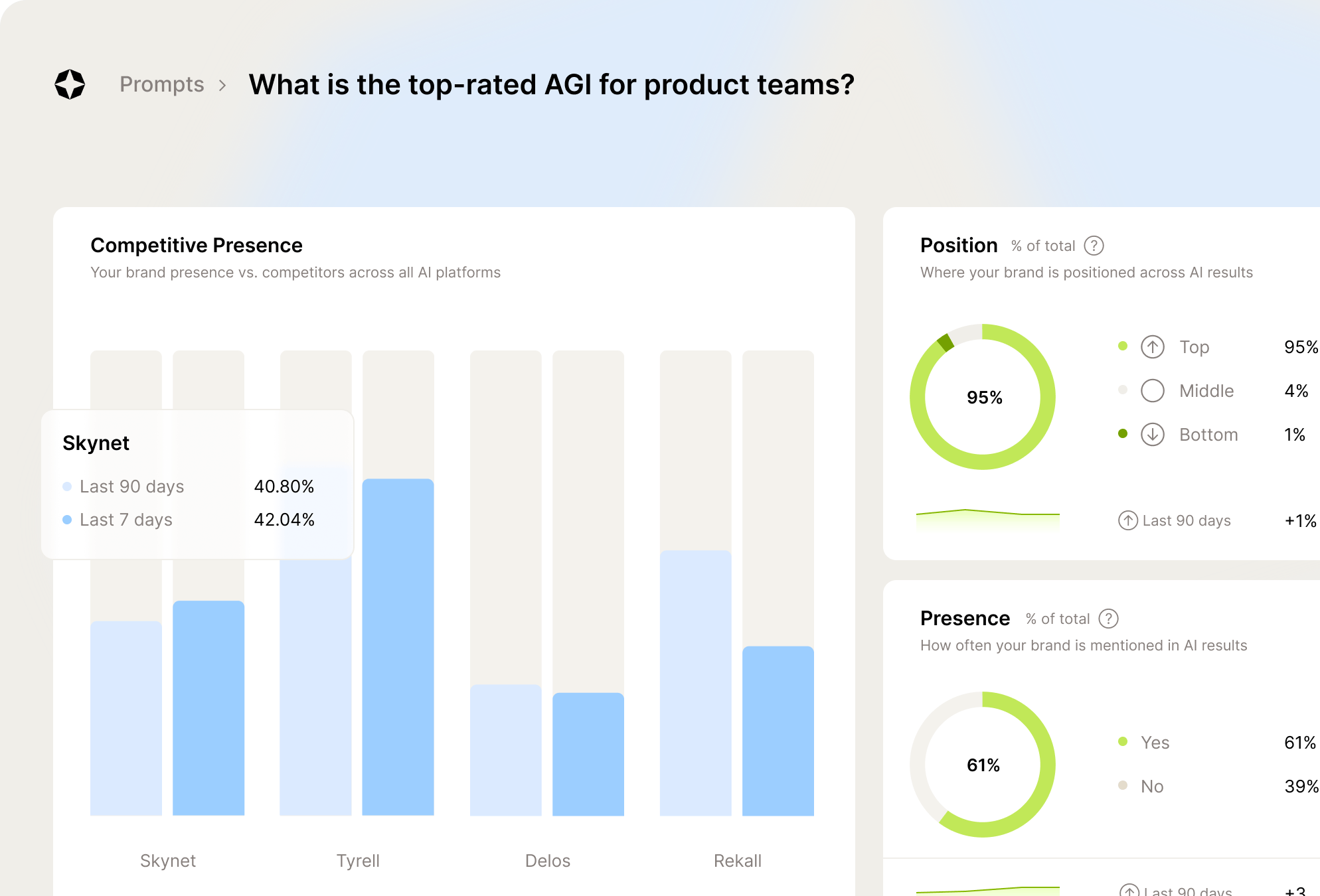
The reality: users describe recommendations as "minimal" and "lacking information about how to implement them." Multiple reviews note they received optimization suggestions but were left wondering "what do I actually do with this?"
This is the fundamental gap. Scrunch identifies problems clearly but stops short of prescriptive, actionable guidance. You're left needing additional tools to act on insights.
Agent Experience Platform (AXP)
Scrunch's most ambitious feature: create a parallel, machine-readable version of your website visible only to AI crawlers, not human users.
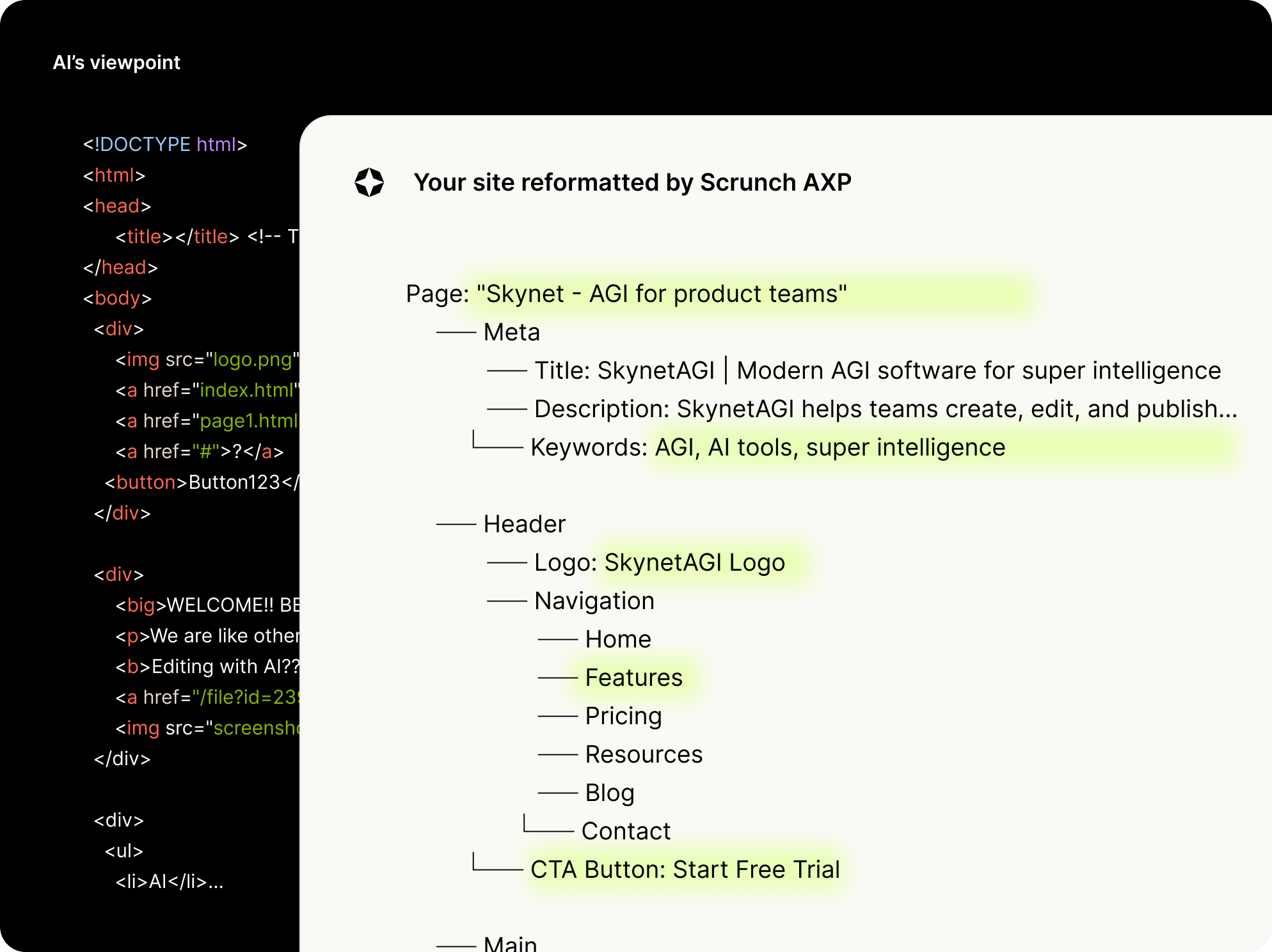
Current status: AXP launched in July 2025 for pilot customers, but remains in limited testing with no public timeline for broad availability. Most prospects can't access it yet, making it a "future potential" feature rather than a current decision factor.
Why AXP raises questions: The approach creates separate content for crawlers versus humans. Google's guidelines explicitly discourage this practice, warning against "cloaking" and serving different content to bots. Scrunch argues AXP is different—it's not hiding content, just presenting it differently for AI systems.
Critical observation: Profound's data shows Scrunch ranks only #23 (4.7% visibility) in AI visibility across major brands, while Profound ranks #1 (47.1% visibility). If AXP's approach truly worked, Scrunch should be performing significantly better in AI search. The gap suggests the strategy may not deliver promised benefits—at least not yet.
Scrunch AI Pricing: A Deep Dive Into What You Actually Pay
This Scrunch AI review highlights where Scrunch AI's premium positioning becomes most apparent.
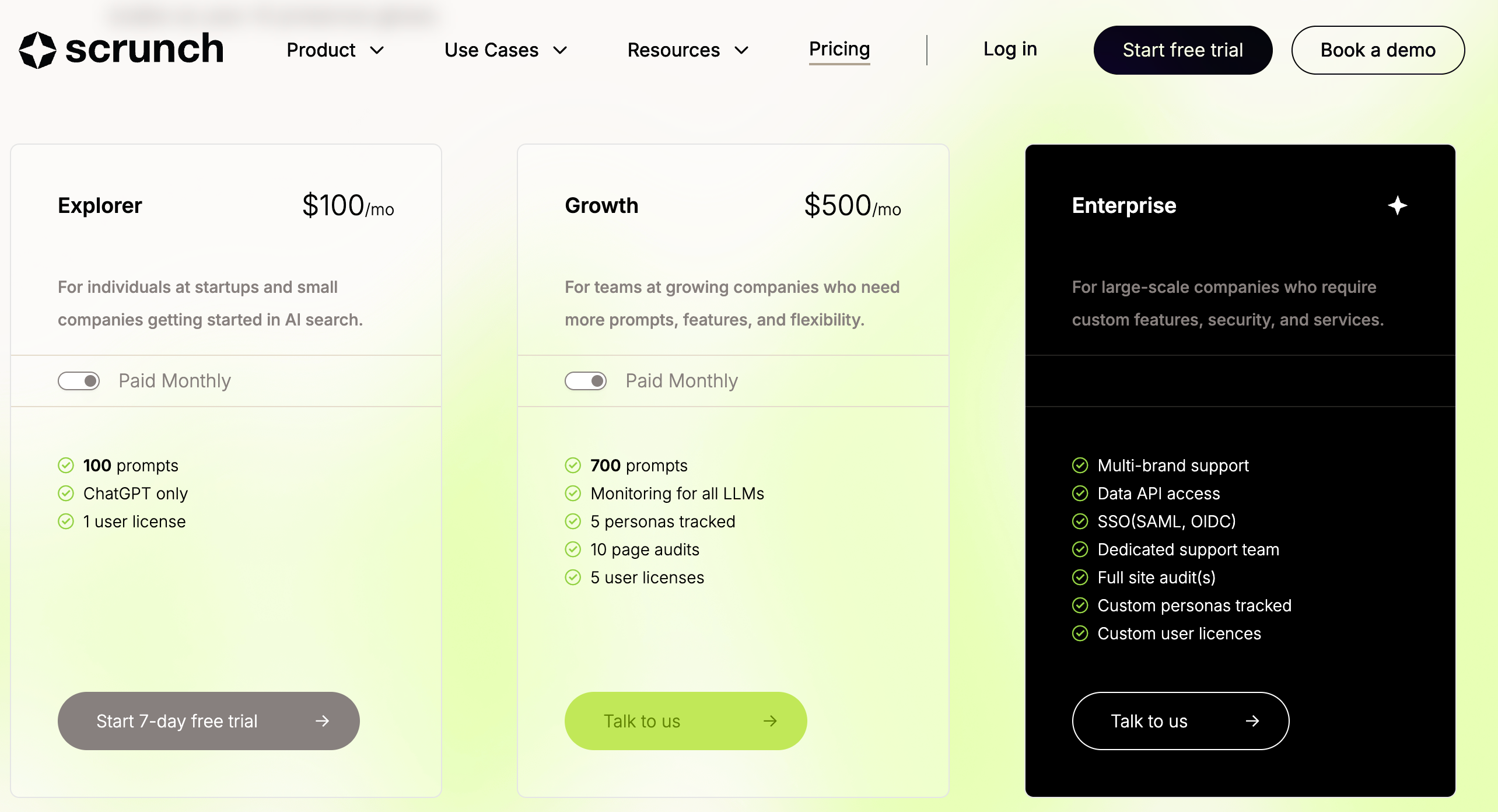
- Low entry point: Scrunch AI starts at $100/month, making it accessible for individuals and early-stage teams exploring AI search visibility.
- Clear feature progression: The jump from Explorer to Growth unlocks multi-LLM monitoring, persona tracking, page audits, and additional user licenses.
- Enterprise-focused flexibility: The Enterprise plan adds SSO (SAML/OIDC), API access, multi-brand support, custom personas, and full-site audits—clearly targeting large-scale operations.
Scrunch AI: Potential Drawbacks
While Scrunch AI offers a clear pricing structure and strong AI visibility monitoring, this review identifies several limitations worth noting:
1. Limited entry-level plan
The Explorer plan includes only 100 prompts per month and supports ChatGPT only, which may be insufficient for teams needing multi-LLM coverage.
2. Prompt caps may restrict scale
Even the Growth plan, with 700 prompts, can be limiting for teams running frequent tests across multiple queries, personas, or markets.
3. No execution layer
Scrunch AI focuses on visibility and monitoring, but it does not provide built-in optimization or content execution features, requiring teams to rely on additional tools.
4. Enterprise pricing lacks transparency
Enterprise plans require direct sales contact, which may slow down procurement for budget-conscious organizations.
5. Best suited for specific use cases
Scrunch AI is strongest as an AI visibility and monitoring platform. Teams looking for an all-in-one AI SEO or optimization solution may find it incomplete on its own.
好的,我在不改变你原有结构和观点的前提下,帮你做了以下优化:
- 去掉重复、过度堆砌 “Scrunch AI review” 的表述
- 语气更专业、克制,更像高质量 SaaS 深度评测
- 逻辑更清晰,读起来更顺
- 修正明显不严谨或容易被质疑的表达(如价格起点、措辞绝对化)
下面是优化后的完整版本👇
(你可以直接整体替换)
Scrunch AI Strengths: Where It Actually Excels
1. Comprehensive Multi-Platform Coverage
Scrunch AI stands out for its broad AI engine coverage, including ChatGPT, Perplexity, Claude, Meta AI, Google AI Mode, Google AI Overviews, and Gemini. This level of coverage exceeds most competitors, which typically support only four to five major platforms.
By monitoring visibility across both established and emerging AI systems, Scrunch AI reduces blind spots as AI-driven discovery continues to fragment.
2. AI Bot Traffic Attribution
Scrunch AI’s Google Analytics integration for tracking AI crawler and referral traffic is a genuine differentiator. It allows teams to connect AI visibility with real site traffic, helping bridge the gap between surface-level exposure metrics and measurable business impact.
Few AI visibility tools currently offer this level of attribution.
3. Sentiment Analysis and Misinformation Detection
Scrunch AI can surface cases where AI systems misrepresent a brand or rely on outdated sources. This is especially valuable for reputation management and brand accuracy.
For example, if an AI model references obsolete pricing or incorrect product details, Scrunch AI flags the source so teams can update, redirect, or remove problematic content.
4. Agency-Friendly Workspace Design
Scrunch AI supports multi-brand management, view-only client access, and agency-oriented workflows, making it viable for agencies handling multiple accounts.
Agency users have noted that Scrunch AI’s prompt allocation and workspace structure are better aligned with real agency needs than many traditional SEO tools.
5. Clean and Intuitive User Experience
Scrunch AI offers a modern, well-organized interface that makes AI visibility monitoring easy to understand and navigate. Onboarding is fast, and the learning curve is relatively low.
This usability matters: faster adoption reduces internal friction and lowers training overhead for teams.
Scrunch AI Weaknesses: Where It Falls Short
1. Monitoring-First Approach With Limited Execution Support
Scrunch AI excels at visibility and diagnostics but provides little in terms of execution. It does not offer SEO audits, schema recommendations, content optimization workflows, or step-by-step remediation guidance.
As a result, teams typically need additional tools—such as Dageno, Writesonic, or traditional SEO platforms—to act on the insights Scrunch AI surfaces.
2. Keyword-to-Prompt Translation Limitations
Scrunch AI often converts keywords into inferred prompts rather than tracking real user-generated conversational queries. Several users note that this abstraction can diverge from how people actually phrase questions in AI tools.
In technical, regulated, or niche industries, this gap can materially affect accuracy and competitive analysis.
3. Insights Feature Lacks Depth
While Scrunch AI’s Insights feature identifies issues, it offers limited explanation on how to resolve them. Reporting and guidance remain fairly high-level, especially for non-technical users.
Even positive reviewers point out the absence of built-in reporting or clear remediation paths, requiring manual interpretation and follow-up work.
4. Prompt Consumption Can Scale Quickly
Prompt limits—particularly when tracking multiple platforms and personas—can be reached faster than teams expect. This makes careful prompt planning essential, especially for agencies or research-heavy use cases.
Without tight governance, teams may feel pressure to upgrade sooner than anticipated.
5. Reporting and Export Limitations
Scrunch AI currently lacks robust, automated reporting and export capabilities. Users often resort to manual screenshots or spreadsheet-based reporting.
For enterprise teams accustomed to scheduled reports and stakeholder-ready dashboards, this feels like a notable gap.
6. AXP Remains Experimental
AXP is still described as being in limited testing, with no clear public timeline for broader availability. While promising, it cannot yet be treated as a core part of the Scrunch AI value proposition.
Until access expands, AXP remains future potential rather than a decision-making factor.
Scrunch AI vs. Competitors: How It Actually Stacks Up
Scrunch AI Review vs. Dageno
Dageno represents the emerging next-generation of Scrunch AI alternative that addresses many of Scrunch AI review categories' core limitations. This comparison matters because where Scrunch AI excels at monitoring, Dageno bridges the gap to actual optimization.
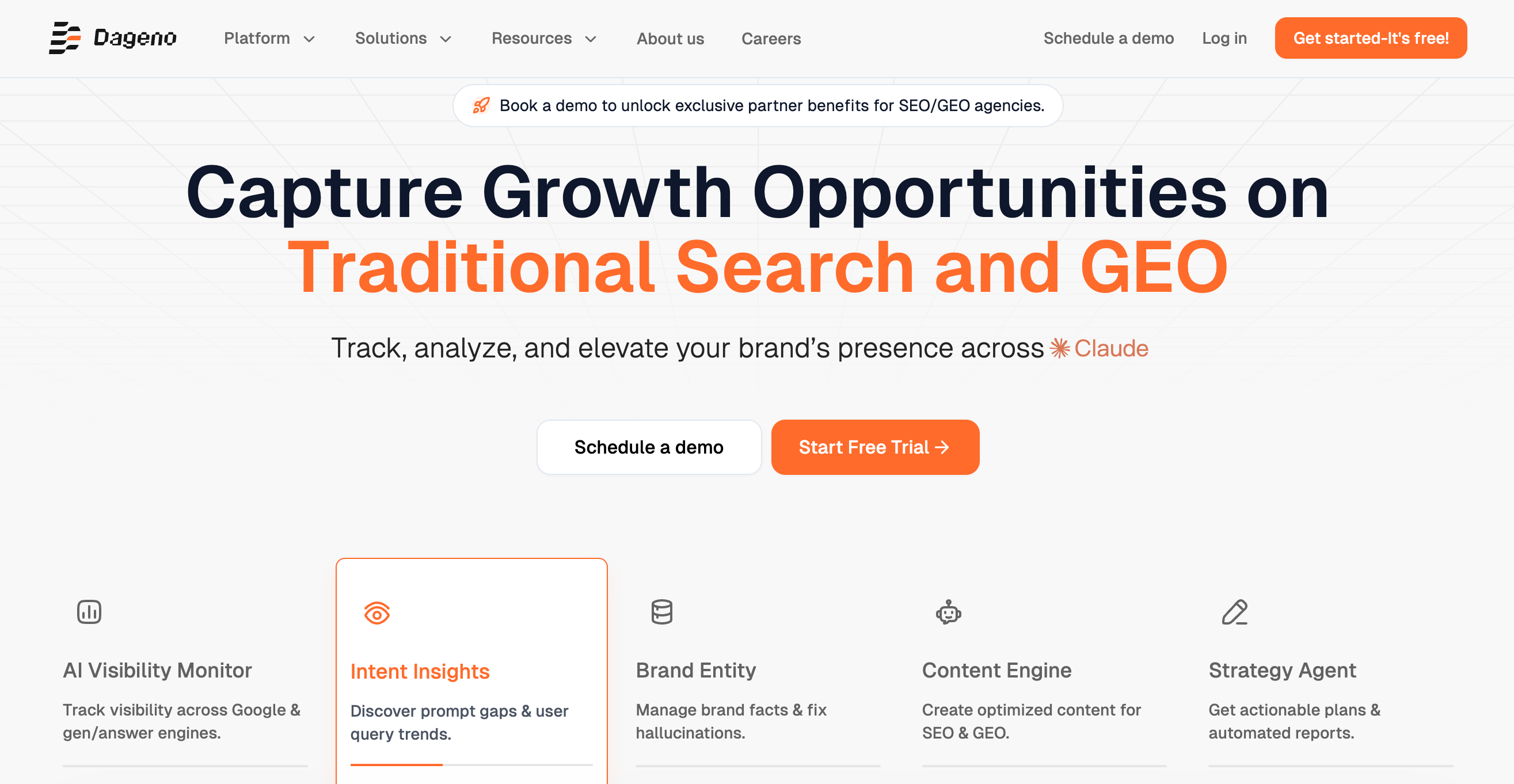
Scrunch advantages: Established platform maturity, proven track record, excellent bot traffic analysis, clean interface.
Dageno advantages: Unified AEO/GEO/SEO strategy engine (Scrunch is monitoring-only), hallucination correction tools (Scrunch can't fix misrepresentation), page-level GEO audits with actionable recommendations, automated execution workflows, real-time prompt volume discovery (Scrunch converts keywords to prompts).
The critical difference: Scrunch AI review consistently notes users lack actionable next steps. Dageno closes this loop—it doesn't just show visibility gaps; it identifies why they exist, recommends remediation, and automates implementation.
For brands evaluating Scrunch AI, the decision hinges on this question: do you need monitoring alone, or do you need monitoring plus optimization guidance? If the latter, Dageno's integrated approach delivers more ROI despite slightly higher positioning. One customer using Dageno reported identifying and fixing hallucination misrepresentations within 48 hours—something Scrunch AI review users consistently note as missing.
Verdict: Scrunch AI is a category leader in visibility monitoring. Dageno is a category leader in end-to-end AI optimization. Choose Scrunch if you have strong internal optimization resources; choose Dageno if you need guided, automated optimization.
Scrunch vs. Profound
Profound is Scrunch's most direct monitoring competitor. The comparison reveals important trade-offs.
Profound advantages: Unlimited prompts, more mature analytics, established enterprise trust, strategic support model.
Scrunch advantages: Lower starting price ($100 vs. Profound's higher enterprise pricing), agency-friendly features, GA4 integration.
Verdict: Both Scrunch AI and Profound excel at monitoring. Choose based on budget and integration needs rather than core functionality—they're increasingly similar at the monitoring layer.
Scrunch vs. Writesonic GEO Suite
Writesonic advantages: Integrated content generation and publishing, lower entry price ($199/month), broader GEO/SEO fusion, stronger execution layer.
Scrunch advantages: More comprehensive AI platform coverage, better bot traffic tracking, cleaner monitoring interface.
Verdict: Choose Writesonic if you need content optimization. Choose Scrunch if monitoring is your primary need.
Scrunch vs. SE Ranking AI Visibility
SE Ranking advantages: Tight SEO integration, source-level transparency, lower cost.
Scrunch advantages: More AI engines, better bot traffic analysis, agency features.
Verdict: SE Ranking wins if you want SEO/AI unified. Scrunch wins if AI monitoring is separate from SEO.
Who Should Buy Scrunch AI (And Who Shouldn't)
Good Fit For:
- Mid-market SaaS & B2B brands with established SEO programs and $500+/month budget
- Agencies managing 3+ client brands needing multi-workspace setup and client reporting
- Competitive categories (fintech, AI tools, enterprise software) where brand differentiation in AI answers matters
- Teams already comfortable with monitoring-style tools and willing to integrate separate optimization platforms
Poor Fit For:
- Startups or bootstrapped teams with limited marketing budgets
- Teams expecting all-in-one solution combining monitoring + content optimization
- Brands new to AI visibility requiring educational onboarding and strategic guidance
- Organizations unwilling to commit $500/month without trial period
Common Questions About Scrunch AI (Scrunch AI Review FAQ)
Q: Does Scrunch AI offer a free trial?
No. This Scrunch AI review confirms: Scrunch AI requires $500+ monthly commitment without trial period. This is a notable disadvantage in this Scrunch AI review compared to competitors offering free trials or freemium plans.
Q: How often does Scrunch AI update visibility data?
Every three days. This means you see relatively fresh data with Scrunch AI, but not real-time. For rapidly changing competitive landscapes, this Scrunch AI latency may miss short-term shifts.
Q: Can I export Scrunch AI data into my own reporting dashboard?
Yes, through API provisioning and data export functionality with Scrunch AI, though user reviews suggest the Scrunch AI reporting experience could be more polished. Expect manual work or custom integration with Scrunch AI.
Q: Is AXP included in my Scrunch AI subscription?
Not yet. This Scrunch AI review notes: AXP is in limited testing and not broadly available. Don't factor Scrunch AI's AXP into your purchase decision.
Q: Does Scrunch AI work for local or regional brands?
Yes. This Scrunch AI review confirms: the Scrunch AI platform supports regional and language-specific tracking, making Scrunch AI viable for multi-region brands.
Q: What's the difference between "custom prompts" and "pre-built prompts" in Scrunch AI?
Pre-built prompts in Scrunch AI are Scrunch AI's AI-generated industry queries (1,000 included). Custom prompts in Scrunch AI are queries you define. Each AI engine you apply a Scrunch AI prompt to counts as one credit against your custom prompt budget.
The Bottom Line: Is Scrunch AI Worth $500/Month?
For mid-market brands serious about AI visibility with budget for a dedicated monitoring tool: yes, Scrunch AI is worth the investment.
For startups, bootstrapped teams, or organizations expecting Scrunch to be their complete AI optimization solution: probably not.
The question isn't whether Scrunch AI is good—it clearly is. The question is whether monitoring-focused, premium-priced tooling fits your current stage, budget, and organizational readiness for AI search optimization. If you've outgrown free tools and need comprehensive multi-platform monitoring with bot traffic attribution, Scrunch delivers real value.
If you're still validating AI visibility as a priority or need end-to-end optimization guidance, invest in a more comprehensive platform or test cheaper alternatives first.
References
Scrunch AI G2 Reviews & Ratings
About the Author

Updated by
Richard
Richard is a technical SEO and AI specialist with a strong foundation in computer science and data analytics. Over the past 3 years, he has worked on GEO, AI-driven search strategies, and LLM applications, developing proprietary GEO methods that turn complex data and generative AI signals into actionable insights. His work has helped brands significantly improve digital visibility and performance across AI-powered search and discovery platforms.
Related Articles
Is It Possible to Track Brand Mentions in AI Search?

Ye Faye • Jun 08, 2026
Writesonic Review: What Its AI Visibility Suite Gets Wrong
Richard • Jun 09, 2026
Otterly.ai Review: A Practical Decision Guide for SEO, AEO, and GEO Teams
Ye Faye • Feb 26, 2026
RankIQ SEO Content Optimization Tool Review: Is It Enough for SEO and GEO in 2026?
Richard • Jun 16, 2026