How to Build a Programmatic SEO Content Factory (Step-by-Step Guide)
Build a scalable SEO content factory using programmatic SEO.
Track AI search visibilityNo install
Updated by
5 Min Read
Updated on Jan 19, 2026
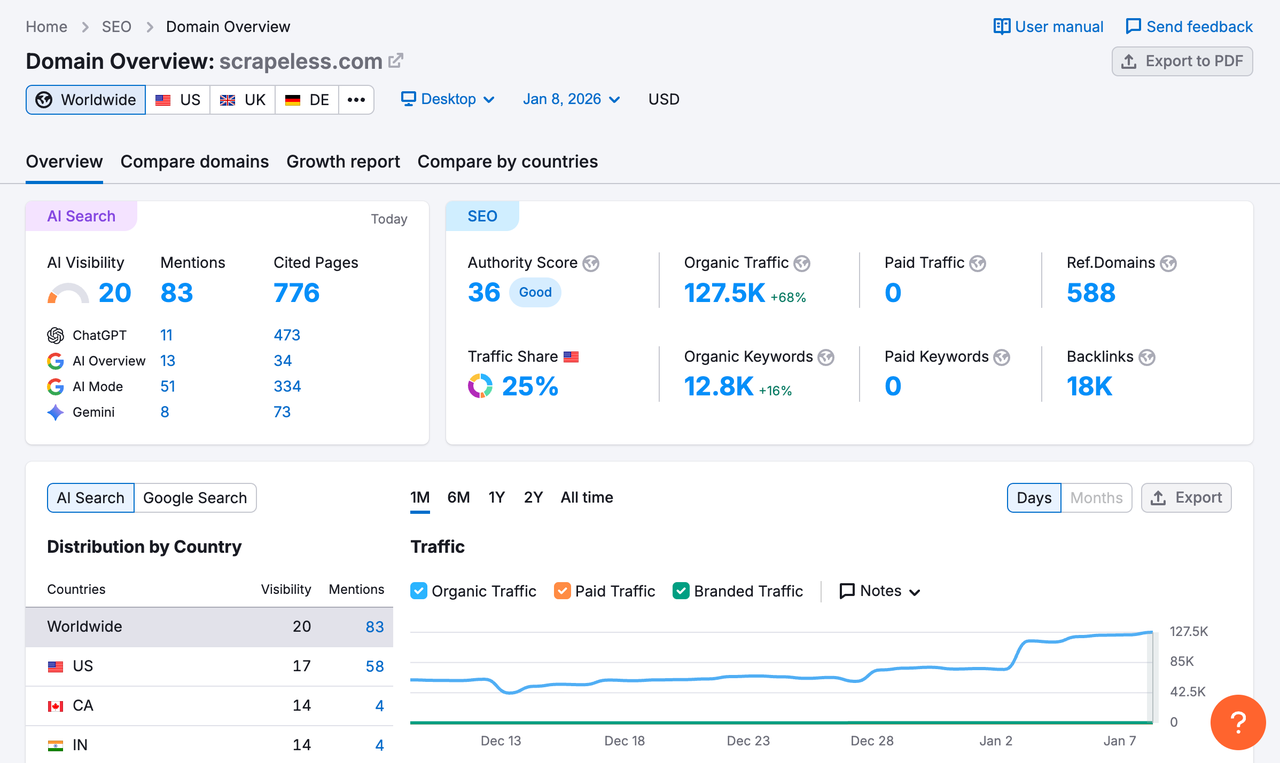
In one month, I built a content factory system using programmatic SEO, increasing organic search traffic by 111.29%, reaching 127.5K total traffic.
This is not black magic, nor a content farm.
It is the result of methodology + engineering + alignment with AI search mechanisms.
The Core Conclusion (TL;DR)
Programmatic SEO is not about batch-writing content.
It is about scaling the creation of real, combinable information that search systems (and AI) can understand, validate, and reuse.
What Programmatic SEO Is Not
Many people misunderstand programmatic SEO as:
- AI mass rewriting
- Keyword stuffing
- Template + number replacement
- Content farms
This is the biggest misconception in the industry.
What I Explicitly Did Not Do
-
❌ Rewrite YouTube/blog content with AI to generate highly similar pages
-
❌ Patch together chatbot conversations to create information illusions
-
❌ Replace keywords in templates to generate empty shell pages
- Example:
Lawyer fees $40,000 / $50,000 / $60,000
- Example:
-
❌ Fabricate data without sources (salaries, market sizes, statistics)
In modern Google and AI search systems, these practices lead to only one outcome:
Hallucination + Low-value content
The True Definition of Programmatic SEO
What Is Programmatic SEO?
Programmatic SEO is the structured decomposition of a set of related search demands, and the large-scale generation of incremental information through engineering methods.
How It Differs from Traditional SEO
Effective programmatic SEO must satisfy three conditions simultaneously:
- Information Increment – Each page adds new, irreplaceable information
- Structured Creation – Content modules are stable, reusable, and combinable
- Automated Closed Loop – Generation, publishing, indexing, monitoring, and iteration are automated
You do not need to write one article per keyword.
You need a formula:
Core Topic × User Intent × Scenario/Condition × Information Dimension × Output Type
The Content Formula Explained
1. Core Topic
Your main domain of service
- Example:
Wine label design
2. User Intent
What the user is trying to achieve
- How-to
- Decision-making
- Comparison
- Examples
- Resources / Tools
3. Scenario / Condition
Context or usage scenario
- Luxury wine
- Craft beer
- Minimalist style
4. Information Dimension
Decomposable information units
- Specifications / Regulations
- Process steps
- Methods / Techniques
- Case studies
- Pros & cons
5. Output Type
AI-usable or page-level presentation format
- How-to module
- Comparison chart
- FAQ module
- Case study
- Tool / resource module
What My Failed Attempts Taught Me
Failure 1: Repetitive Information
- Pages looked complete but were semantically identical
- Different wording ≠ new information
- AI detects similarity through embeddings
Failure 2: Keyword Stuffing
-
Awkward keyword variations
-
Modern search systems prioritize:
- Semantic completeness
- Problem-solving value
Failure 3: Empty Shell Pages
- Template + number replacement
- No new decision-making information
Failure 4: False Information (Fatal)
- Fabricated salaries, market size, statistics
In an AI search environment, this is equivalent to lying.
The Turning Point: A Proven Three-Step Framework
The framework I ultimately made work consistently is:
Step 1 | Planning: Structured Keyword System
Step 2 | Generation: Designing the Content Protocol
Step 3 | Engineering: Automating the System
Let's break them down one by one.
Step 1: Keyword Cluster Planning - From "Keyword Piling" to "Structured Generation"
This is the most important and often underestimated step in the entire system.
Because whether it's subsequent content production, automation processes, or visibility in AI search, it essentially depends on:
Whether you started with a "structured thinking" approach or a "keyword piling" approach.
Below, I will introduce several dimensions I focus on when selecting keywords.
1.1 Start with a Core Theme
Do not start with scattered keywords.
Start with a clear, extensible theme:
- Example:
Packaging design
Then decompose demand across dimensions:
- Function: dieline, mockups, label design
- Scenario: food, fashion, wine, electronics
- Style: minimalist, vintage, luxury
- Industry: beauty, FMCG, beverage
Example (Wine Packaging):
- Wine label design
- Beer label design
- Spirits label design
- Luxury wine label design
- Minimalist wine label design
1.2 Blue Ocean Keyword Validation
Use SEMRUSH with a 3-step filter:
- Find low-DR competitor sites
- Analyze keywords from their top pages
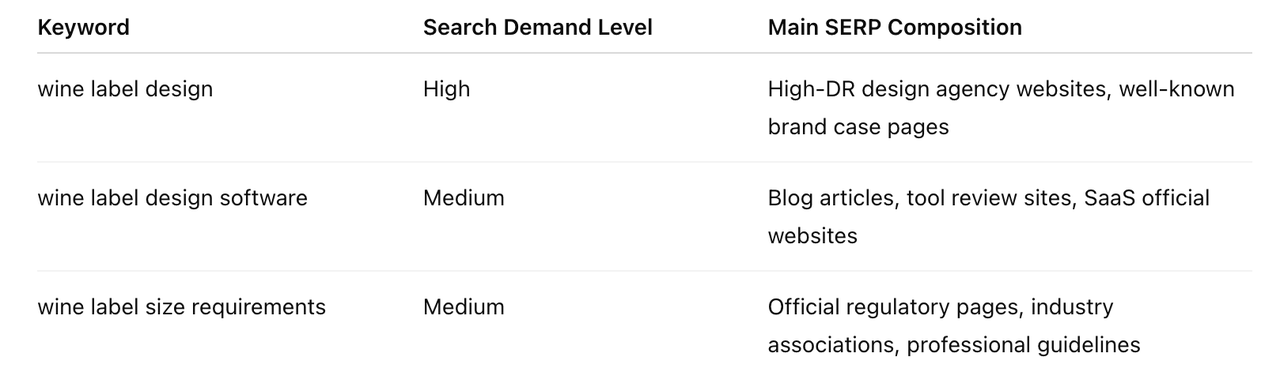
- Manually inspect SERPs (pages 1–2)
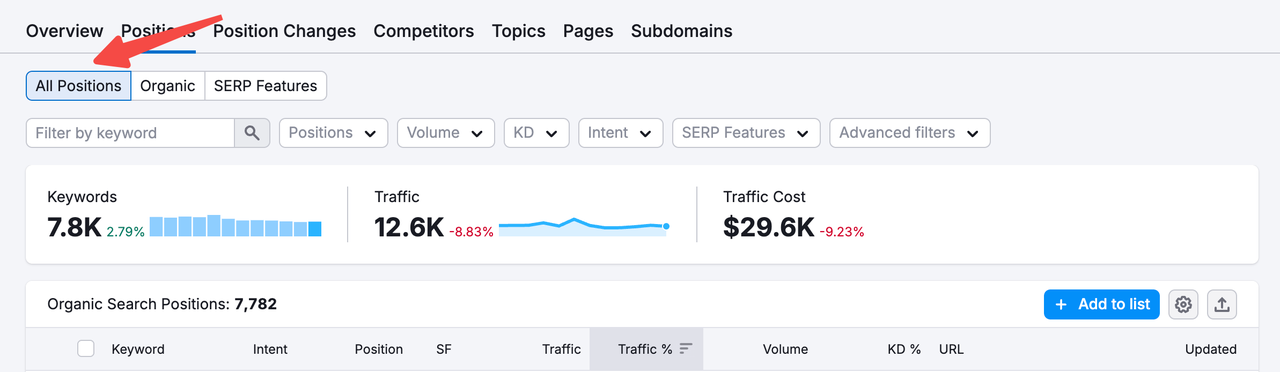
Example Illustration
1.3 Search Volume → Prompt Volume (AI Perspective)
Add an AI search layer:
- Focus on Prompt Volume, not just search volume
- Tools: Profound / Dageno
Evaluate:
- Is this topic frequently asked in AI tools?
- Are questions procedural, comparative, or example-based?
- Is the trend growing?
Example prompts:
- How to design a wine label?
- What size should a wine label be?
- Best wine label design software
These prompts directly shape titles and structure.
1.4 Query Fan-out (AI Question Decomposition)
After confirming Prompt Volume, I further analyze Query Fan-out.
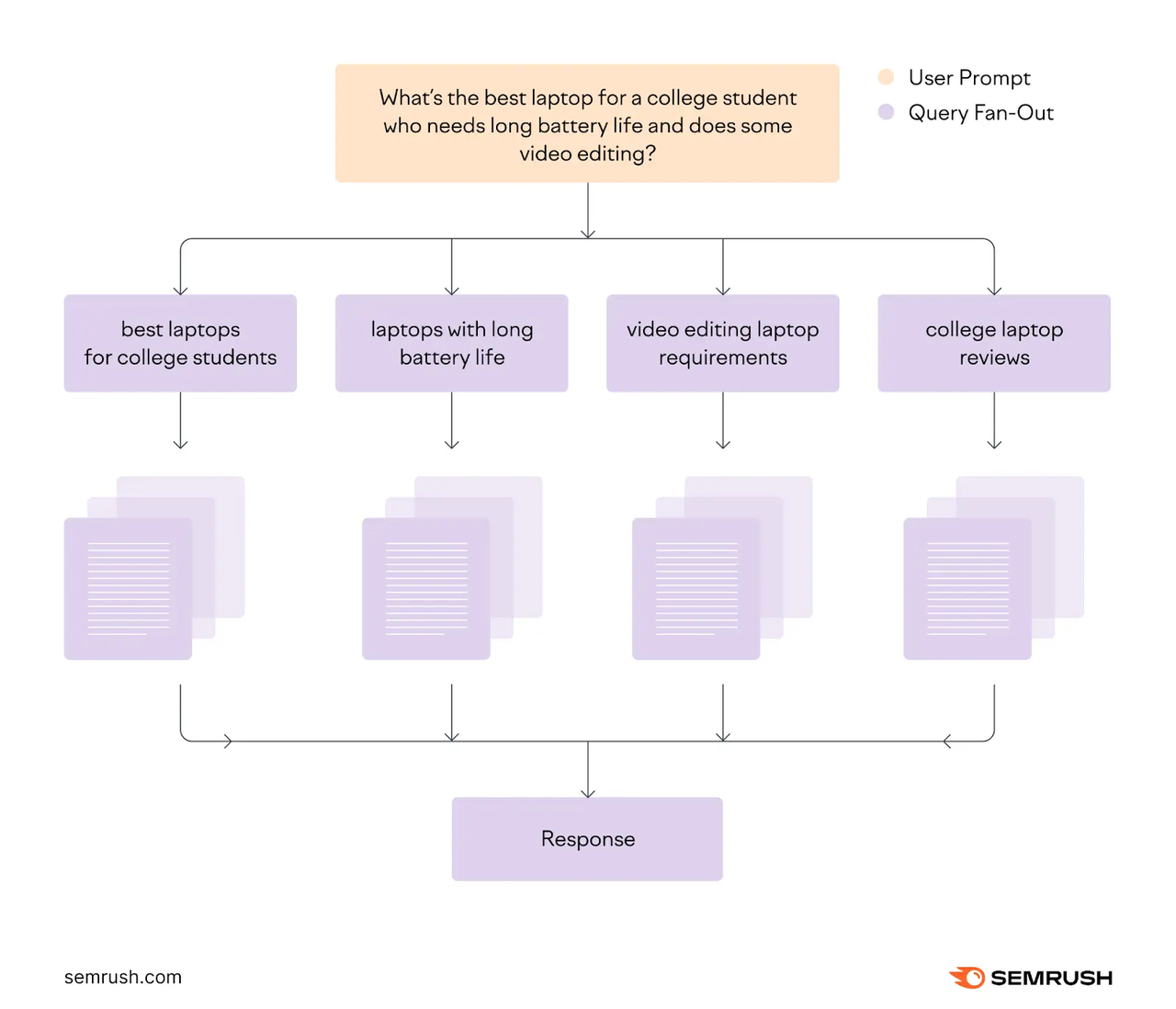
Query Fan-out is a core mechanism used by AI search systems when generating answers.
When a user inputs a question, AI does not just answer based on the superficial meaning of the question. Instead, it internally decomposes it into multiple sub-questions, retrieves and reasons in parallel, and then integrates the relevant information into a complete answer.
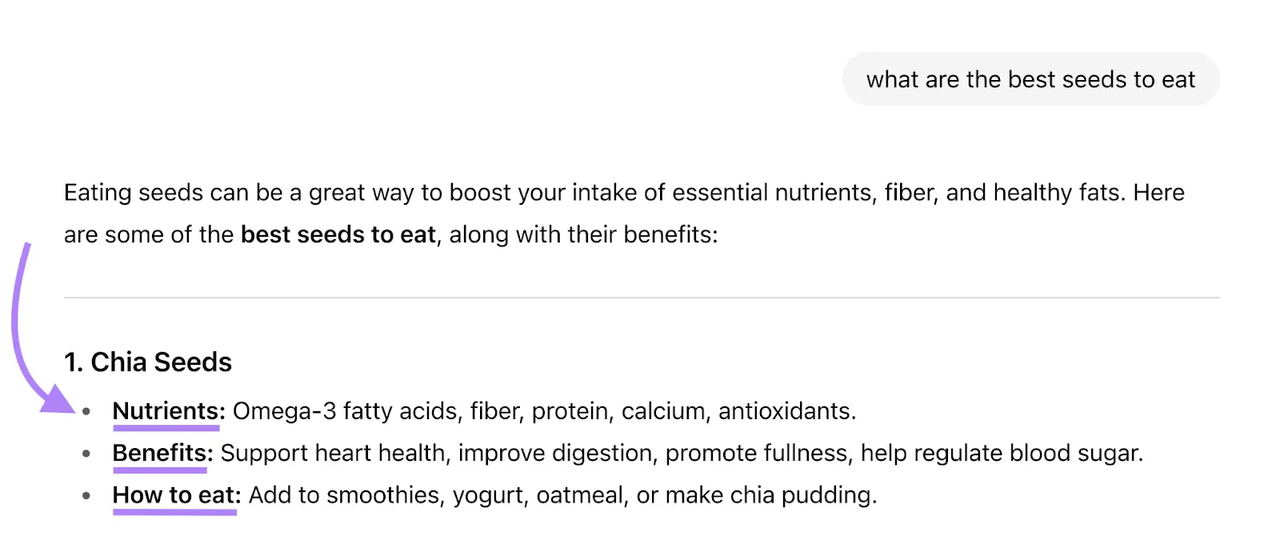
For example, when a user is interested in "wine label design," AI often naturally expands it into:
- Tool Level: What software can be used?
- Specification Level: What are the dimensions, regulations, and industry requirements?
- Method Level: What is the specific design process?
- Comparison Level: How does it differ from other wines or packaging types?
- Example Level: Are there any mature or high-end case studies?
These are not artificially set content categories, but rather information structures necessary for AI to provide high-quality answers.
In practice, I directly map the Query Fan-out results identified in Profound to:
- Page structure
- Content module splitting
- And subsequent automated content production logic
The goal is only one:
To make content naturally appear in the path of AI's combined answers.
Here, I recommend free external tools to obtain these precise sub-questions: Mike King's Qforia or Dian's Fan-out Tool.
Step 2: Keywords → Content Production Units
The original keyword organization leaned towards traditional SEO. Now, keywords need to be organized by decomposing fields according to the formula:
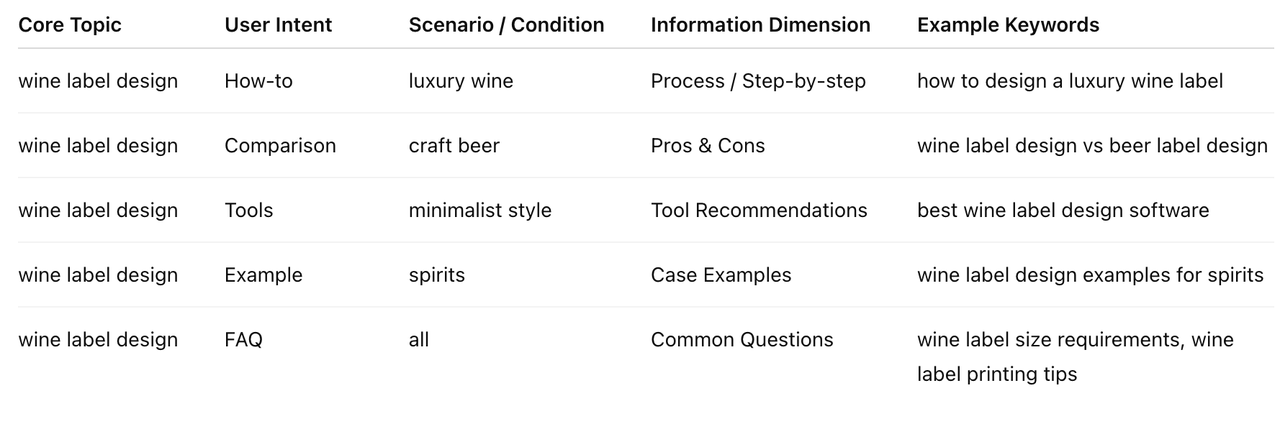
Idea: Each keyword now corresponds not just to a search term, but to a complete content generation field, facilitating downstream automated production.
Step 3: Content Generation via Content Protocols
Core understanding: In programmatic SEO, each piece of content is not an article, but rather an information interface.
- Formula = Content Input Conditions
- Determines "whose problem this content is solving and what that problem is."
- Content Protocol = Content Output Structure
- Determines "whether this problem is fully answered," and whether it can be correctly understood and cited by AI search systems.
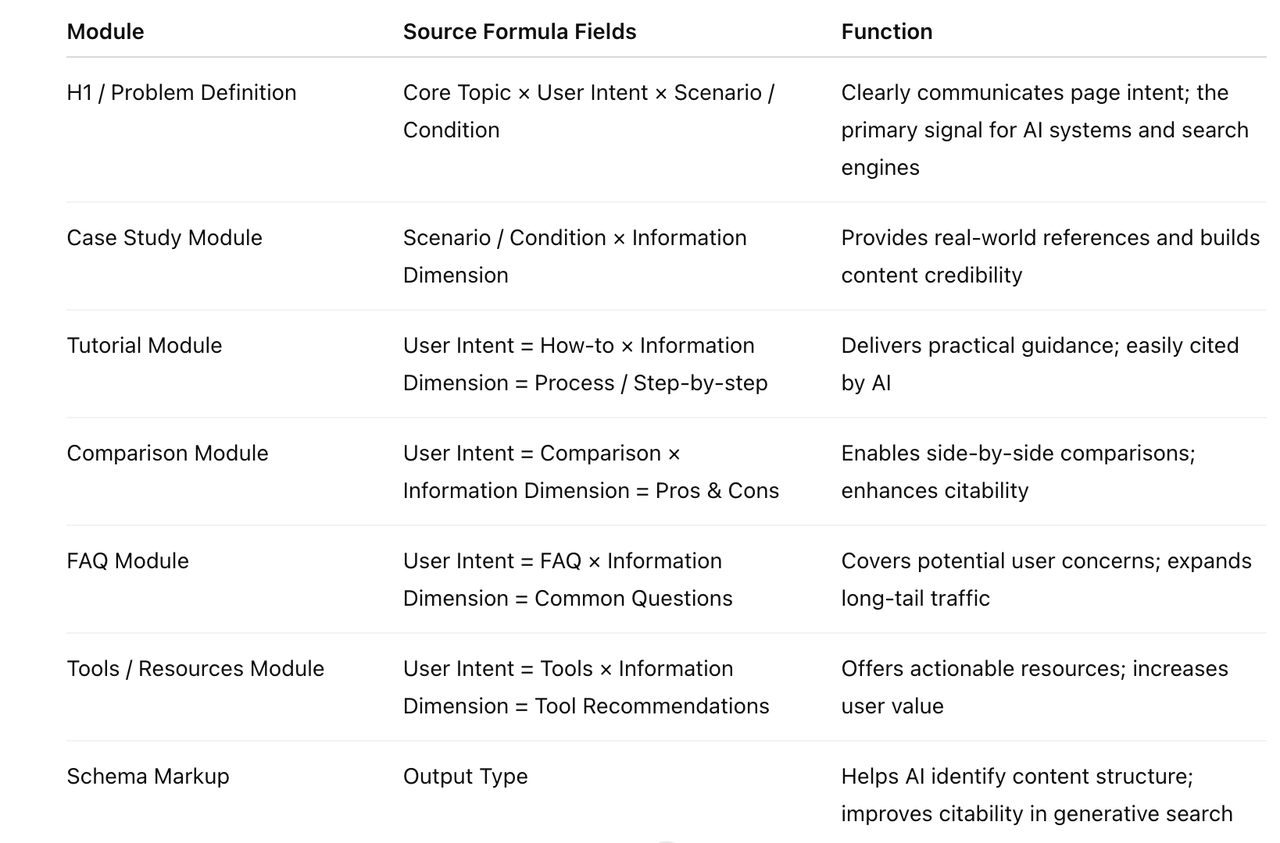
3.1 Standard Content Module Mapping Formula
3.2 Why Each Module is Essential
H1 Problem Definition Layer
- Core Topic × Scenario × Demand = A complete question.
- The first judgment criterion for AI and search engines is the title and the opening intent.
- If the H1 is not precise, the entire content may be ignored or misunderstood by AI.
Case Study Module
- AI needs to know that "the problem indeed exists in reality."
- Build credibility through case studies, and let search engines know that your content is not an empty template.
Tutorial Module
- The tutorial module is the part that truly solves specific needs.
- Each step must be verifiable, without irrelevant information.
- This is the content most easily cited by AI, and the most valuable to users.
Comparison Module
- AI naturally likes to make horizontal comparisons when generating answers.
- Provide the pros and cons of different solutions and applicable scenarios to enhance content citability.
FAQ Module
- Core Topic × Scenario × Demand will naturally extend to potential questions.
- Pre-cover potential user questions to increase the probability of AI extraction and natural long-tail traffic.
Tool / Resource Module - Transform information into actionable operations.
- Make content not only readable but also usable.
- AI sees "action instructions," making it easier to cite in generated answers.
⚠️ Importance of Structured Markup
Use Schema markup (JSON-LD) to make your page structure completely transparent to generative engines:
- HowTo Schema (for tutorial modules)
- ComparisonChart Schema (for comparison modules)
- FAQPage Schema (for FAQ modules)
This will significantly increase the probability of your content being correctly identified and cited by AI.
Step 4: Engineering the Closed Loop
4.1 Why is Engineering Essential?
Without engineering, there are only two outcomes:
- Human resources collapse.
- Quality gets out of control as scale increases.
Moreover, in the era of generative engines, engineering has additional necessity:
- Page updates need to automatically trigger re-indexing and AI visibility re-evaluation.
- It's necessary to monitor the citation frequency and position of different pages in generative engines.
- It's necessary to dynamically optimize content structure to adapt to the evolution of AI search algorithms.
4.2 CMS Selection: Why I Recommend Headless CMS
I recommend Strapi/Payload for one reason only:
Fields are first-class citizens, not pages.
I'm not concerned with "how to write pages," but rather:
- Which fields are reusable (e.g., "tool recommendation" module used on 100 pages).
- Which fields are combinable (e.g., H2 modules can be flexibly arranged).
- Which fields determine page differences (e.g., different "case studies" determine the uniqueness of different pages).
Key Difference:
Traditional WordPress/Webflow = Pages first, then content.
Headless CMS = Data structure designed first, pages are different presentations of data.
Different content is essentially different data structures. This is the watershed for achieving true scalability.
Recommended Architecture:
- Headless CMS (Strapi/Payload) stores structured content.
- Next.js/Hugo automatically generates static pages based on templates.
- Automated scripts trigger updates periodically.
4.3 Automated Publishing and Indexing: Keeping Search Engines and AI Up-to-Date with You
Sitemap Engineering
- Split Sitemaps by content type (news/blog/guides, etc.).
- Automatically update lastmod (triggered by field changes).
Google Search Console Integration
- Use the Indexing API to automatically push new pages.
Generative Engine Visibility Monitoring
- Regularly use Dageno to check if your content appears in ChatGPT/Perplexity answers.
- Track changes in citation frequency.
- Identify which topics gain attention in generative engines.
WordPress users can achieve the same effect with n8n + WP REST API.
Final Thought
Programmatic SEO is not about producing more content.
It is about producing more usable, structured, truthful information—at scale—so that both humans and AI systems can trust, combine, and cite it.
About the Author

Updated by
Ye Faye
Ye Faye is an SEO and AI growth executive with extensive experience spanning leading SEO service providers and high-growth AI companies, bringing a rare blend of search intelligence and AI product expertise. As a former Marketing Operations Director, he has led cross-functional, data-driven initiatives that improve go-to-market execution, accelerate scalable growth, and elevate marketing effectiveness. He focuses on Generative Engine Optimization (GEO), helping organizations adapt their content and visibility strategies for generative search and AI-driven discovery, and strengthening authoritative presence across platforms such as ChatGPT and Perplexity
