The best way to monitor competitor mentions in AI search is to track which brands appear, rank, get cited, and get recommended across high-intent prompts in ChatGPT, Gemini, Perplexity, Google AI, Copilot, and Grok.
Explore 12,000+ niche markets with no login required
TL;DR
Monitoring competitor mentions in AI search means tracking whether AI systems recommend, cite, compare, and describe competitors instead of your brand.
The most important competitor AI search metrics are share of voice, visibility gap, average position, citation share, source gap, sentiment, prompt-level competitor presence, and platform-specific rankings.
Competitor monitoring should happen at the prompt level because one high-intent question can reveal exactly where AI systems mention competitors and ignore your brand.
The strongest workflow connects competitor mention data to source analysis, content strategy, technical GEO fixes, and measurable follow-up attribution.
Dageno AI helps teams monitor competitor mentions and close GEO gaps through data monitoring → strategy → content generation → result attribution.
What Does It Mean to Monitor Competitor Mentions in AI Search?
Monitoring competitor mentions in AI search means measuring how often AI systems mention, rank, cite, and recommend competitors when users ask questions about your category, product, use case, or brand alternatives.
In traditional SEO, competitor monitoring often means tracking which URLs outrank your pages on Google. In AI search, competitor monitoring is different. A competitor can win even when the user never sees a classic search results page. ChatGPT, Gemini, Perplexity, Google AI Overviews, Google AI Mode, Copilot, and Grok can synthesize a direct answer, recommend a short list of brands, cite specific sources, and frame one competitor as the best option.
A complete competitor mention workflow should answer seven questions:
Which competitors appear in AI answers for high-value prompts?
Which competitors appear before your brand?
Which competitors get cited as trusted sources?
Which prompts mention competitors but omit your brand?
Which AI platforms favor specific competitors?
Which competitor content or third-party sources shape AI answers?
Which GEO actions can close the competitor gap?
Dageno AI is relevant because competitor monitoring in AI search should not stop at a mention count. The Dageno AI GEO platform helps brands monitor visibility, citations, share of voice, sentiment, source gaps, prompt gaps, and competitor performance across major AI search systems.
Why Competitor Mentions in AI Search Matter
Competitor mentions in AI search matter because users increasingly ask AI systems for recommendations, comparisons, alternatives, and buying advice before visiting websites.
OpenAI explains that ChatGPT Search can provide answers with links to web sources, and its source panel can show cited sources and related links. OpenAI Help Center – ChatGPT Search
Google explains that AI features in Search help users explore questions and connect with supporting web sources, which means AI-generated answers can influence discovery and source visibility before a traditional click. Google Search Central – AI features and your website
The competitor article behind this topic emphasizes that AI search competitor monitoring should track constraint-based prompts, competitor cited alerts, and share-of-voice movements rather than relying only on traditional SEO rankings. LLMClicks.ai – Monitor competitor mentions in AI search
The business risk is clear: if AI systems repeatedly recommend competitors for bottom-funnel prompts, your brand may lose consideration before the buyer reaches your website. Dageno AI helps teams identify those competitor-owned AI moments and turn them into content, source, and attribution actions.
Original insight:
A competitor mention in AI search is not just an awareness signal. It is a demand-capture signal because the AI system may be actively shaping a buyer’s shortlist.
Competitor Mentions vs Competitor Rankings
Competitor mentions show whether a competing brand appears in an AI answer, while competitor rankings show how prominently the competitor appears inside that answer.
Both metrics matter. A competitor mentioned in position one is usually more dangerous than a competitor mentioned in a long “also consider” list. A competitor cited by the AI answer may be even more influential because citation indicates source authority, not only brand presence.
Dimension
Competitor mention
Competitor ranking
Main question
“Did the competitor appear?”
“Where did the competitor appear?”
AI search signal
Brand presence in an answer
Prominence and perceived authority
Business meaning
Competitor entered the consideration set
Competitor may be preferred by the AI answer
Best follow-up metric
Share of voice
Average position and citation share
Dageno AI use case
Identify competitor visibility gaps
Track rank, position, and platform differences
Dageno AI helps teams track both layers. Visibility and share of voice show whether competitors appear, while average position and citation share show how strongly AI systems position those competitors.
The Core Metrics for Monitoring Competitor Mentions in AI Search
The core metrics for monitoring competitor mentions in AI search are visibility, share of voice, average position, citation share, source gap, sentiment, platform coverage, and opportunity score.
A competitor mention report should not only count names. A useful report should explain where competitors win, why they win, and what the brand should do next.
Metric
What the metric measures
Why the metric matters
Dageno AI workflow connection
Competitor visibility
How often AI systems mention competitors
Shows who appears in AI answers
Tracks competitor presence across prompts
Share of voice
Your brand’s AI presence versus competitors
Shows who owns the AI narrative
Benchmarks brand authority against competitors
Average position
Where each brand appears in AI answers
Shows competitor prominence
Tracks ranking advantage by prompt and topic
Citation share
Which brand’s sources are cited
Shows source authority
Identifies competitor source advantages
Source gap
Prompts where competitors are cited and your brand is not
Shows missing trust signals
Converts gaps into content and source tasks
Sentiment
How positively or negatively AI describes each brand
Shows reputation risk and opportunity
Prioritizes messaging and proof fixes
Platform coverage
Which AI systems favor which competitors
Shows where to focus GEO resources
Supports platform-specific strategy
Opportunity score
Which competitor gaps are highest priority
Turns monitoring into action
Creates a ranked execution list
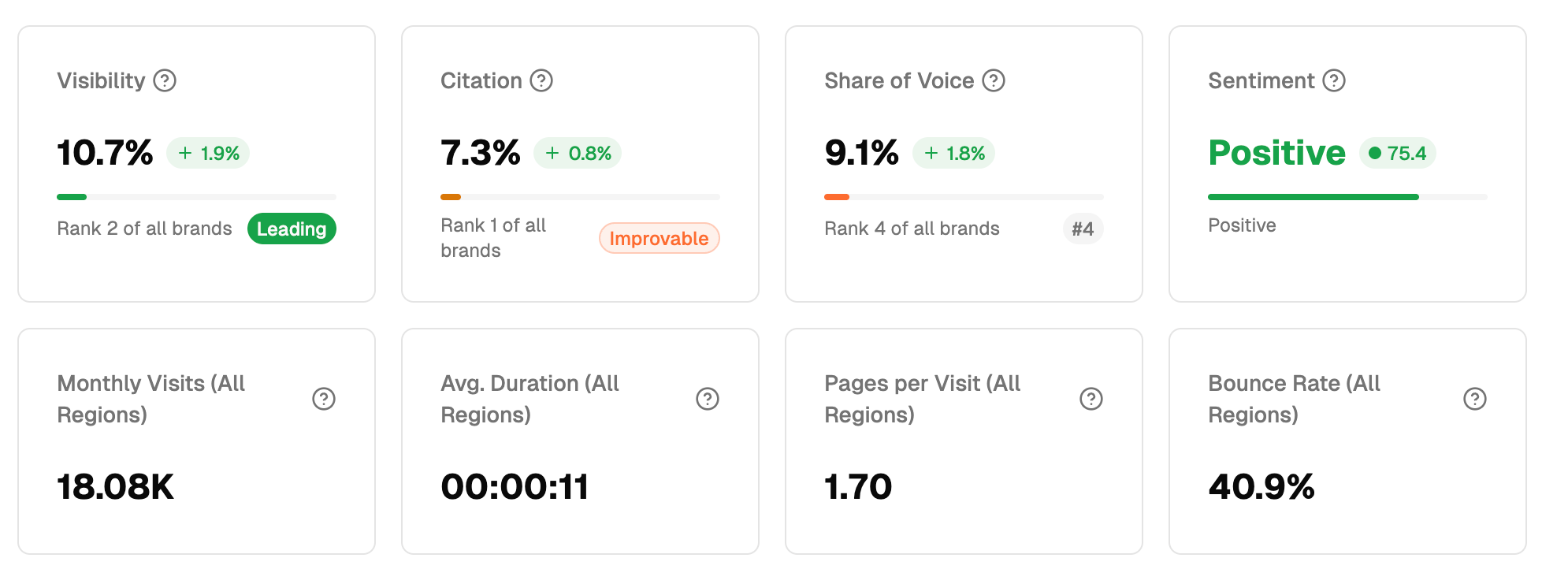
Dageno AI’s Overview module is useful because it brings Visibility, Citation, Share of Voice, and Sentiment together. These metrics give teams an executive-level view of whether AI systems are talking about the brand or competitors.
Practical example:
A SaaS company may see that Competitor A appears in 78% of “best [category] software” prompts while the brand appears in only 22%. If Competitor A also receives more citations and appears earlier in the answer, the issue is not only visibility; the issue is competitor narrative dominance.
Start With Competitor Prompt Discovery
The best competitor monitoring workflow starts with discovering the prompts where buyers ask AI systems to compare, shortlist, or choose solutions.
A weak prompt list creates a weak competitor report. Tracking only your brand name will not show where competitors win category discovery. The best prompt list includes discovery, comparison, alternative, trust, pricing, implementation, and buying-criteria prompts.
High-value competitor prompt types include:
“Best [category] tools”
“[Brand] vs [Competitor]”
“Alternatives to [Competitor]”
“Top [category] platforms for [industry]”
“Which [solution] should I choose for [use case]?”
“Is [Competitor] better than [Brand]?”
“What are the disadvantages of [Competitor]?”
“Best affordable alternatives to [Competitor]”
“Which [category] tools are easiest to implement?”
“Which [category] vendors are best for enterprise teams?”
Dageno AI’s Free Prompt Miner helps teams discover high-value AI prompts based on brand, market, business line, region, and language. This matters because competitor monitoring should reflect real buyer questions, not internal keyword assumptions.
Original insight:
The best competitor prompt set should include “enemy prompts.” These are prompts where a user starts with a competitor name, such as “alternatives to [Competitor]” or “is [Competitor] worth it?” Enemy prompts reveal whether AI systems let your brand enter a competitor-owned buying journey.
Prompt-Level Competitor Tracking Is the Smallest Verifiable Unit
Prompt-level competitor tracking shows the exact questions where AI systems mention competitors, omit your brand, cite competitor sources, or rank competitors above you.
Aggregate dashboards are helpful, but prompt-level data is where GEO becomes actionable. One prompt can show that AI systems mention four competitors, rank your brand last, and cite two competitor-owned pages. That is a clear execution brief.
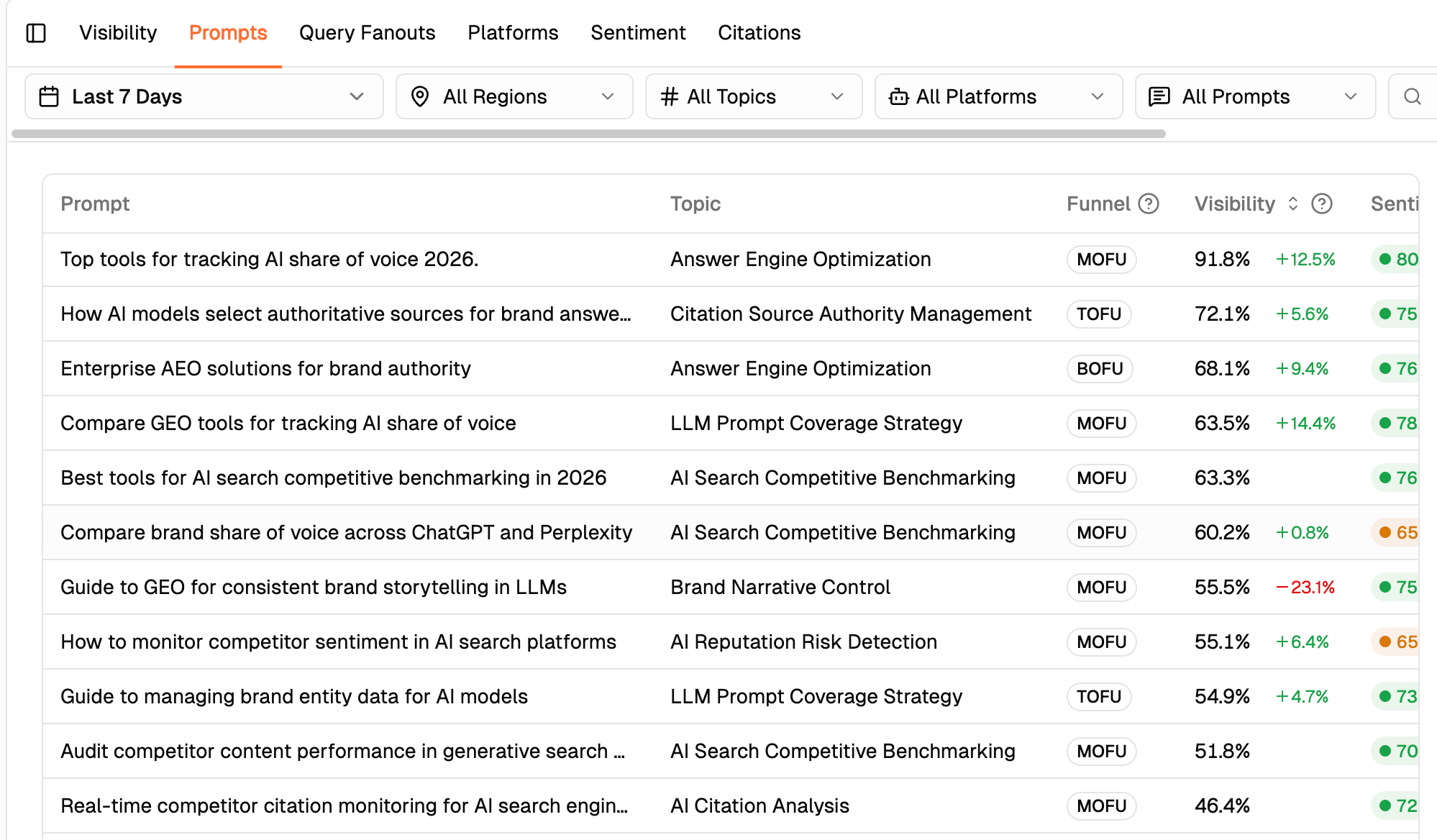
Dageno AI’s Prompts Analysis module helps teams inspect the exact user questions that drive AI visibility, competitor mentions, ranking positions, and source gaps.
Dageno AI’s prompt detail view helps teams see brand mentions, ranking positions, competitors, and source gaps at the level where content teams can act.
Practical example:
For the prompt “best AI visibility tools for agencies,” Dageno AI may show that Competitor A ranks first, Competitor B ranks second, and your brand is absent. The content action could be an agency-focused GEO page, a comparison table, partner proof, and third-party source building.
Share of Voice Reveals Who Owns the AI Narrative
Share of voice measures how much of the AI answer landscape belongs to your brand compared with competitors.
Share of voice is more useful than raw mention count because AI search is a competitive narrative environment. A brand can appear occasionally while competitors dominate the answer set, citation set, and recommendation language.
Dageno AI’s Analytics module helps teams compare visibility, share of voice, rank, and trend changes across topics, platforms, and competitor sets.
The Share of Voice view helps teams identify whether AI systems talk about the brand or competitors more often for the same topic.
Share of voice should be reviewed by:
Topic
Prompt cluster
Funnel stage
Platform
Region
Language
Product line
Competitor group
Citation source
Sentiment theme
Original insight:
AI share of voice should be tied to sales objections. If sales repeatedly loses deals to one competitor and Dageno AI shows that competitor dominates bottom-funnel AI prompts, the competitor mention data becomes a direct go-to-market priority.
Competitor Citation Tracking Shows Why AI Trusts Competitors
Competitor citation tracking identifies the domains and pages AI systems use when recommending or describing competing brands.
Competitor mentions tell you who appears. Competitor citations tell you why they appear. If AI systems repeatedly cite a competitor’s documentation, comparison page, analyst mention, review profile, or industry guide, your brand has a source authority gap.
Ahrefs reported that in its 2026 study of 863,000 SERPs, only 38% of AI Overview citations came from pages ranking in Google’s top 10, which means AI citation behavior should be tracked directly rather than inferred from classic rankings. Ahrefs – AI Overview citations and top 10 rankings
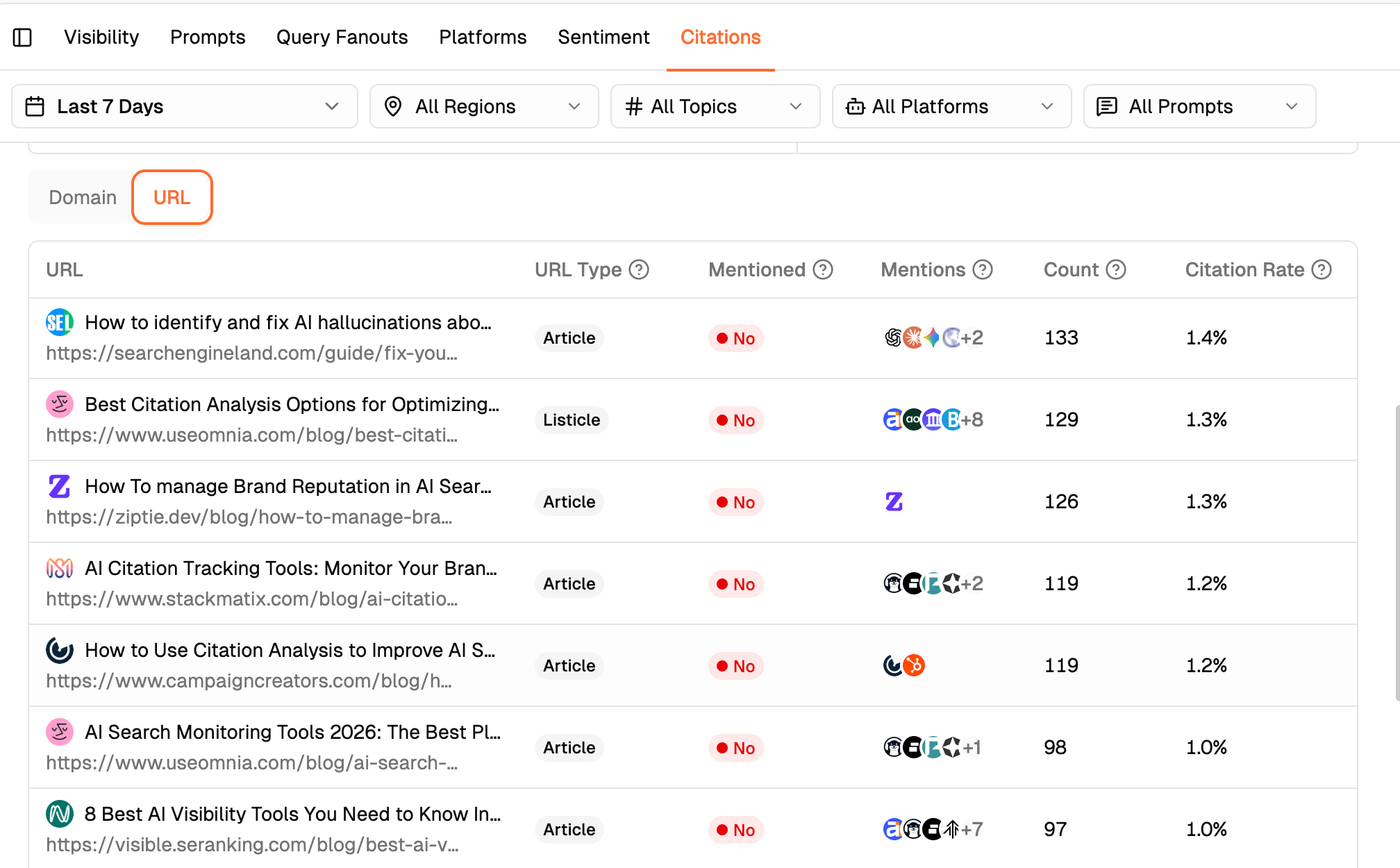
Dageno AI’s Citations module helps teams identify which domains and specific URLs AI systems cite for the brand and competitors. This is critical for competitive GEO because source gaps are often the reason competitors win AI recommendations.
Use this competitor citation audit model:
Competitor source type
What to inspect
GEO response
Competitor product pages
Which product claims AI uses
Create clearer product and feature pages
Competitor comparison pages
Which evaluation criteria AI repeats
Build fair, evidence-backed comparison content
Competitor documentation
Which technical answers AI trusts
Improve documentation and implementation guides
Review platforms
Which strengths or complaints AI summarizes
Strengthen review response and proof assets
Third-party directories
Which category descriptions shape AI answers
Update listings and category positioning
Media coverage
Which external mentions validate competitors
Build credible PR and expert source coverage
Forums and communities
Which user discussions influence sentiment
Address real product issues and publish transparent answers
Practical example:
If AI systems cite a competitor’s “best tools for remote teams” page when answering a high-intent prompt, the fix may require a new use-case page, clearer comparison content, third-party validation, and a stronger internal linking path to that page.
Platform-level competitor monitoring shows which AI engines favor which competitors.
A competitor may dominate ChatGPT but be weaker in Perplexity. Another competitor may rank strongly in Google AI Overviews because its pages align better with Google’s source selection. Platform-level competitor tracking helps teams avoid assuming that one AI engine represents the entire AI search market.
Dageno AI covers major AI search and generative platforms, including ChatGPT, Perplexity, Gemini, Google AI Overviews, Google AI Mode, Copilot, and Grok. The platform also supports multi-region and multi-language monitoring for global markets.
Dageno AI’s Platforms module compares visibility, share of voice, average position, citation share, sentiment score, and rank trends by AI platform.
Platform-level competitor monitoring should answer:
Which platforms mention competitors most often?
Which platforms cite competitor domains most often?
Which platforms rank your brand lower than competitors?
Which platforms describe competitors more positively?
Which platforms reveal the fastest opportunity to improve?
Which platforms matter most for your customer journey?
Dageno AI helps teams allocate GEO resources based on platform-specific evidence instead of spreading effort evenly across every AI engine.
Topic Performance Shows Where Competitors Own Demand
Topic performance reveals which semantic question clusters competitors dominate.
AI users do not ask one keyword. They ask many variations of the same underlying need. Competitor monitoring should group those variations into topics so teams can see where a competitor owns an entire demand cluster.
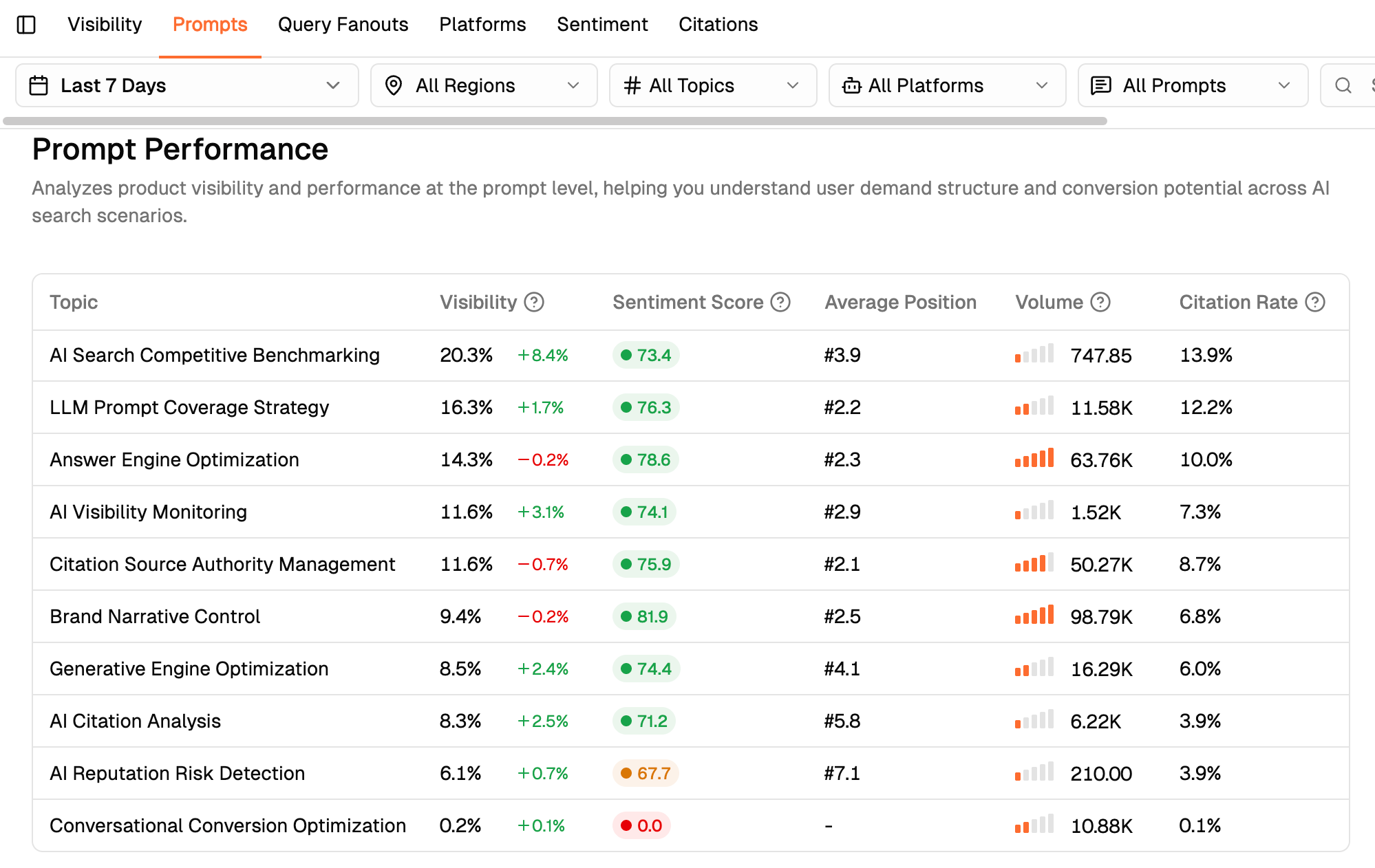
Dageno AI’s Topic Performance module helps teams move from keyword tracking to question semantics. It shows visibility, sentiment, average ranking, citation rate, and volume signals across related prompt clusters.
Topic-level competitor monitoring helps teams find:
High-volume topics where competitors dominate
Low-competition topics where your brand can win faster
Bottom-funnel prompts where competitors appear first
Topics with strong competitor citation share
Topics where AI sentiment favors competitors
Topics where your content does not answer the right questions
Original insight:
The best competitive GEO strategy is not always to attack the largest topic first. A brand can often gain faster traction in mid-volume, high-intent topics where competitors have weak citations and AI answers are still unstable.
Sentiment Comparison Reveals Whether Competitor Mentions Are Persuasive
Sentiment comparison shows whether AI systems describe your brand and competitors positively, neutrally, or negatively.
A competitor mention is not automatically a competitor win. AI may mention a competitor but describe it as expensive, difficult to implement, poorly suited for small teams, or limited in support. Sentiment analysis helps teams distinguish dangerous competitor mentions from weak or neutral mentions.
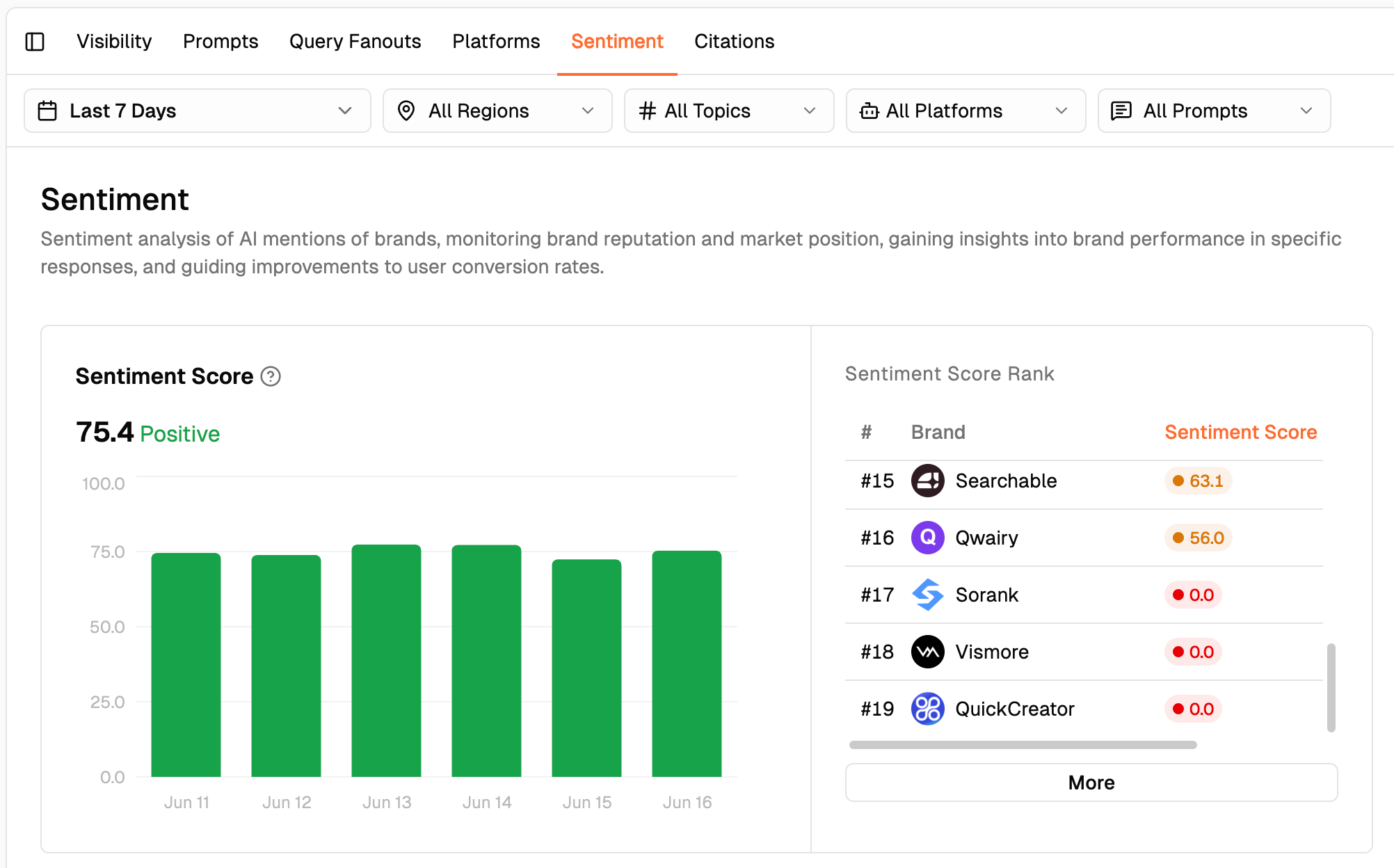
Dageno AI’s Sentiment module helps teams monitor emotional distribution and sentiment trends across AI mentions.
Competitor sentiment should be tracked by:
Pricing
Ease of use
Reliability
Customer support
Security
Integration depth
Implementation speed
Enterprise readiness
Best-fit customer type
Weaknesses and disadvantages
Business Insider reported on a 2026 Semrush study showing that marketers face AI search challenges such as competitors being mentioned more frequently, inaccurate brand descriptions, and unclear brand positioning. Business Insider – AI search and brand visibility challenges
Practical example:
If AI systems say a competitor is powerful but difficult to implement, your brand can create implementation-speed pages, migration guides, onboarding proof, and comparison content that positions your product as the easier choice.
Query Fanouts Reveal Competitor Research Paths
Query fanouts reveal the sub-queries and source paths AI systems use when researching an answer.
Competitor mentions often appear because AI systems explore sources where competitors are more visible. A high-fanout prompt can reveal that AI is researching a category deeply, but the brand is absent from the research pathway.
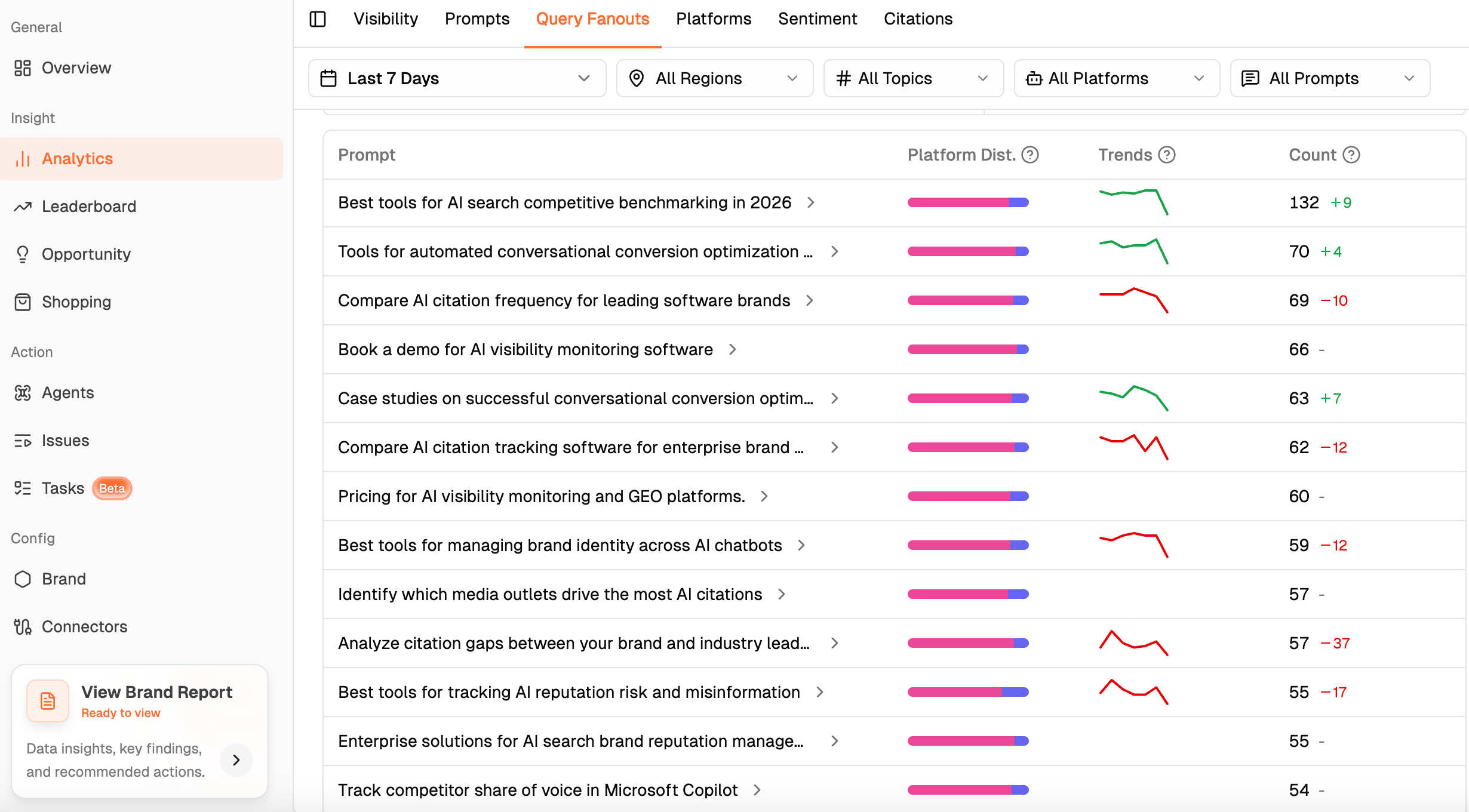
Dageno AI’s Query Fanouts module helps teams understand the research depth behind prompts and identify source paths where competitors dominate.
Query fanout monitoring should identify:
High-research prompts where competitors appear
Sub-queries that repeatedly lead to competitor content
Third-party sources that validate competitors
Owned pages missing from AI research paths
Questions that need stronger FAQs or comparison content
Topics where source-building can improve AI trust
Research on generative search citations shows that AI search systems can cite sources differently across providers and topics, which reinforces the need to track source paths directly. arXiv – News source citing patterns in AI search systems
Opportunity Scoring Turns Competitor Mentions Into an Action Plan
Opportunity scoring ranks competitor mention gaps by business value, prompt intent, brand gap, source gap, platform coverage, and execution feasibility.
A competitor monitoring report is only useful when it tells the team what to fix first. The highest-priority opportunity is usually a prompt where competitors appear, competitors are cited, your brand is absent, and the prompt reflects buyer intent.
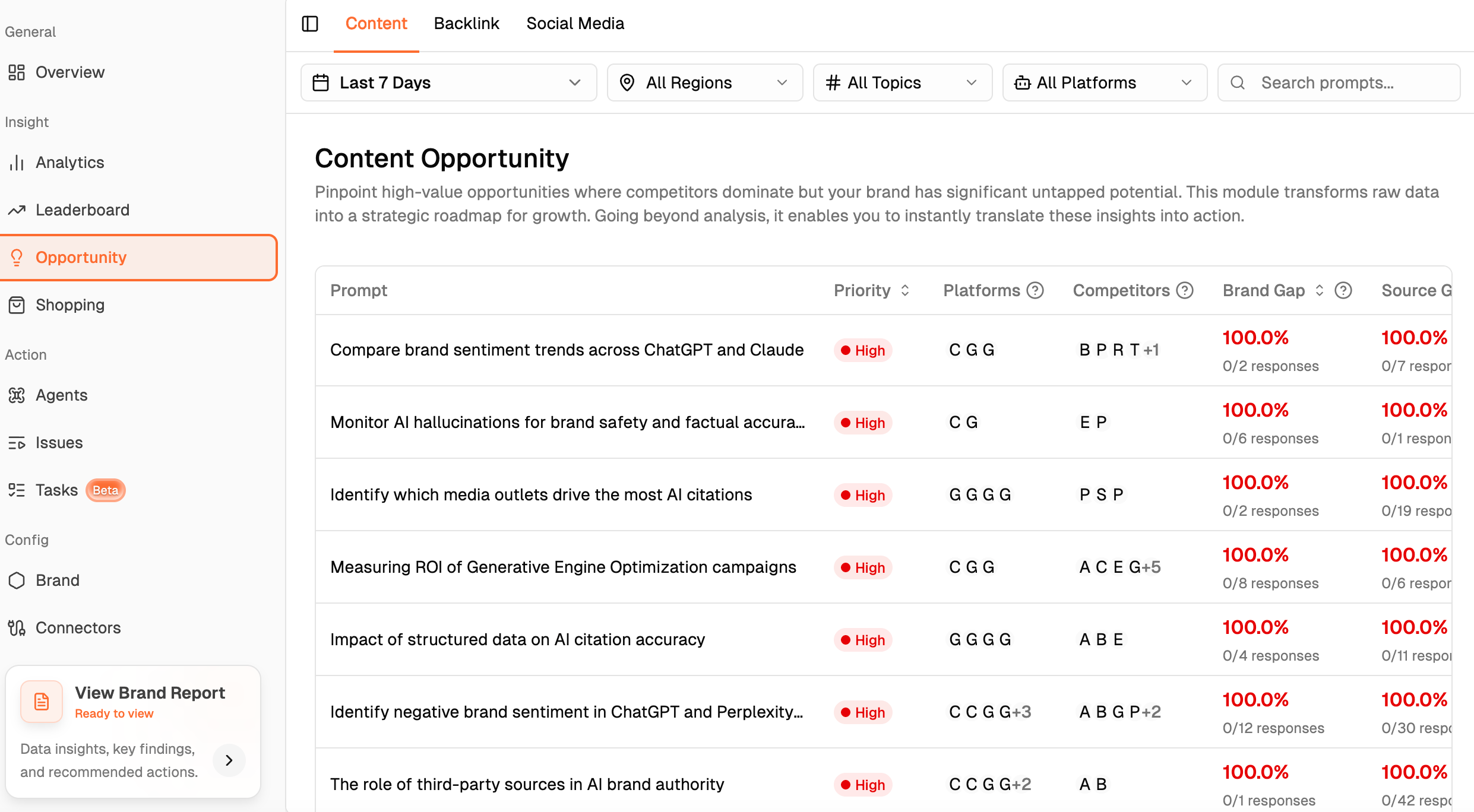
Dageno AI’s Opportunity module automatically aggregates scattered prompt gaps into prioritized action items. Each opportunity can be traced to a prompt, platform, brand gap, source gap, and competitor visibility pattern.
Use this priority model:
Opportunity signal
High-priority example
Recommended action
Competitor mention gap
Competitor appears but your brand does not
Create prompt-specific content
Competitor rank gap
Competitor appears above your brand
Strengthen comparison and proof sections
Competitor citation gap
AI cites competitor sources but not yours
Improve owned pages and external validation
Buyer intent
Prompt includes “best,” “vs,” “alternatives,” or “pricing”
Prioritize sales-aligned content
Platform coverage
Gap appears across ChatGPT, Gemini, and Perplexity
Treat as cross-platform priority
Sentiment opening
AI describes competitor weaknesses
Build positioning pages around your strengths
Execution clarity
A clear page update can address the gap
Move into the next content sprint
Dageno AI makes competitor mention monitoring operational because the platform connects the monitoring layer to the next action.
How to Turn Competitor Mention Data Into Content Strategy
The best way to respond to competitor mentions in AI search is to create source-worthy content that answers the exact prompts where competitors currently win.
Competitor mention data should become a content roadmap. If AI systems mention a competitor for implementation prompts, the brand needs implementation content. If AI systems cite competitors for security prompts, the brand needs security and trust content. If AI systems mention competitors for alternative prompts, the brand needs alternative and comparison pages.
Use this content mapping framework:
Competitor monitoring finding
Likely cause
GEO content action
Competitor appears in category prompts
Stronger category association
Create category and use-case pages
Competitor is cited for technical prompts
Better documentation or technical proof
Improve docs, FAQs, and implementation guides
Competitor wins “alternatives” prompts
Stronger comparison content
Publish alternative and comparison pages
Competitor is praised for ease of use
Better onboarding narrative
Create onboarding, migration, and time-to-value content
Competitor is cited by third-party sources
Stronger external validation
Build media, directory, review, and partner source coverage
AI omits your brand entirely
Weak entity clarity or topical coverage
Improve brand pages, schema, internal links, and topic clusters
Dageno AI’s GEO content strategy workflow helps teams turn competitor gaps into answer-first content. The Single Page Audit can help teams review whether a page is clear, structured, crawlable, and AI-readable.
How Dageno AI Helps Monitor Competitor Mentions in AI Search
Dageno AI helps monitor competitor mentions in AI search by tracking which brands appear, rank, get cited, and get recommended across prompts, topics, platforms, regions, and source paths.
Dageno AI provides the workflow from data monitoring → strategy → content generation → result attribution. This matters because competitor mention data is only useful when every gap can become a measurable action.
Data monitoring:
Dageno AI monitors visibility, citation rate, share of voice, sentiment, average position, prompt performance, platform performance, and competitor movement across major AI search systems. Teams can see not only whether competitors appear, but where they appear and why they may be winning.
Strategy:
Dageno AI identifies competitor prompt gaps, source gaps, citation gaps, platform-specific weaknesses, high-fanout opportunities, and sentiment openings. This helps teams prioritize the competitor gaps most likely to affect revenue.
Content generation:
Dageno AI helps teams turn competitor mention gaps into GEO-ready content, including comparison pages, alternative pages, category guides, FAQs, product explainers, technical documentation, and trust-building pages.
Result attribution:
Dageno AI helps teams connect improvements to visibility, citation share, share of voice, average position, traffic, leads, sales conversations, and customer acquisition signals. The free GEO report can provide a starting point for understanding current AI search performance.
Dageno AI also includes agent workflows that help teams translate GEO data into client-ready reports, proposals, and execution plans. This is especially useful for agencies and in-house teams that need to explain competitor gaps clearly.
The LLMs.txt Generator can also help teams provide AI-readable guidance for important pages, while Dageno AI’s platform monitoring shows whether AI systems actually cite and mention those pages later.
Implementation Checklist for Competitor Mention Monitoring
A practical competitor mention monitoring program should connect prompts, competitors, citations, platforms, sentiment, content, and attribution.
Use this checklist to build a repeatable workflow:
Define the competitor set by product category, geography, segment, and sales reality.
Add brand variants, product names, domain names, and competitor variants.
Build prompt groups for category discovery, alternatives, comparisons, pricing, trust, implementation, and use cases.
Track AI answers across ChatGPT, Gemini, Perplexity, Google AI Overviews, Google AI Mode, Copilot, and Grok.
Measure competitor visibility for each prompt group.
Measure share of voice by topic, platform, and region.
Track average position for your brand and competitors.
Identify prompts where competitors appear and your brand is absent.
Identify prompts where competitors are cited and your brand is not.
Analyze competitor cited domains and pages.
Review sentiment for your brand and competitors.
Track platform-specific competitor advantages.
Use query fanouts to identify deeper source paths where competitors dominate.
Prioritize opportunities by buyer intent, source gap, competitor strength, and execution clarity.
Convert high-priority gaps into comparison pages, FAQs, documentation, trust pages, and category guides.
Audit pages for crawlability, entity clarity, structured content, and AI readability.
Strengthen third-party validation where competitors receive external citations.
Monitor changes after each content or source-building update.
Attribute improvements to AI visibility, citation share, share of voice, traffic, leads, and sales conversations.
Dageno AI supports the full checklist because the platform turns competitor mention monitoring into a continuous GEO system rather than a one-time manual audit.
FAQs
What is competitor mention monitoring in AI search?
Competitor mention monitoring in AI search is the process of tracking how often AI systems mention, rank, cite, and recommend competitors in generated answers.
This type of monitoring helps brands understand whether competitors are winning AI visibility in ChatGPT, Gemini, Perplexity, Google AI Overviews, Copilot, Grok, and other answer engines. Dageno AI helps teams measure these gaps and turn them into GEO actions.
Which competitor metrics matter most in AI search?
The most important competitor metrics in AI search are competitor visibility, share of voice, average position, citation share, source gap, sentiment, platform coverage, and opportunity score.
These metrics work best together. A competitor mention matters more when the competitor appears first, receives citations, is described positively, and appears in bottom-funnel prompts.
How is competitor AI monitoring different from SEO competitor tracking?
Competitor AI monitoring tracks brands inside generated answers, while SEO competitor tracking tracks URLs inside search results.
Traditional SEO tools show which pages rank. AI competitor monitoring shows which brands are recommended, cited, compared, and trusted by answer engines. Dageno AI helps teams bridge this gap with prompt-level tracking, citation analysis, and competitor share-of-voice measurement.
Why do AI systems mention my competitors instead of my brand?
AI systems may mention competitors because competitors have clearer content, stronger citations, better third-party validation, stronger entity signals, or more complete answers to buyer prompts.
The best response is to identify the exact prompt and source gap. Dageno AI helps teams see which competitor sources are cited and which content actions can close the gap.
How often should competitor mentions in AI search be monitored?
Competitor mentions in AI search should be monitored continuously for priority prompts and reviewed weekly or monthly for trend changes.
High-intent prompts such as “best [category] tools,” “[Brand] vs [Competitor],” and “alternatives to [Competitor]” should be reviewed more often because they can influence purchase decisions.
How does Dageno AI help monitor competitor mentions?
Dageno AI helps monitor competitor mentions by tracking visibility, share of voice, average position, citations, sentiment, prompts, platforms, query fanouts, and opportunities across major AI search systems.
Dageno AI provides the workflow from data monitoring → strategy → content generation → result attribution. This makes Dageno AI useful for brands and agencies that want to improve competitive AI visibility, not only report on it.
Dageno is the research and insights team at Dageno AI, publishing industry reports and expert analysis on AI Search Visibility, Generative Engine Optimization (GEO), and AI-powered search discovery.