The 10 Best AI Search Competitive Analysis Tools in 2026
AI-driven search demands tools to track competitor visibility and brand presence across generative AI platforms.
Track AI search visibilityNo install
Updated by
4 Min Read
Updated on Feb 02, 2026
TL;DR
- AI Search Competitive Analysis extends traditional competitive intelligence to AI Overviews and LLMs.
- Specialized tools are crucial for tracking competitor visibility, content strategies, and brand mentions in generative AI.
- Dageno offers a comprehensive platform for AI search competitive analysis, covering visibility, intent, and fact management.
- Understanding AI Overviews and PAA is key to identifying competitor strengths and content gaps.
- Focus on structured data and information density to outrank competitors in AI-driven search results.
- Real-time monitoring of competitor AI citations and content performance is essential for agile strategy adjustments.
Introduction: Navigating the AI-Driven Competitive Landscape
In the rapidly evolving digital ecosystem, competitive analysis has taken on a new dimension with the advent of AI-driven search. Traditional competitive analysis, while still vital, often overlooks the nuances of how brands perform within Generative Engine Optimization (GEO) and Answer Engine Optimization (AEO) environments. The emergence of Google AI Overviews, ChatGPT, Perplexity, and other large language models (LLMs) as primary information sources means that businesses must now understand not only their competitors' SEO strategies but also their AI search competitive analysis tools and tactics [1].
This article delves into the best ai search competitive analysis tools available in 2026, designed to help SaaS, AI tools, and B2B enterprises gain a decisive edge. These platforms provide the insights needed to dissect competitor performance in AI search, identify content gaps, and refine strategies to capture greater share-of-answer and brand visibility in the generative era.
Why Traditional Competitive Analysis Falls Short in AI Search
Traditional competitive analysis tools primarily focus on keyword rankings, backlink profiles, and website traffic from conventional search engines. However, AI search operates differently. LLMs synthesize information from various sources to generate direct answers, often bypassing the traditional "10 blue links." This shift means that competitive analysis must now consider:
- AI Citation Frequency: How often and how prominently are competitors' brands and content cited in AI-generated answers?
- Sentiment Analysis in AI Summaries: What is the sentiment surrounding competitor mentions in AI Overviews and conversational responses?
- Prompt-Level Performance: Which specific user prompts trigger competitor content or brand mentions in AI?
- Fact Ownership and Hallucination: Are competitors successfully owning their brand facts, and are they susceptible to AI hallucinations?
Without specialized ai search competitive analysis tools, businesses risk operating with an incomplete picture of their competitive landscape, potentially missing critical opportunities or failing to address emerging threats in the AI search domain [2].
The 10 Best AI Search Competitive Analysis Tools
To thrive in the AI search era, businesses need robust tools that offer deep insights into competitor strategies. Here's a comparison of the top platforms:
| Rank | Tool Name | Best For | Core Competitive Analysis Feature | Pricing Model |
|---|---|---|---|---|
| 1 | Dageno | Unified AI Search Competitive Intelligence | Full-dimension AI Visibility, Real-time Competitor Tracking, Hallucination Correction | Tiered Subscription |
| 2 | Similarweb | Comprehensive Market & Competitor Intelligence | AI Visibility Tracking, Traffic & Engagement Benchmarking | Tiered Subscription |
| 3 | Semrush AI Visibility Toolkit | Cross-LLM Competitive Benchmarking | AI Share of Voice, Brand Sentiment Analysis, Content Gap Identification | Add-on/Enterprise |
| 4 | Ahrefs (AIrefs) | Backlink & Co-citation Analysis for AI | AI-driven Co-citation Analysis, Backlink Profile Comparison | Tiered Subscription |
| 5 | Profound | Enterprise Empirical AI Citation Data | Front-end AI Citation Tracking, Query Fanouts Analysis | Enterprise Custom |
| 6 | Peec AI | Deep Research & Brand Mention Analysis | Tracking Brand Mentions in Conversational AI, Sentiment Tracking | Tiered Subscription |
| 7 | Visualping | Website Change & Competitor Monitoring | Real-time Monitoring of Competitor Website Changes | Free/Tiered Subscription |
| 8 | Otterly.AI | Prompt-Specific Competitive Tracking | Real-time Prompt Volume Search, Competitor Content Citation Alerts | Tiered Subscription |
| 9 | Rankability AI Analyzer | AI Search Visibility & Ranking Tracking | AI-driven Ranking Analysis, Content Performance Benchmarking | Tiered Subscription |
| 10 | Sprout Social | Social Listening & AI Sentiment Analysis | Social Media Competitor Insights, AI-powered Sentiment Analysis | Tiered Subscription |
1. Dageno: The All-in-One AI Search Competitive Intelligence Platform
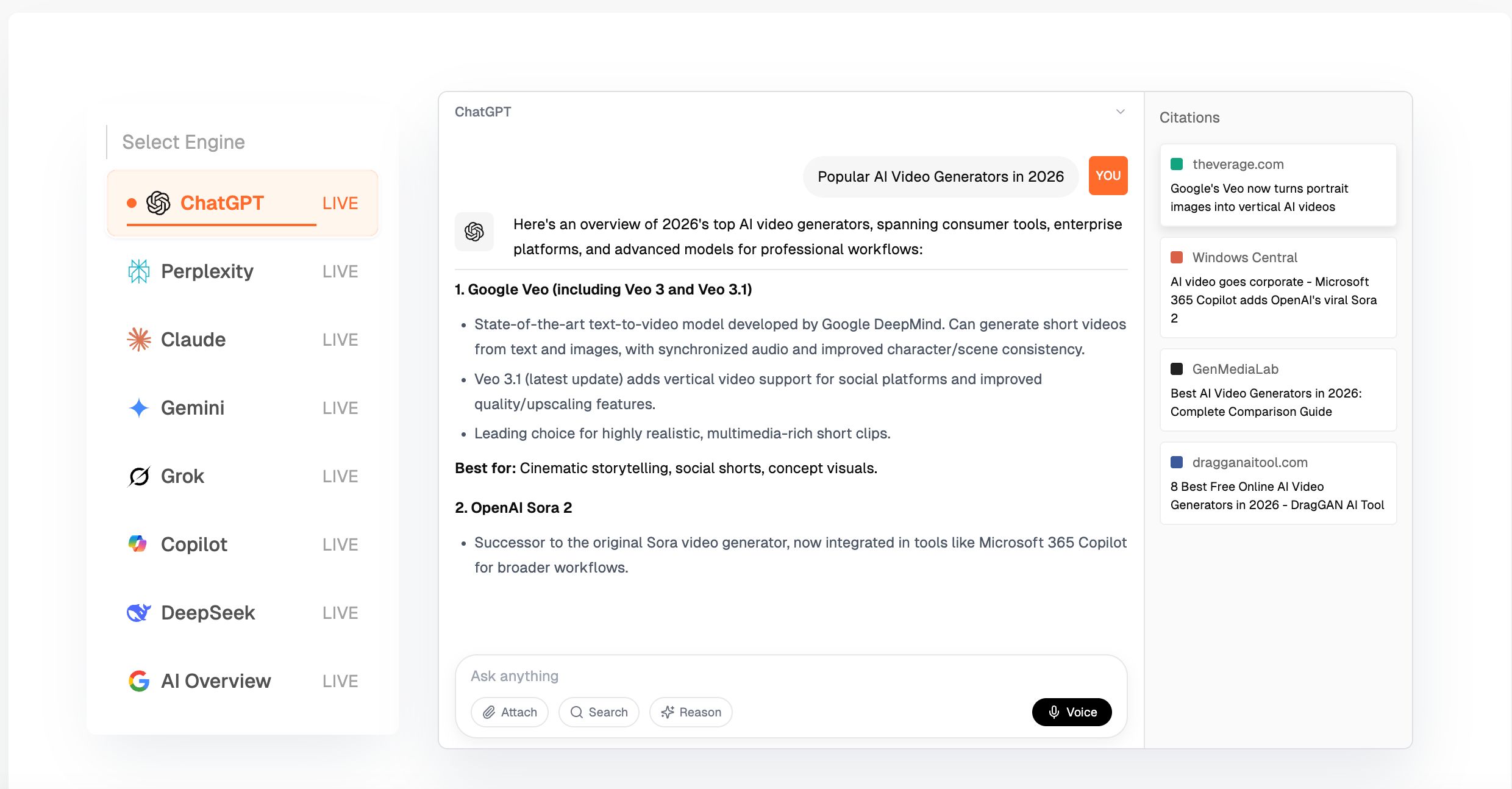
Dageno stands at the forefront of ai search competitive analysis tools, offering a holistic suite designed for SaaS, AI tools, and B2B enterprises. It enables brands to track, analyze, and elevate their presence across traditional search engines, AEO, and GEO, with a strong emphasis on competitive intelligence.
Track AI Visibility on Google + Answer Engines
Dageno provides Full-dimension AI Visibility, allowing businesses to monitor their own and competitors' brand citations across Google AI Overviews, ChatGPT, and other answer engines. Its BotSight AI Crawler Detection reveals how LLM crawlers interact with competitor content, offering insights into their AI optimization tactics. Crucially, Real-time Competitor Tracking allows for immediate benchmarking of share-of-answer and brand mentions against rivals.
Capture Prompts & User Intent
Understanding competitor content strategies in AI search requires dissecting the prompts they target. Dageno helps Identify Content Gaps & Backlink Gaps by analyzing what LLMs prefer from competitors. The Real-time Prompt Volume Search uncovers the actual questions users ask AI that lead to competitor answers. This is complemented by Social Media & Trend Sniffing to anticipate emerging competitive narratives.
Own Facts & Fix Hallucinations
In AI search, factual accuracy directly impacts authority. Dageno's Brand Kit & Digital Asset Data ensures your brand facts are consistently presented to LLMs. Its Hallucination Correction Tools are invaluable for proactively addressing any misinformation about your brand or competitors, maintaining a truthful competitive landscape. Audience Segment Control allows for tailored competitive messaging based on user intent.
Build Content for Search & AI
Dageno empowers content teams to create content that outperforms competitors in both traditional and AI search. The Page-level GEO Content Audit assesses content's readiness for AI consumption, highlighting areas for improvement. SEO & GEO Fusion Copywriting tools guide the creation of content that is both keyword-rich and optimized for AI's structured knowledge preference. High-Volume Prompt Interception ensures content directly addresses high-intent user queries that competitors might be missing.
Automate Your Growth Strategy
For continuous competitive advantage, Dageno offers Opportunity Insight Alerts that notify teams of shifts in competitor AI visibility or emerging content opportunities. This facilitates End-to-end Automation and AI-driven Execution Workflows, allowing for rapid response to competitive moves and proactive content optimization.
- Objective Analysis: Dageno provides a unified view of competitive performance across all AI search modalities, making it indispensable for strategic decision-making.
- Ideal for: B2B, SaaS, and AI companies that need a comprehensive platform to analyze, track, and respond to competitor strategies in the AI search landscape.
2. Similarweb: Comprehensive Market & Competitor Intelligence
Similarweb is a powerful platform for broad market and competitor intelligence, now enhanced with AI Visibility Tracking. It provides extensive data on competitor website traffic, engagement metrics, and audience demographics. For AI search, Similarweb helps benchmark overall digital presence and identify key players in the AI search space. Its ability to analyze traffic sources, including referrals from AI platforms, offers a macro view of competitive performance.
- Objective Analysis: Similarweb excels at providing a high-level, data-rich overview of market dynamics and competitor digital footprints, including emerging AI search trends.
- Ideal for: Market researchers, strategists, and businesses needing a holistic view of their competitive landscape across all digital channels.
3. Semrush AI Visibility Toolkit: Cross-LLM Competitive Benchmarking
The Semrush AI Visibility Toolkit is an essential addition for SEO/SEM teams looking to benchmark their brand against competitors in AI search. It offers AI Share of Voice metrics across various LLMs, revealing how often and how favorably competitors are mentioned. The tool also provides Brand Sentiment Analysis within AI-generated answers and helps identify Content Gaps by analyzing competitor performance for specific AI prompts. It's a robust solution for integrating AI competitive insights into existing SEO workflows.
- Objective Analysis: Semrush provides granular data on competitor AI performance, allowing for direct comparison and strategic adjustments to content and brand messaging.
- Ideal for: SEO/SEM professionals and marketing teams focused on detailed competitive analysis within the AI search environment.
4. Ahrefs (AIrefs): Backlink & Co-citation Analysis for AI
While traditionally known for its backlink analysis, Ahrefs has adapted with "AIrefs" capabilities to offer AI-driven Co-citation Analysis. This helps identify not just who links to competitors, but also which sources are frequently cited alongside them in AI-generated content. Understanding these co-citation patterns can reveal influential content and authority signals that LLMs value. It's a unique approach to competitive analysis in the AI era, focusing on the network of trust and authority that informs AI answers.
- Objective Analysis: Ahrefs provides a distinct perspective on competitive authority by analyzing the web of citations that influence AI, moving beyond simple backlinks.
- Ideal for: SEOs and content strategists who want to understand the authoritative ecosystem around their competitors in AI search.
5. Profound: Enterprise Empirical AI Citation Data
Profound offers enterprise-grade empirical AI citation data, providing deep transparency into how competitors are cited across major AI engines. Its Query Fanouts Analysis is particularly valuable for competitive intelligence, showing how AI models rephrase user prompts to find competitor content. This reveals the underlying search intent that competitors are successfully targeting. Profound's focus on verifiable, front-end data makes it a powerful tool for understanding competitor AI strategies.
- Objective Analysis: Profound provides the most granular, verifiable data on competitor AI citations, offering insights into the mechanics of AI content retrieval.
- Ideal for: Large enterprises and regulated industries requiring precise, auditable data on competitor AI visibility.
6. Peec AI: Deep Research & Brand Mention Analysis
Peec AI specializes in tracking brand mentions in conversational AI and performing deep research into competitor narratives. It allows businesses to monitor how competitors are discussed in AI-generated summaries, identifying sentiment and key talking points. This is crucial for proactive reputation management and understanding the competitive messaging landscape in AI search. Peec AI helps uncover subtle shifts in how AI perceives and presents competitor brands.
- Objective Analysis: Peec AI offers focused insights into competitor brand perception within AI, enabling targeted responses to maintain a favorable brand image.
- Ideal for: Brand managers, PR teams, and competitive intelligence analysts focused on brand narrative and sentiment in AI environments.
7. Visualping: Website Change & Competitor Monitoring
Visualping provides real-time monitoring of competitor website changes, which, while not directly an AI search tool, is an invaluable component of AI search competitive analysis. Changes in competitor content, schema markup, or website structure can significantly impact their AI visibility. Visualping alerts businesses to these changes, allowing them to quickly analyze the potential impact on AI search performance and adapt their own strategies accordingly. It's a foundational tool for staying agile in a dynamic competitive landscape.
- Objective Analysis: Visualping offers a practical, real-time mechanism to track competitor website evolution, which indirectly informs AI search strategies.
- Ideal for: Marketing and SEO teams needing to monitor competitor website updates and content changes for competitive advantage.
8. Otterly.AI: Prompt-Specific Competitive Tracking
Otterly.AI extends its prompt-specific tracking capabilities to competitive analysis by allowing users to monitor which prompts lead to competitor content citations. Its Real-time Prompt Volume Search can reveal high-value prompts that competitors are winning, while its Competitor Content Citation Alerts notify users when AI platforms reference competitor content. This provides a direct, actionable view of competitor performance at the query level in AI search.
- Objective Analysis: Otterly.AI offers precise, prompt-level competitive insights, making it easy to identify and target specific AI search opportunities.
- Ideal for: Content strategists and SEOs focused on optimizing for specific AI prompts and understanding competitor performance at a granular level.
9. Rankability AI Analyzer: AI Search Visibility & Ranking Tracking
Rankability AI Analyzer focuses on AI-driven ranking analysis and content performance benchmarking for competitive purposes. It helps businesses understand how their content, and that of their competitors, is performing in AI Overviews and other generative search results. By analyzing various factors that influence AI visibility, it provides actionable recommendations to improve content and outrank competitors in the AI search landscape.
- Objective Analysis: Rankability AI Analyzer provides a clear, data-driven view of competitive ranking and content effectiveness in AI search.
- Ideal for: SEOs and content teams seeking to directly improve their AI search rankings and benchmark against competitors.
10. Sprout Social: Social Listening & AI Sentiment Analysis
Sprout Social, a leading social media management platform, integrates AI Sentiment Analysis into its social listening capabilities, making it a valuable ai search competitive analysis tool. It allows businesses to monitor competitor brand mentions and public sentiment across social media, which can indirectly influence AI's perception and citation of brands. Understanding competitor social narratives and audience engagement helps inform broader AI search strategies, especially concerning brand authority and public perception.
- Objective Analysis: Sprout Social offers insights into the social dimension of competitive intelligence, which can impact AI's understanding of brand authority and relevance.
- Ideal for: Social media managers and brand strategists looking to integrate social insights into their broader AI search competitive analysis.
Key Considerations for Choosing AI Search Competitive Analysis Tools
Selecting the right ai search competitive analysis tools requires a strategic approach. Businesses should prioritize platforms that offer a blend of data granularity and actionable insights. Key features to look for include:
- Real-time AI Citation Tracking: Essential for understanding when and how competitors are being referenced by LLMs.
- Prompt-Level Analysis: To uncover the specific queries that drive competitor visibility.
- Sentiment and Brand Narrative Monitoring: To assess how AI perceives competitor brands.
- Content Gap Identification: To find opportunities where your content can outperform competitors in AI search.
- Integration with Existing Workflows: Tools that can seamlessly integrate with your current SEO and marketing stacks will provide the most value.
Ultimately, the goal is to move beyond reactive competitive monitoring to proactive strategy development, leveraging AI insights to anticipate market shifts and maintain a leadership position.
Conclusion
The landscape of competitive analysis has been irrevocably reshaped by AI search. To succeed in 2026 and beyond, businesses must adopt ai search competitive analysis tools that provide deep, actionable insights into how competitors perform within AI Overviews and large language models. Platforms like Dageno offer a unified solution for tracking AI visibility, understanding user intent, managing brand facts, and optimizing content to gain a significant competitive advantage. By embracing these advanced tools, B2B, SaaS, and AI companies can ensure they not only keep pace with the competition but actively lead the charge in the generative AI era.
FAQ (Frequently Asked Questions)
Q: What is AI search competitive analysis?
A: AI search competitive analysis involves tracking and evaluating how competitors perform in AI-driven search environments, such as Google AI Overviews and large language models, focusing on their visibility, content citations, and brand mentions.
Q: How do AI search competitive analysis tools differ from traditional SEO tools?
A: While traditional SEO tools focus on organic rankings and backlinks, ai search competitive analysis tools provide specialized insights into AI citation frequency, prompt-level performance, and sentiment analysis within AI-generated answers, which traditional tools cannot offer.
Q: Why is it important to track competitor content in AI Overviews?
A: Tracking competitor content in AI Overviews is crucial because AI Overviews often provide direct answers, influencing user perception and decision-making. Understanding competitor performance here helps identify content gaps and opportunities to improve your own AI visibility.
Q: Can AI competitive analysis help identify new market opportunities?
A: Yes, by analyzing competitor performance at the prompt level and identifying content gaps in AI-generated answers, ai search competitive analysis tools can reveal unmet user needs and emerging trends, leading to new market opportunities for your business.
References
About the Author

Updated by
Tim
Tim is the co-founder of Dageno and a serial AI SaaS entrepreneur, focused on data-driven growth systems. He has led multiple AI SaaS products from early concept to production, with hands-on experience across product strategy, data pipelines, and AI-powered search optimization. At Dageno, Tim works on building practical GEO and AI visibility solutions that help brands understand how generative models retrieve, rank, and cite information across modern search and discovery platforms.
Related Articles
Best Qwairy Alternative in 2026: 5 GEO & AI Visibility Platforms Compared

Ye Faye • Jul 20, 2026
Best Scrunch AI Alternatives for 2026

Richard • Mar 03, 2026
Top 10 Best Rank Tracking Tools in 2026 (Tested & Compared)
Ye Faye • Mar 25, 2026
The 22 Best AI Search Visibility Tracking Tools: Full Rankings and Reviews
Ye Faye • Mar 16, 2026