TL;DR
- The five tools to compare for Copilot tracking are Bing Webmaster Tools AI Performance, Ahrefs Brand Radar, Otterly AI, Profound, and Dageno AI. Use Bing for owned-page citation evidence, Ahrefs or Otterly for repeatable prompts, Profound for enterprise programs, and Dageno for GEO execution with enterprise Copilot coverage, subject to the access agreed for your plan.
- Bing search position is not a Copilot answer rank. Keep citation counts, brand mentions, recommendation position, and competitor share of voice separate.
- Check the exact Copilot experience and subscription: documented platform coverage does not mean every plan includes it.
Copilot rank tracking combines Bing's first-party citation trends with repeated prompt checks to measure brand mentions, cited pages, and competitor visibility without mistaking Bing positions for AI answer placement.
The best Microsoft Copilot rank tracking setup combines first-party citation data from Bing Webmaster Tools with a third-party platform that reruns your commercial prompts. Copilot does not have a stable blue-link “rank”; use repeated answers and exact cited URLs to judge changes.
Best Copilot rank tracking tools at a glance
Choose among these five tools by the evidence you need: Microsoft citation totals, controlled Copilot answers, or the workflow for fixing visibility gaps.
| Tool |
Best for |
Copilot evidence |
Competitor prompts |
Source detail |
Pricing approach |
| Bing Webmaster Tools |
First-party Microsoft citation data |
Native aggregated data |
No |
Your cited URLs and grounding queries |
Free |
| Ahrefs Brand Radar |
Large datasets and custom Copilot prompts |
Copilot dataset plus custom tracking |
Yes |
Domain and page research |
Paid plans/add-ons |
| Otterly AI |
Lightweight recurring Copilot monitoring |
Daily prompt runs; Copilot listed in Lite |
Yes |
Links and citations |
US$29/month Lite; 15 prompts |
| Profound |
Enterprise multi-engine intelligence |
Copilot documented; confirm contracted access |
Yes |
Citations and sources |
Enterprise quote for Copilot |
| Dageno AI |
Turning visibility gaps into GEO work |
Copilot listed under Enterprise platform coverage; confirm exact experience and plan access |
Yes |
Citation and source-gap workflows |
Enterprise coverage; confirm plan scope |
All five products publicly document Copilot-related capabilities, with different datasets and plan requirements. Dageno lists Copilot under Enterprise platform coverage and connects visibility findings to GEO execution; confirm the exact Copilot experience and access for your plan before purchasing.
What is Copilot rank tracking?
Copilot rank tracking is the repeated measurement of how a brand or website appears in Microsoft Copilot answers. Depending on the tool, it may include:
- Whether the brand is mentioned
- Where it appears in a recommendation
- Whether an owned URL is cited
- Which third-party sources support the answer
- Which competitors appear instead
- How the answer describes the brand
- How results change by prompt, market, language, and date
Traditional Bing rank tracking still matters because Copilot uses web retrieval, but page position alone cannot show whether a brand is recommended or cited in an AI-generated answer.
1. Bing Webmaster Tools AI Performance: best first-party Copilot data
Bing Webmaster Tools introduced AI Performance in public preview in February 2026. It reports how a verified site's content is cited across Microsoft Copilot, AI-generated summaries in Bing, and selected partner integrations.

Use the cited-page and grounding-query views to identify which of your URLs Microsoft retrieves, then investigate those pages separately in your prompt benchmark.
What it reports
- Total citations across supported AI experiences
- Average number of uniquely cited pages per day
- Sampled grounding queries used to retrieve cited content
- Citation counts for individual URLs
- Citation trends over the selected period
This is the most authoritative place to confirm that Microsoft surfaces are citing your own pages. It is also free, so every site targeting Copilot visibility should configure it before paying for another dashboard.
Best for
Publishers, brands, and SEO teams that need first-party evidence about owned-page citations.
Limitations
Bing Webmaster Tools aggregates supported AI surfaces. Microsoft explicitly notes that the figures do not indicate a page's rank, authority, or placement inside an individual answer. It also does not provide a complete competitor prompt tracker. Pair it with controlled prompt monitoring when you need share of voice or answer-level comparisons.
Read the announcement at Bing Webmaster Tools AI Performance.
2. Ahrefs Brand Radar: best for Copilot discovery at scale
Ahrefs Brand Radar includes Microsoft Copilot among its tracked AI platforms. It combines a large search-backed prompt database with custom prompts that can be scheduled daily, weekly, or monthly.
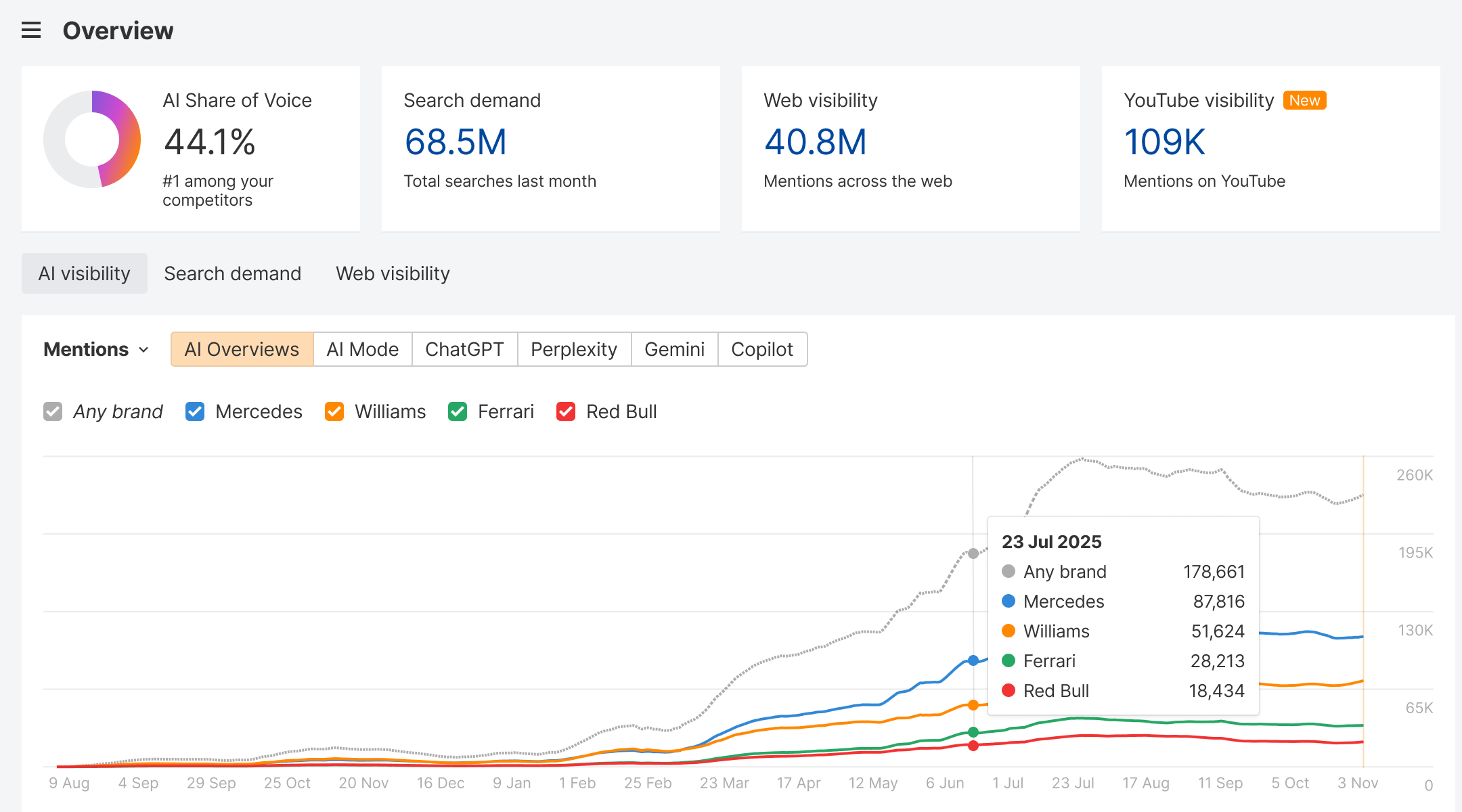
Filter the view to Copilot before comparing mentions or cited pages, and keep the discovery index separate from the custom prompts used for trend reporting.
Best features
- Broad discovery of brand, product, and competitor mentions
- Custom recurring prompts for controlled monitoring
- AI share-of-voice comparisons
- Citation and source research
- Connection to Ahrefs' established SEO data
Best for
SEO teams and competitive researchers who want to compare Copilot visibility with search, backlink, content, and other AI-platform signals.
Limitations
Large-dataset discovery and custom prompt tracking answer different questions. Do not treat them as one continuous metric. Use custom prompts for controlled period-over-period reporting and the large database to discover new topics, sources, or competitors.
See the official Ahrefs Brand Radar page and custom prompt documentation.
3. Otterly AI: best lightweight Copilot monitor
Otterly AI explicitly supports Microsoft Copilot and monitors configured search prompts on a recurring schedule. It is easier to adopt than a full enterprise intelligence platform and provides the essentials smaller teams usually need.
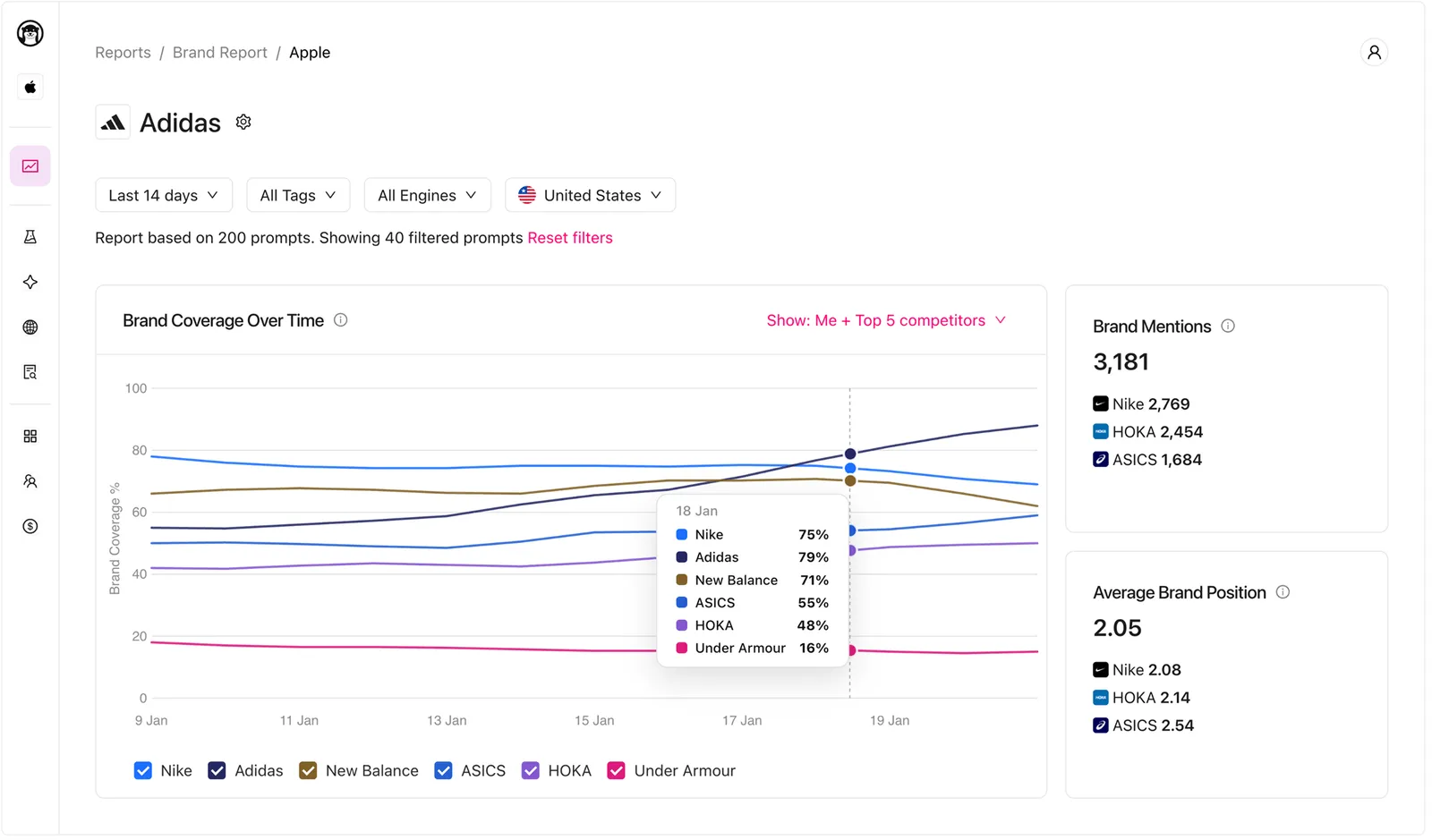
Review the same Copilot prompt group across several daily runs, then inspect the linked sources behind gained or lost mentions.
Best features
- Microsoft Copilot prompt monitoring
- Brand mention and competitor tracking
- Link and citation monitoring
- Historical answer and citation changes; confirm notification rules separately
- Self-serve setup and public plan information
Best for
Small businesses, consultants, and agencies that need scheduled Copilot checks without a complex implementation.
Limitations
The value depends heavily on prompt quality. A small set of overly branded prompts can produce a flattering but commercially weak score. Confirm how prompts, engines, and locations count toward plan limits.
Otterly's help center states that Microsoft Copilot is monitored daily; verify the current plan scope at Otterly monitoring intervals.
4. Profound: best enterprise Copilot intelligence
Profound lists Microsoft Copilot among the front-end AI experiences covered by Answer Engine Insights. It is built for larger organizations that need cross-platform reporting, regional analysis, citations, sentiment, and governance.
Use a Copilot-specific platform filter and a stable competitor set when reviewing enterprise trends; confirm that the contracted workspace includes the required engine and regions.
Best features
- Copilot visibility and share of voice
- Answer position and sentiment
- Citation and cited-domain analysis
- Region and platform filtering
- Enterprise reporting across brands and teams
Best for
Global brands and enterprise marketing teams that need a formal Copilot measurement program alongside ChatGPT, Google AI experiences, Perplexity, and other answer engines.
Limitations
Copilot access requires checking the enterprise scope rather than relying on Profound's entry price. Its Starter plan tracks ChatGPT only, and Growth lists ChatGPT, Perplexity, and Google AI Overviews. Ask sales for the exact Copilot experience, markets, refresh frequency, prompt volume, exports, and historical retention.
Review Profound Answer Engine Insights.
5. Dageno: best for converting AI visibility gaps into execution
Dageno AI is best considered when tracking must lead to action. Its broader workflow organizes prompts, compares brand and competitor visibility, analyzes citations and source gaps, and turns findings into content and technical GEO priorities.
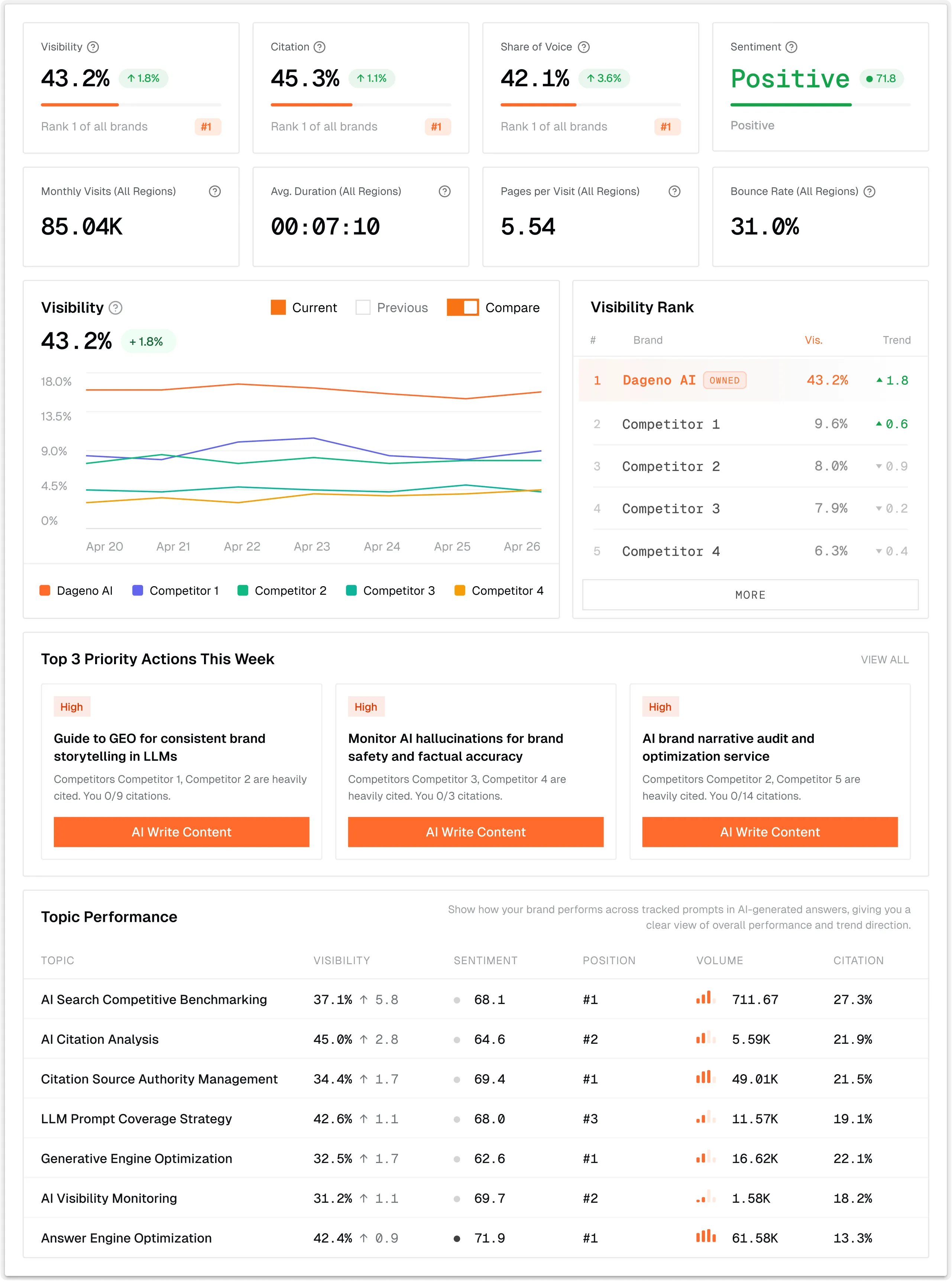
Use the dashboard to turn prompt and source gaps into an owner, a content or technical action, and a later measurement date. For Copilot analysis, confirm the exact experience available in your workspace.
That execution layer is useful after Bing Webmaster Tools or a Copilot monitor reveals a problem. If Microsoft cites a competitor's comparison page but not yours, the next step is not another chart. The team needs to inspect the source pattern, strengthen first-party evidence, clarify product facts, improve page structure, and earn relevant third-party corroboration.
Best features
- Prompt and competitor analysis across AI search
- Citation and source-gap diagnosis
- Content opportunity discovery
- GEO content and technical workflows
- Measurement connected to prioritized actions
Best for
SEO, content, and growth teams that want an end-to-end GEO workflow rather than a Copilot-only dashboard.
Important Copilot note
Dageno's pricing page lists Copilot under the Enterprise plan's platform coverage. Starter, Growth, and Scale say “Choose any 3 platforms”; that wording alone does not establish Copilot access on those plans. Confirm the exact Copilot experience, collection settings, and access for your plan. Dageno can connect the resulting visibility and source gaps with content and technical GEO work.
How to choose a Copilot tracking stack
Start with Bing Webmaster Tools for your own cited pages, then add a supported Copilot prompt monitor for competitor context and repeated answers.
If your buyers also use other answer engines, compare multi-platform AI search monitoring alongside your Copilot requirements.
Choose first-party data plus prompt monitoring
For most teams, the best stack is:
- Bing Webmaster Tools AI Performance for first-party owned-site citation trends.
- Ahrefs, Otterly, or Profound for repeated prompts, competitor comparisons, and answer-level context.
- Dageno or an internal workflow for turning source and content gaps into owned actions.
No single dataset answers every question. First-party data is authoritative for your verified site but aggregated. Third-party prompt monitoring provides competitive context but is a sample created under the vendor's collection conditions.
Choose by the decision you need to make
- Need to know which owned pages Microsoft cites? Start with Bing Webmaster Tools.
- Need to discover Copilot mentions at scale? Compare Ahrefs Brand Radar.
- Need an affordable recurring prompt set? Compare Otterly AI.
- Need enterprise regions, reporting, and governance? Evaluate Profound.
- Need to turn findings into content and GEO work? Evaluate Dageno's workflow and its listed enterprise Copilot coverage; confirm the experience and access for your plan.
How to build a reliable Copilot benchmark
Build a reliable benchmark by fixing the prompt set, recording collection conditions, repeating checks, and comparing mentions and citations within the same dataset.
Step 1: create prompt groups by intent
Use discovery, comparison, alternative, product, problem, and purchase prompts. Include the audience or constraint when it changes the recommendation, such as “for a 20-person B2B sales team” or “for multilingual ecommerce.”
Step 2: keep a stable benchmark set
Do not replace all prompts whenever new keywords appear. Keep a stable set for trend reporting and a separate discovery set for emerging questions.
Step 3: record collection conditions
Track the Copilot surface, date, location, language, login state, and any settings the tool exposes. Microsoft Copilot experiences are not interchangeable, and answers may change over time.
Step 4: repeat prompts
One response is not a rank. Repeated runs help separate a persistent visibility pattern from normal generative variation.
Step 5: measure the full answer
For every prompt, collect:
- Brand mentioned or absent
- Recommendation position
- Competitors mentioned
- Owned citations
- Third-party citations
- Description accuracy
- Sentiment
- Changes from the previous period
Step 6: reconcile with Bing first-party data
Use Bing Webmaster Tools to validate whether owned citation activity moves in the same direction. Differences are expected because the datasets measure different surfaces and samples. Investigate them; do not force them into one score.
How to improve Copilot visibility after tracking
Improve Copilot visibility by updating useful source pages, making product facts explicit, fixing retrieval barriers, and testing the same prompts again after changes.
Make important facts explicit
State the product category, intended audience, capabilities, limitations, pricing basis, integrations, and proof clearly. Copilot should not need to infer core facts from vague marketing copy.
Strengthen cited pages
When Bing Webmaster Tools reveals pages already receiving citations, improve their depth, structure, freshness, and supporting evidence. When important pages receive none, check indexing, crawlability, duplication, and whether the page directly answers a useful question.
Use IndexNow for material updates
IndexNow notifies participating search engines when a URL is added, changed, or removed. It does not guarantee a citation, but it can help Bing discover current content sooner. See IndexNow.
Build external corroboration
AI answers often cite independent reviews, comparisons, documentation, communities, and authoritative editorial sources. Identify the domains already cited for your category and earn accurate, useful coverage instead of manufacturing low-quality mentions.
Recheck the same prompt set
Measure after Microsoft has recrawled the affected pages and enough collection cycles have passed. Compare prompt groups, citations, and competitor gaps rather than celebrating one favorable answer.
Common Copilot tracking mistakes
The main mistakes are treating citations as fixed ranks, substituting Bing positions for Copilot answers, and comparing scores built from different datasets.
Calling every metric a rank
Citation totals, mention rate, recommendation position, and share of voice are different measures. Label them accurately.
Assuming Bing rank equals Copilot visibility
Strong search performance helps discoverability, but it does not prove that an AI answer mentions or cites the brand.
Trusting unsupported platform lists
AI tools change coverage often. Confirm Microsoft Copilot on a current official product page or contract, including the exact surface and plan.
Comparing numbers from different datasets directly
First-party aggregated citations, vendor discovery indexes, and controlled custom prompts have different denominators. Compare trends within the same dataset.
Ignoring answer accuracy
A mention can be harmful if Copilot presents old pricing, missing features, or the wrong positioning. Add accuracy checks to the monitoring workflow.
Final recommendation
Start with Bing Webmaster Tools because it is free and provides first-party Microsoft citation evidence. Add Otterly AI for a lightweight recurring prompt set, Ahrefs Brand Radar for large-scale discovery and SEO context, or Profound for enterprise intelligence. Use Dageno when your larger problem is converting AI visibility gaps into structured content and GEO work; its pricing page lists Copilot under Enterprise coverage, and the exact experience and plan access should be confirmed.
The most defensible report keeps each dataset separate, tracks a stable commercial prompt set, records citations and competitors, and acts on repeated patterns rather than isolated answers.
Frequently asked questions
Does Microsoft offer Copilot citation tracking?
Yes. Bing Webmaster Tools AI Performance reports aggregated citations, cited pages, sampled grounding queries, and trends across Microsoft Copilot, Bing AI summaries, and selected partner integrations.
What is the best Microsoft Copilot rank tracker?
Bing Webmaster Tools is the best free first-party source for owned-page citations. Ahrefs Brand Radar, Otterly AI, and Profound add competitor and prompt monitoring at different scales. Dageno lists Copilot under Enterprise platform coverage and connects visibility findings to GEO execution; confirm the exact experience and access for your plan.
Can Google Search Console track Copilot?
No. Google Search Console reports Google Search data. Use Bing Webmaster Tools for Microsoft's first-party citation reporting and a supported third-party monitor for controlled Copilot prompts.
How often should Copilot prompts be tracked?
Weekly tracking is enough for many strategic programs. Daily collection can reveal faster changes, but decisions should be based on repeated patterns across a stable prompt set.
Can a tool guarantee Copilot citations?
No. Tools measure visibility and reveal opportunities. Citations depend on retrieval, relevance, accessibility, evidence, source quality, freshness, and Microsoft's systems.
References