When Your Brand's AI Visibility Differs by Region: When to Build Localized Pages and When Not to Split Your Site
Your brand is recommended in one region and missing in another. Learn how to compare like-for-like responses, trace the gap to questions, language, local pricing, availability, or sources, and decide whether to localize a page, update a shared page, or keep observing
Explore 12,000+ niche markets with no login required
Updated by
AI-assisted for research support
14 Min Read•
Updated on Sep 30, 2026
TL;DR
Compare responses from two regions on the same platform and for the same type of question before deciding whether to build a localized page. Consider a localized page when the difference comes from region-specific prices, availability, purchase channels, or evidence, and the product actually targets that region. If the missing information applies across regions, add it to a shared page. If the sample is too small, keep observing. If the price range falls outside the product line, mark it as a non-target question.
Regional differences usually come from four places: different questions, different languages, differences in local pricing and availability, and different cited sources. Read the purchase conditions in the response first, then check the brand's official site and local sources.
In this smartwatch example, Apple's low visibility in India comes from questions about watches under ₹5,000, a different price range from the Apple Watch SE 3's starting price of ₹29,900. In Poland, a response about watches under 1500 zł covers the SE 3's starting price of 1099 zł but does not mention Apple. However, there is currently only one comparable ChatGPT response, so the right decision is to keep observing.
1. First Confirm the Difference Is Real: How Many Responses Does Each Region Have for the Same Question on the Same Platform?
1.1 Use the Regions Table to Find Anomalies and the Responses to Explain Them
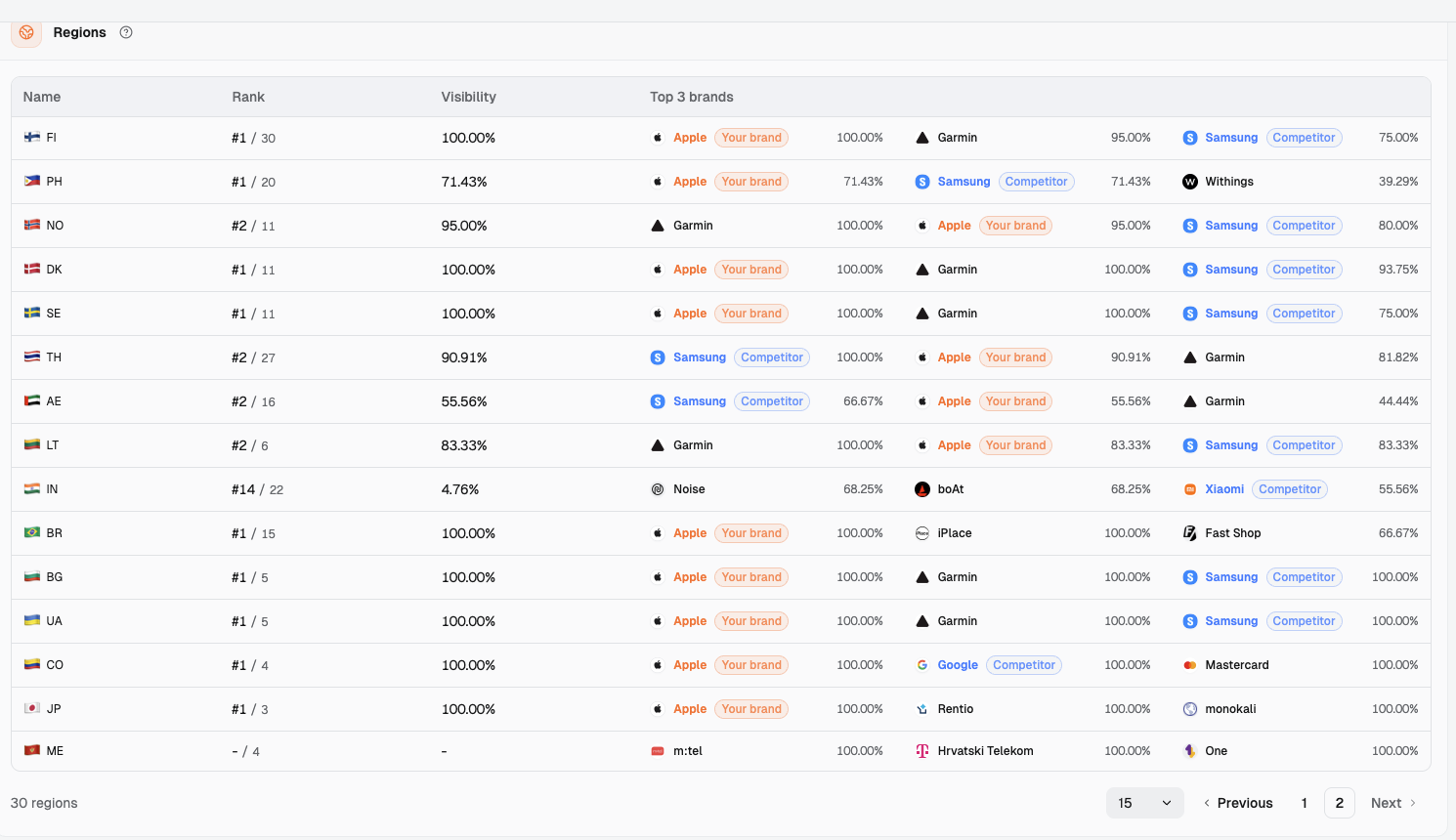
In the overall Market overview results, Apple has 62.31% Visibility and ranks #1. Under “Market overview → Platforms & regions,” the regions table lists Name, Rank, Visibility, and Top 3 brands. Yet the India row shows Apple at #14 with just 4.76% Visibility, while the top three brands are Noise, boAt, and Xiaomi.
The Market overview regions table: Apple ranks #14 in India (IN) with 4.76% Visibility; the top three brands are Noise, boAt, and Xiaomi.
The gap stands out, but the regions table only tells you to investigate India first. It does not show what users asked, which products appeared in the responses, or what type of page to build. Next, follow “Demand & insights → Search intents → Recommendations → Choose by budget or tier → View AI responses” and open the individual records. If a brand merely ranks behind a competitor in a region, such as Apple at #2 behind Garmin at #1 in the United States row, use the framework for assessing a brand that ranks behind competitors. This article focuses on cases where the brand barely appears in a region.
This sub-intent has 108 responses. Seven show “Answer preview is unavailable.” and display only citations, so they are excluded from the comparison. Researchers also need to separate platforms and regions: responses in the drawer cannot be filtered by region, so each response's region label at the top must be checked and recorded manually. In practice, flag anomalous regions in the regions table, then record the platform, region, and price range discussed in every usable response.
1.2 One Sub-Intent Can Contain Completely Different Price Questions
The current Evidence preview shows only Source answer and Related citation analysis. It does not show the original prompt or collection time. Therefore, every reference to the “same type of question” in this article is based on what budget, use case, and purchase conditions the response appears to address, judging from the answer content. The previous article on model differences also found different questions mixed under the same sub-intent; regional comparisons require the same separation first.
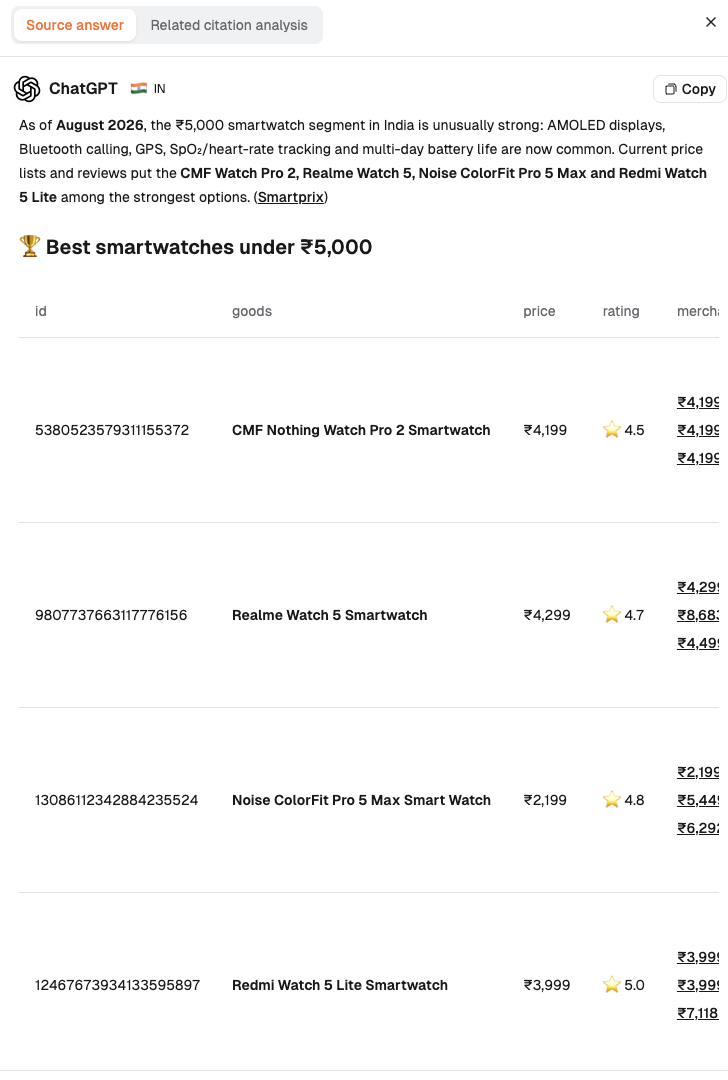
India has two responses, one from ChatGPT and one from Gemini. Judging from the answer content, both recommend smartwatches under ₹5,000, and neither mentions Apple. The ChatGPT response begins:
“As of August 2026, the ₹5,000 smartwatch segment in India is unusually strong: AMOLED displays, Bluetooth calling, GPS, SpO₂/heart-rate tracking and multi-day battery life are now common. Current price lists and reviews put the CMF Watch Pro 2, Realme Watch 5, Noise ColorFit Pro 5 Max and Redmi Watch 5 Lite among the strongest options.”
Its product table lists the CMF Nothing Watch Pro 2 (₹4,199), Realme Watch 5 (₹4,299), Noise ColorFit Pro 5 Max (₹2,199), and Redmi Watch 5 Lite (₹3,999). The Gemini response also states: “Here are the top-rated smartwatches under ₹5,000 in India, offering the best value for money across design, health tracking, GPS, and display quality.”
The ChatGPT response for India (IN): it sets a budget under ₹5,000 at the start, and its product table lists CMF, Realme, Noise, and Redmi.
On September 30, 2026, Apple's India site listed the Apple Watch SE 3 from ₹29,900. Both responses have a budget ceiling below that starting price. The Indian result is explained by the question's price range: the ₹5,000 limit defines the candidate products from the outset. If you are this brand, record it as a “non-target question”; entering that price range is a product decision. When you see a regional difference, place the budget ceiling from each response beside the publicly listed starting price on the official site.
2. Where Regional Differences Usually Come From: Questions, Language, Local Commercial Facts, and Sources
2.1 Different Questions: Start with the Price Range Set by Local Users
The India example shows how one “Choose by budget or tier” sub-intent can contain entirely different purchase questions. People in different regions ask within local budgets. When the budget changes, the entire set of candidate brands can change with it. Some responses from Spain, Italy, and Belgium also discuss inexpensive watches or products under €100. These records support the same order of operations: read the price range before discussing the region.
This step determines whether further content research is worthwhile. When the brand's products exceed the question's budget, the page task stops here. When the products fall within the budget but do not appear, move to the next level and examine the sources. Add “budget or tier” and “public starting price on the official site” columns to each response record, then separate non-target questions from comparable questions.
2.2 Different Languages: Preserve the Original Wording, Then Decide Whether It Asks the Same Thing
Language is one comparison condition, but the language label alone does not tell the team whether to split the site. Researchers should preserve the response's original wording and an English translation, then check the product category, budget, intended user, and device conditions being discussed. Two regions can still be observed as the same type of question when their purchase conditions match, even if they use different languages. Once the purchase conditions change, record them separately.
The Polish response ends by asking whether the user has an iPhone or Android device: “Jeśli podasz mi, czy masz iPhone'a czy Androida …” (meaning: “If you tell me whether you have an iPhone or Android device ...”). This shows that the device condition may narrow the candidates further and belongs in the record. Keep language, budget, and device conditions in separate columns rather than using the region label as a substitute for the question content.
2.3 Availability and Price: Use Public Facts from the Local Official Site to Establish Whether the Product Is in Range
Price and availability determine whether the product meets the basic conditions for consideration in the question. The ₹29,900 starting price on Apple's India site puts the Apple Watch SE 3 outside the question about products under ₹5,000. The starting price of 1099 zł on the Polish site falls within the 1500 zł budget, while the $249 starting price on the US site falls within the $300 budget. This article preserves local currencies and makes no exchange-rate conversions or purchasing-power comparisons.
The demo project has no client-provided information about channels, business priorities, or existing pages. The case facts used here come from the brand's public official pages. In a real project, the brand must also confirm local models, channels, how long prices remain valid, and business importance. If you are this brand, use public facts from the official site to establish whether the product fits the question, then send unpublished commercial details to the brand team for confirmation.
2.4 Different Local Sources: Poland Provides a Lead Worth Following
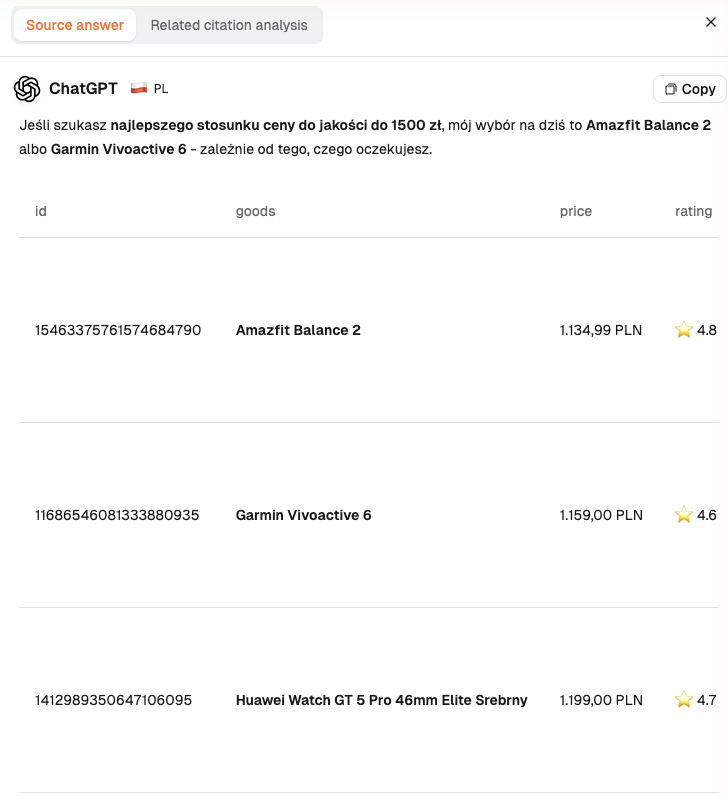
Judging from the answer content, this Polish ChatGPT response is looking for good-value watches under 1500 zł:
“Jeśli szukasz najlepszego stosunku ceny do jakości do 1500 zł, mój wybór na dziś to Amazfit Balance 2 albo Garmin Vivoactive 6 - zależnie od tego, czego oczekujesz.”
(Meaning: “If you are looking for the best value for money under 1500 zł, my picks today are the Amazfit Balance 2 or Garmin Vivoactive 6, depending on what you expect.”)
The ChatGPT response for Poland (PL): the question concerns choices under 1500 zł, and the product table lists products from Amazfit, Garmin, Huawei, and others, with no Apple product.
The product table lists the Amazfit Balance 2 (1.134,99 PLN), Garmin Vivoactive 6 (1.159,00 PLN), Huawei Watch GT 5 Pro 46mm (1.199,00 PLN), and Samsung Galaxy Watch7. The response has 41 citations, mainly from euro.com.pl, ceneo.pl, mediamarkt.pl, allegro.pl, and other Polish retail, comparison, and technology sites. Apple's Polish site lists the Apple Watch SE 3 from 1099 zł, within the response's budget, but Apple is absent from the recommendation list.
The US comparison response asks about watches under $300. The first row of its product table is the Apple Watch SE (3rd generation) 40mm at $249.00, labeled “Best for iPhone users.” The US site also lists the SE 3 from $249. Neither the Polish nor the US response cites apple.com, so the lack of an official-site citation cannot explain the difference in the recommendation lists. What we can see is that the Polish response's product table and citations come from local retailers and comparison sites, and its recommendation list omits Apple; the US response places Apple in the first row of its product table.
This is a source lead that requires more responses of the same type for validation. Save the product table, recommendation rationale, and cited URLs for each response, and label brand sites, local retailers, comparison sites, and review sites separately.
3. What the Dashboard Can Answer and What the Brand Must Supply
3.1 Use the Dashboard to Locate Regions, Open Responses, and Check Citations
In Dageno, start with the regions table under “Market overview → Platforms & regions” to find anomalies. Then go to “Demand & insights → Search intents → Recommendations → Choose by budget or tier → View AI responses.” In Evidence preview, use Source answer to read the response and Related citation analysis to save source URLs.
The regions table breaks AI search visibility down by region and shows where a brand performs differently. The response text shows which price range and selection criteria it actually discusses, while the citation list shows which public sources the response uses. Because the response list requires manual review, your record should include at least the platform, region, language, response topic, budget, whether the brand appears, recommended products, and cited URLs. Complete one round of manual recording with these columns before deciding which regions should enter monitoring.
3.2 The Brand Owns Commercial Facts and Page Decisions
The dashboard does not contain the product roadmap, target price ranges, local channels, business priorities, or a list of existing regional pages. The demo project also has no real client to confirm these details. The India example is therefore classified as “under ₹5,000 is a non-target question,” while the Poland example is classified as “keep observing.” The brand makes the final decision on whether to approve a localized page.
A real project should use a confirmation table with these fields: region and language, full question, platform, available products, price, channels, existing regional or language pages, business importance, evidence URL, confirmer, and date. Leave client fields blank in this case and label them “To be confirmed by the brand.” Send the table to the product, commercial, and local teams, then create page tasks after their confirmations arrive.
3.3 Use Monitored Prompts to Fix the Comparison Scope
Current market responses do not show the verbatim prompt or collection time. To fix the question, region, and platform for the next round, use Monitored prompts under Monitoring settings. The table columns are #, Prompt, Platforms, Regions, Answers, Brands, Details, Leading, and Status. This demo project currently has no records, so this section describes the method only. Under the CSV format requirements for importing prompts, each row requires platforms, regions, and language, allowing the region and language to be fixed together. The interface states that each region × platform combination consumes one prompt allowance, so broader retest scopes use more allowances.
First save the original Polish and English questions, specify their regions and platforms, and keep later responses separate from this market record. The brand confirms the observation period, frequency, owner, and stop conditions. Define the four fixed dimensions of question, platform, region, and language before counting new response records.
4. Is the Evidence Sufficient to Explain Why a Brand Is Recommended in One Region but Disappears in Another?
4.1 Page Evidence: Does the Local Page Answer This Purchase Question?
Open the brand's public page for the target region and check the product model, local price, availability information, and purchase path. The Indian, Polish, and US official sites provide the SE 3 starting price for each market, which is enough to establish whether the product falls within the response's budget. The brand still needs to provide a list of any other regional or language pages it maintains and identify who owns them.
Page evidence establishes what the brand has made public. Explaining the recommendation result also requires product facts and external sources. Save the official URL, model, starting price in local currency, verification date, and applicable market for each region.
4.2 Product Facts: First Determine Whether the Product Meets the Local Question's Conditions
The Indian question has a budget ceiling of ₹5,000, while the SE 3's public starting price is ₹29,900, so the question falls outside the product line. The Polish question has a budget ceiling of 1500 zł and the SE 3 starts at 1099 zł, meeting the price condition for consideration. The US question has a budget ceiling of $300 and the SE 3 starts at $249; the response also puts the Apple Watch SE in its first group.
If a response gives the wrong local price or availability, use the process for correcting brand fact errors in AI responses. This case focuses on whether the brand appears. Separate the statuses “within budget,” “over budget,” and “brand confirmation required” before proceeding.
4.3 External Sources: Check Which Selection Criteria Local Materials Provide
The Polish response's recommendation table and citations center on local retail and comparison sites. This is the regional difference currently visible. The US response also lacks a citation to Apple's official site, yet it puts the Apple Watch SE in the first group. Researchers should therefore continue reading what the local sources say: whether the listed price is current, whether the product is available, which users it suits, and which comparison criteria they apply.
Only after more Polish responses to the same question show the same absence consistently will the three evidence types—pages, product facts, and external sources—support a content decision. For a fuller method of drilling down from responses to sources, see the workflow for checking brand recommendations across AI platforms. Build a row-level link between each response rationale, product, and source URL rather than replacing content analysis with domain counts.
5. Decide: Build a Localized Page, Add to a Shared Page, or Keep Observing
What you see
Source of the difference
Decision
Next action
Example in this case
The product is available and the region matters to the business; multiple responses to the same type of question repeatedly omit it; local prices, channels, or sources differ materially from other regions
Region-specific facts
Build a localized page
State local availability, price, model, channels, and verifiable evidence, then retest with the original fixed question
None
The missing details are specifications, intended users, or compatibility that apply across regions
Shared product information
Add the details to a shared page; do not split the site
Update the main product page or shared explanation and maintain one set of common facts
None
There are too few comparable responses, or the difference appears at only one observation point
Insufficient sample
Keep observing
Fix the question, region, and platform, then collect more new responses
PL: ChatGPT currently has only one comparable response
The question's price range falls outside the brand's product line
Question-product mismatch
Do not build a localized page; mark it as a non-target question
Let the product team decide whether to enter that price range; do not create a page now
IN: under ₹5,000, while the SE 3 starts at ₹29,900
India is the most striking gap in the regions table, but reading the responses stops the task at “different question.” If you are this brand, you do not need a new India page for choices under ₹5,000; the product team decides whether to enter that price range.
Poland is different. The 1500 zł budget covers the SE 3's starting price of 1099 zł, yet the response recommends Amazfit, Garmin, and Huawei and uses local retail and comparison sources. But ChatGPT currently has only this one comparable Polish response, so the decision for this round remains “keep observing.” The three-way decision should accommodate real-world cases in which a category stays empty: no region in this case qualifies for “build a localized page,” and the evidence does not support “add to a shared page.”
Google Search Central's guidance on multi-regional and multilingual sites distinguishes between language versions and versions aimed at a specific country or region. For the decision in this article, splitting pages requires locally distinct facts; language is one condition among several. Put each region in one row of the decision table and attach the response, official-site facts, and source URLs to the decision.
6. After the Decision: What to Change on the Page and How to Set the Retest Scope
6.1 For a Localized Page, State the Facts That Actually Differ Locally
When a region meets the localization conditions, the page should state at least the products and models available locally, the price or price range, relevant conditions, purchase channels, and public evidence supporting those claims. When local reviews or retail sources provide key selection criteria, the brand can provide accurate information, while the source owner independently decides whether to use it.
No region in this case meets those conditions, so this article assigns no page to India or Poland. Create a localized-page task only for a region that has passed the decision table, and map every local fact to its source.
6.2 For a Shared Page, Maintain Only Information Common Across Regions
If responses lack specifications, intended-user details, compatibility, or shared conditions of use, adding the information to a common product page is easier to maintain. If only availability differs across regions, add a regional availability and purchase note to the shared page instead of duplicating similar copy.
This case has not revealed that type of shared information gap. List the missing facts, confirm whether they are the same across regions, and then decide whether to update the shared page.
6.3 Retest Only the Missing Side in Poland and the Comparison Side in the United States
Retest group
Region / language
Fixed question
Platforms
Why include it
Observation period / frequency / owner
Missing side
PL / Polish
Best smartwatch under 1500 zł
ChatGPT, Gemini, Google AI Mode
The price is within range, but the current single ChatGPT response omits the brand
To be confirmed by the brand
Comparison side
US / English
Best smartwatch under $300
ChatGPT, Gemini, Google AI Mode
The brand appears in the first group for the same type of question, providing a baseline for detecting a decline
To be confirmed by the brand
Excluded
IN
Under ₹5,000
—
The price range is outside the product line unless the product team decides to enter it
—
For every round, save the original question, platform, region, language, complete response, whether the brand is mentioned, whether it receives an explicit recommendation, cited URLs, and any time information that is actually visible. When a page changes, record the change and date separately, then use only new responses for the retest. See the method for verifying whether AI recommendations improved for a more complete record format. Have the brand confirm the observation period, frequency, and owner before starting this monitoring set.
7. Conclusion
The regions table is best for finding anomalies, not for assigning page work directly. Apple's Visibility in India is only 4.76%, with a rank of #14, making it look like the most severe regional gap in this article. Opening the responses shows that both questions are limited to products under ₹5,000, while the official starting price of the SE 3 is ₹29,900. The gap comes from the question's price range, so the decision is to skip a localized page and mark it as a non-target question.
The lead worth following is instead hidden in Poland, the region ranked #2. The 1500 zł question covers the SE 3's starting price of 1099 zł, but the ChatGPT response does not mention Apple, and its product table and citations concentrate on local retailers and comparison sites. There is currently only one comparable response, so start by expanding the sample with a fixed question.
The international SEO lead's final job is to tie every regional difference to a specific question. Consider a localized page when local facts remain different across responses. Add missing shared facts to a common page. Keep observing while the sample is small. Stop the page task when the question falls outside the product line.
Start understanding your brand's AI search performance
Can You Compare the Same Need Across Two Regions That Use Different Languages?
Yes. Preserve the original text and translation from both regions, then use the response content to compare the budget, use case, intended users, and device conditions. In the next round, use Monitored prompts to fix the question text in both languages and record the results separately.
When Do You Need a Local Page If You Already Have a Global Product Page?
Consider a local page when locally available products, prices, models, channels, or evidence differ materially, and multiple responses to the same type of question repeatedly show the regional absence. If the missing facts apply across regions, update the shared page.
Can You Build a Local Page Just Because the Citations Exclude the Brand's Official Site?
First check whether the brand meets the question's conditions, then examine which selection criteria the local sources provide. The US comparison response also omits apple.com from its citations but places Apple in the first group, so the decision requires the response, official-site facts, and external sources together.
What Should You Do If a Regional Response Gives the Wrong Price?
First verify the model, price, and applicable conditions on the brand's official site for that region. Then follow the process for handling brand fact errors to arrange a correction. Record pricing errors as an accuracy issue, separate from the brand absence discussed here.
How Soon Should You Check After a Local Page Goes Live?
The brand confirms the observation period, retest frequency, and owner. Fix the question, region, language, and platform for the retest, then save each new response and its citations. Do not reopen an old response and count it as a new result.
Dageno is the research and insights team at Dageno AI, publishing industry reports and expert analysis on AI Search Visibility, Generative Engine Optimization (GEO), and AI-powered search discovery.