7 Best Local Rank Tracking Tools for 2026: Track Google Maps, Local Pack, and AI Search Visibility
A detailed guide to the best local rank tracking tools in 2026, with Dageno AI added as the AI search visibility layer every local SEO stack now needs.
Explore 12,000+ niche markets with no login required
TL;DR
Local rank tracking tools in 2026 include Nightwatch, BrightLocal, Localo, AccuRanker and Keyword.com for location-based search; agencies can add Dageno AI separately to monitor local AI recommendations.
The seven products compared are Dageno AI, Nightwatch, BrightLocal, Localo, AccuRanker, Keyword.com, and Semrush Local.
Use a local rank tracker to compare search results by location. Choose a product with documented geo-grid capabilities when you need a map of rankings across a service area.
Dageno AI complements this workflow by monitoring local-intent AI answers; it is not a Google Maps grid rank tracker.
Local Rank Tracking Tools at a Glance
The right tool depends on whether you need local search positions, local SEO operations, or AI-generated local recommendations.
Tool
Primary use
Check before choosing
Dageno AI
Local-intent AI recommendations, mentions, and citations
Confirm models and markets; use a separate tool for Google Maps grids
Nightwatch
Location-based rank tracking and agency reporting
Confirm locations, local SERP features, and AI plan scope
BrightLocal
Local rankings, citations, reviews, and audits
Choose the local tracking and operational features required
Localo
Visual local rankings and Google Business Profile work
Confirm grid coverage and supported locations
AccuRanker
Location-based keywords, SERP features, and refreshes
Confirm local result types, update allowance, and exports
Check geographic precision and any separate AI-monitoring package
Semrush Local
Listings, reviews, and local visibility in the Semrush ecosystem
Distinguish the Local package from AI Visibility Toolkit
Why Local Rank Tracking Has Changed
Local SEO used to be easier to measure. A business tracked target keywords, monitored Google Business Profile performance, checked map pack rankings, improved citations, earned reviews, and optimized landing pages.
That workflow still matters. Google Business Profile remains one of the most important assets for local discovery because Google allows businesses to manage how the business appears on Search and Maps, add photos, manage reviews, publish updates, and show accurate hours, services, and contact information through a free profile. Google Business Profile
But buyers are also asking AI systems questions such as:
“Best dentist near downtown Austin”
“Reliable HVAC company in Denver with good reviews”
“Where should I take my dog for grooming in Brooklyn?”
“Top-rated wedding photographers in Nashville”
Traditional local rank trackers are excellent for Google Maps, Google Search, and Local Pack measurement. Traditional local rank trackers do not always show whether ChatGPT, Perplexity, Gemini, or Google AI Overviews recommend a business in conversational local answers.
That is why the modern local SEO stack needs a new category: AI search visibility tracking.
1. Dageno AI — Best for Local AI Search Visibility
Dageno AI complements local rank tracking by monitoring whether supported AI engines mention, cite, or recommend a business for local-intent questions. It does not measure Google Maps grid positions. Confirm the models and markets included in the selected plan before designing a local monitoring program.
Use a stable set of service-and-location prompts to review brand mentions, citations, and competitor recommendations, then inspect the underlying answers before prioritizing location-page improvements.
Dageno AI is especially useful for agencies, franchises, service-area businesses, clinics, hospitality brands, home-service companies, and multi-location operators that already track Google visibility but now need to monitor AI answer visibility, citation frequency, share of voice, sentiment, source attribution, and prompt-level performance. Dageno AI also fits naturally into a broader local SEO process because Dageno AI connects monitoring with optimization workflows: teams can identify missing AI citations, improve entity clarity, strengthen location pages, add structured content, update service-area information, and build AI-readable authority signals.
Use Dageno AI alongside the local rank-tracking tools your team already needs, with separate reports for AI recommendations and traditional search positions.
Best for: Local businesses and agencies that want to measure AI-generated local recommendations, not only Google Maps rankings.
Key strengths:
Tracks brand visibility across major AI search engines
Measures citations, mentions, sentiment, and share of voice
Helps identify AI visibility gaps in local-intent prompts
Supports GEO, AEO, and AI SEO workflows
Complements Google Maps rank trackers rather than replacing them
2. Nightwatch — Best All-in-One Local Rank Tracker for Agencies
Nightwatch is a strong local rank tracking platform for agencies and businesses that need local SERP tracking, map visibility monitoring, keyword rank tracking, reporting, and SEO workflow features in one dashboard.
Nightwatch is particularly useful when a business needs to track rankings from many locations, compare performance across neighborhoods, and create client-ready reports. Local SEO agencies benefit from consolidated dashboards, Google integrations, white-label reporting, and location-specific tracking.
Best for: Agencies, consultants, and multi-location businesses.
Key strengths:
Local rank tracking across different geographic points
Google Maps and Local Pack visibility monitoring
White-label reporting for client accounts
Keyword research, site audits, and reporting features
Useful for traditional SEO and local SEO dashboards
Limitations: Nightwatch also offers AI visibility tracking. Compare its selected models, prompt limits, and reporting with your requirements; evaluate Dageno AI separately if you need its GEO workflow.
3. BrightLocal — Best for Local SEO Operations and Citation Management
BrightLocal is one of the best-known local SEO platforms because BrightLocal combines rank tracking with review monitoring, citation management, local SEO audits, and reputation reporting.
BrightLocal is useful for agencies that manage a full local SEO program, not only rankings. If a client needs help fixing inconsistent NAP data, monitoring reviews, tracking local rankings, and building reports, BrightLocal provides a practical operational toolkit.
Best for: Agencies managing citations, reviews, rankings, and local SEO audits.
Key strengths:
Citation tracking and management
Review monitoring
Local search audits
White-label reporting
Multi-location support
Limitations: BrightLocal has many features, so the interface can feel heavy for teams that only need visual geo-grid rank tracking.
4. Localo — Best for Visual Local Rank Heatmaps
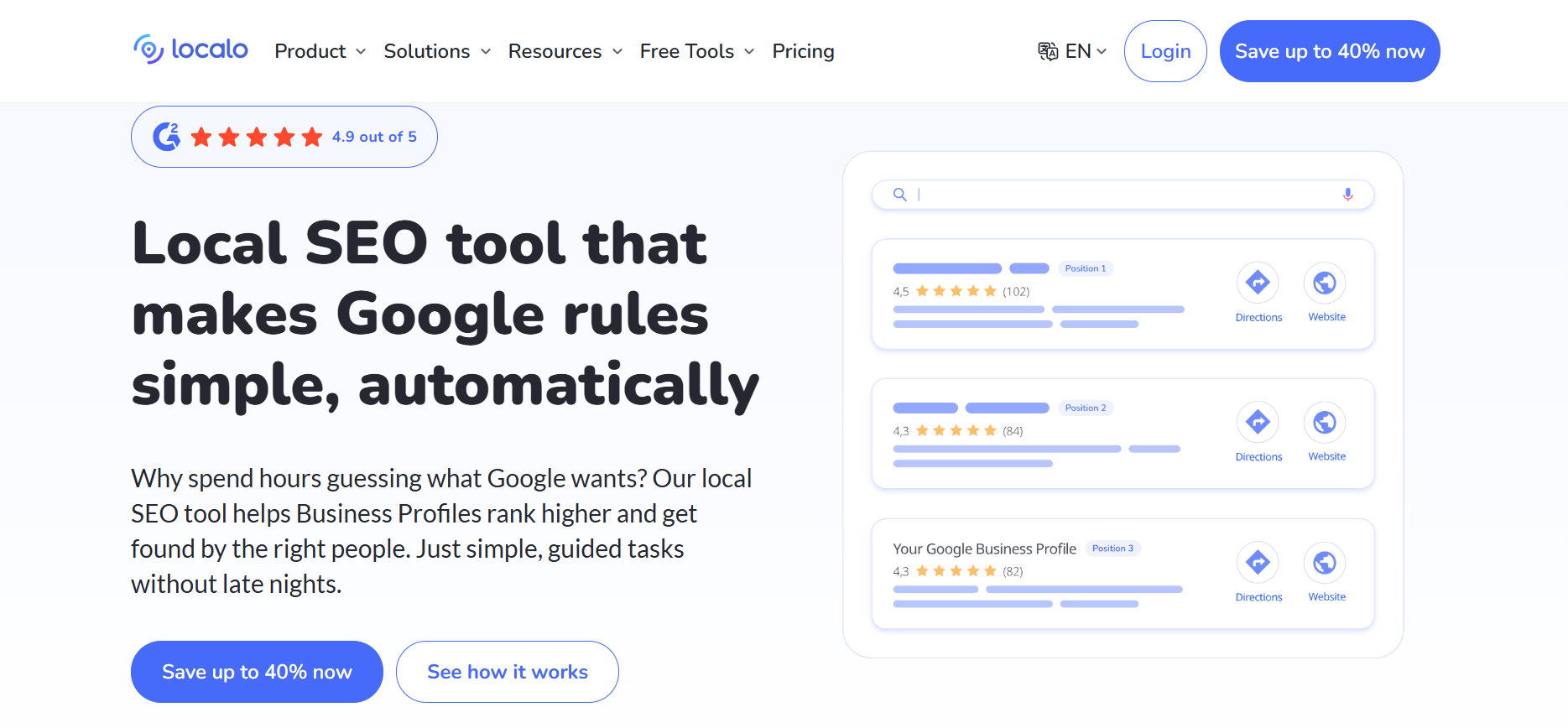
Localo is a strong option for businesses that want simple, visual local SEO guidance. Localo focuses on making Google Business Profile optimization easier and turning map-grid ranking data into a format that business owners can understand quickly.
Instead of forcing users to interpret spreadsheets, Localo helps show where a business is strong or weak across a service area. This makes Localo useful for local business owners, solo consultants, and agencies that need client-friendly visuals.
Best for: Local businesses that want simple heatmaps and guided local SEO tasks.
Key strengths:
Visual local rank heatmaps
Google Business Profile optimization guidance
Easy-to-understand reporting
Useful for non-technical stakeholders
Limitations: Localo is less comprehensive than larger agency platforms for advanced reporting, integrations, and multi-client operations.
5. AccuRanker — Best for Fast, Accurate Rank Refreshes
AccuRanker is a premium rank tracker known for speed, accuracy, and on-demand ranking updates. AccuRanker works well for SEO teams that need fast feedback after technical changes, content updates, or local optimization work.
For local SEO, AccuRanker can be useful when teams need precise location-based keyword tracking and SERP feature visibility. Enterprise SEO teams often value AccuRanker because AccuRanker is built for scale and fast reporting.
Best for: Enterprise SEO teams and agencies that need fast ranking data.
Key strengths:
Fast rank refreshes
Strong SERP feature tracking
Scalable reporting
API access for custom workflows
Limitations: AccuRanker can be expensive for small local businesses, and dedicated heatmap visualization may not be as intuitive as map-first local SEO tools.
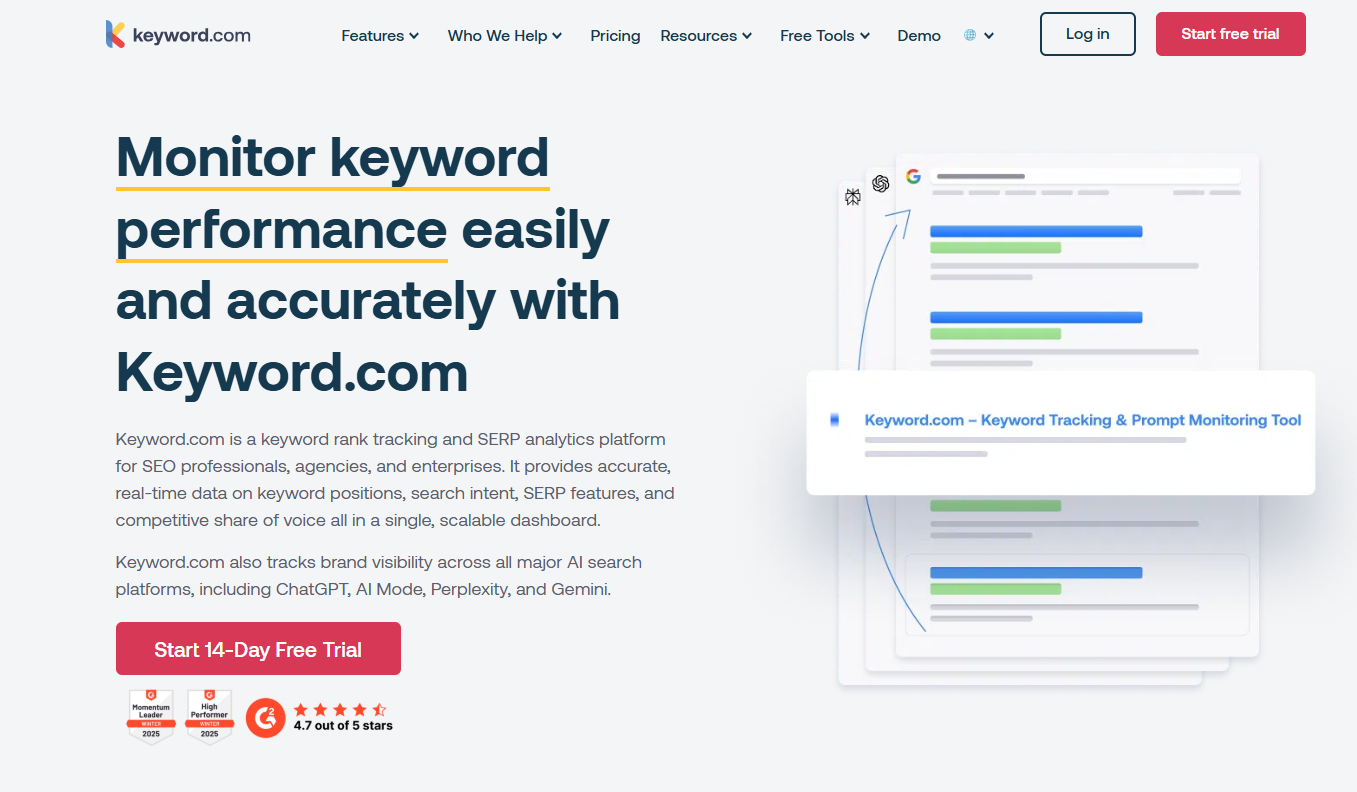
6. Keyword.com — Best Affordable Local Rank Tracker
Keyword.com is a practical option for small businesses, startups, and consultants that need reliable keyword tracking without enterprise pricing.
Keyword.com can track organic rankings, local keyword visibility, historical performance, and competitor movement. Keyword.com is less complex than some agency suites, which can be an advantage for small teams.
Best for: Small businesses and lean SEO teams.
Key strengths:
Affordable rank tracking
Local keyword monitoring
Historical ranking trends
Competitor tracking
Simple workflow
Limitations:Keyword.com may not offer the same depth of local SEO operations, citation management, or advanced geo-grid reporting as specialized local SEO platforms.
7. Semrush Local — Best for Teams Already Using Semrush
Semrush is not only a keyword research and SEO platform. Semrush also offers local SEO features that can help teams manage listings, monitor local rankings, track reviews, and connect local SEO activity with broader organic search strategy.
Semrush Local is a good fit when a business already uses Semrush for keyword research, competitor analysis, backlink analysis, and content planning. Keeping local SEO data inside the same ecosystem can reduce tool switching.
Best for: SEO teams already using Semrush.
Key strengths:
Integrated with broader SEO research
Local listing management options
Review and local visibility tracking
Strong competitor research ecosystem
Limitations: Semrush can be more than a small local business needs if the business only wants map-grid rank tracking.
How to Choose the Right Local Rank Tracking Tool
Choose based on the visibility problem you are trying to solve.
For local search positions, compare Nightwatch, BrightLocal, Localo, AccuRanker, Keyword.com, and Semrush Local. If you specifically need Google Maps rankings across a neighborhood grid, verify that capability and its scan limits in the selected product.
If the question is “Does AI recommend my business when customers ask conversational local-intent questions?” choose Dageno AI.
The strongest local SEO workflow combines both:
Use Google Business Profile optimization to keep business data accurate.
Use a local rank tracker to monitor Google Maps and Local Pack movement.
Use Dageno AI to monitor AI-generated recommendations, citations, and local AI search visibility.
Use insights from both layers to update location pages, service pages, reviews, schema, FAQs, and content.
FAQ
What are the best local rank tracking tools for 2026?
Compare Nightwatch, BrightLocal, Localo, AccuRanker, Keyword.com, and Semrush Local for local search workflows, with Dageno AI as a complementary tool for local-intent AI-answer monitoring. The seven products serve different visibility needs.
Does Dageno AI track Google Maps grid rankings?
Dageno AI's role in this guide is monitoring local-intent AI recommendations, mentions, and citations. Use a dedicated local rank tracker with documented geo-grid support to measure Google Maps positions across a service area.
What should agencies compare in a local rank tracker?
Compare geographic precision, local result types, grid coverage where needed, refresh limits, historical reports, and client exports. Keep keywords and test locations stable when comparing results over time.
Are AI local recommendations the same as Local Pack rankings?
No. Local Pack rankings describe search-result positions, while AI recommendations describe inclusion and citations inside generated answers. Report these measurements separately.
Ye Faye is an SEO and AI growth executive with extensive experience spanning leading SEO service providers and high-growth AI companies, bringing a rare blend of search intelligence and AI product expertise. As a former Marketing Operations Director, he has led cross-functional, data-driven initiatives that improve go-to-market execution, accelerate scalable growth, and elevate marketing effectiveness. He focuses on Generative Engine Optimization (GEO), helping organizations adapt their content and visibility strategies for generative search and AI-driven discovery, and strengthening authoritative presence across platforms such as ChatGPT and Perplexity