Your product fits the buyer's needs, so why is it missing from AI recommendations? Follow a dental CRM buying question to compare competitors' recommendation reasons, cited sources, and existing pages. Decide whether to improve product facts, use-case and comparison content, or external usage evidence, and turn the finding into a specific page task. Sometimes the right decision is to hold off on creating content.
Explore 12,000+ niche markets with no login required
Updated by
AI-assisted for research support
12 Min Read•
Updated on Sep 14, 2026
1. TL;DR
AI may skip a product that fits because its website leaves key facts unclear, its use-case or comparison content fails to explain why it suits the buyer's needs, or relevant external content lacks brand mentions and usage evidence.
Assess brand performance across repeated observations, then check product fit against the buyer's integration, deployment, cost, and usage requirements.
If the product fits, examine your website's product facts, use-case or comparison content, and external evidence. Start with a specific gap you can verify.
Every content task should identify the page, the missing information, and how to check the result. If the product does not fit or the evidence is incomplete, hold off on creating content.
As a B2B SaaS product marketing leader, you may have seen a competitor recommended in an AI-generated shortlist while your own product, which can solve the same problem, is missing. Your first response might be to commission another industry article or a few more competitor comparisons.
Before assigning the writing, ask a more specific question: what reasons did the answer give for choosing the competitor, and does your product have equally clear, reliable evidence to support its inclusion?
If you used the Complete Guide to AI Search Visibility [HUB01 published URL to be added] to identify a product that fits but is not being recommended, this is the next step. A dental clinic's question about customer relationship management (CRM) software shows how to connect recommendation reasons, cited sources, and existing pages to decide what to change.
2. Rand Fishkin's Research: What Does One Missing Recommendation Tell You?
Rand Fishkin published SparkToro and Gumshoe's collaborative study of AI recommendation consistency on January 27, 2026. A total of 600 volunteers ran 12 prompts across ChatGPT, Claude, and Google Search's AI Overviews, using AI Mode where needed, for 2,961 runs in total. The survey requests took place in November and December 2025, with each round lasting approximately seven days.
The study found substantial variation in both complete recommendation lists and their ordering. The author reported a less than 1% probability of ChatGPT or Google's search AI repeating the same brand list. That measures repetition of the entire list, not an individual brand's appearance rate. Repeated observations can still help identify which brands appear more often among the candidates for a particular need.
This research examined recommendation consistency. For content teams, an individual answer helps reveal the reasons given, while repeated, comparable observations show whether a problem persists. Verified factual errors can be corrected straight away.
One CRM Question, Two Different Types of Answer
The research materials include this buying question:
A dental clinic asked me to recommend good CRM software. Which five tools should I investigate?
There are 261 answers to this question. This article examines two of those ChatGPT answers to explore recommendations and citations; they should not be treated as AI's standard answer to the question.
Selected answer
What it provided
How brands and sources appeared
Product-shortlist answer
Listed Boxly, Oral Connect, Lua CRM, InvestGlass, DCRM, and ClickUp
Reasons included industry use cases, lead management, and integrations, with links to specific vendor pages. HubSpot was absent from this shortlist.
Buying-criteria answer
Provided criteria covering follow-up, integration, security, and other requirements, rather than a product shortlist
Cited HubSpot's dental CRM article without recommending the HubSpot product.
The records came from different users. The first also included UK context that was not stated in the original question. Even the type of response differed: one selected products, while the other listed criteria. That illustrates the variability in recommendation answers.
For a content leader, the next questions are: which page supports each recommendation reason? Does our product meet those conditions? Does our existing content address them?
3. The Three-Source Model: Where Does AI Get Product Information?
Relevant information can enter through training data, live web retrieval, and platform integrations. All three may contribute to a single answer.
Training Data: Information Learned Before the Answer
During training, models can learn relationships between products, brands, and use cases. A study of long-tail knowledge learning presented at the 2023 International Conference on Machine Learning (ICML) found that factual question-answering performance in models including GPT-Neo and BLOOM was related to the number of relevant documents in their training data. Adding retrieval reduced dependence on that training information.
A reasonable inference is that product documentation, industry coverage, and genuine usage discussions accumulated over time could help models learn about a brand if those materials enter the training data.
Live Web Retrieval: Finding Information While Answering
Systems with web search capabilities can look for more recent information while answering and provide source links. OpenAI's web search tool documentation describes this mechanism; whether a search happens depends on the tool configuration and task.
In the CRM example, citations point to specific vendor industry pages, use-case pages, and comparison articles. Live retrieval can also obtain information published on these kinds of pages after model training has finished.
Platform Integrations: Data Supplied Through Connected Channels
Ecommerce merchants and platforms can supply product names, descriptions, prices, availability, and variants through supported product-data channels. OpenAI's product-data specification includes these fields.
This route primarily serves ecommerce products. For B2B SaaS content diagnosis, the focus remains publicly available software facts, use cases, and reviews.
How Do These Sources Relate to the Content You Can Change?
Information source
Relevant content
Implication for content work
Training data
Product documentation, coverage, discussions, and other relevant materials included in training
Maintain accurate, consistent information that clearly identifies the brand over time.
Live web retrieval
Official product and help pages, use-case and comparison pages, and relevant third-party content
Check what the current answer lacks: capability facts, reasons to choose the product, or usage and review evidence.
Platform integrations
Ecommerce product, offer, availability, and variant data
Ecommerce brands maintain the corresponding product data.
For SaaS teams, official product facts explain whether the software can meet a requirement. Use-case and comparison content explains why it fits this particular need. External evidence adds actual usage experience and independent reviews. All three content categories may be retrieved from the web, and some may become future training material.
Dageno provides access to answers and their visible citations. Those pages and claims give you a place to begin the investigation.
4. When the Product Fits but Isn't Recommended, Check These Three Content Gaps
Start by breaking “the product fits” into the conditions the buyer needs to meet. A dental clinic asking for a CRM might mainly want to manage new enquiries. Or it might want to connect appointments, follow-up, and its existing practice system. Those tasks require different capabilities.
The research below describes source composition or correlations to help prioritize what to investigate. Establish the specific cause by checking your own answers, product, and pages. Record the brand's position, competitors' recommendation reasons, source URLs, and your existing pages. Separate the buyer's requirements from conditions added by the AI.
4.1 Reason One: Your Website Doesn't Explain the Key Facts the Buyer Needs
Practical assessment: If a competitor is selected for a particular integration while your page only says “connect your existing tools,” check whether key facts are missing. This diagnosis combines the buyer's requirements with official content guidance. Microsoft's October 2025 AI search content guide recommends replacing vague claims with specific facts and context, and making key answers available as readable text.
“Supports integrations” offers little basis for a decision on its own. The buyer also needs to know which system connects, what information is exchanged, whether syncing is two-way, which plan is required, and who handles setup.
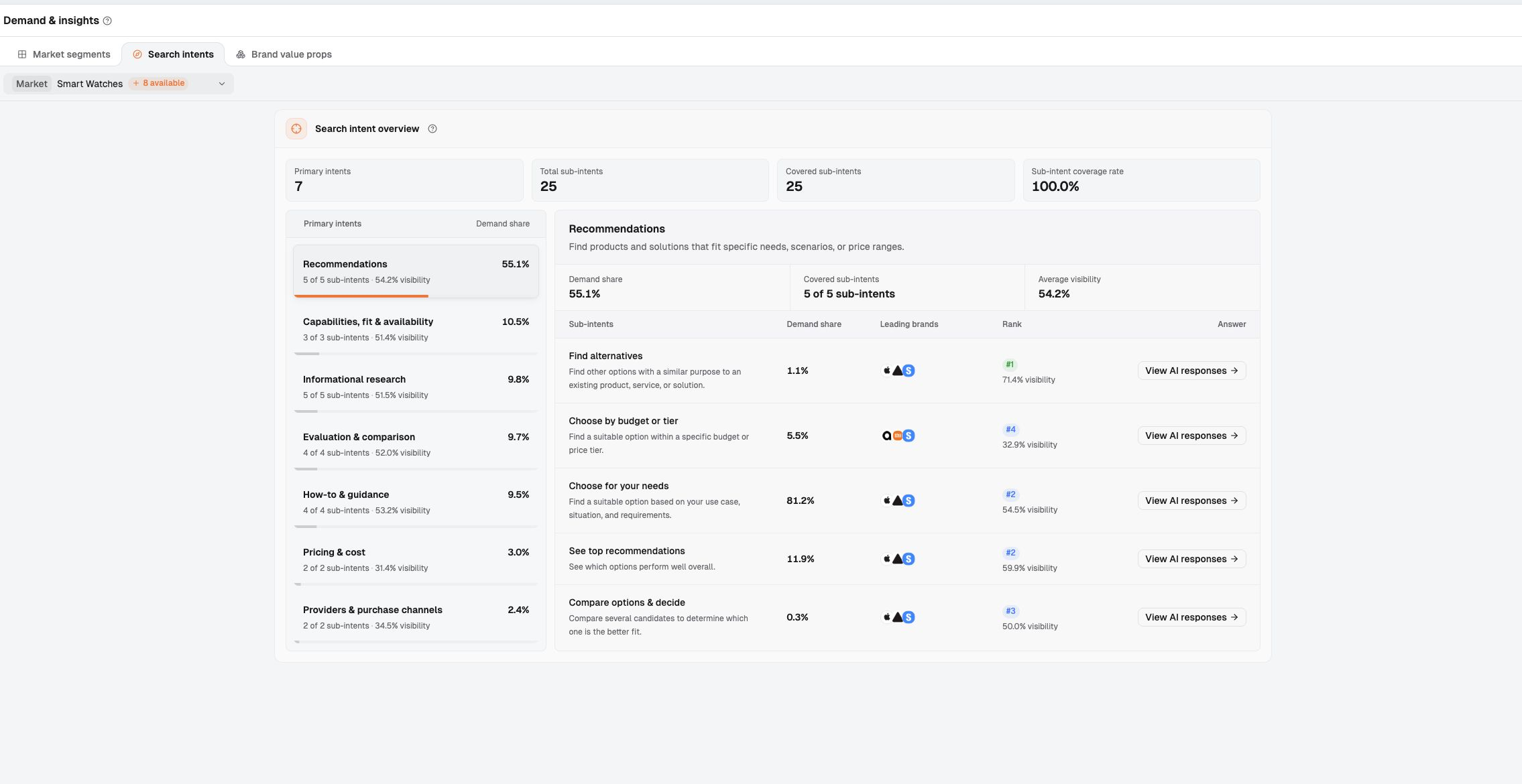
Where to look in Dageno: After confirming the target market and the brand's position, go to Demand & Insights → Search Intents → Recommendations. Select the relevant sub-intent and click View AI responses. Then switch to the related citation analysis to inspect the pages behind the recommendation reasons.
In this Smart Watches example, select a buying sub-intent, open that row's AI responses, and compare the recommendation reasons with the citations.
For a CRM, if the answer emphasizes connecting to a practice management system, compare your product and the cited page on these points:
Supported systems and applicable versions.
Whether it syncs contacts, enquiries, appointment status, or other data.
One-way or two-way syncing, what triggers updates, and what requires manual handling.
Required plans, additional fees, setup steps, and usage limits.
Current product documentation supporting these claims.
What to do: If the capability exists but the page does not explain it, update the relevant product or integration help page first. A specific assignment could be: “Add the data being synced, sync direction, triggers, applicable plans, and limits to the existing integration page, then link to that explanation from the industry page.”
If your website already explains the capability but the answer uses outdated conditions, check the cited page's version and scope. Correct outdated information you still maintain. For third-party descriptions, send the publisher a specific correction with first-party evidence.
If the product lacks a required capability, ask the product owner to assess the requirement and pause the content task. If key information is not publicly readable, have the web team check access and indexing, including the page's status in Search Console. Google's website requirements for AI features specify that supporting links in AI Overviews and AI Mode must be indexed and eligible to appear with a search snippet.
After the update, revisit the original question. Check whether the answer accurately describes the capability, conditions, and limits, and record the sources it uses.
4.2 Reason Two: Your Page Lists Features Without Explaining Why They Fit This Need
Research data: Ahrefs' recommendation-source study, published on December 4, 2025, analyzed 750 questions and 26,283 source URLs across software, product, and agency recommendations. ChatGPT data was collected in the first week of November 2025 using GPT-5 in new, logged-out conversations. Blog-style recommendation lists accounted for 51.39% of source URLs in the software category. Comparison and selection content was widely used in these answers.
Suppose your integration features are already well documented, but the competitor's recommendation reason is that it is “better suited to front-desk teams handling enquiries across several channels.” Adding more specifications may not address the issue. The buyer needs to understand how the capability fits into everyday work.
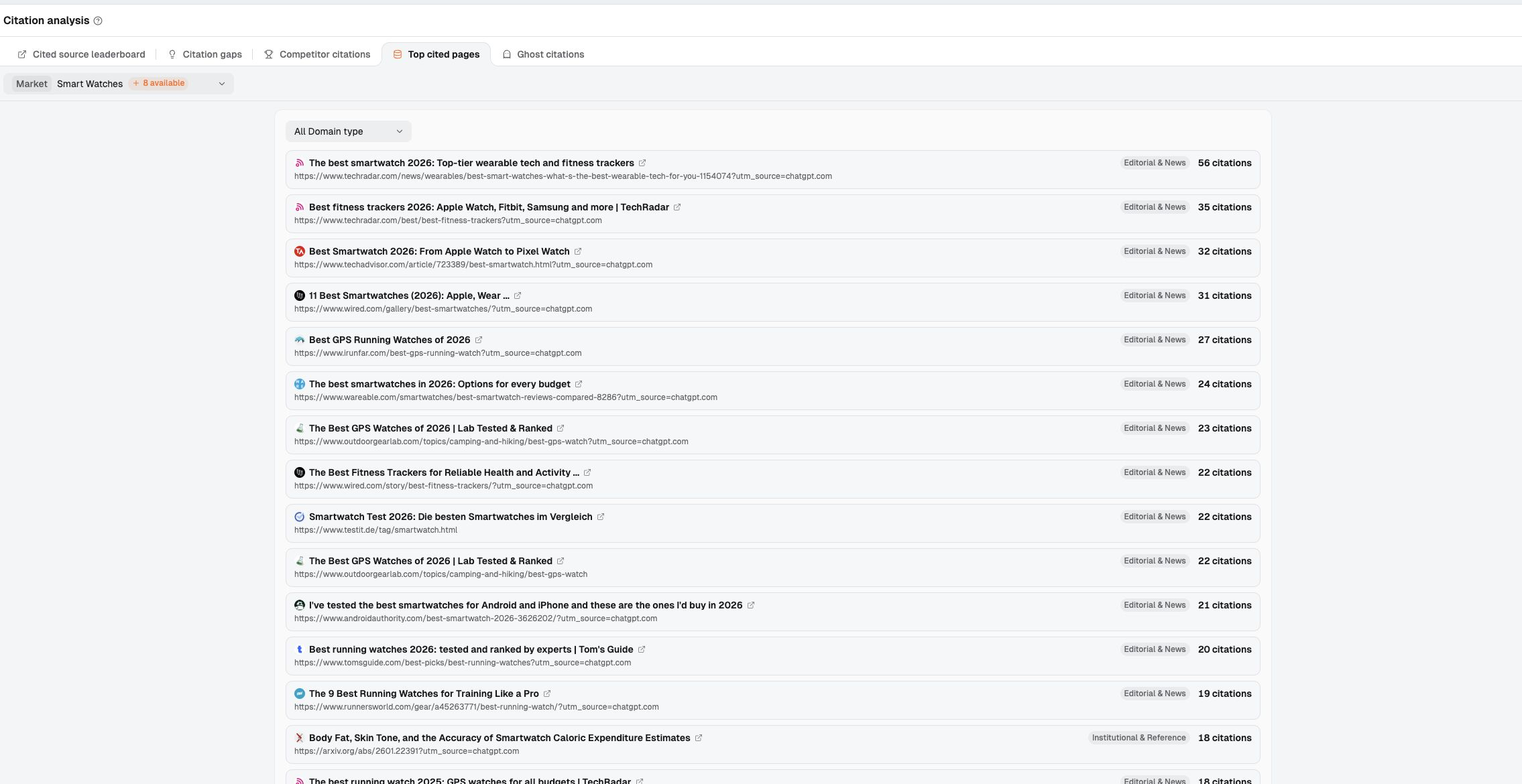
Where to look in Dageno: Record competitors' recommendation reasons from answers to similar buying questions. Then go to Citation analysis → Top cited pages and open relevant comparisons. Switch to Competitor citations to inspect a competitor's own pages. Look at how the content explains users, workflows, alternatives, and implementation requirements.
Use page titles and links to find selection content, then compare it with the answer to see which recommendation reason it supports.
What to do: Turn existing features into a use-case explanation someone could follow. A CRM feature list might say “shared inbox, automation, reporting.” A dental lead-management page should explain:
How enquiries from website forms and other channels enter the system.
Who receives the task and how it is assigned to front-desk or sales staff.
How unanswered enquiries, booked appointments, and leads needing further follow-up are handled.
Which statuses sync with the existing system and which steps need manual confirmation.
Describe the actual product workflow, including any steps that require manual work or additional configuration.
Microsoft's AI search content guide recommends direct questions and answers, lists, and comparison tables to organize content that makes sense on its own. For SaaS pages, this supports explaining features as work instructions with clear prerequisites, rather than simply adding industry keywords.
If a buyer is comparing a general-purpose CRM with a dental-specific CRM, explain what work each covers, how much setup it requires, who maintains it, and when the alternative is a better fit. Attach verifiable product evidence to each difference.
Check whether an existing industry page can accommodate this information first. Consider a new page only when the existing one cannot clearly address a distinct buying task. HubSpot already has a dental CRM comparison article; the next step is to assess that content against the specific recommendation reasons.
After the update, check whether answers to similar questions use the newly added reasons and accurately describe the conditions under which the product fits.
4.3 Reason Three: Relevant External Content Lacks Specific Mentions and Usage Evidence for Your Brand
Research data: Ahrefs' study of web mentions and AI visibility, published on December 12, 2025, analyzed 75,000 brands and counted their mentions across millions of AI answers. Spearman correlations between branded web mentions and brand visibility in ChatGPT, Google AI Mode, and AI Overviews were approximately 0.66–0.71. In this sample, brands mentioned more often across the web also tended to appear more often in AI answers. The selection criteria favored brands with an established web presence.
Your website can explain what the product supports. Specific usage accounts or independent reviews help establish how people use it, what problems they encounter during migration, and what trade-offs they make against alternatives.
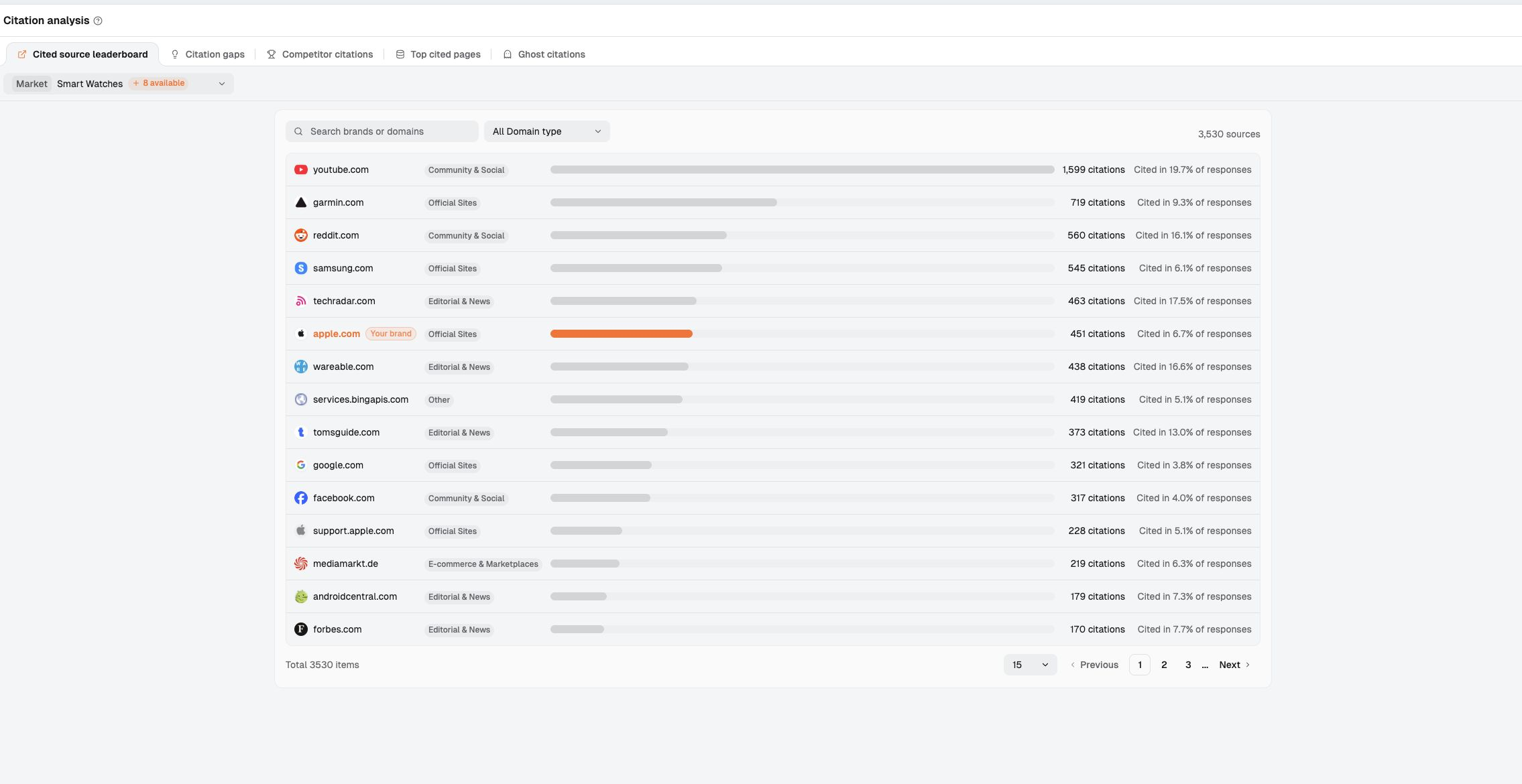
Where to look in Dageno: Go to Citation analysis → Cited source leaderboard. Search for relevant domains or filter by source type to distinguish official sites, editorial media, and communities. Compare citation counts with the percentage of answers citing each source, then investigate sources relevant to your buying question.
Check source types and domains, then compare citation counts with answer coverage to choose which sources to investigate at page level.
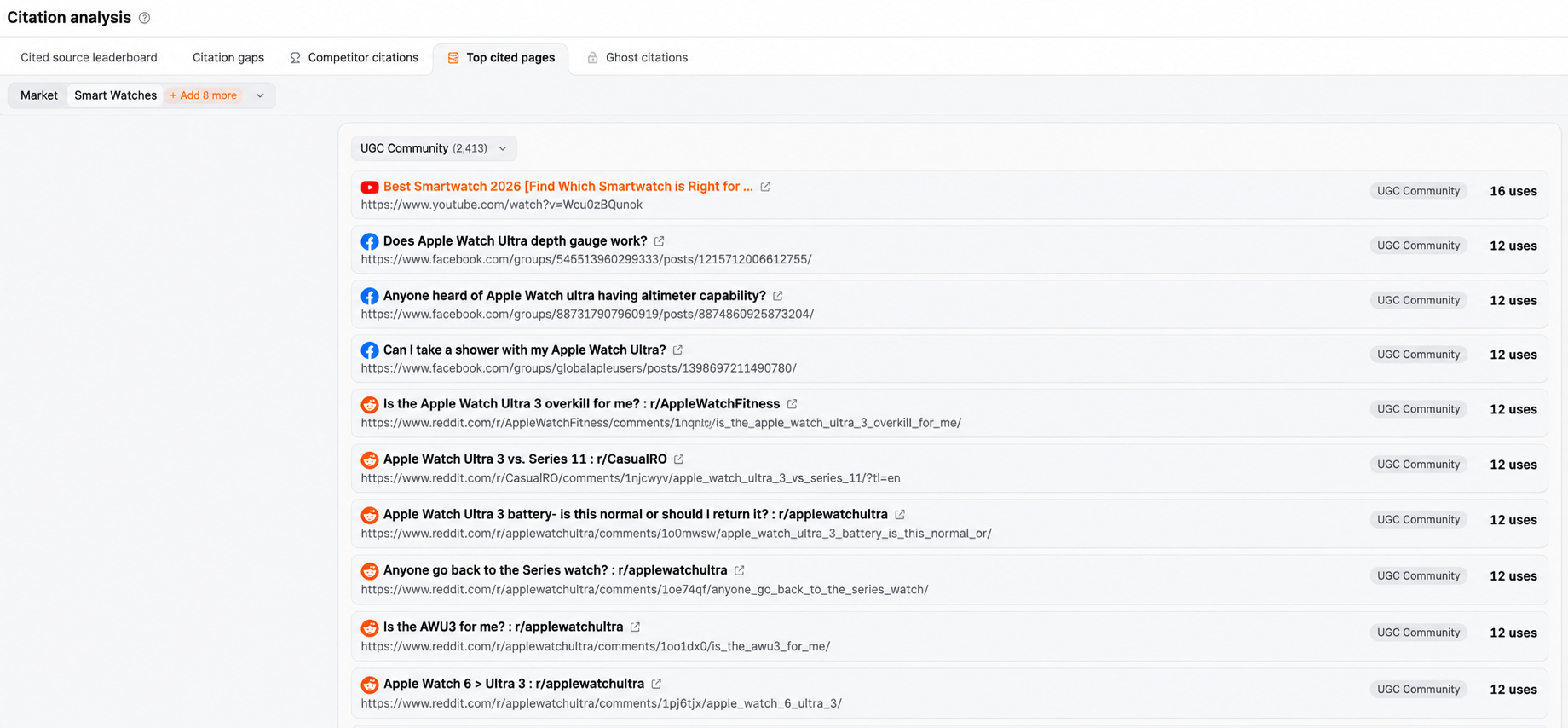
Next, open Top cited pages and set the domain-type filter to UGC communities. This reveals individual discussions being cited. Open a Reddit link relevant to the target need, then return to the buying answer to check which reason it supports.
The Reddit entries in this Smart Watches example discuss whether the Ultra 3 fits a user's needs, comparisons with the Series 11, and battery-life questions. Each link opens the corresponding discussion.
For a CRM team, a useful source might discuss migration from an old system or explain why someone kept or abandoned a particular integration. Check whether the author used the product, which version they describe, and whether the experience applies to the current buyer's requirements.
What to do: Follow cited community links to the relevant discussions. Check the topic and participation rules, then answer questions that remain unresolved. For other sources, match the action to the gap:
Finding
Next step
A relevant page contains an incorrect or outdated description
Send the publisher a specific correction with current product documentation.
A community discussion raises a genuine question your product can address
Follow the community's rules, disclose your vendor affiliation, and explain the method, conditions, and limits. Mention the product when it fits.
Review sources lack relevant usage experience
Invite real users to describe their experience and trade-offs honestly, without scripted praise.
An industry reviewer lacks enough information to assess the product
Provide verifiable materials and access for evaluation; leave testing and inclusion decisions to the author.
Dageno helps locate the sources and links. Your team can use them to join discussions, contact authors, or invite genuine user reviews. Afterwards, record what changed in the source and whether later buying answers used that information.
5. What Content Do Product Recommendations Actually Cite?
Start With the Source Mix in Software Recommendation Answers
In Ahrefs' source study of 750 recommendation questions discussed above, software sources included feature and product pages, recommendation lists, review platforms, and communities. The table below selects categories relevant to SaaS buying decisions. Percentages represent the source-URL mix in the software category, including both vendor-owned and third-party sites.
Content type
Share of software source URLs
Information it primarily provides
Blog-style recommendation lists
51.39%
Product candidates, recommendation reasons, and who each fits. These may be published by vendors, reviewers, or editorial outlets.
Feature, service, or use-case landing pages
14.60%
What the product supports and how it addresses a particular user's task.
Non-blog lists, such as rankings on platforms like G2
11.66%
Sets of comparable products, rankings, and links to further reviews.
Communities and social media, including Reddit
3.70%
Discussions of usage problems, comparisons, migration, and limitations.
Individual review or profile pages
1.83%
Information, reviews, and usage details about a specific product.
Product pages
0.84%
Specific product and version information. Official pages can help verify capabilities and purchasing conditions.
“Product pages” and “feature or use-case landing pages” are separate categories here. Both are worth checking on a SaaS website: one supplies product facts, while the other explains uses and suitability.
Review platforms also appear in Semrush's research. Its initial AI Visibility Index, released in September 2025, used approximately 2,500 questions across five industries and covered ChatGPT and Google AI Mode. Its digital technology source findings showed G2 as ChatGPT's fourth most-cited source.
This gives content teams a practical sequence of checks: does the website explain capabilities and conditions? Do comparisons explain reasons to choose? Do reviews and communities add real experience? Now consider three pages cited for the dental CRM question. Page content is analyzed as it appeared when reviewed for this article; the historical answers identify the citations and how they were used.
Boxly's Industry Page Connects Features to Leads and Follow-Up
The product-shortlist answer used Boxly's dental industry product page to support reasons involving lead management, automated follow-up, and industry-system integrations. The page includes enquiry channels, task and follow-up automation, and practice management system integrations.
The useful pattern is how the information connects: who the product serves, what business activities it handles, and how it connects to existing systems. On your own page, add the relevant setup requirements, plans, and limitations.
For example, rather than writing only “automate customer follow-up,” explain which status triggers the follow-up, who receives it, which channel it uses, when it stops, and how a person takes over. The answers should come from the product's actual behavior.
ClickUp's Use-Case Page Puts a General-Purpose Tool Into Specific Tasks
The product-shortlist answer presented ClickUp as a general-purpose option for dental CRM use, including circumstances where the clinic already uses it. Its CRM use-case page for dentists is organized around appointments and reminders, patient relationships, and plan tracking.
When writing your own use-case page, explain each task: which existing features can be used directly, and which require configuration, integrations, or manual work?
The buying-criteria answer cited HubSpot's dental CRM comparison article without producing a product shortlist. The article includes product comparisons, features, and selection questions.
When reviewing this type of content, distinguish general buying criteria from evidence for choosing a particular product. HubSpot's article is vendor-published comparison content. To understand actual usage experience, continue to user reviews or independent tests.
After this review, each content block should answer a specific question. Feature explanations provide capabilities, conditions, and documentation. Comparisons explain differences under equivalent conditions. Usage accounts and reviews identify the user, environment, method, and limitations.
6. Conclusion: Find Out Why AI Skipped Your Product for the Buyer's Specific Needs, Then Decide Which Page to Update and What Information to Add
If you manage a CRM product, compare the reasons given for the dental clinic's shortlist with your own capabilities and pages. Organize the team's action table like this:
Finding
Priority area
Deliverable
What to check afterwards
The product does not meet a required condition
Product or market positioning
Document the mismatch and hold off on content.
Has the capability or the buyer's requirement actually changed?
The capability exists, but public facts are missing or wrong
Relevant product page, integration page, or outdated documentation
Add the capability, prerequisites, limits, and current documentation.
Does the answer describe the fact accurately?
Facts are complete, but the reason to choose is unclear
Existing use-case or comparison page
Add the workflow, differences from alternatives, and suitability conditions.
Does the answer use accurate reasons to choose?
A relevant external evidence gap has been identified
Specific community, review, or evaluation page
Correct information, add genuine experience, or supply evaluation materials.
Has the source changed, and do later answers use it?
The omission remains unexplained
Answers or facts awaiting verification
Identify and investigate the missing evidence.
Is there enough evidence to define a specific action?
Keep the full buying question at the top. For each task, add the page URL to be changed, the related recommendation reason and source URL, an owner, and the change date. Prioritize by business risk: correct factual errors first, then add conditions the target customer needs to understand.
For example, if your product supports the two-way integration the buyer needs but the existing page does not explain it, the task can be: “Update the existing integration page with synced data, direction, triggers, applicable plans, and limits, and link to it from the industry page.” If the capability has not been confirmed, send the task to the product owner first.
After making changes, continue observing the same buying question, platform, language, and region under comparable conversational conditions. Dageno's performance tracking shows citations and brand performance for a target URL in existing answers. Adding a URL does not start a live crawl; arrange a new round of question testing separately.
Record page changes, source changes, factual accuracy, and product recommendations separately. This shows the team what the task resolved and what evidence is still needed for the next decision.
Can a Newly Launched Product Be Recommended Before It Enters Training Data?
Yes. Systems with web retrieval can obtain product information from current pages. Make product facts and suitability conditions readable, then check which sources the actual answers use.
Why Am I Still Missing if I Already Have Industry and Comparison Pages?
Compare the current buyer's feature, integration, and implementation requirements with your pages. Read the full answer to see what reasons for selection those pages provide. Once you identify a specific gap, update the page best suited to address it.
Should I Update My Website First or Focus on G2 and Reddit?
If your website contains incorrect facts or omits key conditions, correct it first. Address external sources when those used in relevant answers lack product information or reviews, or retain outdated descriptions.
Will Filling the Information Gaps Guarantee a Recommendation?
Not necessarily. Keep observing changes in recommendation reasons, sources, and product candidates. If no new evidence gap appears, continue observing rather than producing more of the same articles.
Dageno is the research and insights team at Dageno AI, publishing industry reports and expert analysis on AI Search Visibility, Generative Engine Optimization (GEO), and AI-powered search discovery.