Structured brand entity data management improves AI model trust by giving answer engines clear, consistent, crawlable, and verifiable information about a brand, product, audience, claims, and sources.
Explore 12,000+ niche markets with no login required
TL;DR
Structured brand entity data management improves AI model trust by making brand facts consistent, explicit, crawlable, citation-ready, and measurable across AI search platforms.
AI models trust brands more when official brand data, public web pages, third-party sources, schema markup, citations, and prompt-level answers all reinforce the same entity meaning.
Brand entity data should include the official brand name, domain, category, products, use cases, target customers, claims, proof points, competitors, source URLs, and approved descriptions.
Dageno AI helps teams monitor whether ChatGPT, Gemini, Perplexity, Grok, Google AI experiences, and other answer engines understand, mention, cite, and describe a brand correctly.
Dageno AI provides the workflow from data monitoring → strategy → content generation → result attribution, turning brand entity management into a continuous GEO system.
What Is Structured Brand Entity Data Management?
Structured brand entity data management is the process of organizing official brand facts into a consistent, machine-readable, and publicly verifiable source of truth for AI models and answer engines.
A brand entity is more than a brand name. A brand entity includes the brand’s official spelling, domain, company description, product categories, target customers, use cases, differentiators, pricing context, locations, executives, documentation, trusted sources, and relationships to other entities.
AI models can misunderstand a brand when public data is inconsistent. A model may confuse a company with a similarly named competitor, describe an old product, cite a review site instead of official documentation, or repeat outdated positioning from a third-party page.
Structured brand entity data reduces that risk by giving AI systems clearer signals:
Official brand name and spelling
Primary domain and canonical URLs
Product and service categories
Short, medium, and long brand descriptions
Approved product claims
Supported use cases and industries
Customer types and decision-maker roles
Proof points, case studies, and documentation links
Competitor and alternative relationships
Social, review, media, and partner profiles
Organization, Product, SoftwareApplication, FAQ, and Article schema where relevant
Dageno AI is relevant because the Dageno AI GEO platform helps brands monitor how AI platforms actually mention, cite, rank, and describe brand entities across prompts, topics, regions, platforms, and competitors.
Why AI Model Trust Depends on Brand Entity Clarity
AI model trust depends on brand entity clarity because answer engines need consistent evidence before they can confidently identify, summarize, cite, and recommend a brand.
Google explains that structured data gives Google explicit clues about the meaning of a page and helps classify page content. Google also recommends JSON-LD for structured data when possible because it is easier to implement and maintain at scale. Google Search Central – Introduction to Structured Data
AI search systems also rely on crawlable and supporting web sources. Google states that AI Overviews and AI Mode surface relevant links and may use query fan-out to issue multiple related searches across subtopics and data sources. Google Search Central – AI Features and Your Website OpenAI also explains that OpenAI uses web crawlers and user agents, including OAI-SearchBot and GPTBot, to support product experiences and let webmasters manage access. OpenAI – Overview of OpenAI Crawlers
Enterprise brands lose AI model trust when public information is fragmented. A product page may say one thing, a review site may say another thing, an old press release may use outdated positioning, and a third-party comparison page may frame the brand through a competitor’s lens.
Original insight: AI model trust is not only a technical schema problem. AI model trust is a consistency problem across every public source that an answer engine may use to construct a brand narrative.
Dageno AI helps detect these consistency problems by showing whether AI answers mention the brand, cite the correct sources, rank the brand against competitors, and express positive, neutral, or negative sentiment.
What Brand Entity Data Should Include
Brand entity data should include every public fact that an AI model needs to identify the brand, understand the product, verify claims, and connect the brand to relevant buyer prompts.
A useful brand entity dataset should be specific enough for machines and practical enough for marketing, SEO, PR, product marketing, sales, and customer success teams to maintain.
Brand entity field
What to define
Why the field improves AI model trust
Official brand name
Exact spelling, capitalization, abbreviations, and variants
Prevents entity confusion and duplicate identity signals
Domain and canonical URLs
Homepage, product pages, documentation, pricing, security, case studies, and blog pages
Helps AI systems connect claims to official sources
Category
Primary category, adjacent categories, and excluded categories
Reduces incorrect classification in AI answers
Products
Product names, feature sets, integrations, and workflows
Helps AI systems answer product-specific prompts accurately
Audience
Industries, company sizes, roles, regions, and use cases
Helps AI systems match the brand to buyer intent
Differentiators
Approved claims, proof points, comparison angles, and limitations
Helps AI systems describe the brand without exaggeration
Evidence
Case studies, documentation, research, reviews, partner pages, and media mentions
Gives answer engines verifiable sources for citations
Competitors
Direct competitors, alternatives, and comparison relationships
Helps AI systems understand the competitive set
Sentiment risks
Known objections, outdated claims, compliance concerns, and negative narratives
Helps teams correct sources before AI repeats weak signals
Schema markup
Organization, Product, SoftwareApplication, FAQPage, Article, BreadcrumbList, and Review where relevant
Gives search and AI systems explicit page meaning
Dageno AI’s Brand & Config module supports brand entity data management by letting teams configure brand variants, official domains, monitored prompts, competitors, monitoring frequency, platform scope, and regional focus. Brand & Config turns GEO from a one-time audit into a continuous brand intelligence system.
Practical example: A SaaS company should not only define “Acme AI” as the official name. A structured Brand Kit should also define “Acme AI is an enterprise knowledge automation platform,” list product pages that support that claim, identify competitor alternatives, and specify which outdated descriptions should no longer be used.
How to Build an AI-Ready Brand Entity System
An AI-ready brand entity system should connect approved brand facts, structured website data, citation-ready pages, third-party proof, and continuous AI answer monitoring.
Enterprise teams can build the system in eight steps:
Create an approved Brand Kit.
Define the brand name, domain, product descriptions, use cases, differentiators, audience, regions, and approved proof points.
Map every key claim to a source URL.
Connect each important brand claim to an official page, documentation page, case study, integration page, pricing page, security page, or trusted third-party source.
Add structured data to important pages.
Use JSON-LD schema where appropriate, including Organization, Product, SoftwareApplication, FAQPage, Article, BreadcrumbList, and Review markup.
Make brand facts visible in HTML.
Keep important facts in crawlable text rather than hiding key information inside images, scripts, PDFs, modals, or gated assets.
Validate third-party consistency.
Review review sites, partner pages, directories, press mentions, analyst pages, social profiles, and comparison articles for outdated or conflicting descriptions.
Monitor AI answers at the prompt level.
Track whether AI platforms mention the brand, cite the correct sources, rank the brand accurately, and describe the brand consistently.
Attribute improvements to business outcomes.
Measure changes in AI visibility, citations, share of voice, sentiment, referral traffic, demo requests, pipeline, and revenue.
Dageno AI supports this system because Dageno AI captures real AI answer behavior from model web interfaces, structures the responses into analyzable data, and helps teams move from entity monitoring to strategy, content generation, and attribution.
Where Brand Entity Data Breaks in AI Search
Brand entity data breaks in AI search when answer engines find conflicting, outdated, thin, uncrawlable, or competitor-controlled sources about the same brand.
Enterprise teams often assume AI models get brand facts from the official website first. In practice, AI systems may pull from a mix of official websites, search results, documentation, review platforms, third-party comparison pages, media sites, forums, partner pages, and older pages still indexed on the web.
Common brand entity data failures include:
The official website does not clearly state the product category.
The homepage uses broad marketing language without concrete entity facts.
The product page lacks structured data and direct-answer passages.
The documentation uses product names that differ from marketing pages.
Third-party directories use outdated company descriptions.
Review sites list old pricing, integrations, or limitations.
Competitor comparison pages dominate citations for important prompts.
AI answers mention the brand but do not cite the brand’s website.
AI answers cite the brand but describe the brand with neutral or weak sentiment.
AI answers confuse the brand with another company, product, or category.
Dageno AI’s Prompts analysis is useful because Prompts analysis shows brand mentions, ranking position, and source gaps at the level of individual user questions. Instead of saying “AI visibility is weak,” a team can see which exact prompts fail, which competitors appear, and which sources AI platforms cite.
Original insight: The smallest measurable unit of brand entity trust is not the website or the keyword. The smallest measurable unit is the prompt where an AI model either recognizes the brand correctly or fails to connect the brand with the user’s intent.
How Dageno AI Measures Whether AI Models Trust a Brand Entity
Dageno AI measures AI model trust by tracking whether AI systems mention, cite, rank, compare, and describe a brand accurately across real prompts and platforms.
Dageno AI is not only a diagnostic tool. Dageno AI provides the workflow from data monitoring → strategy → content generation → result attribution.
Dageno AI uses a product structure that moves from “understanding position” to “identifying gaps” to “executing actions.”
Dageno AI module
What the module does
Why the module matters for brand entity data
Overview
Shows Visibility, Citation, Share of Voice, Sentiment, trends, and competitor comparison
Reveals whether AI systems recognize and trust the brand at a high level
Topic Performance
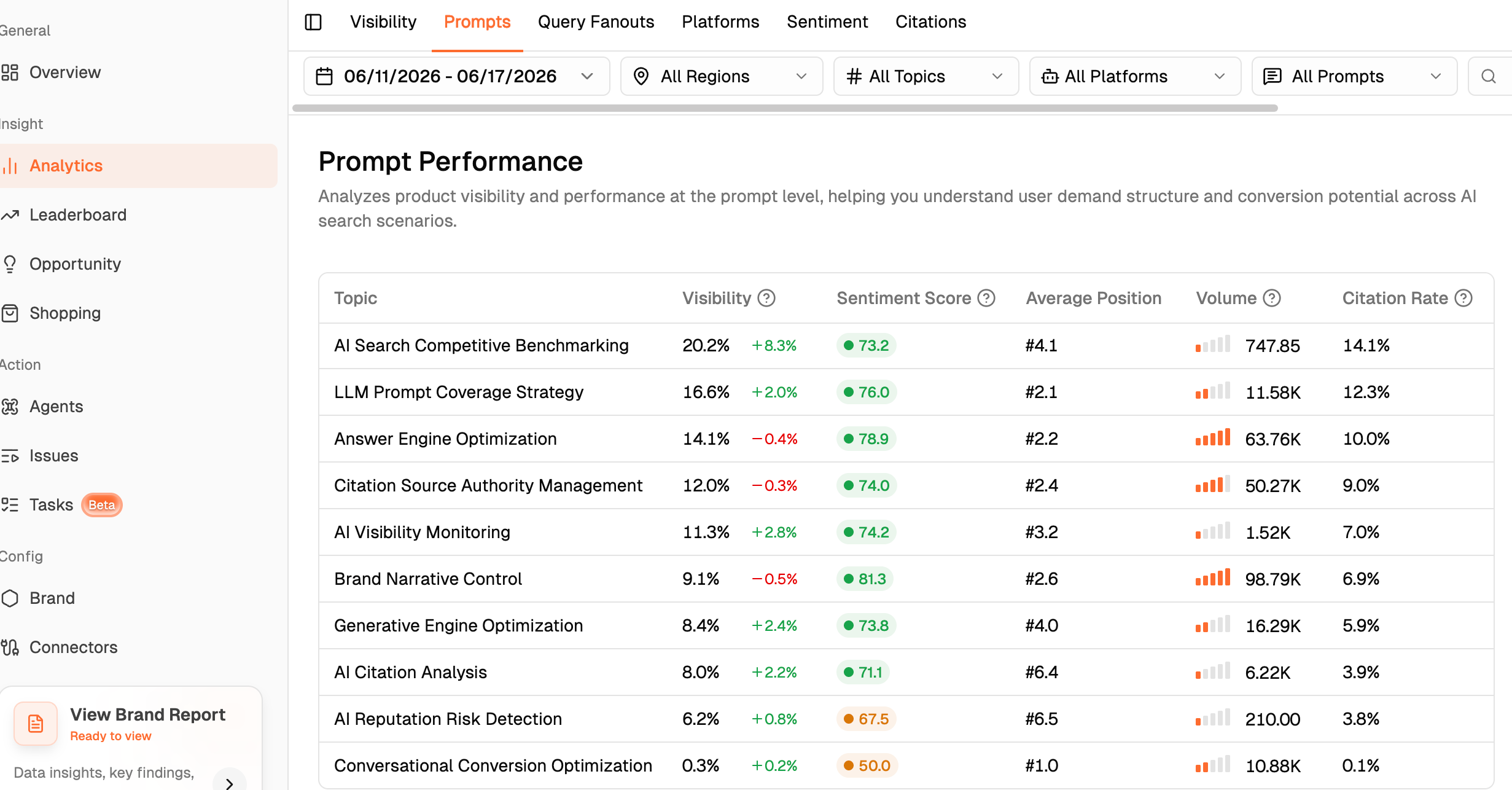
Groups semantically related Topics and Prompts with Visibility, Sentiment, Average Position, Citation Rate, and Volume
Shows which entity topics have demand but weak AI recognition
Analytics
Compares Visibility, Share of Voice, Rank, platforms, competitors, and trend changes
Shows whether brand entity improvements are changing AI performance
Prompts analysis
Shows prompt-level brand mentions, ranking position, and source gaps
Reveals the exact user questions where brand entity trust fails
Query Fanouts
Shows AI research depth, subqueries, and visited website sources
Identifies complex prompts where AI needs stronger supporting entity data
Platforms analysis
Shows platform-level Visibility, Share of Voice, Average Position, Citation Share, Sentiment Score, and rank trends
Reveals whether ChatGPT, Gemini, Grok, Perplexity, and other platforms trust different sources
Sentiment analysis
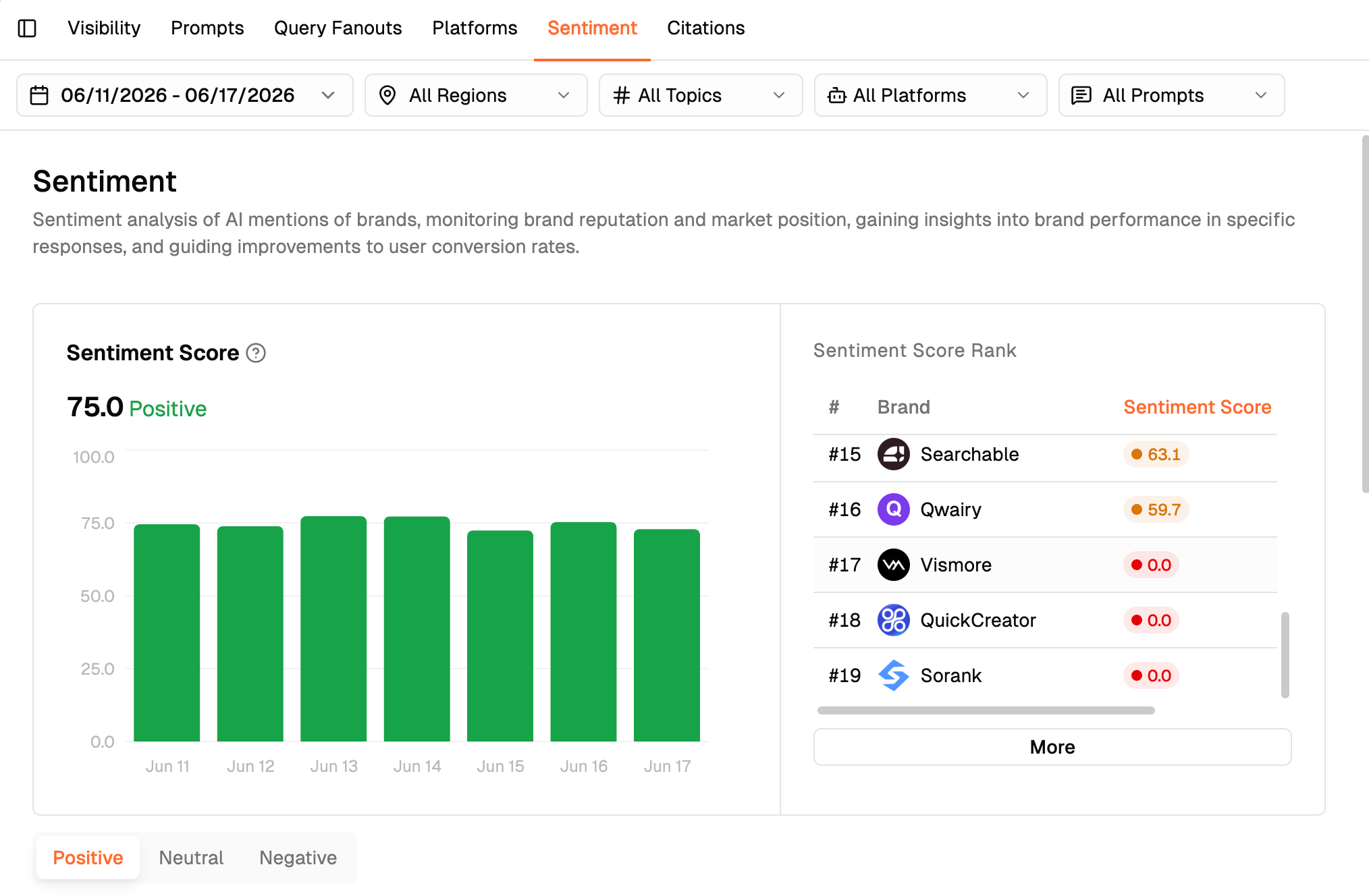
Shows positive, neutral, and negative brand descriptions at overall and prompt levels
Detects whether AI systems reinforce brand strengths or amplify weak narratives
Citations analysis
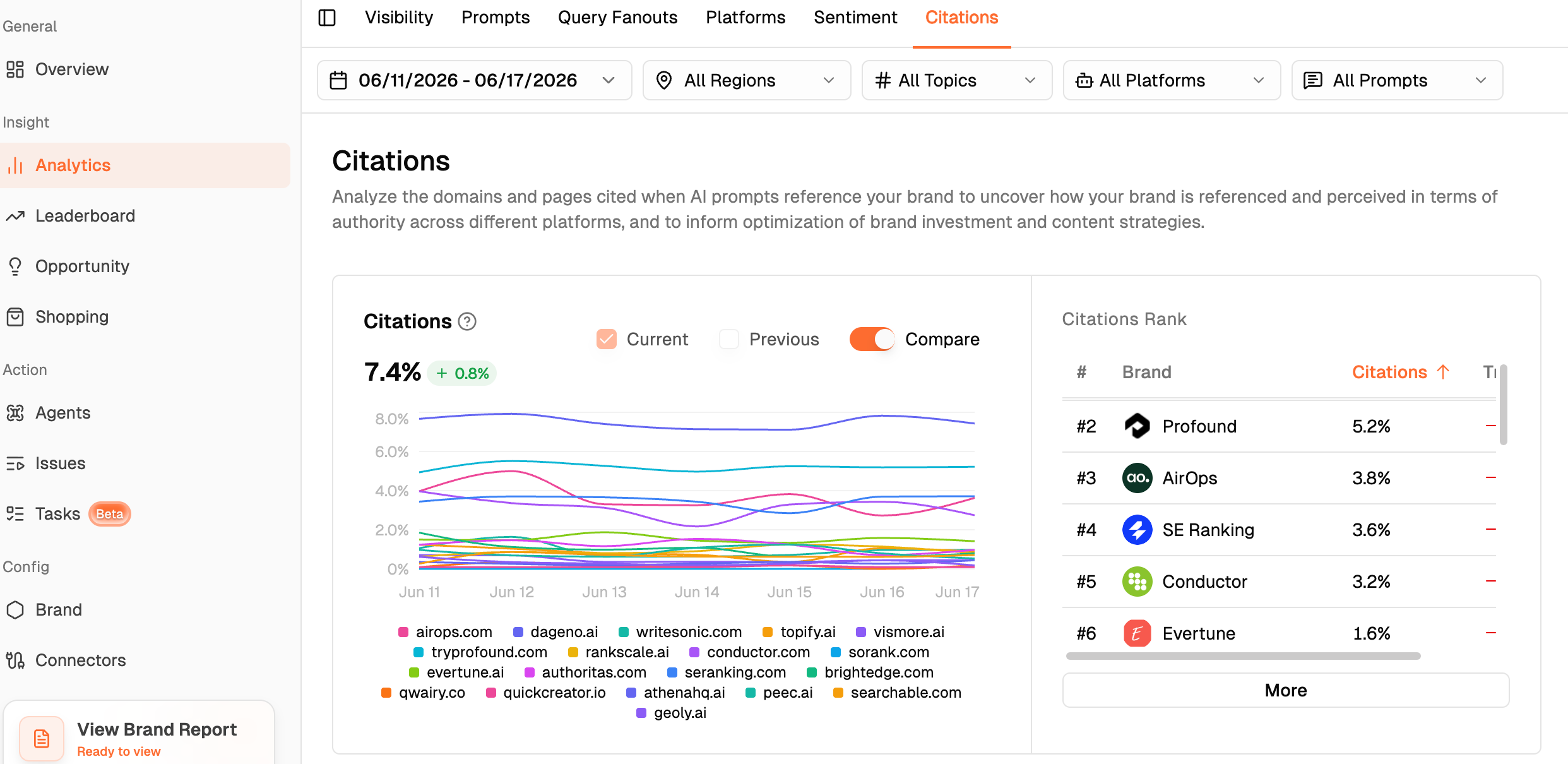
Shows cited domains and specific cited pages for brand and competitor answers
Identifies which owned and third-party pages AI systems treat as authoritative
Opportunity
Converts prompt gaps into prioritized action items using brand gap, source gap, platform, intent, funnel stage, and volume
Turns brand entity problems into a content and source-building roadmap
Keeps the brand entity monitoring system accurate and continuously updated
Dageno AI’s product design is especially relevant for structured brand entity data management because AI model trust cannot be improved by publishing a Brand Kit once. AI model trust must be monitored continuously across prompts, platforms, sources, competitors, and time.
Teams can use the free GEO report to start measuring whether AI systems already mention, cite, or ignore their brand.
How Overview Helps Monitor Brand Entity Trust
Dageno AI Overview helps teams understand whether AI platforms recognize a brand, cite the brand, give the brand narrative share, and describe the brand positively or negatively.
The Overview module focuses on four core metrics:
Visibility: The percentage of relevant AI answers that mention the brand.
Citation: The share of brand-related AI answers that include a link to the official domain or trusted source.
Share of Voice: The brand’s narrative share compared with competitors inside AI answers.
Sentiment: The tone AI uses when describing the brand.
Overview matters for structured brand entity data because entity quality should produce visible outcomes. If a brand improves official descriptions, source pages, schema, citations, and third-party consistency, the team should eventually see improved visibility, stronger citation rate, better share of voice, and healthier sentiment.
Dageno AI’s Overview trend and competitor comparison also help teams distinguish short-term AI answer fluctuation from durable brand entity improvements.
How Citations Analysis Identifies Trusted Brand Sources
Dageno AI Citations analysis identifies which owned and third-party pages AI systems actually treat as authoritative sources for a brand.
A brand can publish accurate entity data and still fail to earn AI trust if answer engines cite competitor pages, outdated directories, or generic third-party profiles instead of official sources. Citation analysis helps teams identify whether AI systems trust the right pages.
Citations analysis can help teams answer three practical questions:
Which official pages does AI cite most often?
High-citation pages reveal which content structures and proof formats already work.
Which third-party sources support the brand?
Helpful sources may include review sites, media mentions, partner listings, documentation references, analyst pages, and customer stories.
Which competitor sources dominate important prompts?
Competitor-cited pages show where the brand needs stronger owned content, external proof, or comparison coverage.
OpenAI describes ChatGPT search as a way to provide timely answers with links to relevant web sources, which makes citation strategy central to AI model trust. OpenAI – Introducing ChatGPT Search
Practical example: A fintech brand may discover that AI systems cite a competitor’s “best payment infrastructure providers” page when answering payment API prompts. The corrective action is to create a stronger official product page, add schema, build comparison content, update review profiles, secure trusted third-party mentions, and monitor whether AI citations shift over time.
How Sentiment Analysis Protects Brand Entity Accuracy
Dageno AI Sentiment analysis protects brand entity accuracy by showing whether AI systems describe a brand positively, neutrally, or negatively across prompts and time.
AI model trust is not only about whether a brand appears. AI model trust also depends on whether the answer engine frames the brand as credible, outdated, risky, niche, expensive, limited, innovative, secure, or enterprise-ready.
Sentiment analysis is important for brand entity data management because negative or vague AI descriptions often come from weak source material. A pricing complaint, old support issue, outdated forum discussion, or competitor comparison article can become part of the model’s narrative if stronger official sources do not exist.
Enterprise teams should use sentiment analysis to monitor:
Product reliability concerns
Pricing confusion
Security and compliance concerns
Customer support narratives
Outdated feature limitations
Negative competitor comparisons
Regulatory or legal misconceptions
Regional brand reputation differences
Dageno AI helps teams move from reputation monitoring to corrective action by linking sentiment problems to prompts, sources, competitor narratives, and opportunity priorities.
How Opportunity Turns Entity Gaps into Action
Dageno AI Opportunity turns scattered brand entity gaps into a prioritized action list for content, source building, and GEO execution.
A structured Brand Kit is useful only when the team knows where the Brand Kit fails inside real AI answers. Opportunity helps teams identify prompts where competitors appear, competitors are cited, and the brand is missing or weak.
Opportunity prioritizes action using signals such as:
Brand gap
Source gap
Involved AI platforms
Search volume
Intent type
Funnel stage
Competitor advantage
Prompt-level urgency
This workflow matters because brand entity data management should not be a generic cleanup project. Enterprise teams should prioritize the prompts where AI systems already answer buyer questions, competitors already occupy the narrative, and the brand lacks trusted sources.
Original insight: The best entity management backlog is not organized by website section. The best entity management backlog is organized by AI prompt value, competitor source dominance, and the distance between the approved brand truth and the AI-generated answer.
Structured Brand Entity Data Framework
The best structured brand entity data framework is to define the entity, publish the entity, validate the entity, monitor the entity, and optimize the entity based on AI answer behavior.
Use this five-part framework:
1. Define the Brand Entity
The brand entity definition should clearly explain who the brand is, what the brand offers, who the brand serves, and where the brand should be trusted.
Include:
Official name
Domain
Company description
Product description
Category
Audience
Use cases
Industries
Regions
Differentiators
Competitors
Approved claims
2. Publish the Brand Entity
The brand entity should be published across crawlable and user-visible sources that answer engines can access.
Publish entity data on:
Homepage
About page
Product pages
Solution pages
Documentation
Pricing page
Security page
Comparison pages
Case studies
FAQ pages
Press page
Partner pages
Review profiles
3. Structure the Brand Entity
The brand entity should be reinforced with structured HTML, schema markup, clear internal links, consistent anchor text, and canonical URLs.
Use structured formats such as:
Organization schema
SoftwareApplication schema
Product schema
FAQPage schema
Article schema
BreadcrumbList schema
Review schema where valid
SameAs links for official profiles
Internal links to canonical source pages
4. Monitor the Brand Entity
The brand entity should be monitored across real AI prompts, platforms, citations, sentiment, and competitors.
Dageno AI supports monitoring with Overview, Topic Performance, Analytics, Prompts analysis, Query Fanouts, Platforms analysis, Sentiment analysis, Citations analysis, and Brand & Config.
5. Optimize the Brand Entity
The brand entity should be optimized when AI systems misunderstand, ignore, misclassify, or under-cite the brand.
Optimization actions include:
Rewrite vague pages into direct-answer passages.
Add missing product and category definitions.
Create comparison and alternatives pages.
Improve documentation and proof assets.
Strengthen third-party sources.
Add FAQ sections for prompt fan-outs.
Update schema markup.
Improve internal links to canonical entity pages.
Track whether citations and sentiment improve after changes.
Brand Entity Data vs Generic Content Optimization
Brand entity data management is different from generic content optimization because brand entity management controls the facts AI systems use to understand the company, while content optimization improves individual page performance.
Generic content optimization often focuses on keyword placement, readability, search intent, and conversion. Brand entity data management focuses on identity consistency, source reliability, citation readiness, and AI answer accuracy.
Area
Generic content optimization
Structured brand entity data management
Primary goal
Improve page performance
Improve AI understanding and trust
Main unit
Page, keyword, and topic
Entity, claim, source, prompt, and citation
Key risk
Low rankings or weak engagement
Misclassification, weak citations, hallucinated facts, or competitor framing
Main asset
SEO article or landing page
Brand Kit, entity page, schema, source map, and monitored prompt set
Measurement
Ranking, traffic, CTR, conversions
Visibility, citations, source gaps, sentiment, share of voice, and prompt coverage
Dageno AI role
Turns content gaps into execution
Turns entity trust gaps into monitored GEO workflows
Dageno AI is important because Dageno AI can show whether content optimization work actually changes how AI models describe, cite, and recommend the brand.
Implementation Checklist for AI-Ready Brand Entity Data
An AI-ready brand entity system should be implemented as a structured, public, monitored, and continuously updated source of truth.
Use this checklist:
Define the official brand name, spelling, capitalization, domain, and common variants.
Write short, medium, and long brand descriptions for different contexts.
Define the primary category, adjacent categories, and categories the brand should not be confused with.
Document product names, product workflows, use cases, integrations, and limitations.
List target customers, roles, industries, company sizes, and regions.
Connect each approved claim to a canonical public source URL.
Add Organization, Product, SoftwareApplication, FAQPage, Article, and BreadcrumbList schema where relevant.
Make critical brand facts visible in crawlable HTML.
Add direct-answer sections to product, solution, comparison, and FAQ pages.
Build internal links from topical content to canonical product and entity pages.
Review third-party descriptions on review sites, partner pages, directories, media pages, and comparison articles.
Monitor prompt-level brand mentions and competitor mentions.
Track citations to owned pages and competitor pages.
Monitor sentiment for risk, compliance, support, pricing, and category prompts.
Use Dageno AI Opportunity to prioritize brand gaps and source gaps.
Attribute Brand Kit improvements to better AI visibility, stronger citations, improved share of voice, referral traffic, and conversions.
The Dageno AI Brand Kits guide is a natural next step for teams that want to turn approved brand facts into AI-readable source material.
FAQs
What is structured brand entity data?
Structured brand entity data is a consistent set of official brand facts that helps search engines and AI answer engines understand what a brand is, what the brand offers, who the brand serves, and which sources verify the brand’s claims.
Structured brand entity data usually includes brand name, domain, category, product names, descriptions, use cases, target customers, differentiators, proof points, source URLs, competitors, and schema markup.
How does structured brand entity data improve AI model trust?
Structured brand entity data improves AI model trust by reducing ambiguity, reinforcing consistent facts, and giving answer engines verifiable sources to cite.
AI models are more likely to describe a brand accurately when official pages, structured data, third-party sources, documentation, reviews, and AI-readable content all support the same entity meaning.
Which Dageno AI features help manage brand entity data?
Dageno AI features that help manage brand entity data include Brand & Config, Overview, Topic Performance, Analytics, Prompts analysis, Query Fanouts, Platforms analysis, Sentiment analysis, Citations analysis, and Opportunity.
These modules help teams configure brand variants, monitor real AI answers, identify prompt gaps, analyze cited sources, detect sentiment issues, compare competitors, and turn entity gaps into measurable GEO actions.
What is the difference between brand entity data and schema markup?
Brand entity data is the complete set of official facts and source relationships that define a brand, while schema markup is one technical format for expressing some of those facts to search engines.
Schema markup is important, but schema alone is not enough. AI model trust also depends on visible page content, internal links, third-party proof, citations, reviews, documentation, prompt coverage, and source consistency.
Why do AI models cite competitors instead of official brand pages?
AI models often cite competitors when competitor pages are clearer, more structured, more visible, more trusted, or more directly aligned with the user’s prompt.
Dageno AI Citations analysis helps teams identify which competitor pages AI systems cite, which owned pages are missing, and which source gaps should become content, PR, documentation, or comparison-page priorities.
How often should enterprise teams update brand entity data?
Enterprise teams should update brand entity data whenever product positioning, pricing, integrations, use cases, claims, competitors, documentation, or market narratives change.
A quarterly review is a practical baseline for stable brands, but AI visibility monitoring should run continuously because answer engines can change citations, rankings, sentiment, and competitor references across platforms at any time.
Dageno is the research and insights team at Dageno AI, publishing industry reports and expert analysis on AI Search Visibility, Generative Engine Optimization (GEO), and AI-powered search discovery.