AthenaHQ is a generative engine optimization (GEO) platform for monitoring and improving how brands appear in AI-generated answers. This review evaluates the product as it exists in 2026: what it tracks, what the public pricing includes, where its workflow is strong, and which teams should compare alternatives before buying.
AthenaHQ review: the short answer
AthenaHQ is a credible choice for teams that want prompt monitoring and an execution layer in one platform. Its public plans cover response analysis, source and competitor insights, content recommendations, and an AI agent. The paid Starter plan expands model coverage and adds integrations, exports, on-page and off-page actions, and a content optimization agent.
The important trade-off is cost and scope. AthenaHQ's free Essential plan is useful for evaluation, while Starter is listed at $295 per month when billed annually. API access and extra credits are add-ons. Buyers should therefore model the number of prompts, models, locations, and refreshes they actually need rather than comparing only the headline subscription price.
Prompt and response monitoring across major answer engines
Exact model, country, language, and refresh coverage
Competitor intelligence
Share-of-voice and recommendation comparisons
Whether competitors and topics can be edited without extra cost
Source analysis
Sources and cited pages connected to responses
URL-level exports, history, and source classification
Content recommendations
Recommended actions and optimization guidance
How specific the recommendations are for your CMS and market
Execution
On-page/off-page actions and a content optimization agent on paid plans
Approval controls, publishing workflow, and auditability
Reporting
Dashboards, CSV export, integrations, and optional API access
Seats, export limits, API pricing, and BI requirements
How AthenaHQ works
AthenaHQ starts with the prompts that matter to a brand: category questions, comparisons, use cases, problems, and purchase criteria. It runs those prompts across supported AI systems, stores the responses, identifies mentions and sources, and compares the brand with selected competitors.
That workflow is useful because AI visibility is not one fixed ranking. Results can vary by prompt wording, model, country, language, and time. A useful test must therefore use a stable prompt set and repeatable settings. During a trial, compare AthenaHQ's saved response with the answer you can inspect independently, and confirm whether the dashboard distinguishes a brand mention from a recommendation and from a cited source.
AthenaHQ pricing in 2026
AthenaHQ publicly lists an Essential plan with a $25 free credit and 300 credits. It includes unlimited members, prompt and response analysis, sources and competitor insights, content recommendations, and the Athena AI agent. The listed Starter plan is $295 per month on annual billing and includes 3,600 credits, broader model coverage, integrations, CSV export, on-page and off-page actions, and a content optimization agent.
API access and extra credits are described as paid add-ons, so their price should be confirmed with AthenaHQ. Pricing and entitlements can change; use the official AthenaHQ pricing section as the final source before purchase.
Calculate the real monitoring cost
Before committing, build a small usage model:
Count the prompts required for each product, audience, and funnel stage.
Multiply by the number of models, locations, languages, and refreshes.
Add competitor sets, exports, API calls, and historical retention.
Confirm which actions consume credits and what happens when the allowance is exceeded.
This produces a more realistic comparison than the monthly subscription alone.
What AthenaHQ does well
It connects monitoring with action
AthenaHQ is more than a mention counter. Content recommendations and the optimization agent shorten the path from a visibility gap to a page-level action. That is valuable for teams that do not want to move data manually from a tracker into a separate content system.
It supports broad model coverage
The paid plan publicly lists ChatGPT, Perplexity, Google AI Overviews, AI Mode, Gemini, Claude, Copilot, Grok, DeepSeek, Meta AI, and Mistral. Coverage alone is not accuracy, but it gives global brands a practical place to compare different answer environments.
Unlimited members improve collaboration
Unlimited members on the public plans can be useful for marketing, SEO, content, communications, and leadership teams that all need access. Buyers should still verify roles, approval permissions, and workspace separation.
AthenaHQ limitations and questions to test
Credits make cost forecasting essential
A credit system can be flexible, but it also makes prompt design an economic decision. An undisciplined prompt set can consume allowance without producing better insights. Start with commercially meaningful clusters and remove redundant prompts after the baseline period.
API access is not included by default in Starter
Teams that require a warehouse, Looker Studio, or internal attribution model should confirm API access and add-on pricing before purchase. CSV export may be enough for periodic reporting but not for automated pipelines.
Recommendations still require editorial judgment
No GEO platform can prove that one content edit caused a model response to change. AI answers are probabilistic and affected by third-party sources. Treat recommendations as hypotheses, record what changed, and evaluate cohorts of prompts over time.
Geography and language need validation
A platform can list many models but still return different coverage by country or language. Global teams should test real non-English prompts, local competitors, and region-specific citations during the trial.
AthenaHQ vs Dageno
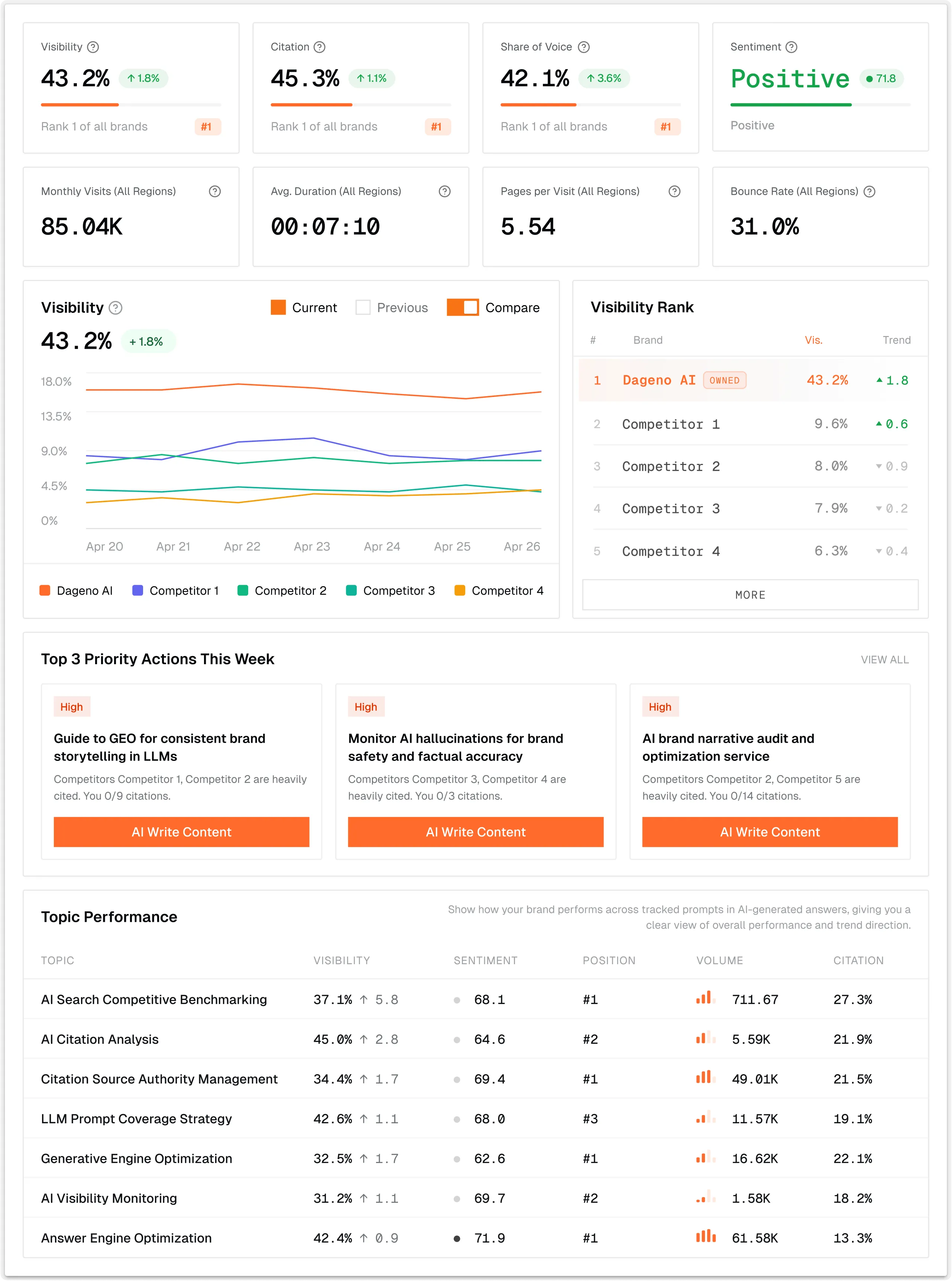
AthenaHQ and Dageno both address AI-search visibility, competitive analysis, and content improvement. The best choice depends on workflow fit rather than a universal winner.
Decision area
AthenaHQ
Dageno
Best evaluation angle
Credit-based monitoring plus agentic actions
Integrated visibility, citation, content, and attribution workflow
Public entry point
Free Essential tier
Free registration and product evaluation
Content workflow
Recommendations and optimization agent
Content opportunity discovery and creation workflow
Reporting test
Credits, exports, API add-on, model coverage
Prompt detail, citation analysis, publishing and attribution
Buyer priority
Broad model coverage and collaborative monitoring
A connected loop from monitoring to content and measurement
The sensible approach is to run the same 30–50 prompts in both products. Compare exact answers, brand classification, cited URLs, competitor mapping, exportability, and the time required to turn an insight into a published improvement.
Dageno is the most relevant alternative for teams that want AI visibility monitoring connected to citation analysis, content workflows, and result attribution. It is especially worth testing when execution speed matters as much as dashboard breadth.
Profound
Profound is oriented toward enterprise answer intelligence, with visibility, conversation, and source analysis for large teams.
Otterly offers a simpler monitoring entry point for teams that want to track prompts, links, and brand visibility without starting with an enterprise workflow.
AthenaHQ is a strong shortlist candidate for multi-person marketing teams that want broad model coverage, structured competitor insights, and an execution agent. It is less straightforward for buyers that need predictable high-volume monitoring or included API access.
Run a controlled trial before choosing. Use one stable prompt set, record the settings, inspect the underlying answers, and compare total workflow cost. That reveals far more than a feature checklist.
Frequently asked questions
Is AthenaHQ free?
AthenaHQ publicly lists a free Essential tier with a credit allowance. Limits and entitlements should be verified on the official pricing page.
How much does AthenaHQ cost?
The public Starter price is $295 per month on annual billing. Extra credits and API access are add-ons, so high-volume teams should request a usage-based estimate.
Does AthenaHQ create content?
Its paid plan lists a content optimization agent and self-learning content improvement. Test the output, editorial controls, and CMS workflow with your own pages before relying on it in production.
What is the best AthenaHQ alternative?
Dageno is a strong alternative for an integrated monitoring-to-content workflow. Profound may suit enterprise answer intelligence, while Otterly can suit a lighter monitoring pilot.
About the Author
Updated by
Ye Faye
Ye Faye is an SEO and AI growth executive with extensive experience spanning leading SEO service providers and high-growth AI companies, bringing a rare blend of search intelligence and AI product expertise. As a former Marketing Operations Director, he has led cross-functional, data-driven initiatives that improve go-to-market execution, accelerate scalable growth, and elevate marketing effectiveness. He focuses on Generative Engine Optimization (GEO), helping organizations adapt their content and visibility strategies for generative search and AI-driven discovery, and strengthening authoritative presence across platforms such as ChatGPT and Perplexity