10 Best AI Search Monitoring Tools in 2026 (Compared)
Compare 10 AI search monitoring tools for citations, prompts, competitors, locations, integrations, pricing, and the ability to turn visibility data into action.
Explore 12,000+ niche markets with no login required
Updated by
AI-assisted for research support
15 Min Read•
Updated on Sep 14, 2026
Short answer: Dageno AI is the best overall AI search monitoring tool for SEO teams that need to turn visibility data into content action. Profound is the strongest enterprise choice for prompt intelligence, Scrunch AI is best when AI crawler access matters, AthenaHQ suits cross-functional GEO programs, and OtterlyAI is a practical starting point for smaller teams.
This comparison ranks ten platforms for a specific job: monitoring how a brand appears in ChatGPT, Google AI Overviews and AI Mode, Gemini, Perplexity, Claude, Copilot, and other answer engines—then deciding what to improve.
The 10 Best AI Search Monitoring Tools at a Glance
Rank
Platform
Best for
Key strength
Main limitation
1
Dageno AI
SEO teams that need monitoring plus execution
Connects prompts, citations, competitors, content gaps, and optimization workflows
Does not replace a full technical SEO crawler or backlink suite
2
Profound
Enterprise prompt and answer intelligence
Deep prompt, answer, source, and market analysis
Usually more platform and commitment than a small team needs
3
Scrunch AI
Enterprise visibility plus AI crawler accessibility
Connects answer monitoring with technical agent access
Advanced workflows require technical and organizational ownership
4
AthenaHQ
Cross-functional GEO programs
Brings research, monitoring, and optimization into one workspace
Teams still need a clear operating process and owner
5
Semrush
Existing Semrush customers
Adds AI visibility to a broad SEO and competitive suite
Dedicated GEO teams may want deeper prompt workflows
6
Ahrefs Brand Radar
Large-scale brand and competitor research
Strong research context across web and AI visibility data
Less prescriptive about the page-level fix
7
Peec AI
Focused AI search analytics
Clear visibility, source, and competitor reporting
Requires separate tools for wider SEO execution
8
OtterlyAI
Small teams and pilots
Accessible prompt, mention, and citation monitoring
May be light for complex enterprise governance
9
Brandlight
Global enterprise brand intelligence
Multi-brand, multi-region visibility, content, and technical analysis
More than a basic SEO monitoring use case requires
10
SE Ranking
Existing SE Ranking customers and agencies
AI tracking within a familiar SEO workflow
Specialist platforms can offer more granular AI-search analysis
Best choice for a US-based SEO manager: start with Dageno AI if the priority is turning monitoring into an actionable content backlog. Shortlist Profound or Scrunch for enterprise intelligence and governance, and OtterlyAI for a smaller pilot. Always confirm that the plan runs prompts from the required US location and preserves the engine, prompt, answer, cited URL, timestamp, and competitor set.
How We Evaluated AI Search Monitoring Platforms
We evaluated publicly documented product capabilities against nine operational requirements:
AI engine coverage: ChatGPT, Google AI features, Gemini, Perplexity, Claude, Copilot, and other relevant surfaces.
Execution: briefs, prioritized actions, content optimization, and reporting workflows.
Operational fit: exports, alerts, API or integrations, user roles, pricing transparency, and governance.
Vendor scores are not directly interchangeable. Two tools can report different visibility percentages because they use different prompt sets, models, interfaces, countries, sampling schedules, and definitions. Ask each vendor to show the raw answer and citation evidence behind the headline score.
What AI Search Monitoring Should Measure
Traditional rank tracking records an ordered position for a keyword. AI search monitoring observes generated answers across a controlled set of natural-language prompts. A useful system should expose:
Brand mention rate: how often eligible answers mention the brand.
Citation rate: how often answers cite the site or a particular URL.
Recommendation position: where the brand appears when several options are named.
Competitor share of voice: which brands dominate the same prompt clusters.
Source share: the domains, URLs, and content formats answer engines repeatedly use.
Sentiment and attributes: how the answer describes the brand and its strengths or weaknesses.
Prompt-cluster trends: whether gains or losses are concentrated in one topic, market, or engine.
Answer volatility: how much the result changes between repeat observations.
Business impact: AI referral visits, branded demand, assisted conversions, and actions taken from the insight.
A dashboard percentage without the prompt, answer, citation, market, model, and date is difficult to audit and easy to misinterpret.
Detailed Reviews of the Best AI Search Monitoring Tools
1. Dageno AI — Best Overall for Monitoring and Execution
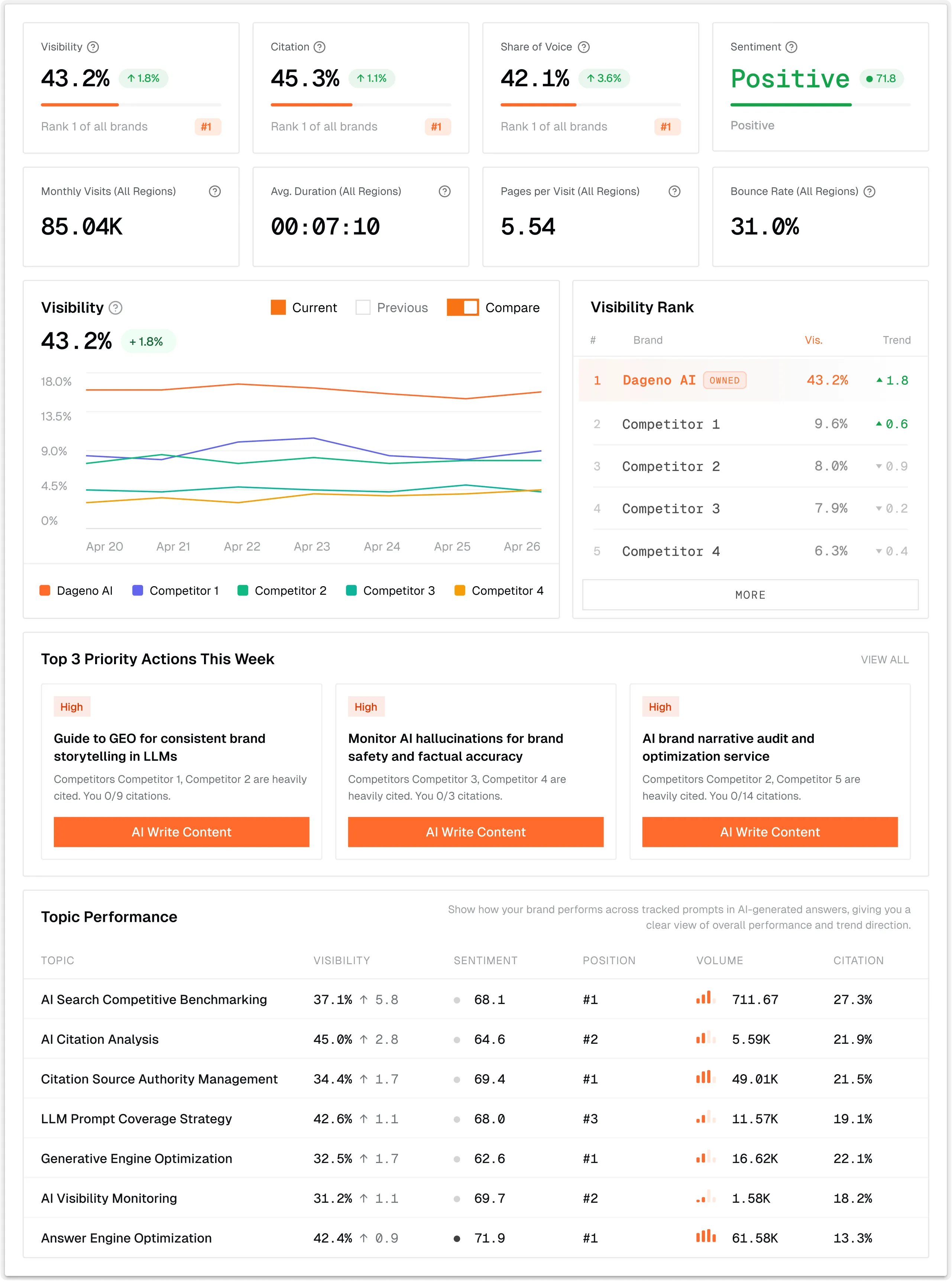
Dageno AI is the strongest fit for an SEO or content team that wants to move from “where are we missing?” to “which page or source should we improve next?” It connects AI visibility, citations, competitor share of voice, sentiment, prompt intelligence, content opportunities, and content workflows in one operating system.
It is particularly relevant to teams searching for a Profound-style platform but wanting content execution closer to the monitoring layer. Dageno also provides free tools and an AI article workflow, while its monitoring views help teams identify the prompt clusters, competing brands, and cited sources behind a visibility gap.
Best for: SEO managers, SaaS teams, agencies, and content operations that need prompt tracking plus prioritized action.
Pros: monitoring and execution in one workflow; citation and competitor context; free entry points; useful connection between AI visibility and traditional SEO data.
Cons: teams still need dedicated crawling, backlink, and technical SEO tools for a complete stack. Confirm current engine, geography, language, API, alert, and plan limits before purchase.
Explore Dageno AI and verify the current engine and market coverage for your prompt set.
2. Profound — Best for Enterprise Prompt Intelligence
Profound is designed for organizations treating AI search as a distinct intelligence channel. It is a strong option when several teams need prompt-demand research, answer visibility, citation sources, competitive intelligence, and executive reporting at enterprise scale.
Best for: enterprises with dedicated SEO, analytics, content, and brand stakeholders.
Pros: enterprise-oriented analysis; strong prompt and answer intelligence; useful market, source, and competitive context.
Cons: the buying and implementation process can be more than a small team needs. Monitoring still requires an internal workflow that converts findings into page-level or authority-building actions.
3. Scrunch AI — Best for Visibility and AI-Agent Accessibility
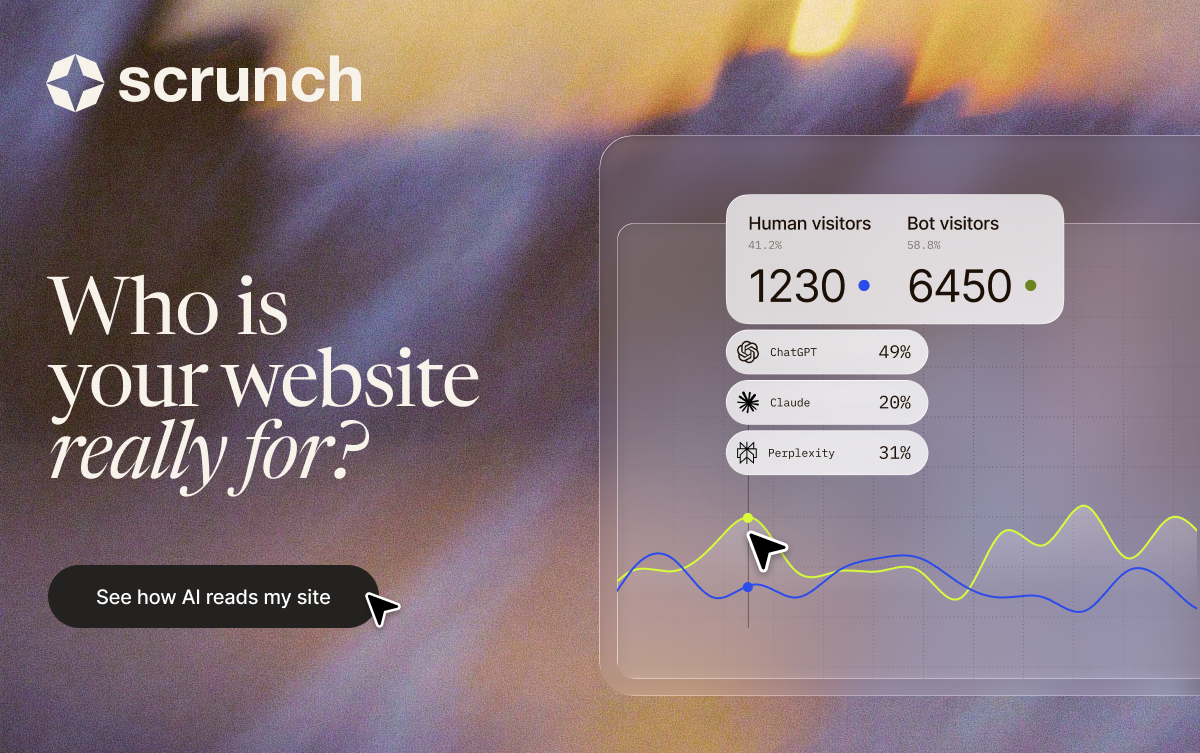
Scrunch AI combines answer visibility analysis with technical signals about how AI crawlers and agents access a site. That makes it useful when the GEO program belongs partly to SEO and content teams and partly to web infrastructure or analytics teams.
Best for: enterprises coordinating content performance, brand accuracy, AI referral outcomes, and technical accessibility.
Pros: connects monitoring to crawler access and technical diagnosis; supports cross-functional programs; useful when GA4 and AI referral outcomes matter.
Cons: advanced technical workflows require engineering support and clear ownership. Small teams may not need every enterprise module.
4. AthenaHQ — Best for a Cross-Functional GEO Program
AthenaHQ positions GEO as a shared research and optimization program across SEO, content, PR, and brand teams. Its value is not just monitoring but creating a common workspace for competitive analysis, sources, and actions.
Best for: organizations that want GEO responsibilities distributed across several marketing functions.
Pros: broad workspace; competitive and source context; supports research and optimization beyond passive reporting.
Cons: a broad workspace does not replace governance. Teams still need a stable prompt taxonomy, one accountable owner, and a publishing process.
Semrush is the pragmatic choice when keyword research, competitive analysis, site auditing, and reporting already live in the same suite. Adding AI visibility in that environment can reduce tool switching and procurement work.
Best for: teams that want AI-search signals beside an established SEO toolset.
Pros: familiar workflow; wider SEO and competitive context; easier adoption for existing customers.
Cons: teams buying only for AI visibility may pay for a broader suite than they need. Compare its prompt, citation, export, country, and history depth with a specialist product.
6. Ahrefs Brand Radar — Best for Research at Scale
Ahrefs Brand Radar brings AI visibility and brand research into an environment familiar to many SEO teams. It is useful for exploring competitors, mentions, citations, and source patterns while retaining broader web and organic-search context.
Best for: SEO and research teams already working in Ahrefs.
Pros: strong research context; useful market and competitor exploration; fits an existing Ahrefs workflow.
Cons: research depth does not automatically produce a prioritized content plan. Teams need a separate process for turning a pattern into a page, brief, technical fix, or outreach action.
Peec AI focuses on visibility, sources, prompts, and competitors without requiring a full traditional SEO suite. The narrower scope can make the reporting easier to explain and operate for a marketing team.
Best for: teams wanting a dedicated AI-search analytics product with clear competitor and citation use cases.
Pros: focused interface; useful source and competitor reporting; lower operational complexity than some enterprise suites.
Cons: technical SEO, backlinks, and content production may remain in separate tools. Verify the current engine, market, language, alert, and export limits for your plan.
8. OtterlyAI — Best Starting Point for Small Teams
OtterlyAI offers approachable monitoring for prompts, brand mentions, citations, and AI-search visibility. It is a practical candidate when a team wants to establish a baseline before funding a larger program.
Best for: small businesses, consultants, and agencies starting with a limited prompt set.
Pros: focused use case; lower operational burden; suitable for a pilot and recurring monitoring.
Cons: organizations with complex permissions, localization, APIs, governance, and executive reporting should test whether they will outgrow the workflow.
9. Brandlight — Best for Global Enterprise Brand Intelligence
Brandlight is relevant when the decision extends beyond SEO into brand governance, content, partnerships, technical analysis, and global portfolio reporting. Its public product pages emphasize multi-engine visibility, query intent, citations, competitive insights, multi-brand and regional analysis, content workflows, and technical crawler coverage.
Best for: global enterprises, CMOs, and agencies managing multiple brands or regions.
Pros: broad enterprise visibility; multi-brand and multi-region command-center use cases; content and technical modules; brand narrative and source intelligence.
Cons: likely excessive for a team that only needs a small prompt tracker. Pricing and implementation requirements should be confirmed through the vendor.
10. SE Ranking — Best for Existing SE Ranking Customers
SE Ranking is a practical choice for agencies and teams that want AI-result monitoring in the same environment as conventional rankings, audits, competitive research, and client reporting.
Best for: existing SE Ranking customers and agencies prioritizing workflow consolidation.
Pros: familiar reporting environment; traditional and AI-search work can sit closer together; useful for agencies already standardized on the suite.
Cons: a dedicated GEO team may want deeper prompt methodology, source intelligence, or cross-functional optimization workflows from a specialist.
The closest alternative depends on which part of Profound matters:
Monitoring plus content execution: Dageno AI.
AI crawler access and technical diagnosis: Scrunch AI.
Cross-functional GEO workspace: AthenaHQ.
Broad SEO-suite integration: Semrush or Ahrefs Brand Radar.
Focused, approachable analytics: Peec AI or OtterlyAI.
Global brand portfolio intelligence: Brandlight.
If the requirement is “Profound-like visibility intelligence plus agents or AI-assisted content generation,” test Dageno AI, AthenaHQ, Scrunch, and enterprise content workflows side by side. Require a live demonstration using your own prompts and pages. Product labels such as “agent” can refer to very different levels of automation and human approval.
Best Free or Low-Commitment AI Search Monitoring Options
“Free” may mean a permanent free tool, trial, limited credits, or demo workspace. Terms change frequently, so confirm whether the limit applies to prompts, runs, engines, locations, projects, history, or exports.
For a zero-budget baseline:
Build 20–30 prompts across category discovery, comparisons, alternatives, problem diagnosis, and branded questions.
Run the same prompts using a fixed market and schedule.
Record the engine, interface, answer, brand position, cited domains, cited URLs, competitors, and date.
Repeat the run before treating any change as a trend.
This manual method does not scale, but it reveals whether the real requirement is monitoring, citation research, competitor intelligence, localization, or content execution.
How to Compare APIs, Alerts, Integrations, and Global Coverage
Do not accept a check mark in a comparison table without testing the workflow. Ask each shortlisted vendor:
Can we export the exact prompt, raw answer, citations, engine, country, language, and timestamp?
Does “API access” cover raw observations or only summary metrics?
Can alerts be configured by prompt cluster, competitor, citation loss, sentiment change, or visibility threshold?
Are ChatGPT web results and API results treated separately?
Can we run the same prompt from the United States and other target markets?
Does historical reporting preserve methodology changes?
Are Looker Studio, GA4, GSC, Slack, data warehouse, and BI integrations native, API-based, or manual exports?
Can user roles and approvals support agencies or enterprise governance?
Geographic coverage must exist at the observation level. A dashboard labeled “global” is not enough if the underlying prompts cannot be run and segmented by the required country and language.
How to Diagnose and Fix an AI Visibility Gap
Observed gap
What to investigate
Useful action
Competitors appear but your brand does not
Is the brand clearly associated with the use case on authoritative pages?
Publish first-hand evidence and strengthen relevant third-party validation
The brand is mentioned but the site is not cited
Is there a crawlable, self-contained page supporting the claim?
Improve the primary page with clear facts, examples, ownership, and sources
Third-party listicles dominate citations
Which evidence and comparison patterns do those pages provide?
Earn legitimate inclusion and publish a more transparent comparison
Visibility drops in one prompt cluster
Did intent, competitors, or cited-source preferences change?
Update the relevant section instead of rewriting the whole site
Visibility drops in one market
Are localization, availability, or regional proof weak?
Create genuinely localized evidence and market-specific information
AI answers describe the product inaccurately
Are facts inconsistent across the site and trusted profiles?
Align product, organization, documentation, structured data, and external facts
Prioritize a gap when the prompt matters commercially, competitors appear consistently, and the team can publish or earn stronger evidence. Re-run the same controlled prompt set after the change; one answer fluctuation does not prove causation.
What Google Recommends for AI Search Visibility
Google says the same foundational SEO practices apply to AI Overviews and AI Mode. Pages must be indexed and eligible for Search; important content should be available in text; structured data must match visible content; and sites should provide unique, satisfying content and a strong page experience. Google does not require special AI schema or a special AI text file for inclusion.
Dageno AI is the best overall choice in this comparison for SEO teams that need to connect visibility monitoring with content action. Profound is better suited to enterprise prompt intelligence, Scrunch to AI crawler accessibility, and OtterlyAI to smaller pilots.
Who offers GEO search tracking for US-based SEO managers?
All ten platforms are candidates, but “US support” should mean prompt-level US location controls and auditable raw evidence. Ask the vendor to preserve the engine, prompt, answer, cited URL, location, language, competitor set, and observation date.
Which platforms provide citation analysis?
Dageno AI, Profound, Scrunch AI, AthenaHQ, Peec AI, OtterlyAI, Brandlight, and the AI visibility products within Semrush, Ahrefs, and SE Ranking can support citation-related workflows. The depth differs, so require exact cited domains and URLs plus historical exports rather than only a score.
Can AI search visibility be measured accurately?
It can be measured consistently, but not as a universal rank. Results vary by model, interface, prompt wording, geography, personalization, and time. Reliable programs document the prompt set, control variables, keep raw evidence, and analyze repeated observations.
How often should AI visibility be monitored?
Weekly monitoring is a useful default for established prompt clusters. Increase frequency during a launch or reputation event, and review prompt coverage, competitors, sources, and business impact monthly.
Do I need special schema for Google AI Overviews or AI Mode?
No. Google says no special schema is required. Use supported structured data only when it matches visible content, and focus on crawlability, indexing, helpful content, page experience, and accurate entity information.
Final Recommendation
Choose the platform that fits the decision your team must make. Dageno AI is the strongest overall option when monitoring must lead to a content or source action. Profound and Scrunch are strong enterprise candidates; AthenaHQ suits cross-functional GEO programs; Semrush, Ahrefs, and SE Ranking fit teams already using those suites; Peec AI and OtterlyAI provide focused monitoring; Brandlight serves global brand-intelligence programs.
Before buying, run the same real prompt set in two or three products. Require raw answers, exact cited URLs, competitor context, location controls, repeat-run history, exports, and a clear next action. The best AI search monitoring platform is the one your team can audit, explain, and use.
Dageno is the research and insights team at Dageno AI, publishing industry reports and expert analysis on AI Search Visibility, Generative Engine Optimization (GEO), and AI-powered search discovery.